
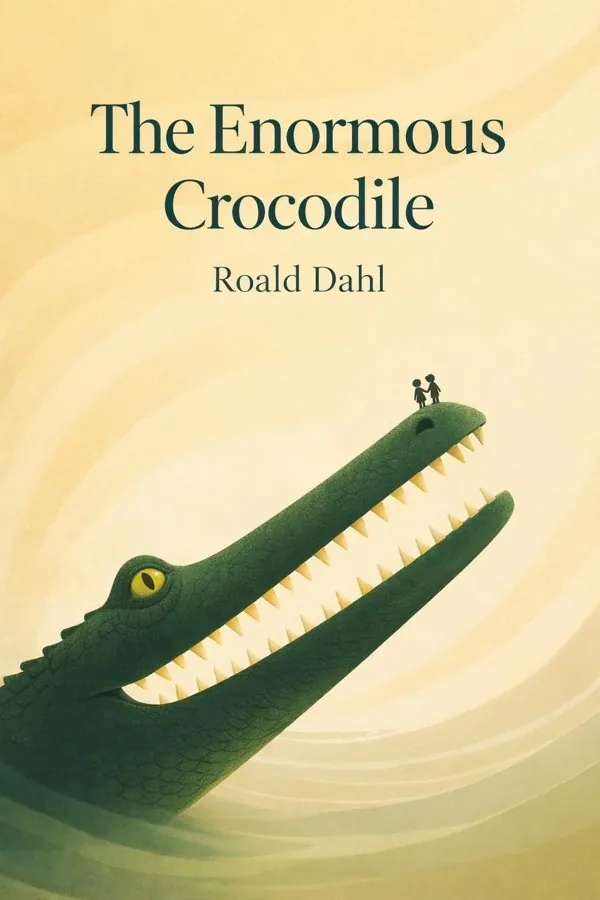
The Enormous Crocodile: Summary & Key Insights
by Roald Dahl
 10 min9 chapters
Key Takeaways from The Enormous Crocodile
A character often tells you who they are long before their actions prove it.
Stories become richer when they show that not everyone accepts wrongdoing in silence.
A villain’s journey can be as revealing as the final confrontation.
Not all intelligence deserves admiration.
The most satisfying justice in children’s stories often comes not from lectures but from watching bad plans fall apart.
What Is The Enormous Crocodile About?
The Enormous Crocodile by Roald Dahl is a classics book spanning 4 pages. The Enormous Crocodile is one of Roald Dahl’s sharpest and most entertaining stories for young readers: a fast, funny, slightly wicked tale about a greedy predator who is convinced he is clever enough to outwit everyone around him. The plot is simple and unforgettable. A huge crocodile leaves the river determined to eat a child, boasting that he has secret tricks and clever disguises that no one can resist. But as he moves through the jungle and toward the world of humans, other animals watch, object, and repeatedly ruin his plans. What follows is a delicious contest between swaggering selfishness and the combined force of decency, courage, and common sense. What makes the book matter is not just its suspense or humor, but its moral clarity. Dahl understood that children enjoy stories where danger feels real, villains are outrageously vain, and justice arrives with satisfying force. His authority as a storyteller comes from that rare ability to speak directly to a child’s sense of fear, fairness, and delight. Paired with Quentin Blake’s energetic illustrations, The Enormous Crocodile remains a classic because it turns a simple chase story into a memorable lesson about greed, arrogance, and the power of standing together.
This FizzRead summary covers all 9 key chapters of The Enormous Crocodile in approximately 10 minutes, distilling the most important ideas, arguments, and takeaways from Roald Dahl's work.
The Enormous Crocodile
The Enormous Crocodile is one of Roald Dahl’s sharpest and most entertaining stories for young readers: a fast, funny, slightly wicked tale about a greedy predator who is convinced he is clever enough to outwit everyone around him. The plot is simple and unforgettable. A huge crocodile leaves the river determined to eat a child, boasting that he has secret tricks and clever disguises that no one can resist. But as he moves through the jungle and toward the world of humans, other animals watch, object, and repeatedly ruin his plans. What follows is a delicious contest between swaggering selfishness and the combined force of decency, courage, and common sense.
What makes the book matter is not just its suspense or humor, but its moral clarity. Dahl understood that children enjoy stories where danger feels real, villains are outrageously vain, and justice arrives with satisfying force. His authority as a storyteller comes from that rare ability to speak directly to a child’s sense of fear, fairness, and delight. Paired with Quentin Blake’s energetic illustrations, The Enormous Crocodile remains a classic because it turns a simple chase story into a memorable lesson about greed, arrogance, and the power of standing together.
Who Should Read The Enormous Crocodile?
This book is perfect for anyone interested in classics and looking to gain actionable insights in a short read. Whether you're a student, professional, or lifelong learner, the key ideas from The Enormous Crocodile by Roald Dahl will help you think differently.
- ✓Readers who enjoy classics and want practical takeaways
- ✓Professionals looking to apply new ideas to their work and life
- ✓Anyone who wants the core insights of The Enormous Crocodile in just 10 minutes
Want the full summary?
Get instant access to this book summary and 100K+ more with Fizz Moment.
Get Free SummaryAvailable on App Store • Free to download
Key Chapters
A character often tells you who they are long before their actions prove it. The Enormous Crocodile begins with exactly that kind of revealing boast: he announces, with horrifying pride, that he intends to eat a child. This is not a passing thought or a private fantasy. It is a declaration meant to shock, impress, and intimidate. Even the other crocodile reacts with disgust, and that contrast matters. Dahl immediately shows that the Enormous Crocodile is not simply hungry; he is morally twisted, proud of his cruelty, and delighted by the fear he causes.
This opening does several things at once. It creates instant tension, because readers know danger is coming. It defines the villain with crystal clarity, because he is not pretending to be misunderstood or accidental in his harm. And it sets up one of the book’s central ideas: arrogance is often self-exposing. The crocodile believes that boasting makes him seem powerful, but his speech actually warns everyone around him. His evil is made visible because he cannot resist talking about it.
In everyday life, this idea still applies. People who constantly brag about manipulating others, breaking rules, or getting what they want at any cost often reveal more than they intend. Their words become warnings. Teachers, parents, and young readers can use this opening to discuss how character is shown through speech, not just behavior, and why we should pay attention to what pride is attached to.
The deeper lesson is that wickedness often begins in attitude before it appears in action. The crocodile’s downfall starts the moment he opens his mouth, because his vanity blinds him to the fact that others are listening.
Actionable takeaway: Pay close attention to what people brag about; pride often reveals values more clearly than appearances do.
Stories become richer when they show that not everyone accepts wrongdoing in silence. Early in the book, the other crocodile warns the Enormous Crocodile that eating children is disgraceful. This moment may seem small, but it introduces an important moral force: the voice that names evil for what it is. Dahl could have filled the story only with pursuit and trickery, yet he pauses to show a creature from the same species rejecting the villain’s behavior. That distinction tells readers that being powerful, hungry, or animal-like does not excuse cruelty.
The warning matters because it establishes choice. The Enormous Crocodile is not driven by necessity alone. He hears a clear objection and ignores it. That means his actions are deliberate. In children’s literature, this is crucial. Young readers learn that there is a difference between making a mistake and choosing harm despite being told better. The crocodile does not stumble into wrongdoing; he embraces it.
This idea has practical value beyond the story. In homes, classrooms, and friendships, people often face moments when they must speak up against behavior that is unfair, dangerous, or mean. The other crocodile is not glamorous, but he models a simple form of courage: naming what is wrong. He may not stop the villain directly at that moment, but he refuses to normalize the plan.
Readers can also reflect on the fact that warnings are only useful when someone is willing to listen. The Enormous Crocodile’s vanity makes him immune to advice. He believes cleverness places him above morality. That is one of the story’s sharpest insights: intelligence without conscience becomes a tool for harm.
Actionable takeaway: When you see something wrong, say so clearly and early; even if it does not change the wrongdoer, it strengthens everyone else’s sense of what is right.
A villain’s journey can be as revealing as the final confrontation. As the Enormous Crocodile leaves the river and moves through the jungle, he turns the landscape into a stage for his ego. He slithers from place to place boasting that he has secret plans, brilliant disguises, and clever tricks for catching children. Each animal he meets becomes an audience for his vanity. The jungle is not just scenery here; it is a testing ground where the crocodile’s confidence keeps colliding with the alertness and decency of others.
This movement through different settings builds suspense in a simple but effective way. Readers know his goal, but they do not yet know which trick he will try first or who will intervene. The changing scenes also widen the moral world of the story. The crocodile may think this is his personal hunt, yet the jungle quietly becomes a community that observes, judges, and responds. One animal after another recognizes the danger and refuses to let him pass unchallenged.
There is a practical lesson in this structure. Harmful people often depend on secrecy, speed, and isolation. They succeed when no one compares notes, no one pays attention, and no one interrupts the process early. The crocodile loses ground each time he meets another creature because his plan must survive contact with witnesses. In real life, communities become safer when members share concern, ask questions, and notice suspicious behavior instead of assuming someone else will handle it.
The journey also teaches that movement does not equal progress. The crocodile is always advancing physically, yet morally and strategically he is being weakened. Every boast makes him more vulnerable, and every encounter gives others more opportunity to interfere.
Actionable takeaway: Remember that dangerous plans become weaker when they are seen, discussed, and challenged by a watchful community.
Not all intelligence deserves admiration. The Enormous Crocodile prides himself on being cunning, inventive, and theatrical. He creates disguises, hides himself in plain sight, and imagines elaborate ways to lure children close enough to strike. In another kind of story, clever planning might make a character impressive. Dahl turns that expectation upside down. The crocodile’s schemes are undeniably imaginative, but because they serve greed and cruelty, they become ridiculous as well as dangerous.
This is one of the book’s strongest ideas: cleverness alone is not a virtue. The crocodile can think quickly, improvise costumes, and exploit appearances, yet he lacks wisdom, restraint, and empathy. As a result, his intelligence is brittle. It cannot adapt well when other creatures intervene, and it cannot earn loyalty or trust. Every trick depends on deception, so every failure exposes how shallow his brilliance really is.
This theme has wide application. Children are often praised for being smart, fast, or resourceful, but this story invites a better question: smart for what? A student who uses creativity to cheat, a classmate who manipulates others socially, or an adult who uses charm dishonestly may look impressive for a moment, but their intelligence is misdirected. Wisdom includes ethics. It considers consequences and the well-being of others.
The collapse of the crocodile’s plans also teaches that deceptive cleverness rarely survives repeated testing. A trick may work once in theory, but the more moving parts it has, the more likely it is to fail under pressure. Goodness, by contrast, often works through straightforward acts of warning, interruption, and solidarity.
Actionable takeaway: Admire intelligence only when it is joined to honesty and care; ask not just whether a plan is clever, but whether it is right.
The most satisfying justice in children’s stories often comes not from lectures but from watching bad plans fall apart. In The Enormous Crocodile, the villain repeatedly invents schemes to snatch children: disguising himself, positioning himself like something harmless, and trying to exploit ordinary trust. Each trick is meant to display his superiority. Instead, each collapse exposes a deeper truth: evil depends on fragile illusions, and those illusions shatter when others act with courage.
Dahl structures these failed plots almost like comic set pieces. The crocodile prepares, preens, and imagines his triumph. Then another animal spots the deception and ruins it, often in a swift, physical, and funny way. The rhythm matters. It gives children the excitement of danger without abandoning them to hopelessness. With every failure, the story reassures readers that wickedness is not unstoppable, even when it seems large, loud, and confident.
There is also an important lesson about intervention. The crocodile does not fail only because his plans are imperfect; he fails because others decide to interfere. A monkey, a bird, or another jungle creature sees what he is trying to do and acts. That pattern teaches readers that threats often continue until someone interrupts them. Waiting passively gives deception room to work. Timely action changes outcomes.
In practical terms, this can spark useful discussions about safety and awareness. Not every danger announces itself honestly. Sometimes the harmful thing looks playful, ordinary, or attractive. The ability to question appearances and seek help is part of real-world wisdom. So is the willingness to protect those who may not see the risk themselves.
Actionable takeaway: When something feels deceptive or unsafe, do not ignore it; question appearances quickly and get help before a harmful plan can unfold.
One of the quiet strengths of The Enormous Crocodile is that the hero is not a single grand champion. The story is won by a community of creatures who, in different ways, resist the villain. That matters because many tales focus on one brave individual, while Dahl shows something equally important: shared responsibility. The crocodile is enormous, aggressive, and self-assured, but he is also alone. The animals who oppose him are varied in size and temperament, yet together they create a network of resistance that he cannot fully control.
This idea reflects real life more accurately than stories of solitary heroism often do. Harmful behavior is frequently contained not by one perfect rescuer but by many ordinary acts of vigilance. One person notices. Another speaks. Another intervenes physically. Another warns the vulnerable. That layered response is exactly what the crocodile faces. Every time he advances, someone else is ready to complicate his path.
For young readers, this is encouraging. It suggests that you do not need to be the biggest, strongest, or loudest person to help stop something wrong. You may simply need to be attentive and willing to act in your role. Teachers can connect this to classroom life: one student speaks up when another is excluded, another tells an adult about bullying, and a third welcomes the child who has been targeted. Each action is small, but together they change the environment.
The story also contrasts community with selfishness. The crocodile thinks only of his appetite. He cannot imagine mutual care because he has no interest in anyone but himself. That is why he misunderstands the world around him. He assumes others are bystanders, when in fact they are participants.
Actionable takeaway: Do not underestimate small acts of protection; when people cooperate, even a powerful threat becomes manageable.
Children’s stories often deal with fear best when they refuse to be solemn about it. The Enormous Crocodile is unquestionably menacing: he wants to eat children, he stalks, he deceives, and he looms large over the plot. Yet Dahl wraps that danger in comic exaggeration, rhythmic language, and absurd confidence. The result is a story that lets children confront fear while still feeling delight. They are not trapped inside terror; they are invited to laugh at it, study it, and ultimately see it defeated.
This balance is a hallmark of Dahl’s style. He understands that children are drawn to stories where danger is vivid but not despairing. Humor creates emotional distance. The crocodile’s vanity, his overblown boasting, and the spectacular failure of his tricks prevent him from becoming unbearable. He is scary, yes, but also ridiculous. That combination is powerful because ridicule shrinks what fear magnifies.
In practical terms, this reflects how many children process difficult emotions. They often cope through play, retelling, silliness, or exaggeration. Adults sometimes assume that serious threats must be discussed only in serious tones, but stories like this suggest another path. When we can name something dangerous and still laugh at its pretensions, we become less helpless before it.
The illustrations intensify this effect. Quentin Blake’s loose, energetic drawings give the crocodile movement and absurdity at once. He is dramatic, but never dignified. That visual treatment supports the story’s message that evil may be dangerous, but it does not deserve reverence.
Actionable takeaway: Use humor wisely to face fears; laughing at what is arrogant or threatening can help make it easier to understand, discuss, and resist.
Children often recognize unfairness before they can explain it, which is why they respond so strongly to stories where justice is clear. The ending of The Enormous Crocodile delivers exactly that kind of satisfying reckoning. After all his boasting, plotting, and deception, the villain is not gently corrected or allowed to slink away unchanged. He is decisively defeated. The punishment fits the scale of his arrogance, and the final image is as outrageous as the crocodile himself.
This ending matters because it fulfills the moral promise of the story. From the beginning, the crocodile presents himself as untouchable. He believes appetite and cunning make him superior. If the story ended weakly, the entire structure would wobble. Instead, Dahl gives readers what they have been waiting for: proof that greed and cruelty carry consequences. Justice is not abstract. It is visible, memorable, and impossible to mistake.
There is a useful distinction here between revenge and moral order. The story’s ending is dramatic, even gleeful, but it does more than punish. It restores safety. The children are protected, the community is relieved, and the crocodile’s threat is permanently removed. That resolution can help young readers feel that the world of the story has become stable again.
In life, justice is rarely this swift or theatrical, but the emotional truth still resonates. Wrongdoing should not be admired for its boldness. Harmful behavior should be confronted, limited, and prevented from continuing. The book reminds us that consequences are part of moral education.
Actionable takeaway: Teach and remember that actions have consequences; when harmful behavior is confronted consistently, safety and trust become possible again.
A good ending does more than remove the villain; it reveals what the story values most. After the Enormous Crocodile meets his spectacular end, the mood shifts from danger to release. The creatures who opposed him are no longer merely defenders under pressure. They become witnesses to restored order. This final turn matters because it shows that justice is not only about stopping evil; it is also about making room for joy, relief, and communal triumph.
The celebration is especially important in a children’s book. Young readers do not simply want to know that the bad character has lost. They want to feel the emotional reset. The world must become safe enough again for laughter. Dahl understands this instinctively. By ending with a sense of collective satisfaction, he assures children that fear has not had the last word.
This idea has practical relevance beyond fiction. In families, schools, and communities, we sometimes focus so much on solving a problem that we forget the importance of acknowledging recovery afterward. When a conflict is resolved, when a bully is stopped, or when a difficult situation passes, people often need a moment to celebrate safety restored. That celebration reinforces values. It tells everyone involved: this is what we are protecting, and this is why resistance mattered.
The ending also reminds us that villains rarely imagine the emotional power of solidarity. The crocodile seeks only private gratification. He cannot understand the stronger bond created when others unite to defend the vulnerable. In the end, his selfish appetite is answered by shared joy, and shared joy proves stronger.
Actionable takeaway: After overcoming a challenge, take time to recognize the people who helped and celebrate the return of safety, trust, and community.
All Chapters in The Enormous Crocodile
About the Author
Roald Dahl (1916–1990) was a British novelist, short story writer, poet, and screenwriter whose work has become a cornerstone of modern children’s literature. Born in Wales to Norwegian parents, he first gained attention through writings inspired by his wartime experiences and later became world-famous for books such as Charlie and the Chocolate Factory, Matilda, James and the Giant Peach, The BFG, and Fantastic Mr Fox. Dahl’s stories are known for their bold imagination, dark humor, mischievous tone, and unforgettable villains, as well as their deep understanding of how children think and feel. He had a rare gift for combining danger, absurdity, and justice in ways that felt thrilling rather than didactic. The Enormous Crocodile is a perfect example of his ability to create simple, vivid stories with lasting appeal.
Get This Summary in Your Preferred Format
Read or listen to the The Enormous Crocodile summary by Roald Dahl anytime, anywhere. FizzRead offers multiple formats so you can learn on your terms — all free.
Available formats: App · Audio · PDF · EPUB — All included free with FizzRead
Download The Enormous Crocodile PDF and EPUB Summary
Key Quotes from The Enormous Crocodile
“A character often tells you who they are long before their actions prove it.”
“Stories become richer when they show that not everyone accepts wrongdoing in silence.”
“A villain’s journey can be as revealing as the final confrontation.”
“Not all intelligence deserves admiration.”
“The most satisfying justice in children’s stories often comes not from lectures but from watching bad plans fall apart.”
Frequently Asked Questions about The Enormous Crocodile
The Enormous Crocodile by Roald Dahl is a classics book that explores key ideas across 9 chapters. The Enormous Crocodile is one of Roald Dahl’s sharpest and most entertaining stories for young readers: a fast, funny, slightly wicked tale about a greedy predator who is convinced he is clever enough to outwit everyone around him. The plot is simple and unforgettable. A huge crocodile leaves the river determined to eat a child, boasting that he has secret tricks and clever disguises that no one can resist. But as he moves through the jungle and toward the world of humans, other animals watch, object, and repeatedly ruin his plans. What follows is a delicious contest between swaggering selfishness and the combined force of decency, courage, and common sense. What makes the book matter is not just its suspense or humor, but its moral clarity. Dahl understood that children enjoy stories where danger feels real, villains are outrageously vain, and justice arrives with satisfying force. His authority as a storyteller comes from that rare ability to speak directly to a child’s sense of fear, fairness, and delight. Paired with Quentin Blake’s energetic illustrations, The Enormous Crocodile remains a classic because it turns a simple chase story into a memorable lesson about greed, arrogance, and the power of standing together.
More by Roald Dahl
You Might Also Like



Browse by Category
Ready to read The Enormous Crocodile?
Get the full summary and 100K+ more books with Fizz Moment.