
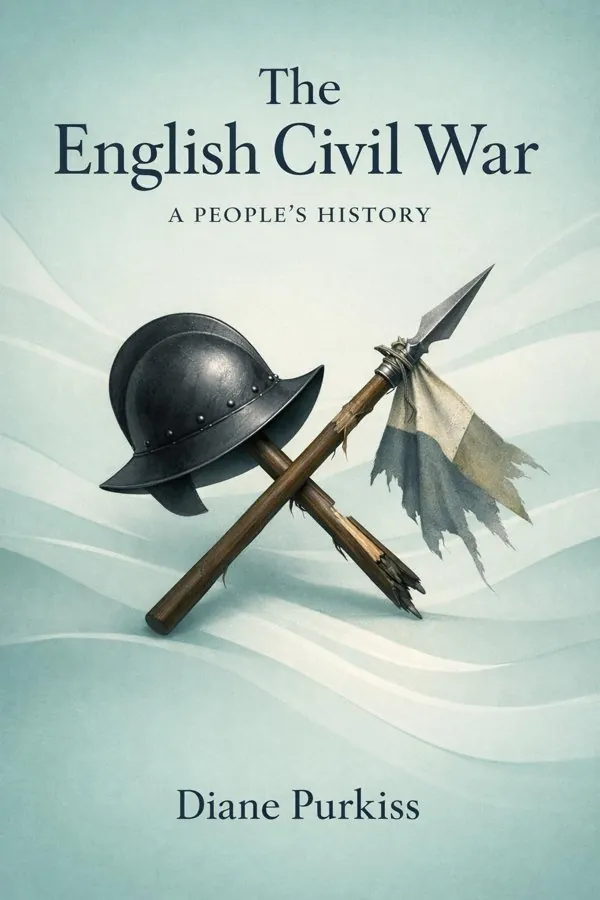
The English Civil War: A People's History: Summary & Key Insights
 10 min10 chaptersAudio available
Key Takeaways from The English Civil War: A People's History
Civil wars rarely begin when everyone agrees that collapse is coming; they begin when a society looks functional on the surface yet is quietly cracking underneath.
The outbreak of war in 1642 reminds us that political breakdown is not a single event but a painful crossing of a threshold.
History changes most radically when events stop belonging only to rulers and start invading ordinary lives.
Periods of upheaval do not merely rearrange governments; they force people to renegotiate who they are and what roles they may claim.
In the seventeenth century, religion was not a side issue attached to politics; it was the language through which politics became urgent, meaningful, and terrifying.
What Is The English Civil War: A People's History About?
The English Civil War: A People's History by Diane Purkiss is a world_history book spanning 10 pages. The English Civil War is often told as a struggle between a stubborn king and an ambitious Parliament, but Diane Purkiss shows that this version is far too narrow. In The English Civil War: A People's History, she reconstructs the conflict from the ground up, revealing how the wars of the 1640s and early 1650s reached deep into homes, churches, marketplaces, and private consciences. This is not only a story of Charles I, Oliver Cromwell, and battlefield strategy. It is also a story of servants, women, ministers, soldiers, widows, and frightened families trying to survive a world that seemed to be coming apart. Purkiss draws on letters, diaries, pamphlets, and eyewitness accounts to restore the human texture of revolution. Her great strength lies in combining rigorous scholarship with a vivid literary imagination, making the period feel immediate without sacrificing historical nuance. The result is a gripping account of how political crisis became social upheaval, how belief turned into action, and how ordinary people helped shape one of the defining turning points in British history.
This FizzRead summary covers all 10 key chapters of The English Civil War: A People's History in approximately 10 minutes, distilling the most important ideas, arguments, and takeaways from Diane Purkiss's work. Also available as an audio summary and Key Quotes Podcast.
The English Civil War: A People's History
The English Civil War is often told as a struggle between a stubborn king and an ambitious Parliament, but Diane Purkiss shows that this version is far too narrow. In The English Civil War: A People's History, she reconstructs the conflict from the ground up, revealing how the wars of the 1640s and early 1650s reached deep into homes, churches, marketplaces, and private consciences. This is not only a story of Charles I, Oliver Cromwell, and battlefield strategy. It is also a story of servants, women, ministers, soldiers, widows, and frightened families trying to survive a world that seemed to be coming apart. Purkiss draws on letters, diaries, pamphlets, and eyewitness accounts to restore the human texture of revolution. Her great strength lies in combining rigorous scholarship with a vivid literary imagination, making the period feel immediate without sacrificing historical nuance. The result is a gripping account of how political crisis became social upheaval, how belief turned into action, and how ordinary people helped shape one of the defining turning points in British history.
Who Should Read The English Civil War: A People's History?
This book is perfect for anyone interested in world_history and looking to gain actionable insights in a short read. Whether you're a student, professional, or lifelong learner, the key ideas from The English Civil War: A People's History by Diane Purkiss will help you think differently.
- ✓Readers who enjoy world_history and want practical takeaways
- ✓Professionals looking to apply new ideas to their work and life
- ✓Anyone who wants the core insights of The English Civil War: A People's History in just 10 minutes
Want the full summary?
Get instant access to this book summary and 100K+ more with Fizz Moment.
Get Free SummaryAvailable on App Store • Free to download
Key Chapters
Civil wars rarely begin when everyone agrees that collapse is coming; they begin when a society looks functional on the surface yet is quietly cracking underneath. Purkiss presents early seventeenth-century England as exactly this kind of place. The kingdom had wealth, ceremony, and a sense of national continuity, but beneath that stability lay unresolved tensions over religion, taxation, royal authority, and local liberties. Charles I believed deeply in hierarchy, sacred kingship, and the beauty of order, yet many of his subjects increasingly feared that his rule ignored custom, Parliament, and Protestant anxieties. His policies did not create discontent from nothing, but they intensified existing fears. Religious reforms associated with Archbishop Laud made many people suspect that England was drifting toward Catholic forms of worship. Efforts to raise revenue without Parliament deepened mistrust. What mattered was not just what the king did, but how people interpreted it: as overreach, betrayal, or danger.
Purkiss is especially good at showing that politics was inseparable from emotion. Suspicion spread through rumor, sermons, gossip, and print. A tax dispute or church reform was never merely administrative; it touched identity, memory, and salvation. In practical terms, this helps modern readers understand how apparently technical political decisions can become explosive when people believe fundamental values are under threat. Institutions fail not only through bad design, but through collapsing trust.
The key takeaway is to look for the hidden pressures beneath public stability. When authority stops listening and communities begin to interpret policy as moral aggression, conflict can escalate far faster than elites expect.
The outbreak of war in 1642 reminds us that political breakdown is not a single event but a painful crossing of a threshold. Purkiss shows how England moved from dispute to armed conflict through a chain of failed negotiations, hardening identities, and mutual fear. Parliament and the Crown each claimed legitimacy, and each increasingly believed the other posed a mortal threat to the kingdom. Once both sides began raising forces, abstract constitutional disagreement became a matter of survival.
One of Purkiss's most powerful insights is that war did not descend on a united people from above. It split existing relationships from within. Villages divided, households argued, and kin found themselves on opposing sides. Local loyalties mattered as much as national ideology. A gentleman might support the king out of inherited duty, while his neighbor sided with Parliament out of religious conviction or concern for local rights. This made the conflict intimate and emotionally devastating. The enemy was often familiar.
Purkiss's people-centered approach helps us see civil war as a social fracture, not only a military campaign. The practical lesson is that polarization becomes most dangerous when opponents cease to see each other as mistaken fellow citizens and begin to see each other as existential enemies. At that point, compromise starts to look like surrender.
An actionable takeaway is to pay attention to how conflicts are framed. When public language shifts from disagreement to purification, betrayal, or absolute danger, institutions need urgent repair before division hardens into irreversible confrontation.
History changes most radically when events stop belonging only to rulers and start invading ordinary lives. A central achievement of Purkiss's book is her insistence that the English Civil War was experienced in kitchens, barns, parish churches, and roads crowded with soldiers and refugees. Armies needed food, horses, lodging, and money, and that meant civilians bore much of the burden. Homes were searched, crops seized, neighborhoods militarized, and travel made uncertain. The war transformed the rhythms of daily life.
Purkiss relies on letters, diaries, petitions, and local records to show how noncombatants interpreted what was happening. Some suffered in silence; others adapted, negotiated, fled, or took sides. A widow petitioning for relief, a minister writing of fear, or a household trying to keep children fed reveals as much about the war as a parliamentary speech. These stories challenge the assumption that ordinary people are passive scenery in major events. They were witnesses, victims, participants, and interpreters.
This perspective has practical value for how we think about conflict in any age. Large political struggles are always filtered through everyday consequences: prices, safety, work, family roles, and emotional endurance. To understand a crisis properly, we must ask not only who won power, but who lost security.
The actionable takeaway is simple: when studying any historical or contemporary conflict, examine how it affects ordinary routines. The true scale of political upheaval becomes visible only when you follow its effects into daily life.
Periods of upheaval do not merely rearrange governments; they force people to renegotiate who they are and what roles they may claim. Purkiss pays close attention to the English Civil War as a crisis of gender and identity. Men were drawn into ideals of martial courage, loyalty, and public action, yet many also experienced fear, defeat, injury, and dependency that complicated those ideals. Women, meanwhile, were not simply left behind. They managed households under pressure, defended property, wrote petitions, carried news, sheltered fugitives, and sometimes intervened directly in politics and religion.
Purkiss refuses the simplistic claim that the war liberated everyone. Instead, she shows how conflict opened temporary spaces while also producing new forms of discipline. Women's voices became more visible in petitions, prophecy, and sectarian activism, but visibility could also provoke backlash. Gender expectations became more unstable precisely because the social order itself was unstable. Questions about obedience in the household echoed questions about obedience in the state.
This chapter of the story matters because it reminds us that political revolutions are also cultural experiments. In moments of crisis, societies test old assumptions about authority, family, and public speech. Modern readers can apply this insight by noticing how emergencies often expand responsibility before institutions formally recognize new roles.
The actionable takeaway is to ask, in every historical turning point: whose voice became newly audible, and at what cost? That question reveals how upheaval changes identity long after battles end.
In the seventeenth century, religion was not a side issue attached to politics; it was the language through which politics became urgent, meaningful, and terrifying. Purkiss demonstrates that the English Civil War cannot be understood without taking belief seriously. Protestants disagreed sharply among themselves about church government, worship, conscience, prophecy, and the signs of God's favor. For many, these were not intellectual preferences but matters of eternal consequence. To lose the right form of worship was to risk national judgment and personal damnation.
This helps explain why compromise often proved so difficult. A modern reader might wonder why disputes over bishops, liturgy, or church ceremony generated such heat. Purkiss's answer is that these disputes signaled deeper questions about spiritual corruption, tyranny, and divine order. Radical groups and sectarians pushed the boundaries further, claiming direct inspiration, demanding liberty of conscience, or envisioning a godlier social order. Such movements widened the space of political imagination but also intensified fear among those who saw them as signs of chaos.
Purkiss's treatment offers a practical lesson in historical empathy. If we reduce religious language to hypocrisy or disguise, we miss what motivated people. The same caution applies today whenever moral or spiritual commitments are dismissed as merely strategic.
The actionable takeaway is to interpret belief as a real force. When people see political decisions as tied to sacred truth, debates harden, stakes rise, and conventional compromise becomes much harder to achieve.
Major battles matter not only because they shift military advantage, but because they transform morale, legitimacy, and the imagination of what is possible. Purkiss treats the battles of the English Civil War as human and symbolic turning points rather than mere movements on a map. Engagements such as Edgehill, Marston Moor, and Naseby did not simply produce casualties; they altered confidence, strategy, and the emotional weather of the conflict. Victories encouraged providential interpretations. Defeats produced blame, grief, and renewed radicalism.
Her attention to the New Model Army is especially important. This was not just a more efficient fighting force. It represented a new form of disciplined political and religious energy, one that increasingly gave Parliament's cause military coherence and ideological momentum. Soldiers were not only drilled; many were also animated by conviction. Purkiss shows how organization, belief, and leadership interacted to create a formidable force.
The broader lesson is that institutions win conflicts when they align structure with purpose. Enthusiasm without organization falters, but organization without belief lacks resilience. Modern readers can apply this to everything from political movements to workplace change: decisive turning points usually come when a group develops both clear systems and shared meaning.
The actionable takeaway is to look beyond headline victories. Ask what each turning point did to morale, discipline, and legitimacy. Those less visible effects often determine the final outcome more than the battlefield result alone.
Executing Charles I in 1649 was not simply the removal of a defeated ruler; it was a shocking act that ruptured centuries of political imagination. Purkiss captures the enormity of regicide by showing how deeply monarchy was embedded in ideas of order, divinity, and continuity. Even many who opposed Charles had not initially imagined trying and killing him. To put a king on trial was to redefine sovereignty itself. Authority no longer seemed guaranteed by sacred inheritance alone.
Purkiss does not present the execution as inevitable. Rather, she shows it emerging from accumulated distrust, military radicalization, and the conviction among some Parliamentarian leaders that no settlement with Charles could be trusted. The king's death solved one problem while creating many others. It removed a focal point of resistance but also horrified moderates, shocked Europe, and intensified debates over legitimacy. If a king could be judged by his people, what other hierarchies might be challenged?
This moment is one of the clearest examples in the book of how revolutionary acts can outrun the intentions of those who helped make them possible. Once symbolic boundaries are crossed, political life changes irreversibly. The old language may remain, but its authority is damaged.
The actionable takeaway is to study not only whether a regime falls, but which taboos are broken in the process. When an unthinkable act becomes thinkable, a society enters a new political world with consequences no one fully controls.
Revolutions often discover that removing an old order is easier than building a stable new one. Purkiss presents the Commonwealth and subsequent republican experiment as a period of restless social and political reordering. Without the monarchy, England did not become straightforwardly free or equal. Instead, the country entered a contested phase in which new possibilities emerged alongside coercion, disappointment, and unresolved contradiction.
On one side were hopes for moral reform, more godly government, and broader participation in shaping the nation. Radical thinkers and movements imagined greater religious liberty, legal reform, and a more accountable political system. On the other side stood military necessity, factional rivalry, Irish and Scottish wars, and the practical burdens of rule. Purkiss shows that the revolutionary state could be both innovative and repressive. It opened debate but also narrowed tolerable dissent when power felt threatened.
This complexity makes the book especially useful for readers interested in the afterlife of revolutions. Political transformation does not move in a straight line from oppression to freedom. New regimes inherit fear, habit, and institutional weakness. They may reproduce some of the very controls they once condemned.
The actionable takeaway is to judge revolutions not only by the ideals they proclaim, but by the structures they create under pressure. Durable change requires more than moral passion; it demands institutions capable of balancing order, participation, and legitimacy.
People do not process civil war only through official documents or peace settlements; they process it through stories, images, songs, sermons, rumors, and memory. Purkiss gives sustained attention to the cultural responses generated by the English Civil War, showing how literature and popular expression recorded fear, hope, grief, and bewilderment. Pamphlets argued, mocked, warned, and inspired. Ballads carried politics into ordinary hearing. Personal writings preserved shock and loss in intimate form.
What makes this so important is that culture does more than reflect events. It helps create the emotional atmosphere in which events are understood. A martyr narrative can sanctify a cause. A satirical pamphlet can delegitimize an enemy. A household diary can preserve a version of suffering that official history overlooks. Purkiss's literary sensitivity allows her to trace how language itself became a battleground. Competing sides fought over interpretation as fiercely as they fought over territory.
For modern readers, this offers a valuable framework for reading any polarized era. Public life is shaped not just by laws and leaders but by narratives people repeat until they feel like truth. To understand a society in crisis, study its media, metaphors, and emotional scripts.
The actionable takeaway is to treat cultural material as historical evidence, not decoration. If you want to know how a conflict was lived and remembered, pay close attention to the stories people told while it was happening.
When the monarchy returned in 1660, England regained a king but not the innocence of the world before war. Purkiss shows that Restoration was not a simple reversal of revolution. It was an attempt to rebuild stability after years of bloodshed, experimentation, and shattered loyalties, yet the memory of civil war remained active and contested. Royalists framed the period as rebellion and martyrdom, especially through the memory of Charles I. Others remembered it as a struggle against tyranny or as a lost opportunity for deeper reform.
This is one of the book's most enduring insights: historical events survive through competing memories, and those memories shape future politics. The English Civil War became a warning, a wound, a source of identity, and a reservoir of political language for generations. What people chose to remember or forget mattered as much as what had objectively happened. Memory organized blame, legitimacy, and national self-understanding.
There is a practical application here for readers of any society emerging from internal conflict. Peace does not end argument over the past. Narratives of victimhood, heroism, betrayal, and restoration continue to influence institutions and public debate long after the shooting stops.
The actionable takeaway is to examine post-conflict memory with as much care as wartime events. A nation does not simply recover from civil strife; it learns to live with rival versions of what the conflict meant.
All Chapters in The English Civil War: A People's History
About the Author
Diane Purkiss is a British historian and literary scholar whose work focuses on the English Civil War, seventeenth-century literature, women's writing, and the cultural history of early modern Britain. She is a Professor of English Literature at the University of Oxford and a Fellow of Keble College. Purkiss is known for combining archival research with literary sensitivity, allowing her to recover not just events but also the emotions, beliefs, and narratives that shaped them. Her writing frequently challenges conventional top-down history by paying close attention to voices often overlooked in political accounts, including women, common soldiers, and ordinary households. In The English Civil War: A People's History, her interdisciplinary strengths are especially clear, as she blends historical scholarship and cultural analysis to create a vivid, deeply human portrait of one of the most transformative periods in British history.
Get This Summary in Your Preferred Format
Read or listen to the The English Civil War: A People's History summary by Diane Purkiss anytime, anywhere. FizzRead offers multiple formats so you can learn on your terms — all free.
Available formats: App · Audio · PDF · EPUB — All included free with FizzRead
Download The English Civil War: A People's History PDF and EPUB Summary
Key Quotes from The English Civil War: A People's History
“Civil wars rarely begin when everyone agrees that collapse is coming; they begin when a society looks functional on the surface yet is quietly cracking underneath.”
“The outbreak of war in 1642 reminds us that political breakdown is not a single event but a painful crossing of a threshold.”
“History changes most radically when events stop belonging only to rulers and start invading ordinary lives.”
“Periods of upheaval do not merely rearrange governments; they force people to renegotiate who they are and what roles they may claim.”
“In the seventeenth century, religion was not a side issue attached to politics; it was the language through which politics became urgent, meaningful, and terrifying.”
Frequently Asked Questions about The English Civil War: A People's History
The English Civil War: A People's History by Diane Purkiss is a world_history book that explores key ideas across 10 chapters. The English Civil War is often told as a struggle between a stubborn king and an ambitious Parliament, but Diane Purkiss shows that this version is far too narrow. In The English Civil War: A People's History, she reconstructs the conflict from the ground up, revealing how the wars of the 1640s and early 1650s reached deep into homes, churches, marketplaces, and private consciences. This is not only a story of Charles I, Oliver Cromwell, and battlefield strategy. It is also a story of servants, women, ministers, soldiers, widows, and frightened families trying to survive a world that seemed to be coming apart. Purkiss draws on letters, diaries, pamphlets, and eyewitness accounts to restore the human texture of revolution. Her great strength lies in combining rigorous scholarship with a vivid literary imagination, making the period feel immediate without sacrificing historical nuance. The result is a gripping account of how political crisis became social upheaval, how belief turned into action, and how ordinary people helped shape one of the defining turning points in British history.
You Might Also Like
The Age of Capital
Eric Hobsbawm
10 min
The Gulag Archipelago
Aleksandr Solzhenitsyn
10 min
Jerusalem: The Biography
Simon Sebag Montefiore
10 min
The Anglo-Saxons
James Campbell
10 min
The Boer War
Thomas Pakenham
10 min
The Industrial Revolutionaries: The Making of the Modern World 1776–1914
Gavin Weightman
10 minBrowse by Category
Ready to read The English Civil War: A People's History?
Get the full summary and 100K+ more books with Fizz Moment.