
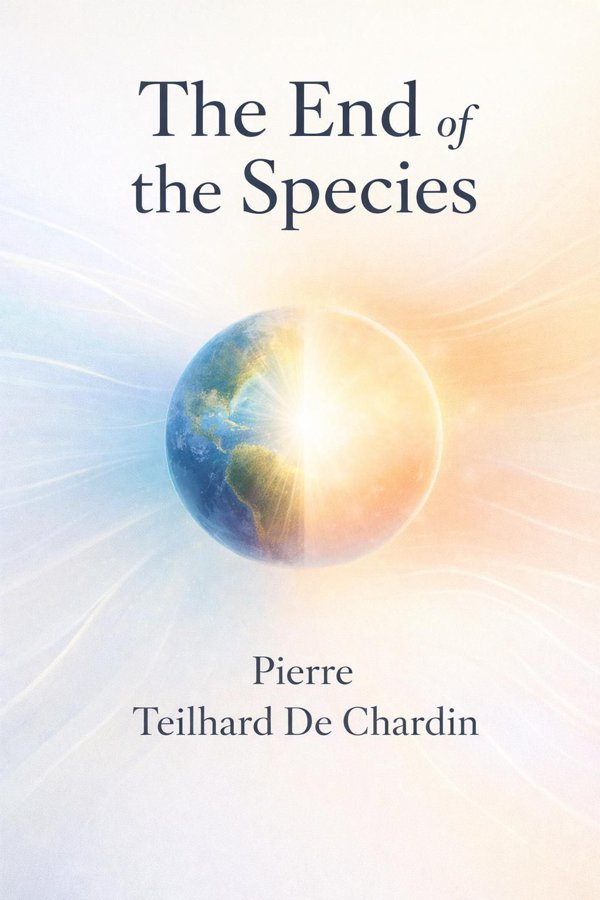
The End of the Species: Summary & Key Insights
 10 min9 chaptersAudio available
Key Takeaways from The End of the Species
The deepest question in this book is not simply how life began, but what kind of universe gives rise to life at all.
A turning point in the history of the universe occurs when evolution begins to know that it is evolving.
One of Teilhard’s most influential ideas is that humanity has created a new layer of planetary reality: the noosphere.
Progress, in Teilhard’s vision, is not endless dispersion but convergence.
Teilhard saw long before the digital age that tools of communication would transform the structure of human evolution.
What Is The End of the Species About?
The End of the Species by Pierre Teilhard De Chardin is a western_phil book spanning 9 pages. Originally published after Pierre Teilhard de Chardin’s death, The End of the Species is a short but remarkably ambitious meditation on humanity’s future. Rather than asking where biological evolution came from, Teilhard asks where it is going. His answer is bold: evolution does not end with the appearance of human beings. With us, it becomes reflective, social, technological, and spiritual. Humanity is not a finished product but a threshold through which the universe begins to think about itself. What makes this essay enduring is the scale of its vision. Teilhard combines insights from paleontology, philosophy, theology, and cultural observation to argue that human history is moving toward increasing complexity, interdependence, and consciousness. He introduces ideas that would become central to his thought, especially the noosphere, the sphere of collective human thought emerging around the planet, and the Omega Point, the ultimate horizon of unification. Teilhard writes with the authority of a scientist and the imagination of a mystic. As a Jesuit priest and trained paleontologist, he was uniquely positioned to explore the tension between evolutionary science and spiritual meaning. This book matters because it offers not just a theory of human destiny, but a way to think about crisis, progress, technology, and global unity.
This FizzRead summary covers all 9 key chapters of The End of the Species in approximately 10 minutes, distilling the most important ideas, arguments, and takeaways from Pierre Teilhard De Chardin's work. Also available as an audio summary and Key Quotes Podcast.
The End of the Species
Originally published after Pierre Teilhard de Chardin’s death, The End of the Species is a short but remarkably ambitious meditation on humanity’s future. Rather than asking where biological evolution came from, Teilhard asks where it is going. His answer is bold: evolution does not end with the appearance of human beings. With us, it becomes reflective, social, technological, and spiritual. Humanity is not a finished product but a threshold through which the universe begins to think about itself.
What makes this essay enduring is the scale of its vision. Teilhard combines insights from paleontology, philosophy, theology, and cultural observation to argue that human history is moving toward increasing complexity, interdependence, and consciousness. He introduces ideas that would become central to his thought, especially the noosphere, the sphere of collective human thought emerging around the planet, and the Omega Point, the ultimate horizon of unification.
Teilhard writes with the authority of a scientist and the imagination of a mystic. As a Jesuit priest and trained paleontologist, he was uniquely positioned to explore the tension between evolutionary science and spiritual meaning. This book matters because it offers not just a theory of human destiny, but a way to think about crisis, progress, technology, and global unity.
Who Should Read The End of the Species?
This book is perfect for anyone interested in western_phil and looking to gain actionable insights in a short read. Whether you're a student, professional, or lifelong learner, the key ideas from The End of the Species by Pierre Teilhard De Chardin will help you think differently.
- ✓Readers who enjoy western_phil and want practical takeaways
- ✓Professionals looking to apply new ideas to their work and life
- ✓Anyone who wants the core insights of The End of the Species in just 10 minutes
Want the full summary?
Get instant access to this book summary and 100K+ more with Fizz Moment.
Get Free SummaryAvailable on App Store • Free to download
Key Chapters
The deepest question in this book is not simply how life began, but what kind of universe gives rise to life at all. Teilhard starts from a sweeping intuition: matter is not inert debris scattered through a meaningless cosmos. It carries within itself a tendency toward organization, complexity, and eventually consciousness. In his view, the story of evolution begins long before plants, animals, or human beings. It begins in the gradual concentration of energy and structure within matter itself.
This matters because it reframes evolution as more than a sequence of accidents. Teilhard does not deny physical processes or biological development; instead, he interprets them as stages in a larger pattern. Atoms become molecules, molecules become cells, cells become organisms, and organisms become capable of sensation, thought, and self-reflection. At each stage, the universe folds inward and becomes more centered. Evolution is therefore not just extension in space, but intensification in depth.
A practical way to understand this idea is to look at complexity in everyday life. A pile of bricks is not a house, and a collection of computers is not yet a networked intelligence. Structure matters. Relationships matter. New levels of order create new capacities. The same principle applies in biology and culture: when parts become integrated, something genuinely new can emerge.
Teilhard’s point is not that progress is easy or guaranteed, but that the universe has a discernible direction toward greater interiority. Human consciousness did not appear from nowhere; it is rooted in the long labor of cosmic development.
Actionable takeaway: When you study any system, from a cell to a society, look beyond isolated parts and ask how increasing connection and organization create new forms of life and meaning.
A turning point in the history of the universe occurs when evolution begins to know that it is evolving. For Teilhard, this is the unique significance of the human being. Animals perceive, adapt, and survive, but humans reflect. We do not merely live; we become aware of living. We ask what we are, where we came from, and where we are going. In that act of reflection, evolution crosses a threshold.
Teilhard does not treat humanity as biologically perfect. We are fragile, conflicted, and unfinished. Yet our capacity for self-awareness makes us qualitatively different from what came before. Reflection allows memory, planning, moral judgment, symbolic language, science, religion, and art. It also means that the future of evolution is no longer driven only by natural selection in the old sense. It increasingly depends on conscious participation.
You can see this in modern life. Humans reshape environments, design technologies, alter genes, create institutions, and transmit knowledge across generations. A wolf adapts to nature; humans reinvent the conditions of adaptation itself. That power can become destructive, but it also reveals Teilhard’s central claim: evolution has entered a reflective phase.
This idea carries moral weight. If we are the point where the universe becomes aware of itself, then human responsibility expands. Our decisions affect not only our immediate survival but the direction of collective development. Education, ethical leadership, and cultural imagination become evolutionary forces.
Teilhard’s vision invites humility as much as pride. Reflection does not make us masters standing outside nature. It makes us participants in a process larger than ourselves, burdened with freedom and capable of either fragmentation or higher unity.
Actionable takeaway: Treat self-awareness as a responsibility, not just a gift. In your work, relationships, and civic life, ask how your choices contribute to the growth of consciousness rather than mere short-term advantage.
One of Teilhard’s most influential ideas is that humanity has created a new layer of planetary reality: the noosphere. Just as the geosphere refers to the physical earth and the biosphere to the realm of life, the noosphere is the sphere of thought, culture, reflection, and shared mental activity that emerges through human beings. It is not a metaphorical flourish alone. For Teilhard, it is an actual evolutionary development, as real in its own way as biological life.
The noosphere forms wherever minds connect through language, memory, institutions, media, science, law, and collective imagination. A library, a university, a legal system, an online network, or a global scientific collaboration are all expressions of it. Humanity no longer evolves simply as separate organisms scattered across the planet. We evolve through systems of communication and knowledge that bind minds together.
This insight feels especially modern. The internet, satellite communication, cloud computing, and social media can all be read as technological intensifications of the noosphere. Yet Teilhard’s point goes beyond technology. The noosphere is not just the presence of more information. It is the thickening of human interdependence through shared thought. Ideas now circulate globally, identities are shaped transnationally, and local actions can have planetary consequences.
Still, the noosphere has risks. Connection can deepen understanding, but it can also spread panic, manipulation, or hostility. A more connected world is not automatically a wiser one. Teilhard would likely say that the noosphere demands moral development equal to technical development.
His larger claim is that human destiny is collective. Our minds are increasingly linked, and the future depends on whether that linkage produces confusion or convergence.
Actionable takeaway: Participate in the noosphere deliberately. Consume, share, and create information in ways that increase clarity, truth, and human solidarity rather than noise and division.
Progress, in Teilhard’s vision, is not endless dispersion but convergence. As evolution advances, units do not simply multiply and spread outward. They also gather into more complex unities. Cells form organisms, organisms form societies, and individual minds enter larger webs of exchange and cooperation. The same pattern, Teilhard argues, governs humanity’s future: consciousness deepens through union.
This is a subtle claim because modern culture often assumes that unity threatens individuality. Teilhard argues the opposite. Genuine convergence does not erase persons; it intensifies them. The more integrated a system becomes, the richer the role of each differentiated part. In a healthy orchestra, musicians do not vanish into sameness. Their distinct voices become more meaningful through coordination.
Applied to human life, convergence means that the future of the species lies in forms of association that preserve uniqueness while increasing communion. We see early forms of this in international science, democratic institutions, cross-cultural dialogue, and collaborative problem-solving. Climate change, public health, migration, and artificial intelligence all reveal that isolated consciousness is no longer enough. Humanity must think at a planetary scale.
Teilhard is not naive about obstacles. Nationalism, ideology, tribalism, and fear can all interrupt convergence. But he believes these tensions do not cancel the deeper movement. The pressure of history pushes humanity toward greater interdependence because our problems and possibilities have become collective.
This idea also offers a personal lesson. Maturity is not radical self-enclosure. It is the capacity to enter larger wholes without losing inner freedom. Families, communities, institutions, and spiritual traditions can all become schools of convergence when they foster unity without domination.
Actionable takeaway: Seek forms of collaboration that preserve individuality while building larger common purpose. Ask in every group you belong to: are we becoming more unified in a way that also makes each person more fully themselves?
Teilhard saw long before the digital age that tools of communication would transform the structure of human evolution. Technology, in his account, is not an accidental add-on to human life. It is one of the main ways reflective consciousness extends itself, links minds, and reorganizes collective existence. Roads, writing, printing, telegraphs, and global media all contribute to the tightening network of the human world.
What matters is not the device itself but the pattern it creates. Every major communication technology compresses distance and increases mutual awareness. When people can exchange ideas rapidly across large spaces, the noosphere becomes denser. Knowledge accumulates faster, institutions become more interdependent, and the horizon of human action expands. In this sense, technology acts as an evolutionary amplifier.
Today, this insight is even more obvious. A scientific discovery can be shared worldwide in hours. Social movements can organize across continents. A financial crisis in one region can ripple globally. A student can learn from lectures delivered oceans away. Yet the same systems can spread misinformation, distraction, surveillance, and emotional fragmentation. Technology creates capacity, not wisdom.
Teilhard’s thought encourages us to ask whether our inventions are drawing humanity toward greater consciousness or merely greater stimulation. Tools that connect us physically may still divide us psychologically if they reward outrage, speed, and superficiality. The challenge is to align technical progress with human depth.
In practical life, this means evaluating technology not only by efficiency but by its effects on attention, empathy, shared understanding, and long-term flourishing. The best technologies are not just powerful; they help persons and communities become more coherent.
Actionable takeaway: Use communication tools with intention. Choose technologies and habits that deepen learning, dialogue, and coordinated action rather than scattering your focus and weakening your capacity for thoughtful connection.
If humanity is entering a new stage of collective development, then technical progress alone will not be enough. Teilhard insists that evolution has a moral and spiritual dimension. The central human problem is not merely how to survive more efficiently, but how to direct growing power toward higher forms of unity. Without moral development, increased complexity can produce catastrophe as easily as fulfillment.
This is one of the most urgent claims in the essay. As human beings gain greater control over nature, society, and even life itself, the consequences of selfishness become larger. Competition, domination, and indifference may once have operated on local scales. In an interconnected world, they become civilizational threats. War, ecological destruction, and ideological fanaticism are signs that our external powers may be advancing faster than our inner capacities.
For Teilhard, morality is not external rule-keeping imposed on an otherwise neutral process. It is the way consciousness learns to participate rightly in evolution. Love, cooperation, responsibility, and fidelity to truth are not sentimental additions to progress. They are the energies that allow real convergence. Only a humanity capable of recognizing one another as persons can move toward higher union without collapsing into coercion.
In practical terms, this applies to institutions as much as individuals. Businesses need ethical frameworks, governments need humane visions of law, and education must cultivate character alongside skill. A brilliant engineer without moral imagination may build systems that harm more than they help.
Teilhard’s spiritual language can be interpreted broadly: whether one is religious or secular, the point remains that inner development must accompany outer advancement. A species with planetary power requires planetary ethics.
Actionable takeaway: Pair every pursuit of efficiency, influence, or innovation with a parallel question: does this deepen responsibility, compassion, and truthfulness, or does it enlarge power without wisdom?
Teilhard’s most famous and controversial concept is the Omega Point, the final horizon toward which evolution tends. Omega is not just a future event or a utopian society. It is the ultimate center of unification in which consciousness reaches its highest intensity without losing personal distinctness. For Teilhard, evolution would be unintelligible if it had no term, no attractor, no culmination capable of drawing finite processes toward greater meaning.
He presents Omega as both philosophical and spiritual. Philosophically, it names the need for a final center that can explain why increasing complexity and consciousness are not random but directional. Spiritually, Teilhard identifies Omega with the divine, especially with a cosmic understanding of Christ. Yet even readers who do not share his theology can appreciate the structural role of the idea: human life requires a vision of an end worthy of its striving.
Without some orienting horizon, progress becomes incoherent. Societies pursue growth without purpose, innovation without meaning, and freedom without shared ends. The result is exhaustion or fragmentation. Omega, by contrast, symbolizes a future in which truth, love, and consciousness converge completely.
In everyday terms, people already live by versions of Omega. A teacher believes education tends toward fuller human flourishing. A reformer believes justice can be more fully realized. A spiritual seeker believes life can be gathered into deeper unity. These are partial expressions of the human need for a final meaning that pulls us forward.
Teilhard does not claim that Omega is fully visible from where we stand. It is approached through faith, intuition, and the discernment of direction within history.
Actionable takeaway: Clarify the highest end that guides your life. Whether you frame it spiritually, ethically, or philosophically, act from a vision of ultimate meaning rather than from momentum alone.
The title of the essay can sound apocalyptic, but Teilhard does not mean the simple extinction of humanity. By the end of the species, he means the end of humanity as a merely biological category. Once reflective consciousness becomes global, organized, and spiritually intensified, the future of humanity can no longer be understood in strictly zoological terms. The species reaches its limit not by disappearing, but by crossing into another mode of existence.
This is a radical redefinition of what an ending is. In many natural processes, an end is also a fulfillment. Childhood ends in adulthood, not because the child is destroyed, but because a new level of identity emerges. Teilhard imagines something similar for humankind as a whole. Biological evolution culminates in the rise of a collective, interior, personalized unity. The species, as species, gives way to a higher order centered on consciousness.
This idea can be applied to historical transitions. Agricultural humanity was not abolished by industrial society, but transformed by it. Local cultures were not erased by global systems, though they were reshaped. Teilhard asks us to imagine a transformation even larger: a humanity that becomes increasingly aware of itself as one body of thought and destiny.
Of course, such a transition is dangerous. Thresholds can involve crisis, resistance, and disorientation. Old identities feel threatened when larger unities emerge. That is why Teilhard’s future is not automatic triumph. It requires choice, endurance, and creative fidelity.
Seen this way, the end of the species is not a pessimistic slogan but a challenge. Are we willing to become more than what biology alone has made us?
Actionable takeaway: When facing social or personal upheaval, ask whether the apparent ending may actually be a transition requiring you to evolve into a broader and more conscious form of life.
One of Teilhard’s lifelong aims was to show that scientific evolution and spiritual belief do not have to cancel each other. In The End of the Species, this reconciliation appears not as a defensive compromise but as a bold synthesis. Science describes the unfolding of complexity in the universe. Faith, in Teilhard’s understanding, reveals the deeper meaning and destination of that unfolding. The two perspectives address different dimensions of the same reality.
This matters because modern thought often forces a false choice. Either the universe is explained by impersonal processes and therefore lacks spiritual significance, or it is governed by divine purpose and therefore science becomes suspect. Teilhard rejects both options. He accepts evolution fully, but insists that evolutionary development can be interpreted as the mode through which spirit manifests and advances.
A practical benefit of this synthesis is intellectual wholeness. Many readers feel torn between empirical knowledge and existential meaning. Teilhard offers a framework in which one can admire scientific discovery without reducing human life to mechanism. The fossil record, biological adaptation, and planetary history are not threats to transcendence; they are part of the grand narrative through which transcendence becomes visible.
Even secular readers can find value here. The deeper principle is that explanation and meaning belong together. Facts alone do not tell us what to live for, while beliefs detached from reality become brittle. Healthy cultures need both disciplined inquiry and larger horizons of purpose.
Teilhard’s synthesis remains controversial, but its enduring appeal lies in its refusal to divide reality into disconnected halves. The world can be lawful and sacred at once.
Actionable takeaway: Resist simplistic either-or thinking. In your own worldview, make room for both rigorous evidence and serious reflection on meaning, purpose, and value.
All Chapters in The End of the Species
About the Author
Pierre Teilhard de Chardin (1881–1955) was a French Jesuit priest, paleontologist, and philosopher whose work sought to unite modern science with Christian thought. Educated in both theology and natural science, he became known for his contributions to evolutionary theory and for his participation in major paleontological research, including work connected to the discovery of Peking Man. Teilhard developed a sweeping vision of the cosmos as an unfolding process moving from matter to life, from life to consciousness, and ultimately toward spiritual unity. His best-known concepts include the noosphere and the Omega Point. Because some of his writings were considered theologically controversial during his lifetime, several important works were published only after his death. He remains one of the most original thinkers at the intersection of science, faith, and philosophy.
Get This Summary in Your Preferred Format
Read or listen to the The End of the Species summary by Pierre Teilhard De Chardin anytime, anywhere. FizzRead offers multiple formats so you can learn on your terms — all free.
Available formats: App · Audio · PDF · EPUB — All included free with FizzRead
Download The End of the Species PDF and EPUB Summary
Key Quotes from The End of the Species
“The deepest question in this book is not simply how life began, but what kind of universe gives rise to life at all.”
“A turning point in the history of the universe occurs when evolution begins to know that it is evolving.”
“One of Teilhard’s most influential ideas is that humanity has created a new layer of planetary reality: the noosphere.”
“Progress, in Teilhard’s vision, is not endless dispersion but convergence.”
“Teilhard saw long before the digital age that tools of communication would transform the structure of human evolution.”
Frequently Asked Questions about The End of the Species
The End of the Species by Pierre Teilhard De Chardin is a western_phil book that explores key ideas across 9 chapters. Originally published after Pierre Teilhard de Chardin’s death, The End of the Species is a short but remarkably ambitious meditation on humanity’s future. Rather than asking where biological evolution came from, Teilhard asks where it is going. His answer is bold: evolution does not end with the appearance of human beings. With us, it becomes reflective, social, technological, and spiritual. Humanity is not a finished product but a threshold through which the universe begins to think about itself. What makes this essay enduring is the scale of its vision. Teilhard combines insights from paleontology, philosophy, theology, and cultural observation to argue that human history is moving toward increasing complexity, interdependence, and consciousness. He introduces ideas that would become central to his thought, especially the noosphere, the sphere of collective human thought emerging around the planet, and the Omega Point, the ultimate horizon of unification. Teilhard writes with the authority of a scientist and the imagination of a mystic. As a Jesuit priest and trained paleontologist, he was uniquely positioned to explore the tension between evolutionary science and spiritual meaning. This book matters because it offers not just a theory of human destiny, but a way to think about crisis, progress, technology, and global unity.
More by Pierre Teilhard De Chardin
You Might Also Like
A Little History of Philosophy
Nigel Warburton
10 min
Areopagitica
John Milton
10 min
How To Think Like A Philosopher: Essential Principles For Clear Thinking
Peter Cave
10 min
Language, Truth and Logic
A. J. Ayer
10 min
The Age of Reason
Thomas Paine
10 min
The Essays
Michel De Montaigne
10 minBrowse by Category
Ready to read The End of the Species?
Get the full summary and 100K+ more books with Fizz Moment.