
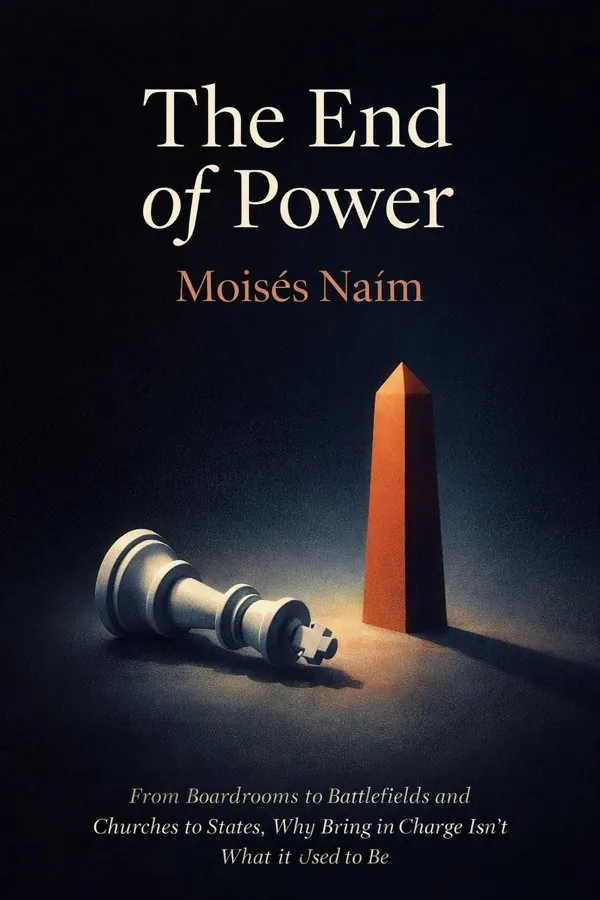
The End of Power: From Boardrooms to Battlefields and Churches to States, Why Being in Charge Isn’t What It Used to Be: Summary & Key Insights
by Moisés Naím
 10 min12 chaptersAudio available
What Is The End of Power: From Boardrooms to Battlefields and Churches to States, Why Being in Charge Isn’t What It Used to Be About?
The End of Power: From Boardrooms to Battlefields and Churches to States, Why Being in Charge Isn’t What It Used to Be by Moisés Naím is a politics book spanning 12 pages. In this influential work, Moisés Naím explores how power is shifting in the modern world. He argues that traditional forms of power—political, corporate, military, and religious—are being eroded by new forces such as globalization, technology, and social movements. The book examines how this diffusion of power affects governments, businesses, and individuals, and what it means for the future of leadership and authority.
This FizzRead summary covers all 12 key chapters of The End of Power: From Boardrooms to Battlefields and Churches to States, Why Being in Charge Isn’t What It Used to Be in approximately 10 minutes, distilling the most important ideas, arguments, and takeaways from Moisés Naím's work. Also available as an audio summary and Key Quotes Podcast.
The End of Power: From Boardrooms to Battlefields and Churches to States, Why Being in Charge Isn’t What It Used to Be
In this influential work, Moisés Naím explores how power is shifting in the modern world. He argues that traditional forms of power—political, corporate, military, and religious—are being eroded by new forces such as globalization, technology, and social movements. The book examines how this diffusion of power affects governments, businesses, and individuals, and what it means for the future of leadership and authority.
Who Should Read The End of Power: From Boardrooms to Battlefields and Churches to States, Why Being in Charge Isn’t What It Used to Be?
This book is perfect for anyone interested in politics and looking to gain actionable insights in a short read. Whether you're a student, professional, or lifelong learner, the key ideas from The End of Power: From Boardrooms to Battlefields and Churches to States, Why Being in Charge Isn’t What It Used to Be by Moisés Naím will help you think differently.
- ✓Readers who enjoy politics and want practical takeaways
- ✓Professionals looking to apply new ideas to their work and life
- ✓Anyone who wants the core insights of The End of Power: From Boardrooms to Battlefields and Churches to States, Why Being in Charge Isn’t What It Used to Be in just 10 minutes
Want the full summary?
Get instant access to this book summary and 100K+ more with Fizz Moment.
Get Free SummaryAvailable on App Store • Free to download
Key Chapters
To understand the end of power, we must first grasp what power means. Power, in its simplest form, is the ability to make others do what you want—or to prevent them from doing things you don’t. It can rest in formal authority, like a title or a law, or in informal influence, like persuasion or reputation. I make a distinction between 'hard power'—coercion through force or reward—and 'soft power'—the capacity to attract, inspire, and shape preferences. Historically, the most durable forms of power combined both, using legitimacy to supplement control.
But in the modern era, all forms of authority have become more porous. Information flows too freely, alternatives multiply too quickly, and the means of resistance are too accessible for any actor to maintain absolute dominance. Where monarchs once commanded subjects, today citizens demand accountability. Where corporations once defined markets, now consumers define brands. Understanding how power works—and how it fails—requires moving beyond the illusion of permanence and accepting that power is a process, not a possession.
When I describe power as decaying, I do not mean that leaders have become weaker as individuals, but that the systems enabling them to enforce will have eroded. Three facts define this decay: power is easier to obtain, harder to use, and easier to lose. Across governments, boardrooms, and battlefields, incumbents face unprecedented volatility. A start-up can disrupt a century-old business within months, a protest can topple a regime in weeks, and a viral idea can undo decades of consensus overnight.
The causes are structural. Globalization, technological advancement, and social connectedness have created a world of instant mobilization, reducing the cost of defiance. Institutions built for control in an age of scarcity now operate in an age of abundance, where attention and coordination outpace authority. The result is not an absence of power but a dispersion of it, transforming leadership from command into negotiation, from dominance into adaptation. Those who cling to old notions of control will find themselves blindsided; those who learn to navigate fluid networks will thrive.
+ 10 more chapters — available in the FizzRead app
All Chapters in The End of Power: From Boardrooms to Battlefields and Churches to States, Why Being in Charge Isn’t What It Used to Be
About the Author
Moisés Naím is a Venezuelan author, journalist, and former Minister of Trade and Industry. He served as editor-in-chief of Foreign Policy magazine and is a distinguished fellow at the Carnegie Endowment for International Peace. Naím is known for his analysis of global political and economic trends.
Get This Summary in Your Preferred Format
Read or listen to the The End of Power: From Boardrooms to Battlefields and Churches to States, Why Being in Charge Isn’t What It Used to Be summary by Moisés Naím anytime, anywhere. FizzRead offers multiple formats so you can learn on your terms — all free.
Available formats: App · Audio · PDF · EPUB — All included free with FizzRead
Download The End of Power: From Boardrooms to Battlefields and Churches to States, Why Being in Charge Isn’t What It Used to Be PDF and EPUB Summary
Key Quotes from The End of Power: From Boardrooms to Battlefields and Churches to States, Why Being in Charge Isn’t What It Used to Be
“To understand the end of power, we must first grasp what power means.”
“When I describe power as decaying, I do not mean that leaders have become weaker as individuals, but that the systems enabling them to enforce will have eroded.”
Frequently Asked Questions about The End of Power: From Boardrooms to Battlefields and Churches to States, Why Being in Charge Isn’t What It Used to Be
The End of Power: From Boardrooms to Battlefields and Churches to States, Why Being in Charge Isn’t What It Used to Be by Moisés Naím is a politics book that explores key ideas across 12 chapters. In this influential work, Moisés Naím explores how power is shifting in the modern world. He argues that traditional forms of power—political, corporate, military, and religious—are being eroded by new forces such as globalization, technology, and social movements. The book examines how this diffusion of power affects governments, businesses, and individuals, and what it means for the future of leadership and authority.
More by Moisés Naím
You Might Also Like
Antifa: The Anti-Fascist Handbook
Mark Bray
10 min
Attack from Within: How Disinformation Is Sabotaging America
Barbara McQuade
10 min
Coercion, Capital, and European States, AD 990–1992
Charles Tilly
10 min
Digital Democracy: Concepts, Methodologies, Tools, and Applications
Various Authors
10 min
Fascism
Stanley G. Payne
10 min
Fire And Fury: Inside The Trump White House
Michael Wolff
10 minBrowse by Category
Ready to read The End of Power: From Boardrooms to Battlefields and Churches to States, Why Being in Charge Isn’t What It Used to Be?
Get the full summary and 100K+ more books with Fizz Moment.