
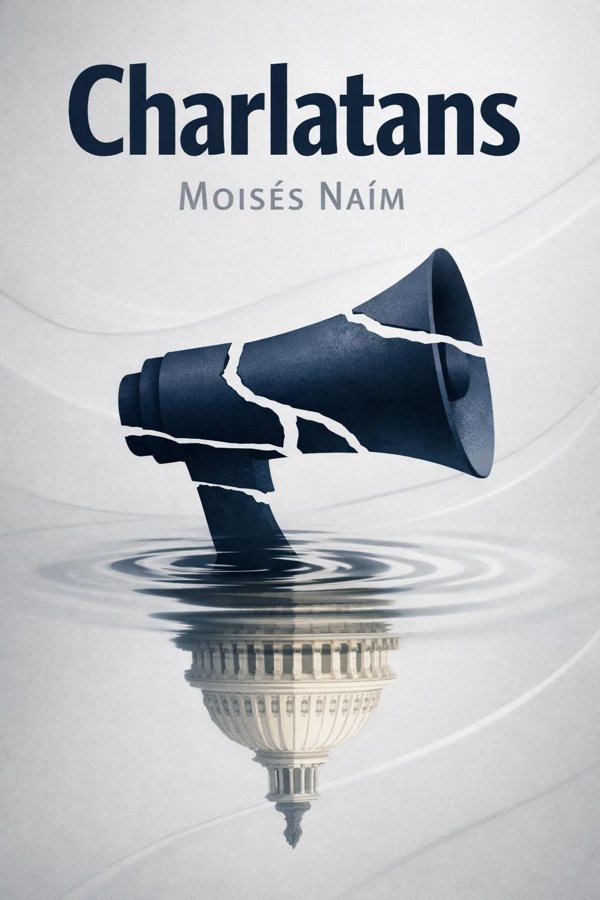
Charlatans: Summary & Key Insights
by Moisés Naím
 10 min5 chaptersAudio available
What Is Charlatans About?
Charlatans by Moisés Naím is a politics book spanning 5 pages. In this thought-provoking essay, Moisés Naím explores the growing influence of charlatans and manipulators of information in contemporary politics and society. He analyzes how misinformation, propaganda, and media manipulation have transformed the way people perceive truth and power, offering a critical reflection on the decline of trust in institutions and the crisis of democracy.
This FizzRead summary covers all 5 key chapters of Charlatans in approximately 10 minutes, distilling the most important ideas, arguments, and takeaways from Moisés Naím's work. Also available as an audio summary and Key Quotes Podcast.
Charlatans
In this thought-provoking essay, Moisés Naím explores the growing influence of charlatans and manipulators of information in contemporary politics and society. He analyzes how misinformation, propaganda, and media manipulation have transformed the way people perceive truth and power, offering a critical reflection on the decline of trust in institutions and the crisis of democracy.
Who Should Read Charlatans?
This book is perfect for anyone interested in politics and looking to gain actionable insights in a short read. Whether you're a student, professional, or lifelong learner, the key ideas from Charlatans by Moisés Naím will help you think differently.
- ✓Readers who enjoy politics and want practical takeaways
- ✓Professionals looking to apply new ideas to their work and life
- ✓Anyone who wants the core insights of Charlatans in just 10 minutes
Want the full summary?
Get instant access to this book summary and 100K+ more with Fizz Moment.
Get Free SummaryAvailable on App Store • Free to download
Key Chapters
Deception has always been a companion to power. From the staged pageantry of monarchs to the propaganda of totalitarian regimes, controlling perception has been the prerogative of rulers. Yet what distinguishes our era from those that preceded it is scale and speed. In the past, lies required an apparatus of censorship or coercion. Now, they require only a click.
In *Charlatans*, I trace how propaganda evolved alongside the instruments of communication. In the twentieth century, radio and television centralized influence in the hands of a few. The Cold War turned deception into a geopolitical art form, with disinformation becoming a weapon as potent as any missile. But even then, truth held certain sanctuaries—universities, newsrooms, courts—institutions that filtered claims through established norms of evidence.
The digital revolution obliterated those boundaries. The same technologies that gave rise to citizen journalism and online transparency also opened a floodgate of unverified voices. Algorithms optimized not for truth but for engagement began rewarding outrage, confirmation bias, and division. Suddenly, every citizen could be both broadcaster and target. The old propaganda pyramid inverted: instead of few manipulating the many, the many now unwittingly manipulate one another. The charlatan merely provides the spark.
Understanding this history reframes our predicament. The tools that charlatans wield today are centuries old in spirit, but their potency is unprecedented. What has changed is not our susceptibility to deception—humans have always craved simple explanations—but the loss of collective mechanisms for truth. When authority fragments, and when each person becomes their own oracle, deception becomes democratic. That is the modern paradox I wished to uncover.
Populism has become the charlatans’ most fertile ground. At its core lies an emotionally charged narrative: the pure people versus the corrupt elite. It is a theater in which facts play a minor role, and feelings dictate allegiance. I have observed this pattern repeat across continents—from North America to Europe to Latin America—where leaders master the art of personalizing power through intimate communication with their followers, bypassing institutions that traditionally mediated public dialogue.
In *Charlatans*, I argue that populism thrives in times of disorientation. Globalization, economic inequality, and cultural change create insecurity. Into that void steps the charismatic simplifier—promising to restore dignity, to avenge grievances, and to speak an unfiltered 'truth' against the establishment. Yet these promises conceal a powerful deceit: populists do not dismantle elites; they replace them. They construct loyalty not through rational persuasion but emotional dependency.
What makes this manipulation so effective is that it feels empowering. Supporters of the charlatan believe they have awakened; in reality, they have been enchanted. By appealing to anger and nostalgia, populists create alternate worlds where complexity disappears and betrayal explains all. Their rhetoric—often conspiratorial, always divisive—turns democratic debate into identity warfare. The charlatan does not ask to be trusted; they demand to be believed.
The rise of populism thus marks a transformation in the nature of political communication. The leader becomes a performer, the public an audience craving emotional resonance. Social media amplifies the illusion of intimacy, creating the sense that authority is personal rather than institutional. But when politics becomes showmanship, truth becomes irrelevant. The spectacle matters more than substance, and democracy loses its north star.
+ 3 more chapters — available in the FizzRead app
All Chapters in Charlatans
About the Author
Moisés Naím is a Venezuelan economist, writer, and commentator. He served as editor-in-chief of Foreign Policy magazine and as Venezuela’s Minister of Industry and Trade. He is the author of several acclaimed works on economics, politics, and globalization, including 'The End of Power'.
Get This Summary in Your Preferred Format
Read or listen to the Charlatans summary by Moisés Naím anytime, anywhere. FizzRead offers multiple formats so you can learn on your terms — all free.
Available formats: App · Audio · PDF · EPUB — All included free with FizzRead
Download Charlatans PDF and EPUB Summary
Key Quotes from Charlatans
“Deception has always been a companion to power.”
“Populism has become the charlatans’ most fertile ground.”
Frequently Asked Questions about Charlatans
Charlatans by Moisés Naím is a politics book that explores key ideas across 5 chapters. In this thought-provoking essay, Moisés Naím explores the growing influence of charlatans and manipulators of information in contemporary politics and society. He analyzes how misinformation, propaganda, and media manipulation have transformed the way people perceive truth and power, offering a critical reflection on the decline of trust in institutions and the crisis of democracy.
More by Moisés Naím
You Might Also Like
Antifa: The Anti-Fascist Handbook
Mark Bray
10 min
Attack from Within: How Disinformation Is Sabotaging America
Barbara McQuade
10 min
Coercion, Capital, and European States, AD 990–1992
Charles Tilly
10 min
Digital Democracy: Concepts, Methodologies, Tools, and Applications
Various Authors
10 min
Fascism
Stanley G. Payne
10 min
Fire And Fury: Inside The Trump White House
Michael Wolff
10 minBrowse by Category
Ready to read Charlatans?
Get the full summary and 100K+ more books with Fizz Moment.