
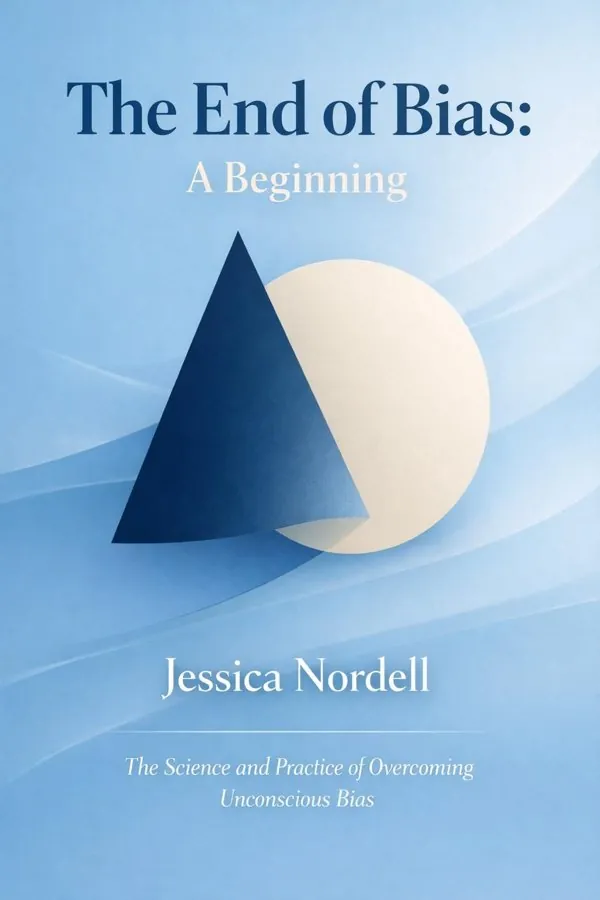
The End of Bias: A Beginning: The Science and Practice of Overcoming Unconscious Bias: Summary & Key Insights
 10 min10 chaptersAudio available
Key Takeaways from The End of Bias: A Beginning: The Science and Practice of Overcoming Unconscious Bias
One of the book’s most powerful insights is that bias did not suddenly appear when researchers gave it a name; what changed was our ability to see it.
A troubling truth sits at the heart of Nordell’s argument: the human brain is designed to categorize quickly, and that efficiency can become a liability.
A classroom is never only a place of learning; it is also a place where expectations are assigned.
Few areas reveal the consequences of bias more starkly than healthcare.
Bias becomes especially dangerous in settings where decisions are fast, high-stakes, and backed by force.
What Is The End of Bias: A Beginning: The Science and Practice of Overcoming Unconscious Bias About?
The End of Bias: A Beginning: The Science and Practice of Overcoming Unconscious Bias by Jessica Nordell is a sociology book spanning 10 pages. Jessica Nordell’s The End of Bias is a deeply researched, urgently relevant exploration of how unconscious bias shapes everyday life—and how it can be changed. Drawing from neuroscience, psychology, education, medicine, criminal justice, and organizational research, Nordell shows that bias is not merely a matter of bad intentions or explicit prejudice. It is often embedded in habits of perception, institutional routines, and social environments that quietly reproduce inequality even among people who believe themselves to be fair. What makes this book especially valuable is its refusal to settle for diagnosis alone. Nordell investigates real-world efforts to reduce bias in schools, hospitals, police departments, and workplaces, asking a practical question: what actually works? As a journalist focused on science, gender, and social change, she brings together rigorous evidence with vivid storytelling, making complex research accessible and human. The result is both unsettling and hopeful. This is a book for readers who want to understand why inequity persists despite good intentions—and for anyone looking for concrete, evidence-based ways to build fairer systems.
This FizzRead summary covers all 10 key chapters of The End of Bias: A Beginning: The Science and Practice of Overcoming Unconscious Bias in approximately 10 minutes, distilling the most important ideas, arguments, and takeaways from Jessica Nordell's work. Also available as an audio summary and Key Quotes Podcast.
The End of Bias: A Beginning: The Science and Practice of Overcoming Unconscious Bias
Jessica Nordell’s The End of Bias is a deeply researched, urgently relevant exploration of how unconscious bias shapes everyday life—and how it can be changed. Drawing from neuroscience, psychology, education, medicine, criminal justice, and organizational research, Nordell shows that bias is not merely a matter of bad intentions or explicit prejudice. It is often embedded in habits of perception, institutional routines, and social environments that quietly reproduce inequality even among people who believe themselves to be fair. What makes this book especially valuable is its refusal to settle for diagnosis alone. Nordell investigates real-world efforts to reduce bias in schools, hospitals, police departments, and workplaces, asking a practical question: what actually works? As a journalist focused on science, gender, and social change, she brings together rigorous evidence with vivid storytelling, making complex research accessible and human. The result is both unsettling and hopeful. This is a book for readers who want to understand why inequity persists despite good intentions—and for anyone looking for concrete, evidence-based ways to build fairer systems.
Who Should Read The End of Bias: A Beginning: The Science and Practice of Overcoming Unconscious Bias?
This book is perfect for anyone interested in sociology and looking to gain actionable insights in a short read. Whether you're a student, professional, or lifelong learner, the key ideas from The End of Bias: A Beginning: The Science and Practice of Overcoming Unconscious Bias by Jessica Nordell will help you think differently.
- ✓Readers who enjoy sociology and want practical takeaways
- ✓Professionals looking to apply new ideas to their work and life
- ✓Anyone who wants the core insights of The End of Bias: A Beginning: The Science and Practice of Overcoming Unconscious Bias in just 10 minutes
Want the full summary?
Get instant access to this book summary and 100K+ more with Fizz Moment.
Get Free SummaryAvailable on App Store • Free to download
Key Chapters
A troubling truth sits at the heart of Nordell’s argument: the human brain is designed to categorize quickly, and that efficiency can become a liability. Neuroscience and cognitive psychology show that perception is not neutral recording. The brain constantly sorts people and situations into familiar patterns, using past experience, cultural signals, and emotional associations to make rapid judgments. These shortcuts once helped humans navigate danger and complexity. In modern social life, however, they can distort reality.
Nordell explains that implicit bias emerges when repeated messages shape automatic associations below conscious awareness. If a culture persistently links leadership with men, threat with Blackness, brilliance with certain social classes, or care work with women, those pairings can become mentally available even in people who consciously reject stereotypes. This does not excuse discrimination, but it does explain why good intentions are not enough. The mismatch between stated values and split-second judgments is one reason bias proves so stubborn.
Importantly, the brain is also plastic. Automatic associations are learned, and learned patterns can be updated. That means exposure, practice, and structural redesign matter. For example, when evaluators use clear criteria before reviewing candidates, they reduce the chance that vague impressions will dominate. When people encounter counter-stereotypical examples repeatedly—women in technical authority, Black physicians, older adults as innovators—the brain’s default expectations can shift.
The practical lesson is simple but demanding: do not trust first impressions as evidence of fairness. Build pauses into decision-making, define standards in advance, and expose yourself regularly to people and stories that challenge cultural defaults. Bias often begins as a shortcut; reducing it starts by slowing down.
A classroom is never only a place of learning; it is also a place where expectations are assigned. Nordell shows how bias in education often operates through subtle differences in attention, discipline, interpretation, and belief. Teachers may unconsciously perceive some students as gifted, disruptive, mature, promising, or difficult based not on objective performance alone but on race, gender, class, disability, or language background. These judgments influence who gets encouragement, who gets corrected harshly, who is recommended for advanced programs, and who begins to internalize a sense of belonging or exclusion.
The book highlights how small moments accumulate. A student interrupted more often may speak less. A child disciplined for behavior tolerated in others may begin to disengage. A girl subtly steered away from math-intensive paths may narrow her ambitions before she realizes she has done so. Nordell’s reporting emphasizes that educational inequity is not always dramatic or intentional. Often it is patterned, quiet, and repeated.
Yet schools are also powerful sites for change. Research-backed interventions can improve fairness: blind grading where possible, structured participation systems, equitable discipline policies, data review by subgroup, and teacher training tied to ongoing practice rather than one-off workshops. Even small procedural adjustments can alter outcomes. For example, tracking who is called on in class can reveal imbalances that teachers never noticed.
The actionable takeaway is for educators and parents to focus on evidence, not assumptions. Review participation, referrals, grades, and opportunities by demographic group. If patterns emerge, do not dismiss them as coincidence. Use data to redesign routines so that support, challenge, and recognition are distributed more fairly.
Few areas reveal the consequences of bias more starkly than healthcare. Nordell shows that unequal treatment in medicine is not limited to overt discrimination; it often emerges through assumptions about pain tolerance, compliance, intelligence, credibility, and risk. These assumptions affect diagnosis, prescribing, communication, and follow-up care. The result is that patients with similar symptoms may receive very different treatment depending on race, gender, body size, age, disability, or socioeconomic status.
The book examines how clinicians working under pressure rely heavily on pattern recognition. In medicine, that can be useful—but when the patterns themselves are shaped by stereotypes or flawed historical data, the consequences can be severe. Women’s pain may be minimized, Black patients may be undertreated, and patients from marginalized groups may be labeled “difficult” when they are simply responding to prior mistreatment or poor communication. Bias also operates in research design and medical education, where the “default patient” has often been too narrow, leading to blind spots in knowledge and care.
Nordell does not argue that doctors are uniquely prejudiced. Rather, she shows that healthcare systems can amplify ordinary cognitive bias through time scarcity, hierarchy, fragmented information, and unequal trust. Effective responses therefore include both individual and structural reforms: checklists, standardized treatment protocols, improved communication training, broader representation in clinical studies, and review of outcome disparities.
The practical takeaway is that fairness in healthcare must be designed, not assumed. Clinicians and institutions should track differences in diagnosis, pain management, maternal outcomes, and follow-up care across groups. Patients, too, can benefit from asking clarifying questions and bringing written symptom records. When life-and-death decisions are involved, reducing bias cannot be optional.
Bias becomes especially dangerous in settings where decisions are fast, high-stakes, and backed by force. Nordell’s discussion of policing and criminal justice shows how unconscious associations can shape whom officers view as suspicious, threatening, defiant, or deserving of leniency. These judgments do not arise in a vacuum. They are influenced by history, neighborhood patterns, media narratives, institutional incentives, and repeated exposure to certain kinds of encounters.
A central point is that biased outcomes do not require openly racist individuals. If officers patrol some communities more intensely, they will detect more infractions there, reinforcing the impression that criminality is concentrated in those places. If split-second assessments of danger are influenced by racialized stereotypes, then surveillance, stops, searches, and uses of force will fall unequally. Once entered into databases, these patterns can appear objective and justify more of the same.
Nordell explores reforms aimed at interrupting this cycle: changing training away from fear-based escalation, setting clearer criteria for stops and searches, improving supervision, collecting detailed data, and designing accountability systems that focus on behavior rather than rhetoric. She also points toward broader criminal justice questions, including how prosecutorial discretion, bail practices, and sentencing norms can preserve inequity long after the initial police encounter.
The actionable takeaway is that institutions entrusted with power must not rely on self-perception alone. Departments need transparent data on stops, arrests, force, and outcomes by race and context, paired with policy changes that reduce discretionary bias. Fairness grows when judgment is examined, constrained, and continually measured—especially where mistakes carry irreversible human costs.
Modern organizations often speak the language of merit, but Nordell shows how easily merit can be confused with comfort, similarity, and stereotype. In hiring, promotion, evaluation, and daily collaboration, people tend to favor those who feel familiar, communicate in expected ways, or match inherited images of leadership and competence. Because these preferences rarely feel like prejudice, they are especially difficult to challenge.
Nordell demonstrates how bias enters workplaces through ordinary processes: unstructured interviews, vague performance criteria, sponsorship networks, assumptions about commitment, and differential interpretation of the same behavior. Assertiveness may signal leadership in one employee and abrasiveness in another. A résumé may be read differently depending on the perceived identity of the applicant. Informal opportunities—stretch assignments, mentoring, visibility with senior leaders—often go to those already seen as fitting the culture. Over time, the organization reproduces itself and then mistakes the result for proof of who belongs.
The book emphasizes that diversity statements alone do little if systems remain unchanged. What works better are structured interviews, predetermined evaluation rubrics, transparent promotion pathways, diverse decision panels, and regular analysis of compensation and advancement patterns. Bias is less likely to flourish when judgments must be explained with reference to shared standards.
The practical takeaway is for leaders to audit every stage where discretion shapes careers. Ask where “gut feeling” substitutes for evidence. If a company truly values fairness, it should redesign decisions so that talent is recognized consistently rather than filtered through familiarity. In workplaces, equity is not anti-merit; it is what makes merit visible.
Perhaps Nordell’s most important corrective is this: simply knowing that unconscious bias exists does not reliably reduce it. Awareness can be a beginning, but by itself it may create overconfidence, defensiveness, or symbolic action without measurable change. The book distinguishes between naming bias and interrupting it. The latter requires repeated practice, environmental redesign, and feedback loops strong enough to alter behavior over time.
Nordell reviews interventions that have shown promise not because they make people feel enlightened, but because they change conditions under which biased judgments occur. These include slowing down decisions, using checklists and rubrics, increasing meaningful contact across group lines, replacing subjective criteria with observable ones, and building habits of reflection around moments of ambiguity. In many settings, the best strategy is not to eliminate human judgment entirely but to make it less vulnerable to distortion.
She also notes that change is easier when people are not shamed into paralysis. If bias is treated only as proof of bad character, people may deny evidence or disengage. A more productive approach recognizes bias as a widespread human tendency with serious social consequences—one that can and must be addressed through discipline and design. This framing preserves accountability while keeping the door open to improvement.
The actionable takeaway is to translate awareness into a system. Pick one recurring decision—grading, interviewing, triage, discipline, performance reviews—and add specific bias interrupters: criteria in advance, written justification, delayed judgment, or outcome review. Progress begins when concern for fairness is turned into repeatable practice.
Bias is often described as a feature of individual minds, but Nordell insists that institutions shape perception itself. Policies, norms, incentives, architecture, language, and historical legacies all tell people what to expect and whom to trust. A school that tracks students early, a hospital that rushes some patients more than others, a newsroom with homogeneous leadership, or a company that prizes constant availability can make inequality seem natural even when no single actor intends it.
This institutional lens changes the scale of the problem. Instead of asking only whether individual people are biased, Nordell asks how systems organize repeated unequal outcomes. That shift matters because a fair-minded person working inside an unfair structure may still produce unfair results. Conversely, better-designed systems can help ordinary people act more justly than instinct alone would allow.
Nordell’s examples suggest that institutional transformation often starts with uncomfortable visibility. Data disaggregated by race, gender, class, and other factors can expose disparities that organizations have normalized or ignored. Once patterns are visible, leaders can revise rules, redistribute opportunities, and create accountability mechanisms. Culture changes not through slogans but through altered expectations about what is measured, discussed, rewarded, and repaired.
The practical takeaway is to stop treating inequity as a string of isolated incidents. Look for repeatable institutional patterns: who advances, who drops out, who gets sanctioned, who feels safe, who is believed. Then redesign the surrounding environment. Lasting progress against bias happens when fairness becomes part of the system’s operating logic, not merely an aspiration voiced by individuals.
Invisible problems remain easy to deny. Nordell shows that one of the most powerful tools in reducing bias is careful measurement. When organizations track outcomes, compare experiences across groups, and study where disparities arise, they move from moral abstraction to practical diagnosis. Measurement does not solve bias by itself, but it makes improvement possible by revealing where intentions and results diverge.
This applies across domains. In education, schools can compare discipline rates, advanced course placement, grading patterns, and participation. In healthcare, institutions can track maternal mortality, pain treatment, waiting times, or diagnostic follow-through. In workplaces, leaders can review hiring funnels, promotion rates, pay equity, and attrition. In criminal justice, agencies can analyze stops, searches, charging decisions, and sentencing disparities. The point is not surveillance for its own sake, but structured learning.
Nordell also warns that not all measures are equally useful. Data can be misleading when categories are too broad, when context is ignored, or when organizations collect numbers without the will to act on them. Metrics should be paired with qualitative insight—stories, observations, interviews—to understand why patterns exist. The goal is accountability, not box-checking.
The actionable takeaway is to choose a few meaningful indicators and review them regularly. Ask not only whether a policy exists, but whether outcomes are becoming more equitable. Bias thrives in ambiguity. Measurement narrows ambiguity and creates pressure to improve. If fairness matters, it should leave evidence.
Facts matter, but Nordell understands that stories often change what facts alone cannot. Throughout the book, narrative serves as more than illustration; it is a method of moral attention. Personal accounts reveal how bias feels from the inside: the exhaustion of being doubted, the cumulative effect of small slights, the cost of being overlooked, the danger of being misread. These stories make visible forms of harm that statistics may capture only partially.
At the same time, Nordell resists turning narrative into sentiment without structure. Empathy can open perception, but by itself it does not remake institutions. The value of personal reflection lies in helping readers notice what they have not had to notice before. It widens the field of concern and challenges defensive habits such as assuming fairness because no harm was intended. When people hear repeated accounts of the same patterned experience, they are forced to confront the gap between isolated interpretation and systemic reality.
Narrative also matters for self-examination. Readers may recognize moments in which they misjudged someone, stayed silent, or benefited from systems they did not choose but rarely questioned. Such reflection is uncomfortable, yet Nordell frames it as a necessary step toward growth rather than a final verdict on character.
The actionable takeaway is to pair data with deliberate listening. Seek out first-person accounts from people whose experiences differ from your own, especially in places where you make decisions or hold influence. Let those stories inform not just sympathy, but concrete changes in how you evaluate, respond, and build systems.
All Chapters in The End of Bias: A Beginning: The Science and Practice of Overcoming Unconscious Bias
About the Author
Jessica Nordell is an American writer and journalist whose work explores science, gender, human behavior, and social change. She has contributed to prominent publications such as The New York Times, The Atlantic, and other major outlets, building a reputation for turning complex research into vivid, accessible storytelling. Her reporting often focuses on the hidden forces that shape everyday life, especially the ways social systems influence perception, opportunity, and inequality. In The End of Bias, Nordell draws on extensive interdisciplinary research and real-world case studies to examine how unconscious bias operates across institutions and what can be done to reduce it. Her work stands out for combining scientific rigor, moral seriousness, and practical relevance, making challenging topics understandable for a broad audience.
Get This Summary in Your Preferred Format
Read or listen to the The End of Bias: A Beginning: The Science and Practice of Overcoming Unconscious Bias summary by Jessica Nordell anytime, anywhere. FizzRead offers multiple formats so you can learn on your terms — all free.
Available formats: App · Audio · PDF · EPUB — All included free with FizzRead
Download The End of Bias: A Beginning: The Science and Practice of Overcoming Unconscious Bias PDF and EPUB Summary
Key Quotes from The End of Bias: A Beginning: The Science and Practice of Overcoming Unconscious Bias
“One of the book’s most powerful insights is that bias did not suddenly appear when researchers gave it a name; what changed was our ability to see it.”
“A troubling truth sits at the heart of Nordell’s argument: the human brain is designed to categorize quickly, and that efficiency can become a liability.”
“A classroom is never only a place of learning; it is also a place where expectations are assigned.”
“Few areas reveal the consequences of bias more starkly than healthcare.”
“Bias becomes especially dangerous in settings where decisions are fast, high-stakes, and backed by force.”
Frequently Asked Questions about The End of Bias: A Beginning: The Science and Practice of Overcoming Unconscious Bias
The End of Bias: A Beginning: The Science and Practice of Overcoming Unconscious Bias by Jessica Nordell is a sociology book that explores key ideas across 10 chapters. Jessica Nordell’s The End of Bias is a deeply researched, urgently relevant exploration of how unconscious bias shapes everyday life—and how it can be changed. Drawing from neuroscience, psychology, education, medicine, criminal justice, and organizational research, Nordell shows that bias is not merely a matter of bad intentions or explicit prejudice. It is often embedded in habits of perception, institutional routines, and social environments that quietly reproduce inequality even among people who believe themselves to be fair. What makes this book especially valuable is its refusal to settle for diagnosis alone. Nordell investigates real-world efforts to reduce bias in schools, hospitals, police departments, and workplaces, asking a practical question: what actually works? As a journalist focused on science, gender, and social change, she brings together rigorous evidence with vivid storytelling, making complex research accessible and human. The result is both unsettling and hopeful. This is a book for readers who want to understand why inequity persists despite good intentions—and for anyone looking for concrete, evidence-based ways to build fairer systems.
You Might Also Like

Between the World and Me
Ta-Nehisi Coates
10 min
Half the Sky
Nicholas D. Kristof, Sheryl WuDunn
10 min
Men Explain Things To Me
Rebecca Solnit
10 min
Rational Ritual
Michael Suk-Young Chwe
10 min
The New Jim Crow
Michelle Alexander
10 min
Beyond Culture
Edward T. Hall
10 minBrowse by Category
Ready to read The End of Bias: A Beginning: The Science and Practice of Overcoming Unconscious Bias?
Get the full summary and 100K+ more books with Fizz Moment.