
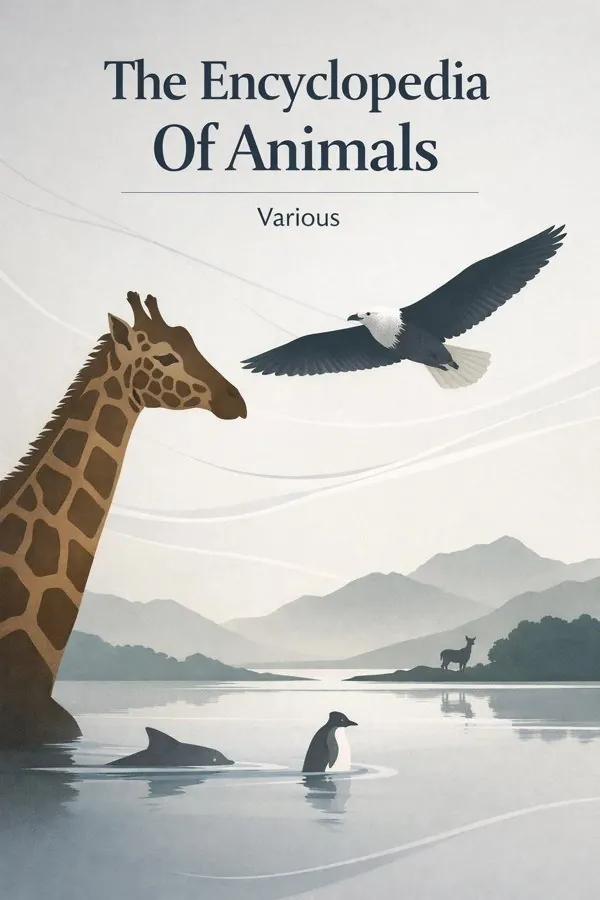
The Encyclopedia Of Animals: Summary & Key Insights
by Various
 10 min9 chaptersAudio available
Key Takeaways from The Encyclopedia Of Animals
At first glance, the animal kingdom can seem like a chaos of forms: whales and worms, eagles and elephants, jellyfish and jaguars.
One reason mammals fascinate us so deeply is that they combine physical power with emotional complexity.
Flight is more than a mode of movement; it is an ecological revolution.
Some of the most misunderstood animals are also among the most revealing.
The largest share of animal life is often the least noticed.
What Is The Encyclopedia Of Animals About?
The Encyclopedia Of Animals by Various is a life_science book spanning 6 pages. The Encyclopedia Of Animals is a sweeping reference guide to the richness, complexity, and wonder of animal life across the planet. Rather than focusing on one species or habitat, it brings together a broad survey of the animal kingdom, explaining how different groups are classified, how they live, what adaptations help them survive, and why so many are now at risk. From powerful mammals and migratory birds to elusive reptiles, deep-sea fish, and tiny invertebrates that sustain ecosystems from below, the book turns biodiversity into a coherent and fascinating story. What makes this work especially valuable is its blend of scientific structure and visual accessibility. It is not just a list of species; it is a framework for understanding life through taxonomy, evolution, behavior, habitat, and conservation. Readers gain both facts and perspective: how animals differ, how they are connected, and how human activity increasingly shapes their fate. Compiled by zoologists, naturalists, and scientific editors, this encyclopedia carries the authority of collaborative expertise while remaining approachable for general readers, students, and anyone curious about the living world.
This FizzRead summary covers all 9 key chapters of The Encyclopedia Of Animals in approximately 10 minutes, distilling the most important ideas, arguments, and takeaways from Various's work. Also available as an audio summary and Key Quotes Podcast.
The Encyclopedia Of Animals
The Encyclopedia Of Animals is a sweeping reference guide to the richness, complexity, and wonder of animal life across the planet. Rather than focusing on one species or habitat, it brings together a broad survey of the animal kingdom, explaining how different groups are classified, how they live, what adaptations help them survive, and why so many are now at risk. From powerful mammals and migratory birds to elusive reptiles, deep-sea fish, and tiny invertebrates that sustain ecosystems from below, the book turns biodiversity into a coherent and fascinating story.
What makes this work especially valuable is its blend of scientific structure and visual accessibility. It is not just a list of species; it is a framework for understanding life through taxonomy, evolution, behavior, habitat, and conservation. Readers gain both facts and perspective: how animals differ, how they are connected, and how human activity increasingly shapes their fate. Compiled by zoologists, naturalists, and scientific editors, this encyclopedia carries the authority of collaborative expertise while remaining approachable for general readers, students, and anyone curious about the living world.
Who Should Read The Encyclopedia Of Animals?
This book is perfect for anyone interested in life_science and looking to gain actionable insights in a short read. Whether you're a student, professional, or lifelong learner, the key ideas from The Encyclopedia Of Animals by Various will help you think differently.
- ✓Readers who enjoy life_science and want practical takeaways
- ✓Professionals looking to apply new ideas to their work and life
- ✓Anyone who wants the core insights of The Encyclopedia Of Animals in just 10 minutes
Want the full summary?
Get instant access to this book summary and 100K+ more with Fizz Moment.
Get Free SummaryAvailable on App Store • Free to download
Key Chapters
One reason mammals fascinate us so deeply is that they combine physical power with emotional complexity. The encyclopedia presents mammals as warm-blooded animals whose success comes not only from their physiology, but also from their behavioral flexibility. Hair or fur, live birth in most species, and milk production are defining traits, yet mammals stand out just as much for their learning capacity, prolonged parental care, and social systems.
Across deserts, forests, oceans, and grasslands, mammals display extraordinary variety. A polar bear’s insulation allows survival in Arctic cold, while a camel’s physiology supports life in arid heat. Primates rely heavily on vision, dexterity, and social intelligence. Marine mammals such as dolphins and whales show how a land-based ancestry can be reshaped for life in water. The encyclopedia emphasizes that mammals are not dominant because they are inherently superior, but because many of them evolved the ability to regulate body temperature, protect offspring, and adapt behavior to changing conditions.
These insights have practical relevance. Conservation efforts for mammals often depend on understanding their breeding cycles, migration routes, territorial needs, and social organization. Protecting elephants, for instance, means preserving movement corridors and family structures, not just individual animals. Studying urban foxes or raccoons can also show how some mammals exploit human-altered environments with remarkable ingenuity.
For readers, mammals offer a bridge between science and empathy. Their visible parenting, communication, and cooperation remind us that survival is often collective. The actionable takeaway: when thinking about mammals, look beyond appearance. Ask how body heat, reproduction, social bonds, and intelligence work together to support survival in a particular habitat.
Flight is more than a mode of movement; it is an ecological revolution. In the encyclopedia, birds emerge as one of the most dynamic animal groups because they transformed the sky into habitat, highway, hunting ground, and refuge. Feathers, lightweight skeletons, acute vision, and specialized beaks are not isolated traits but parts of an integrated system that allows birds to exploit environments in ways few animals can.
Yet the book makes clear that birds are not defined only by flight. Ostriches run, penguins swim, owls hunt in silence, and hummingbirds hover with extraordinary precision. Their forms reflect niche specialization. A hawk’s hooked beak and talons suit predation, while a wader’s long legs and probing bill fit shallow wetlands. Birdsong, plumage, and display behavior reveal another layer of adaptation: communication. Mating, territorial defense, migration coordination, and species recognition all depend on sophisticated signals.
Migration is one of the encyclopedia’s most inspiring themes. Some birds travel thousands of miles across continents and oceans, tracking seasons and food availability with astonishing reliability. This makes them sensitive indicators of environmental change. Declines in migratory species often point to habitat loss, pollution, or climate disruption across multiple regions.
Birds also offer practical value to people. They help control insects, disperse seeds, pollinate plants, and reveal ecosystem health. Even amateur birdwatching trains observation, patience, and ecological awareness. The more carefully one watches local species, the more visible seasonal cycles become.
The actionable takeaway is to treat birds as messengers of environmental conditions. Notice which species live near you, when they appear, what they eat, and how they behave. Paying attention to birds is one of the easiest and most rewarding ways to begin understanding the broader natural world.
Some of the most misunderstood animals are also among the most revealing. The encyclopedia shows that reptiles and amphibians are quiet masters of adaptation, living at the edge of environmental constraints in ways that illuminate evolution itself. Both groups are often associated with cold, damp, or hidden places, yet their biology tells a far richer story about survival, transformation, and ecological sensitivity.
Reptiles, including snakes, lizards, turtles, and crocodilians, are defined largely by dry, scaly skin and dependence on external heat sources. This ectothermic strategy allows them to survive on less food than many mammals or birds, making them remarkably efficient. Their behaviors, such as basking, burrowing, ambushing prey, or remaining motionless for long periods, are not signs of simplicity but of energy-smart design.
Amphibians, by contrast, often live between worlds. Frogs, toads, salamanders, and caecilians commonly begin life in water and later transition to land, making them powerful symbols of evolutionary history. Their permeable skin, however, also makes them vulnerable to pollution, disease, and climate shifts. For this reason, amphibians are among the strongest biological indicators of environmental health.
The practical importance of these groups is immense. Reptiles help regulate prey populations, and amphibians consume vast numbers of insects while serving as prey for many larger animals. Their decline can disrupt entire food webs. Moreover, scientists study amphibian development, reptile thermoregulation, and venom chemistry for medical and ecological insights.
The actionable takeaway is to replace fear with informed observation. When you encounter reptiles or amphibians, consider what their presence says about habitat quality, temperature, moisture, and ecosystem balance. Learning to value these animals expands not only knowledge but ecological responsibility.
The largest share of animal life is often the least noticed. One of the encyclopedia’s strongest contributions is its insistence that fish and invertebrates are not peripheral to nature; they are its foundation. In oceans, rivers, soils, forests, and even cities, these animals drive food webs, nutrient cycles, decomposition, pollination, and ecological stability on a massive scale.
Fish display astonishing diversity in shape, behavior, and habitat. Some inhabit coral reefs in brilliant color, others navigate dark ocean depths, while freshwater species adapt to narrow and changing conditions. Gills, fins, lateral line systems, and body forms suited to speed, camouflage, or bottom-dwelling reveal evolution at work in fluid environments. Fish are essential both ecologically and economically, feeding larger predators and sustaining human communities.
Invertebrates are even more diverse, ranging from insects, spiders, and crustaceans to mollusks, corals, worms, and jellyfish. The encyclopedia highlights how these animals perform tasks that keep ecosystems functioning. Bees and butterflies pollinate crops and wild plants. Earthworms improve soil structure. Coral polyps build reefs that shelter thousands of species. Octopuses demonstrate surprising intelligence, while ants and termites reshape landscapes through collective labor.
For practical understanding, this section encourages readers to stop equating size with importance. A healthy garden depends as much on insects and soil organisms as a savanna depends on large mammals. Environmental threats such as pesticide overuse, overfishing, and ocean acidification often affect these foundational creatures first, with wide consequences later.
The actionable takeaway: pay attention to the small and submerged. Whether choosing sustainable seafood, planting pollinator-friendly flowers, or protecting local waterways, supporting fish and invertebrates means protecting the systems that support nearly all other life.
No animal can be understood in isolation from the place it lives. The encyclopedia repeatedly emphasizes that habitat is not just scenery; it is the matrix that shapes anatomy, behavior, diet, reproduction, and survival. Forest canopies favor climbers and gliders. Deserts reward water conservation and nocturnal habits. Oceans demand buoyancy, salinity tolerance, and new sensory strategies. Grasslands privilege speed, vigilance, and migration. Every environment asks different questions, and evolution answers them in different ways.
This habitat-centered view helps explain why unrelated species sometimes resemble one another. A shark, a dolphin, and an extinct ichthyosaur all evolved streamlined bodies because fast movement through water imposes similar demands. Likewise, burrowing animals from different groups often share compact forms and powerful forelimbs. The book uses such examples to show how environment channels possibility.
Behavior is equally shaped by habitat. Animals in open landscapes may rely on herding and long-distance sight, while those in dense forests depend more on sound, scent, or camouflage. Seasonal habitats, such as temperate zones or wetlands, demand timing: migration, hibernation, breeding cycles, and food storage become essential responses to environmental fluctuation.
This idea has strong practical applications in conservation and everyday thinking. Protecting a species requires protecting the conditions that allow it to live, feed, breed, and move. Saving a bird without preserving nesting trees or wetlands is ineffective. Reintroducing a predator without maintaining prey populations and territory can fail quickly.
The actionable takeaway is to think in ecosystems, not individuals. Whenever you learn about an animal, ask what kind of habitat it needs and what other living and nonliving elements make that habitat function.
Behavior is often the most visible expression of adaptation. The encyclopedia treats behavior not as a decorative extra, but as one of the primary ways animals solve the challenges of life. Finding food, avoiding predators, attracting mates, raising young, defending territory, and cooperating with others all require strategies that can be as important as claws, wings, or scales.
Some behaviors are instinctive and highly patterned, such as a spider spinning a web or a sea turtle hatchling moving toward the sea. Others involve learning, memory, and innovation. Crows use tools, dolphins coordinate hunts, wolves communicate through social signals, and primates teach young through observation and imitation. Even simple-seeming behaviors can represent sophisticated responses to environmental pressures.
The encyclopedia also shows that behavior is often context-dependent. An animal may be solitary in one season and social in another. Aggression may increase during breeding periods. Feeding patterns may shift when predators appear or resources become scarce. Understanding these patterns helps humans reduce conflict with wildlife. For example, better knowledge of bear foraging behavior can guide safer waste management in mountain communities. Knowing pollinator activity patterns can improve gardening and agriculture.
Behavior also deepens empathy without requiring sentimentality. Animal actions are meaningful because they are solutions shaped by evolution. Watching a bird build a nest or a herd coordinate movement reveals intelligence embedded in survival, whether or not it resembles human thought.
The actionable takeaway is to become a patient observer. Instead of asking only what an animal is, ask what it is doing, when, and why. Behavior is often the clearest window into how a species lives and what it needs to endure.
It is difficult to protect what we do not understand. A major message of the encyclopedia is that conservation starts with careful description, classification, and observation. Before a species can be saved, it must be identified correctly, its range mapped, its habits studied, and its threats recognized. This is why encyclopedic knowledge matters: it provides the baseline from which action becomes possible.
The book links animal decline to habitat destruction, pollution, overhunting, invasive species, climate change, and unsustainable trade. But it avoids presenting conservation as abstract doom. Instead, it shows that every species exists within a network of pressures and relationships. A frog may disappear because wetlands are drained. A seabird may decline because overfishing removes its prey. A large carnivore may vanish because fragmented landscapes no longer support roaming territories. Good conservation therefore requires systems thinking.
Practical examples make the point vivid. Protecting sea turtles involves safeguarding nesting beaches, regulating fishing gear, and reducing plastic pollution. Conserving pollinators may require limiting pesticides, preserving wildflower corridors, and diversifying landscapes. Saving endangered mammals often demands cooperation across borders, because migration and breeding habitats do not obey political boundaries.
The encyclopedia also implies that ordinary readers have a role. Supporting habitat restoration, reducing consumption tied to wildlife destruction, choosing sustainable products, and backing science-based policies are all meaningful responses. Education itself is an intervention, because informed people are less likely to dismiss biodiversity as ornamental.
The actionable takeaway is to connect knowledge with responsibility. Learn one threatened species in your region, understand the pressures it faces, and support one concrete action that improves its chances of survival.
Perhaps the deepest insight running through the encyclopedia is that animal diversity should not be understood as a collection of separate curiosities. It is a living web of interdependence. Predators shape herbivore behavior. Pollinators support flowering plants. Scavengers recycle nutrients. Parasites regulate populations. Reef builders create habitat for fish, and burrowing animals aerate soils that sustain plant life. Remove one thread, and the pattern may begin to fray in unexpected places.
This web perspective changes how readers interpret both abundance and rarity. A common insect may be more ecologically important than a famous large mammal because it supports pollination or decomposition at scale. Conversely, apex predators can stabilize entire systems by preventing prey overpopulation. The encyclopedia encourages readers to move beyond charisma and appreciate function.
The practical implications are wide-ranging. In agriculture, monocultures may produce short-term efficiency but reduce the biodiversity that supports resilience. In urban planning, green corridors can help birds, insects, and small mammals move across fragmented spaces. In personal life, even choices such as planting native species, reducing chemical use, or protecting local ponds contribute to ecological networks.
This perspective also reinforces humility. Humans are not outside the web. Food security, climate regulation, soil fertility, clean water, and disease control are all tied to functioning ecosystems and the animals within them. To study animals, then, is also to study the conditions of our own survival.
The actionable takeaway is to think relationally. Whenever you learn about a species, ask not only what it is, but what roles it plays, what depends on it, and what it depends on in return.
All Chapters in The Encyclopedia Of Animals
About the Author
Various refers to the team of contributors behind The Encyclopedia Of Animals, typically including zoologists, field naturalists, science writers, editors, researchers, photographers, and illustrators. Because the animal kingdom is too vast and specialized for one author to cover comprehensively, collaborative reference works like this draw on expertise from multiple disciplines within biology and wildlife studies. These contributors combine scientific accuracy with clear communication, helping readers understand taxonomy, anatomy, behavior, habitats, and conservation. Their work reflects both academic knowledge and observational experience, often shaped by research, field study, and educational publishing. The result is an authoritative yet accessible volume designed to introduce readers of all ages to the diversity and interconnectedness of animal life on Earth.
Get This Summary in Your Preferred Format
Read or listen to the The Encyclopedia Of Animals summary by Various anytime, anywhere. FizzRead offers multiple formats so you can learn on your terms — all free.
Available formats: App · Audio · PDF · EPUB — All included free with FizzRead
Download The Encyclopedia Of Animals PDF and EPUB Summary
Key Quotes from The Encyclopedia Of Animals
“At first glance, the animal kingdom can seem like a chaos of forms: whales and worms, eagles and elephants, jellyfish and jaguars.”
“One reason mammals fascinate us so deeply is that they combine physical power with emotional complexity.”
“Flight is more than a mode of movement; it is an ecological revolution.”
“Some of the most misunderstood animals are also among the most revealing.”
“The largest share of animal life is often the least noticed.”
Frequently Asked Questions about The Encyclopedia Of Animals
The Encyclopedia Of Animals by Various is a life_science book that explores key ideas across 9 chapters. The Encyclopedia Of Animals is a sweeping reference guide to the richness, complexity, and wonder of animal life across the planet. Rather than focusing on one species or habitat, it brings together a broad survey of the animal kingdom, explaining how different groups are classified, how they live, what adaptations help them survive, and why so many are now at risk. From powerful mammals and migratory birds to elusive reptiles, deep-sea fish, and tiny invertebrates that sustain ecosystems from below, the book turns biodiversity into a coherent and fascinating story. What makes this work especially valuable is its blend of scientific structure and visual accessibility. It is not just a list of species; it is a framework for understanding life through taxonomy, evolution, behavior, habitat, and conservation. Readers gain both facts and perspective: how animals differ, how they are connected, and how human activity increasingly shapes their fate. Compiled by zoologists, naturalists, and scientific editors, this encyclopedia carries the authority of collaborative expertise while remaining approachable for general readers, students, and anyone curious about the living world.
More by Various



You Might Also Like
The Selfish Gene
Richard Dawkins
10 min
Awakenings
Oliver Sacks
10 min
Parasite Rex: Inside the Bizarre World of Nature's Most Dangerous Creatures
Carl Zimmer
10 min
The Atlas of Life on Earth
Various
10 min
The Book of Humans: The Story of How We Became Us
Adam Rutherford
10 min
The Horse
Wendy Williams
10 minBrowse by Category
Ready to read The Encyclopedia Of Animals?
Get the full summary and 100K+ more books with Fizz Moment.