
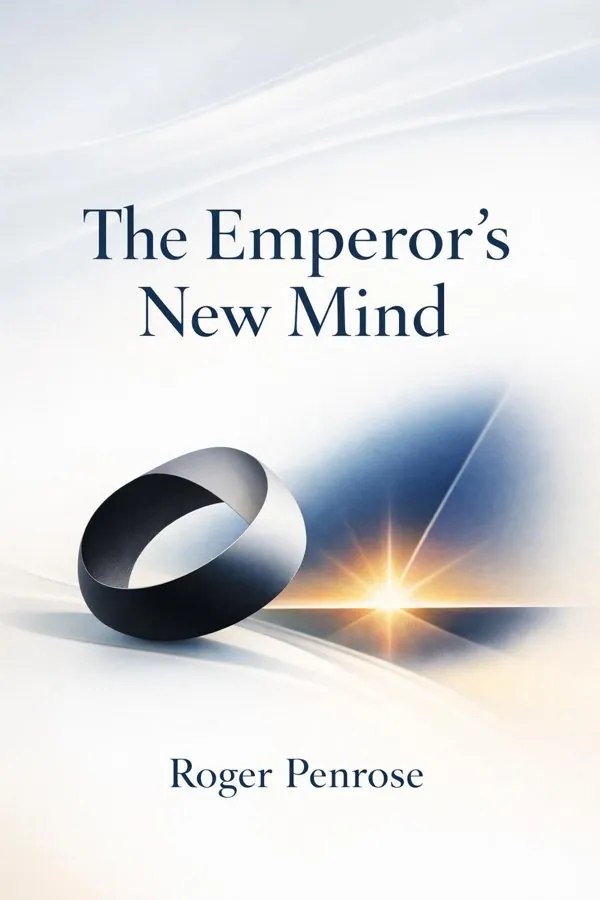
The Emperor's New Mind: Concerning Computers, Minds, and the Laws of Physics: Summary & Key Insights
 10 min12 chaptersAudio available
What Is The Emperor's New Mind: Concerning Computers, Minds, and the Laws of Physics About?
The Emperor's New Mind: Concerning Computers, Minds, and the Laws of Physics by Roger Penrose is a popular_sci book spanning 12 pages. In this groundbreaking work, Sir Roger Penrose explores the relationship between human consciousness and the physical laws of the universe. He argues that human thought cannot be simulated by a computer and that understanding the mind requires new physics beyond current theories. The book traverses topics in mathematics, physics, cosmology, and philosophy, offering a profound inquiry into the nature of intelligence and reality.
This FizzRead summary covers all 12 key chapters of The Emperor's New Mind: Concerning Computers, Minds, and the Laws of Physics in approximately 10 minutes, distilling the most important ideas, arguments, and takeaways from Roger Penrose's work. Also available as an audio summary and Key Quotes Podcast.
The Emperor's New Mind: Concerning Computers, Minds, and the Laws of Physics
In this groundbreaking work, Sir Roger Penrose explores the relationship between human consciousness and the physical laws of the universe. He argues that human thought cannot be simulated by a computer and that understanding the mind requires new physics beyond current theories. The book traverses topics in mathematics, physics, cosmology, and philosophy, offering a profound inquiry into the nature of intelligence and reality.
Who Should Read The Emperor's New Mind: Concerning Computers, Minds, and the Laws of Physics?
This book is perfect for anyone interested in popular_sci and looking to gain actionable insights in a short read. Whether you're a student, professional, or lifelong learner, the key ideas from The Emperor's New Mind: Concerning Computers, Minds, and the Laws of Physics by Roger Penrose will help you think differently.
- ✓Readers who enjoy popular_sci and want practical takeaways
- ✓Professionals looking to apply new ideas to their work and life
- ✓Anyone who wants the core insights of The Emperor's New Mind: Concerning Computers, Minds, and the Laws of Physics in just 10 minutes
Want the full summary?
Get instant access to this book summary and 100K+ more with Fizz Moment.
Get Free SummaryAvailable on App Store • Free to download
Key Chapters
To explore the mind’s uniqueness, I began by retracing the origins of computation itself—Alan Turing’s great insight that any effectively calculable process can be represented by a machine manipulating symbols according to explicit rules. A Turing machine, as elegantly simple as it is profound, captures the essence of algorithmic reasoning. Every modern computer, every line of program code, is ultimately an embodiment of Turing’s theoretical abstraction.
Yet from the start, a tension arises between mechanical computation and human comprehension. When we perform mathematics, when we see in a glance the truth of a theorem’s structure, it feels fundamentally different from the rote manipulation of symbols. Still, one must grant that many acts of reasoning can indeed be formalized. Computers can check proofs, simulate physical systems, and even generate music or art that we find impressive. But the crucial question is this: where does insight—true understanding—reside? Can an algorithm possess it, or is there something in human cognition that escapes formalization?
As the concept of artificial intelligence gained prominence, some thinkers proclaimed that human thought was nothing more than computation. But I sensed that Turing’s vision, while astonishingly powerful, carried internal boundaries. The Church–Turing thesis defines computability, but not the entirety of truth. There exist processes—perhaps even within the physical universe—that transcend these algorithmic limits. Recognizing those boundaries became the first step toward understanding why consciousness might not be computational at all.
With Gödel’s theorems, we encounter one of the most remarkable discoveries in the history of logic: no consistent formal system powerful enough to express arithmetic can prove all truths about the numbers it describes. Even more astonishing, Gödel showed that one could construct specific statements that are true but unprovable within the system itself.
This result shattered the dream, cherished by Hilbert and others, of capturing all mathematical truth through complete formal reasoning. For me, Gödel’s insight hints at something essential about human understanding. When we comprehend a Gödel statement—we see that if the system is consistent, the statement must be true—our recognition of that truth occurs outside the mechanical application of rules within the system. Our mind somehow transcends the boundaries of formal logic to apprehend meaning directly.
Many attempts have been made to reconcile Gödel’s theorem with mechanical intelligence. Some have argued that machines could simply expand their axioms, generating ever more powerful systems to overcome each incompleteness. But this misses the heart of the matter: no matter how far one extends the formal net, the mind still catches sight of truths that elude the net itself. Gödel’s proof, therefore, stands as evidence that the mind engages in a form of understanding that no algorithmic process can emulate.
+ 10 more chapters — available in the FizzRead app
All Chapters in The Emperor's New Mind: Concerning Computers, Minds, and the Laws of Physics
About the Author
Roger Penrose is a British mathematical physicist, mathematician, and philosopher of science. He is known for his work in mathematical physics, particularly in general relativity and cosmology. Penrose was awarded the Nobel Prize in Physics in 2020 for his discoveries about black holes and their formation.
Get This Summary in Your Preferred Format
Read or listen to the The Emperor's New Mind: Concerning Computers, Minds, and the Laws of Physics summary by Roger Penrose anytime, anywhere. FizzRead offers multiple formats so you can learn on your terms — all free.
Available formats: App · Audio · PDF · EPUB — All included free with FizzRead
Download The Emperor's New Mind: Concerning Computers, Minds, and the Laws of Physics PDF and EPUB Summary
Key Quotes from The Emperor's New Mind: Concerning Computers, Minds, and the Laws of Physics
“A Turing machine, as elegantly simple as it is profound, captures the essence of algorithmic reasoning.”
“Even more astonishing, Gödel showed that one could construct specific statements that are true but unprovable within the system itself.”
Frequently Asked Questions about The Emperor's New Mind: Concerning Computers, Minds, and the Laws of Physics
The Emperor's New Mind: Concerning Computers, Minds, and the Laws of Physics by Roger Penrose is a popular_sci book that explores key ideas across 12 chapters. In this groundbreaking work, Sir Roger Penrose explores the relationship between human consciousness and the physical laws of the universe. He argues that human thought cannot be simulated by a computer and that understanding the mind requires new physics beyond current theories. The book traverses topics in mathematics, physics, cosmology, and philosophy, offering a profound inquiry into the nature of intelligence and reality.
More by Roger Penrose
You Might Also Like

Structures: Or Why Things Don"t Fall Down
J.E. Gordon
10 min
The Road to Wigan Pier
George Orwell
10 min
Bonk: The Curious Coupling of Science and Sex
Mary Roach
10 min
First Bite: How We Learn to Eat
Bee Wilson
10 min
In Pursuit Of The Unknown: 17 Equations That Changed The World
Ian Stewart
10 min
Napoleon's Buttons: 17 Molecules That Changed History
Penny Le Couteur and Jay Burreson
10 minBrowse by Category
Ready to read The Emperor's New Mind: Concerning Computers, Minds, and the Laws of Physics?
Get the full summary and 100K+ more books with Fizz Moment.