
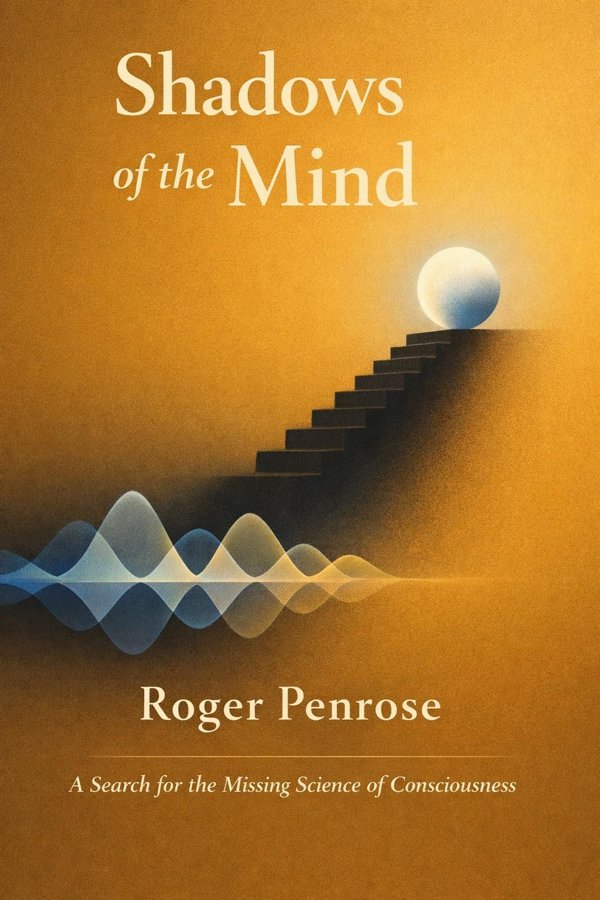
Shadows of the Mind: A Search for the Missing Science of Consciousness: Summary & Key Insights
 10 min9 chaptersAudio available
Key Takeaways from Shadows of the Mind: A Search for the Missing Science of Consciousness
A startling possibility runs through this book: the human mind may be capable of truths no algorithm can fully capture.
The concept of a Turing machine is one of the most powerful ideas in modern science, yet Penrose insists it should not be mistaken for a complete model of thought.
One of Penrose’s most important distinctions is between processing information and actually understanding it.
Penrose’s central scientific wager is bold: if consciousness cannot be explained computationally, then the missing piece may lie in physics itself.
Quantum mechanics enters Penrose’s theory not as fashionable mysticism but as a serious attempt to locate where current science may be incomplete.
What Is Shadows of the Mind: A Search for the Missing Science of Consciousness About?
Shadows of the Mind: A Search for the Missing Science of Consciousness by Roger Penrose is a popular_sci book spanning 11 pages. What if human consciousness cannot be explained by computation alone? In Shadows of the Mind, Roger Penrose takes one of the biggest questions in science and philosophy—how subjective awareness arises—and argues that the standard tools of artificial intelligence, neuroscience, and classical physics are not enough to solve it. Building on themes from The Emperor’s New Mind, Penrose revisits the limits of formal systems, challenges the idea that the brain is simply a biological computer, and proposes that genuinely new physics may be needed to explain conscious experience. His bold suggestion is that quantum processes, especially those linked to gravitational effects, may lie at the heart of understanding. This book matters because it refuses easy answers. Rather than reducing the mind to information processing, Penrose asks whether human understanding reveals something deeper about reality itself. The result is a demanding but fascinating exploration of mathematics, logic, physics, neuroscience, and philosophy. Penrose’s authority is exceptional: he is one of the world’s most influential mathematical physicists, celebrated for foundational work in relativity, black holes, and cosmology. Whether or not readers accept his conclusions, his challenge remains unforgettable: consciousness may expose a missing chapter in science.
This FizzRead summary covers all 9 key chapters of Shadows of the Mind: A Search for the Missing Science of Consciousness in approximately 10 minutes, distilling the most important ideas, arguments, and takeaways from Roger Penrose's work. Also available as an audio summary and Key Quotes Podcast.
Shadows of the Mind: A Search for the Missing Science of Consciousness
What if human consciousness cannot be explained by computation alone? In Shadows of the Mind, Roger Penrose takes one of the biggest questions in science and philosophy—how subjective awareness arises—and argues that the standard tools of artificial intelligence, neuroscience, and classical physics are not enough to solve it. Building on themes from The Emperor’s New Mind, Penrose revisits the limits of formal systems, challenges the idea that the brain is simply a biological computer, and proposes that genuinely new physics may be needed to explain conscious experience. His bold suggestion is that quantum processes, especially those linked to gravitational effects, may lie at the heart of understanding.
This book matters because it refuses easy answers. Rather than reducing the mind to information processing, Penrose asks whether human understanding reveals something deeper about reality itself. The result is a demanding but fascinating exploration of mathematics, logic, physics, neuroscience, and philosophy. Penrose’s authority is exceptional: he is one of the world’s most influential mathematical physicists, celebrated for foundational work in relativity, black holes, and cosmology. Whether or not readers accept his conclusions, his challenge remains unforgettable: consciousness may expose a missing chapter in science.
Who Should Read Shadows of the Mind: A Search for the Missing Science of Consciousness?
This book is perfect for anyone interested in popular_sci and looking to gain actionable insights in a short read. Whether you're a student, professional, or lifelong learner, the key ideas from Shadows of the Mind: A Search for the Missing Science of Consciousness by Roger Penrose will help you think differently.
- ✓Readers who enjoy popular_sci and want practical takeaways
- ✓Professionals looking to apply new ideas to their work and life
- ✓Anyone who wants the core insights of Shadows of the Mind: A Search for the Missing Science of Consciousness in just 10 minutes
Want the full summary?
Get instant access to this book summary and 100K+ more with Fizz Moment.
Get Free SummaryAvailable on App Store • Free to download
Key Chapters
A startling possibility runs through this book: the human mind may be capable of truths no algorithm can fully capture. Penrose develops this claim through Gödel’s incompleteness theorems, which show that in any sufficiently powerful formal mathematical system, there are true statements that cannot be proven within that system. For Penrose, this matters because mathematicians often seem able to recognize the truth of such statements by insight rather than by following a fixed mechanical procedure.
His point is not that people are infallible. Humans make errors constantly. Instead, he argues that understanding is not identical to rule-following. A computer can manipulate symbols perfectly according to explicit instructions, yet still lack genuine grasp of what those symbols mean. A mathematician, by contrast, may step outside a formal system, reflect on its structure, and judge its limitations. That reflective leap is what Penrose thinks computation cannot explain.
This argument challenges strong forms of artificial intelligence, especially the belief that a sufficiently complex program would automatically become conscious or understand in the same way humans do. In practice, it pushes us to distinguish between performance and comprehension. A chatbot may answer elegantly, and a theorem-prover may generate proofs, but neither success alone demonstrates subjective understanding.
The broader application is intellectual humility. When evaluating machines, institutions, or even educational methods, we should ask not only whether they produce correct outputs, but whether they support real insight. Actionable takeaway: whenever you encounter a system that appears intelligent, ask one more question—does it merely follow rules, or does it show signs of flexible understanding beyond its programming?
The concept of a Turing machine is one of the most powerful ideas in modern science, yet Penrose insists it should not be mistaken for a complete model of thought. A Turing machine is an abstract device that follows explicit rules to manipulate symbols step by step. From this simple framework comes our entire modern notion of computation, including digital computers and much of artificial intelligence.
Penrose respects Turing’s achievement deeply, but he argues that defining what can be computed is not the same as explaining consciousness. A chess engine can evaluate millions of positions. A language model can imitate conversation. An autonomous system can navigate roads or detect tumors. These are remarkable examples of algorithmic competence. But competence, in Penrose’s view, does not settle the deeper question of awareness: what it is like to understand, perceive, or be.
He also challenges the idea that passing behavioral tests such as the Turing Test would prove real mentality. If a machine successfully imitates human responses, that might show functional equivalence in narrow contexts, but not necessarily inner experience or genuine semantic grasp. The distinction matters because science often confuses useful simulation with explanation.
In daily life, this is highly relevant. We rely on systems that recommend content, score job applicants, diagnose disease, and drive financial markets. These systems may act intelligently without possessing judgment in a human sense. Treating computational ability as equivalent to mind risks overestimating machines and underestimating human responsibility.
Actionable takeaway: use AI for what it does well—speed, pattern recognition, consistency—but do not assume performance alone equals consciousness, understanding, or moral agency.
One of Penrose’s most important distinctions is between processing information and actually understanding it. The difference seems subtle until we examine ordinary experience. A calculator can produce the correct answer to a multiplication problem without any idea what numbers are. A translation program can convert sentences across languages without appreciating irony, fear, or beauty. Human understanding, Penrose argues, involves meaning, insight, and context-sensitive judgment that cannot be reduced to symbol manipulation alone.
He rejects the view that consciousness is merely what happens when information is processed in sufficient quantity or complexity. If that were true, then ever more complicated software might eventually generate understanding automatically. Penrose is skeptical. He believes something essential is missing from purely computational accounts: they describe the mechanics of representation, but not the lived reality of awareness.
This insight applies far beyond philosophy. In education, students may learn to repeat formulas without grasping concepts. In business, people may optimize metrics while losing sight of purpose. In science, a model may predict outcomes accurately without telling us what underlying reality is actually like. Penrose urges readers to value explanatory depth over surface success.
His challenge also reshapes the way we think about intelligence. If understanding is real and irreducible, then consciousness is not a byproduct of complexity alone. It may depend on physical processes not yet fully recognized by mainstream science.
Actionable takeaway: in your own work, distinguish between fluent output and true comprehension. Whether you are learning, teaching, or using AI, ask: can this system explain, adapt, and connect meaningfully, or is it only manipulating patterns?
Penrose’s central scientific wager is bold: if consciousness cannot be explained computationally, then the missing piece may lie in physics itself. He does not think current neuroscience is useless; the brain obviously matters. But he argues that describing neurons, synapses, and electrical signals in classical terms may never be enough to explain conscious awareness. Something deeper may be operating beneath ordinary neurobiology.
This is where the book becomes especially ambitious. Penrose suggests that consciousness could reveal a gap in our current scientific worldview, much as anomalies in earlier eras forced physicists to move beyond Newtonian ideas toward relativity and quantum mechanics. Instead of assuming that mind must fit neatly into existing theories, he asks whether mind is pointing us toward an unfinished science.
This proposal matters because modern debates often assume a fixed menu of options: either consciousness is computation, or it is an illusion, or it is a mysterious emergent property. Penrose opens a fourth path: consciousness may be real, natural, and lawful, but tied to physical principles we have not yet fully discovered.
A practical analogy is medicine before microbiology. Symptoms were visible, but the correct explanatory framework was missing. Likewise, we may observe behavior, brain activity, and reportable experience while still lacking the right conceptual tools. Penrose’s argument encourages interdisciplinary thinking, connecting physics, biology, mathematics, and philosophy rather than isolating them.
Actionable takeaway: when a problem resists standard explanations, do not assume the problem is unreal. Sometimes persistent mystery is a signal that our framework itself needs revision.
Quantum mechanics enters Penrose’s theory not as fashionable mysticism but as a serious attempt to locate where current science may be incomplete. Quantum theory already forces us to abandon common-sense pictures of reality. Superposition, uncertainty, and measurement all suggest that the physical world behaves in ways classical intuition cannot capture. Penrose asks whether consciousness might be linked to this unresolved layer of nature.
He is especially interested in the measurement problem: how possibilities described by quantum theory become the definite outcomes we actually observe. Standard interpretations often treat this transition in abstract or probabilistic terms. Penrose proposes that this collapse may be an objective physical process rather than something dependent on observation alone. If so, then events associated with quantum state reduction could have relevance for conscious moments.
This does not mean every quantum event is conscious, nor that the brain is magical. Rather, Penrose argues that if the brain can orchestrate physically significant quantum processes, then conscious experience may arise from lawful but non-computational physical transitions. This view is speculative, but it is grounded in a real scientific puzzle.
The practical value of this chapter is conceptual. It reminds us not to use the word “quantum” as a placeholder for mystery. Penrose’s method is the opposite of hand-waving: he ties claims about mind to concrete unresolved issues in foundational physics. That is intellectually demanding and scientifically healthier than vague appeals to complexity.
Actionable takeaway: when confronting extraordinary claims about consciousness, ask whether they are connected to real scientific problems and testable principles—or merely borrowing the language of physics without its discipline.
At the heart of Penrose’s proposal is Objective Reduction, often abbreviated OR. This is his idea that quantum superpositions do not persist indefinitely and do not collapse only because an observer measures them. Instead, Penrose suggests there is an objective, physical threshold tied to gravity and spacetime geometry. When the difference between alternative quantum states becomes too great in gravitational terms, the superposition self-collapses into one actual outcome.
Why does this matter for consciousness? Penrose believes these moments of self-collapse are non-computational events. They are not simply the output of an algorithm running on hidden variables. If the brain somehow harnesses such events in an organized way, then conscious episodes might be rooted in fundamental physical processes that lie beyond standard computation.
The importance of OR is that it turns an abstract philosophical debate into a research program, however controversial. Instead of saying “mind is mysterious,” Penrose identifies a mechanism to investigate. This has inspired both interest and criticism, especially from those who question whether quantum coherence can survive in the warm, noisy brain. Still, the theory’s strength lies in its effort to connect consciousness to a precise problem in physics rather than vague dualism.
A useful application of OR as an idea is methodological. Strong theories make themselves vulnerable. They specify mechanisms, invite challenge, and risk being wrong. That is better than theories that explain everything and therefore predict nothing.
Actionable takeaway: value bold hypotheses that generate clear questions. In complex fields, progress often comes not from safe consensus but from testable ideas that force better experiments and sharper thinking.
A theory of consciousness needs not only a philosophical argument and a physical mechanism, but also a plausible place in the brain where such processes could occur. This is where microtubules enter the discussion. Microtubules are structural components inside cells, including neurons, and Penrose—especially in collaboration with Stuart Hameroff—considers them possible sites where quantum effects might be sustained and organized in biologically meaningful ways.
The appeal of microtubules is that they provide a candidate bridge between subcellular physics and large-scale mental function. If quantum coherence and objective reductions can occur there, then conscious moments might emerge from orchestrated activity within the cytoskeleton of neurons rather than from synaptic firing alone. This would radically expand how we think about brain function.
Critics argue that the brain is too warm, wet, and noisy for delicate quantum states to survive long enough to matter. That objection is serious, and Penrose’s proposal remains controversial for exactly this reason. Yet the broader lesson is valuable even if one remains skeptical of the specific mechanism. Neuroscience may still be missing important levels of organization below standard network models.
There are parallels in other sciences. Major breakthroughs often happen when researchers stop looking only at the obvious scale of explanation. Life is not explained by chemistry alone, nor weather by single molecules. Likewise, consciousness may depend on interactions across multiple levels.
Actionable takeaway: when trying to understand a complex system, do not assume the most visible level is the decisive one. Look for hidden layers of structure that could change the whole explanatory picture.
Penrose does not deny that machines can become extraordinarily powerful. His warning is more precise: even highly advanced AI may still fall short of human-style understanding if computation is not the whole story. This makes his critique more relevant than ever. Systems today can write essays, generate images, beat champions, and assist with scientific discovery. Yet Penrose would ask whether these achievements reveal consciousness—or simply increasingly sophisticated rule-based or statistical processes.
His answer is that intelligence in the functional sense does not automatically produce awareness. A machine may outperform humans in narrow tasks while lacking subjective experience, semantic understanding, or the capacity for non-computational insight. If he is right, then scaling data, speed, and complexity will not by itself cross the boundary into conscious mind.
This perspective has practical consequences. In ethics, it cautions against assigning personhood too quickly to systems that imitate conversation. In policy, it reminds us that accountability must remain with humans even when algorithms appear autonomous. In education and work, it suggests that uniquely human strengths may include judgment, intuition, and forms of understanding not reducible to optimization.
Penrose’s view also offers a healthier response to both hype and fear. We do not need to dismiss AI, but neither should we mythologize it. The real question is not whether machines can do impressive things—they clearly can—but what kinds of intelligence those performances actually represent.
Actionable takeaway: evaluate AI by separating three issues—capability, understanding, and consciousness. A system may excel at the first while remaining entirely uncertain on the other two.
Penrose’s argument ultimately extends beyond neuroscience or computing into a larger philosophical claim: consciousness may be a clue to the structure of reality itself. If awareness cannot be captured by current computational and physical accounts, then mind is not a side issue. It becomes evidence that our scientific image of the world is incomplete.
This has consequences for long-standing debates about materialism, dualism, free will, and the nature of truth. Penrose does not embrace a supernatural explanation. He remains committed to a lawful universe. But he resists the reductionist assumption that everything important about mind must already fit into current physical theories. In that sense, he proposes a naturalism that is unfinished rather than closed.
He also restores dignity to subjective experience. In many modern discussions, consciousness is treated as an inconvenient leftover, something to be reduced, eliminated, or ignored in favor of behavior and computation. Penrose argues the opposite: consciousness is among the most undeniable facts we know. A scientific worldview that cannot account for it is not complete.
For readers, this changes how one approaches mystery. Rather than seeing unresolved questions as failures, Penrose treats them as invitations. Consciousness may be difficult not because it is unreal, but because it sits at the frontier where multiple domains of knowledge meet.
Actionable takeaway: take first-person experience seriously when thinking about science and philosophy. The hardest problems are often the most important, and refusing to trivialize them is the first step toward better understanding.
All Chapters in Shadows of the Mind: A Search for the Missing Science of Consciousness
About the Author
Roger Penrose is a British mathematical physicist, mathematician, and philosopher of science whose work has shaped modern understanding of spacetime, black holes, and cosmology. Educated at University College London and the University of Cambridge, he became renowned for deep contributions to general relativity, including singularity theorems developed with Stephen Hawking. Penrose is also known for influential ideas in geometry, tiling, and the foundations of physics, as well as for writing intellectually ambitious books for general readers. In discussions of mind and consciousness, he is distinctive for arguing that human understanding cannot be fully reduced to computation. In 2020, he received the Nobel Prize in Physics for showing that black hole formation is a robust prediction of general relativity.
Get This Summary in Your Preferred Format
Read or listen to the Shadows of the Mind: A Search for the Missing Science of Consciousness summary by Roger Penrose anytime, anywhere. FizzRead offers multiple formats so you can learn on your terms — all free.
Available formats: App · Audio · PDF · EPUB — All included free with FizzRead
Download Shadows of the Mind: A Search for the Missing Science of Consciousness PDF and EPUB Summary
Key Quotes from Shadows of the Mind: A Search for the Missing Science of Consciousness
“A startling possibility runs through this book: the human mind may be capable of truths no algorithm can fully capture.”
“The concept of a Turing machine is one of the most powerful ideas in modern science, yet Penrose insists it should not be mistaken for a complete model of thought.”
“One of Penrose’s most important distinctions is between processing information and actually understanding it.”
“Penrose’s central scientific wager is bold: if consciousness cannot be explained computationally, then the missing piece may lie in physics itself.”
“Quantum mechanics enters Penrose’s theory not as fashionable mysticism but as a serious attempt to locate where current science may be incomplete.”
Frequently Asked Questions about Shadows of the Mind: A Search for the Missing Science of Consciousness
Shadows of the Mind: A Search for the Missing Science of Consciousness by Roger Penrose is a popular_sci book that explores key ideas across 9 chapters. What if human consciousness cannot be explained by computation alone? In Shadows of the Mind, Roger Penrose takes one of the biggest questions in science and philosophy—how subjective awareness arises—and argues that the standard tools of artificial intelligence, neuroscience, and classical physics are not enough to solve it. Building on themes from The Emperor’s New Mind, Penrose revisits the limits of formal systems, challenges the idea that the brain is simply a biological computer, and proposes that genuinely new physics may be needed to explain conscious experience. His bold suggestion is that quantum processes, especially those linked to gravitational effects, may lie at the heart of understanding. This book matters because it refuses easy answers. Rather than reducing the mind to information processing, Penrose asks whether human understanding reveals something deeper about reality itself. The result is a demanding but fascinating exploration of mathematics, logic, physics, neuroscience, and philosophy. Penrose’s authority is exceptional: he is one of the world’s most influential mathematical physicists, celebrated for foundational work in relativity, black holes, and cosmology. Whether or not readers accept his conclusions, his challenge remains unforgettable: consciousness may expose a missing chapter in science.
More by Roger Penrose
You Might Also Like

Structures: Or Why Things Don"t Fall Down
J.E. Gordon
10 min
The Road to Wigan Pier
George Orwell
10 min
Bonk: The Curious Coupling of Science and Sex
Mary Roach
10 min
First Bite: How We Learn to Eat
Bee Wilson
10 min
In Pursuit Of The Unknown: 17 Equations That Changed The World
Ian Stewart
10 min
Napoleon's Buttons: 17 Molecules That Changed History
Penny Le Couteur and Jay Burreson
10 minBrowse by Category
Ready to read Shadows of the Mind: A Search for the Missing Science of Consciousness?
Get the full summary and 100K+ more books with Fizz Moment.