
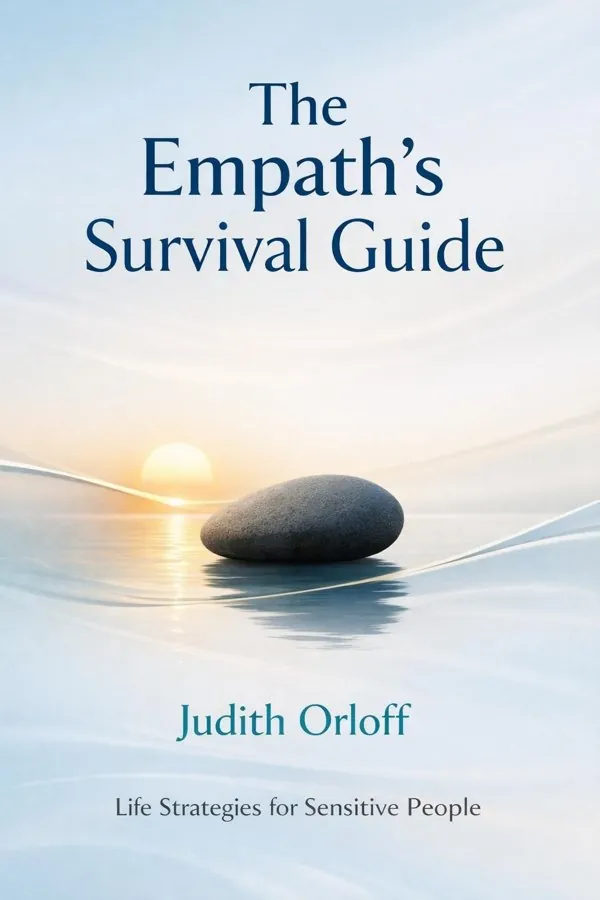
The Empath’s Survival Guide: Life Strategies for Sensitive People: Summary & Key Insights
 10 min9 chaptersAudio available
Key Takeaways from The Empath’s Survival Guide: Life Strategies for Sensitive People
What if the very trait that exhausts you is also one of your greatest strengths?
You do not need to speak to someone to be affected by them.
Compassion without boundaries eventually turns into resentment.
For many empaths, alone time is not a luxury—it is maintenance.
Love does not erase sensitivity; it tests whether it is respected.
What Is The Empath’s Survival Guide: Life Strategies for Sensitive People About?
The Empath’s Survival Guide: Life Strategies for Sensitive People by Judith Orloff is a mental_health book. Some people do not just notice the emotional atmosphere in a room—they absorb it. In The Empath’s Survival Guide, psychiatrist Judith Orloff argues that sensitivity is not a flaw to overcome but a powerful trait that must be understood, protected, and directed wisely. The book is a practical manual for people who feel drained by crowds, overwhelmed by conflict, deeply affected by other people’s moods, or unusually connected to intuition and subtle energy. Rather than dismissing these experiences, Orloff treats them as real challenges that require real strategies. What makes this book especially valuable is the combination of clinical insight and holistic perspective. Orloff is a board-certified psychiatrist who writes from both medical training and years of work with highly sensitive patients. She explains how empaths can stop confusing emotional absorption with compassion, create healthier boundaries, manage relationships, and avoid burnout. The result is not a vague celebration of sensitivity, but a grounded guide to daily survival and emotional balance. For anyone who has ever felt “too much” in a world that rewards numbness, this book offers validation, language, and tools for living with strength instead of exhaustion.
This FizzRead summary covers all 9 key chapters of The Empath’s Survival Guide: Life Strategies for Sensitive People in approximately 10 minutes, distilling the most important ideas, arguments, and takeaways from Judith Orloff's work. Also available as an audio summary and Key Quotes Podcast.
The Empath’s Survival Guide: Life Strategies for Sensitive People
Some people do not just notice the emotional atmosphere in a room—they absorb it. In The Empath’s Survival Guide, psychiatrist Judith Orloff argues that sensitivity is not a flaw to overcome but a powerful trait that must be understood, protected, and directed wisely. The book is a practical manual for people who feel drained by crowds, overwhelmed by conflict, deeply affected by other people’s moods, or unusually connected to intuition and subtle energy. Rather than dismissing these experiences, Orloff treats them as real challenges that require real strategies.
What makes this book especially valuable is the combination of clinical insight and holistic perspective. Orloff is a board-certified psychiatrist who writes from both medical training and years of work with highly sensitive patients. She explains how empaths can stop confusing emotional absorption with compassion, create healthier boundaries, manage relationships, and avoid burnout. The result is not a vague celebration of sensitivity, but a grounded guide to daily survival and emotional balance. For anyone who has ever felt “too much” in a world that rewards numbness, this book offers validation, language, and tools for living with strength instead of exhaustion.
Who Should Read The Empath’s Survival Guide: Life Strategies for Sensitive People?
This book is perfect for anyone interested in mental_health and looking to gain actionable insights in a short read. Whether you're a student, professional, or lifelong learner, the key ideas from The Empath’s Survival Guide: Life Strategies for Sensitive People by Judith Orloff will help you think differently.
- ✓Readers who enjoy mental_health and want practical takeaways
- ✓Professionals looking to apply new ideas to their work and life
- ✓Anyone who wants the core insights of The Empath’s Survival Guide: Life Strategies for Sensitive People in just 10 minutes
Want the full summary?
Get instant access to this book summary and 100K+ more with Fizz Moment.
Get Free SummaryAvailable on App Store • Free to download
Key Chapters
What if the very trait that exhausts you is also one of your greatest strengths? Judith Orloff begins by reframing empathy and emotional sensitivity as valuable forms of intelligence rather than signs of fragility. Many empaths have spent years being told they are overly dramatic, too emotional, or incapable of handling stress. Orloff challenges this narrative by showing that empaths often possess unusual intuition, compassion, creativity, and depth of perception. They can sense underlying motives, pick up on emotional nuances, and connect meaningfully with others. The problem is not sensitivity itself; the problem is living without the tools to manage it.
The book distinguishes between caring about people and absorbing their emotional states. An empath may enter a tense workplace and immediately feel anxious, even if nothing bad has happened to them personally. They may spend time with a grieving friend and leave feeling emotionally flattened for days. Without self-awareness, they mistake absorption for kindness and overexposure for love. Orloff’s insight is that empathy becomes a burden when it is uncontained. Once sensitivity is understood, it can be channeled into healing professions, art, meaningful relationships, and wise decision-making.
This reframe matters because shame intensifies overwhelm. When people believe their sensitivity is defective, they are less likely to protect it. But when they see it as a natural trait that requires stewardship, they can build a life that supports it. A teacher may schedule quiet breaks between classes. A manager may avoid conflict-heavy environments. A caregiver may learn to distinguish their feelings from a client’s distress.
Actionable takeaway: Replace self-criticism with observation. For one week, notice where your sensitivity helps you and where it depletes you. That awareness is the first step toward using empathy as a strength instead of experiencing it as a liability.
You do not need to speak to someone to be affected by them. One of Orloff’s most important ideas is that empaths often absorb stress, fear, anger, or fatigue from people and environments without realizing it. This process can lead to emotional exhaustion, brain fog, anxiety, irritability, and even physical symptoms. A crowded store, a conflict-filled office, or an emotionally demanding family gathering can leave an empath depleted long before they understand why.
Orloff explains that many sensitive people lack a clear filter between their own inner state and the emotional weather around them. Because of this, they can confuse other people’s feelings with their own. A calm morning can turn heavy after a short conversation with a pessimistic coworker. A partner’s stress can become your insomnia. Social media, news overload, and constant digital stimulation can intensify this effect, exposing empaths to a nonstop stream of fear, outrage, and urgency.
The key is learning to identify what belongs to you and what does not. Orloff encourages practices such as pausing after interactions and asking, “Was this feeling mine before I entered this situation?” That simple question can restore a sense of personal clarity. She also recommends limiting exposure to emotionally chaotic settings when possible and taking recovery time seriously. If a birthday party leaves you drained, that does not mean you are antisocial. It may simply mean your nervous system needs decompression.
Practical examples include stepping outside during a loud event, reducing time with chronically negative people, turning off the news when your body feels activated, and creating transition rituals after work such as a walk, shower, or a few minutes of silence.
Actionable takeaway: Start tracking your energy after specific people and places. The patterns will reveal what you are absorbing and help you make better choices about exposure and recovery.
Compassion without boundaries eventually turns into resentment. Orloff argues that one of the biggest challenges empaths face is believing they must always be available, agreeable, and emotionally open to others. Because they feel deeply and often sense other people’s pain quickly, they can become rescuers by default. They overlisten, overgive, and overaccommodate until they feel used, numb, or invisible.
The book makes a crucial distinction: boundaries are not barriers against love; they are structures that make love sustainable. A healthy boundary defines where you end and another person begins. It allows you to care without carrying, support without saving, and listen without losing yourself. This can be difficult for empaths because saying no may trigger guilt or fear of disappointing others. But Orloff shows that chronic self-abandonment is far more damaging than temporary discomfort.
In practical terms, boundaries can be physical, emotional, temporal, and digital. Physical boundaries may mean needing personal space or limiting touch. Emotional boundaries involve refusing to become someone’s constant dumping ground. Time boundaries include ending calls, not replying immediately to every message, or protecting evenings for recovery. Digital boundaries might involve muting stressful group chats or limiting access to people who contact you only when they need something.
Orloff encourages direct, respectful language. For example: “I care about you, but I can only talk for ten minutes,” or “I’m not able to take this on right now.” These statements are not cold; they are clear. The clearer your limits, the less likely you are to end up overextended and emotionally flooded.
Actionable takeaway: Choose one recurring situation where you feel drained and set a specific boundary this week. Make it simple, concrete, and kind. Protecting your energy is not selfish—it is what allows your care to remain genuine.
For many empaths, alone time is not a luxury—it is maintenance. Orloff emphasizes that sensitive people often need more solitude than others in order to return to themselves after absorbing external stimulation. In a culture that celebrates constant availability and sociability, this need can be misunderstood as withdrawal, moodiness, or avoidance. The book insists that solitude is often the most effective way for an empath to clear mental clutter and regulate their nervous system.
When empaths do not get enough restorative quiet, they can lose their internal signal. They become saturated with other people’s emotions, opinions, demands, and expectations. This saturation may show up as difficulty making decisions, irritability, fatigue, or the sense that they are disappearing inside their responsibilities. Solitude restores contrast. It helps empaths hear their own thoughts, feel their own emotions, and reconnect to what they actually want.
Orloff does not present solitude as total isolation. Instead, she recommends intentional pockets of decompression: a morning ritual before checking messages, a walk without headphones, time in nature, meditation, journaling, prayer, or simply sitting in silence. Even a few minutes between stimulating events can make a meaningful difference. A parent may wake up twenty minutes early to drink coffee alone. A therapist may take a silent break between sessions. An employee may eat lunch outside rather than in a noisy break room.
Importantly, solitude is framed as proactive rather than reactive. You do not have to wait until you are overwhelmed to seek space. Building regular time alone into your schedule can prevent emotional overload before it starts and allow you to show up to relationships with more patience and presence.
Actionable takeaway: Create one nonnegotiable daily period of quiet, even if it is only ten to fifteen minutes. Treat it as emotional hygiene, not optional self-indulgence.
Love does not erase sensitivity; it tests whether it is respected. Orloff explores how empaths often struggle in relationships because they are highly attuned to subtle shifts in mood, tone, and energy. This can make them deeply caring partners and loyal friends, but it can also leave them vulnerable to emotional overfunctioning, people-pleasing, and attraction to narcissistic or draining individuals. Many empaths unconsciously end up in relationships where they give more emotional labor than they receive.
A central lesson in the book is that healthy relationships for empaths are built on mutual respect for emotional needs, space, and honest communication. Sensitive people may require downtime after socializing, less chaotic conflict styles, or more reassurance when tension arises. These are not unreasonable demands. Problems develop when empaths minimize their needs in order to seem easygoing or when partners dismiss sensitivity as overreaction.
Orloff also warns against confusing intensity with intimacy. Because empaths feel strongly, they may mistake emotional turbulence for connection. But a relationship that constantly destabilizes your nervous system is not necessarily passionate—it may simply be dysregulating. She encourages readers to notice whether they feel safe, expanded, and respected around someone, or chronically anxious, guilty, and depleted.
Practical applications include having explicit conversations about alone time, recognizing red flags like manipulation or emotional inconsistency, and choosing relationships with people who can listen without domination. Empaths may also benefit from slowing down romantic involvement and observing how their body feels after interactions rather than focusing only on chemistry.
Actionable takeaway: Audit your closest relationships by asking one question: Do I feel restored or drained after being with this person most of the time? Let the answer guide where you invest your heart and energy.
A sensitive mind can easily confuse intuition with anxiety unless it is grounded. Orloff treats intuition as one of the empath’s natural gifts, but she is careful not to romanticize every emotional reaction as truth. Real intuition tends to feel clear, quiet, and immediate, while fear is often repetitive, urgent, and mentally noisy. Learning the difference requires self-trust, bodily awareness, and regular grounding practices.
Grounding means returning attention to the body and the present moment so that emotional and energetic impressions do not pull you into confusion. For empaths, this can involve breathing exercises, meditation, time in nature, movement, prayer, or visualizations that create a sense of containment. These practices help sensitive people distinguish what they are perceiving from what they are projecting. A grounded empath is less likely to panic, overidentify with another person’s distress, or make decisions based solely on emotional contagion.
Orloff suggests that intuition can serve daily life in practical ways. It may tell you which social invitations to decline, which professional opportunities feel off, or when someone’s words do not match their energy. For example, you might meet a charming new acquaintance who says all the right things, yet your body feels tense and guarded. Rather than dismissing that signal, grounding helps you stay with it and evaluate calmly. Likewise, intuition may guide you toward nourishing choices, like needing rest before you consciously realize you are overstimulated.
The goal is not mystical certainty but clearer inner listening. Intuition is most useful when combined with observation, reflection, and boundaries.
Actionable takeaway: Before making an important decision, pause for two minutes, breathe slowly, and ask, “What does my body know before my mind explains?” Record the answer and compare it with the eventual outcome to strengthen trust in your signals.
Modern life often overwhelms empaths not because they are incapable, but because they are overstimulated. Orloff highlights how noise, crowds, multitasking, conflict, screens, and constant demands can flood a sensitive nervous system. An empath may function well in small doses of stimulation but struggle when the environment becomes relentless. This overload can lead to fatigue, irritability, insomnia, emotional shutdown, or the desire to escape completely.
The book encourages readers to stop treating overstimulation as a personal failure. Instead, it is useful feedback about capacity. Sensitive people often need to structure life with greater care: fewer back-to-back commitments, more transition time, calmer spaces, and realistic limits on sensory and emotional input. This does not mean avoiding the world altogether. It means designing interactions with awareness of recovery costs.
Practical strategies include carrying noise-canceling headphones, planning errands during quieter hours, reducing clutter at home, turning off nonessential notifications, and balancing demanding activities with restorative ones. A person who attends an all-day conference may schedule an empty evening afterward. Someone who works in a busy hospital may create a dim, quiet home environment to reset. Even nutrition, sleep, and hydration matter more when your system is highly reactive.
Orloff’s broader point is that sensitivity requires rhythm. When empaths ignore their limits, they often swing between overexposure and collapse. But when they pace themselves, they can remain engaged without burning out. The aim is not a smaller life; it is a sustainable one.
Actionable takeaway: Identify your top three sources of overstimulation and reduce just one this week. Small changes in noise, schedule, or digital exposure can significantly improve your energy and emotional clarity.
When the outside world feels invasive, inner practices become a form of protection. Orloff includes a spiritual dimension in her approach, arguing that empaths often benefit from rituals that help them feel centered, protected, and connected to something larger than immediate emotional turbulence. Whether readers interpret this spiritually, psychologically, or symbolically, these practices function as anchors that reduce overwhelm.
The book describes tools such as meditation, prayer, visualization, time in nature, and mindful breathing. Orloff often recommends imagining a protective shield around the body before entering stressful environments. Skeptics may view this as a mental cue rather than an energetic reality, but the effect can still be helpful. A visualization can remind you to stay separate from what is not yours to carry. It can create intentionality before difficult meetings, family events, or public spaces.
Spiritual practice also helps empaths shift from constant emotional reaction to witnessing. Instead of immediately merging with someone else’s pain, they can observe it with compassion and steadiness. This distinction is powerful: witnessing allows care without collapse. Over time, rituals can reinforce a sense of inner home, making external chaos less defining.
Examples include taking five breaths before entering work, saying a short intention such as “I will stay grounded in my own energy,” lighting a candle at the end of the day to release what you absorbed, or walking in nature after a hard conversation. The exact form matters less than consistency. Repeated practices train the mind and body to return to balance.
Actionable takeaway: Choose one grounding ritual before stressful encounters and one release ritual afterward. Use them consistently for a week and notice whether you feel less porous and more centered.
For empaths, self-care is not cosmetic—it is structural. Orloff’s larger message is that sensitive people cannot wait until they are depleted to care for themselves. Because they naturally orient toward others, they often neglect the basics that keep them emotionally stable: rest, nourishment, movement, meaningful work, supportive relationships, and time to reset. Over time, this neglect can make their sensitivity feel unbearable, when in fact the real issue is chronic under-recovery.
The book frames self-care as a daily system of prevention. Sleep protects emotional resilience. Nutritious food stabilizes the body. Exercise helps discharge stress. Creative expression gives emotional intensity a healthy outlet. Time in nature reduces psychic clutter. Honest communication reduces hidden resentment. Saying no preserves energy for what matters. Each choice may seem small, but together they determine whether empathy feels enriching or crushing.
Orloff also emphasizes the importance of self-compassion. Many empaths hold themselves to unrealistic standards because they feel responsible for everyone’s comfort. They may believe that needing rest means they are lazy, or that wanting space means they are unloving. The book pushes back on this harshness. Sustainable sensitivity depends on treating your own needs as legitimate rather than secondary.
A practical application might be creating a weekly care plan that includes protected sleep, movement, low-stimulation time, and limits around emotionally draining obligations. It may also mean seeking therapy, support groups, or medical care when overwhelm becomes persistent or severe.
Actionable takeaway: Build a personal “energy protection checklist” with five essentials—such as sleep, alone time, movement, healthy meals, and one boundary—and review it each evening. Survival improves when care becomes routine instead of occasional.
All Chapters in The Empath’s Survival Guide: Life Strategies for Sensitive People
About the Author
Judith Orloff is a board-certified psychiatrist, author, and speaker best known for her work on empathy, intuition, and emotional wellness. Trained in conventional medicine, she developed a distinctive approach that blends psychiatry with practical strategies for highly sensitive people and empaths. Her writing focuses on how emotional absorption, overstimulation, and poor boundaries affect mental and physical well-being, and how readers can build healthier, more protected lives. Orloff has written multiple bestselling books and has become one of the most recognizable voices on empath psychology in mainstream self-help. Her work is especially valued for making sensitive readers feel understood while also offering concrete tools for self-care, relationships, and emotional resilience.
Get This Summary in Your Preferred Format
Read or listen to the The Empath’s Survival Guide: Life Strategies for Sensitive People summary by Judith Orloff anytime, anywhere. FizzRead offers multiple formats so you can learn on your terms — all free.
Available formats: App · Audio · PDF · EPUB — All included free with FizzRead
Download The Empath’s Survival Guide: Life Strategies for Sensitive People PDF and EPUB Summary
Key Quotes from The Empath’s Survival Guide: Life Strategies for Sensitive People
“What if the very trait that exhausts you is also one of your greatest strengths?”
“You do not need to speak to someone to be affected by them.”
“Compassion without boundaries eventually turns into resentment.”
“For many empaths, alone time is not a luxury—it is maintenance.”
“Love does not erase sensitivity; it tests whether it is respected.”
Frequently Asked Questions about The Empath’s Survival Guide: Life Strategies for Sensitive People
The Empath’s Survival Guide: Life Strategies for Sensitive People by Judith Orloff is a mental_health book that explores key ideas across 9 chapters. Some people do not just notice the emotional atmosphere in a room—they absorb it. In The Empath’s Survival Guide, psychiatrist Judith Orloff argues that sensitivity is not a flaw to overcome but a powerful trait that must be understood, protected, and directed wisely. The book is a practical manual for people who feel drained by crowds, overwhelmed by conflict, deeply affected by other people’s moods, or unusually connected to intuition and subtle energy. Rather than dismissing these experiences, Orloff treats them as real challenges that require real strategies. What makes this book especially valuable is the combination of clinical insight and holistic perspective. Orloff is a board-certified psychiatrist who writes from both medical training and years of work with highly sensitive patients. She explains how empaths can stop confusing emotional absorption with compassion, create healthier boundaries, manage relationships, and avoid burnout. The result is not a vague celebration of sensitivity, but a grounded guide to daily survival and emotional balance. For anyone who has ever felt “too much” in a world that rewards numbness, this book offers validation, language, and tools for living with strength instead of exhaustion.
More by Judith Orloff
You Might Also Like
Big Feelings: How to Be Okay When Things Are Not Okay
Liz Fosslien, Mollie West Duffy
10 min
Creative Arts Therapies Handbook: Art, Music and Dance Therapy Practices for Wellbeing
Susan I. Buchalter
10 min
Emotional First Aid: Healing Rejection, Guilt, Failure, and Other Everyday Hurts
Guy Winch
10 min
Lost Connections: Why You're Depressed and How to Find Hope
Johann Hari
10 min
No Time to Panic: How to Stop Worrying and Embrace Life
Matt Gutman
10 min
Overcoming Mobbing: A Recovery Guide for Workplace Aggression and Bullying
Maureen Duffy, Len Sperry
10 minBrowse by Category
Ready to read The Empath’s Survival Guide: Life Strategies for Sensitive People?
Get the full summary and 100K+ more books with Fizz Moment.