
The Elephant in the Brain: Summary & Key Insights
by Robin Hanson
 10 min9 chapters
Key Takeaways from The Elephant in the Brain
The most uncomfortable truths are often the most useful, and this book begins with one: people are not usually transparent to themselves.
The mind’s cleverest trick may be its ability to hide its own tricks.
Much of modern life looks more rational when you realize it is also a status tournament.
People talk to exchange information, but that is only part of the story.
One of Hanson’s most debated arguments is that education is valued less for the knowledge it imparts and more for the signals it sends.
What Is The Elephant in the Brain About?
The Elephant in the Brain by Robin Hanson is a psychology book published in 2001 spanning 5 pages. What if your reasons for doing things are not the real reasons at all? In The Elephant in the Brain, Robin Hanson and Kevin Simler argue that much of human behavior is driven by hidden motives we rarely acknowledge, even to ourselves. We say we want to help, learn, vote, date, or work for noble reasons—but beneath the surface, we are often seeking status, alliances, influence, and social approval. The “elephant” is this large, obvious truth about human nature; the “brain” is our capacity to hide it from ourselves. This book matters because it offers a sharper lens for understanding everyday life. It reframes education, charity, medicine, politics, art, and even conversation as arenas of social signaling rather than purely rational or moral action. That does not make people evil; it makes them strategic, social, and deeply concerned with reputation. Robin Hanson, an economist and researcher known for his work on social institutions, combines evolutionary thinking, economics, and psychology to challenge comforting stories about why people do what they do. The result is provocative, unsettling, and unusually clarifying.
This FizzRead summary covers all 9 key chapters of The Elephant in the Brain in approximately 10 minutes, distilling the most important ideas, arguments, and takeaways from Robin Hanson's work.
The Elephant in the Brain
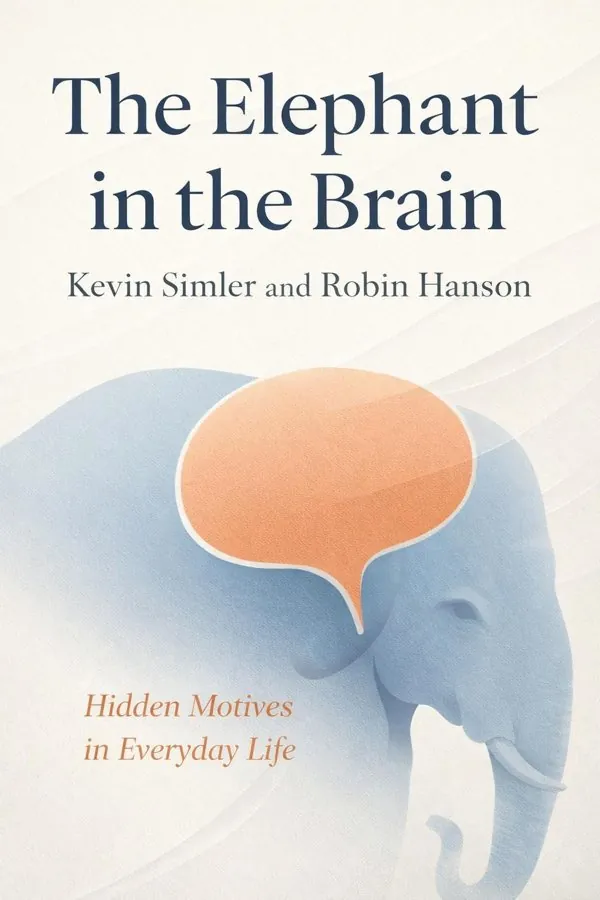
What if your reasons for doing things are not the real reasons at all? In The Elephant in the Brain, Robin Hanson and Kevin Simler argue that much of human behavior is driven by hidden motives we rarely acknowledge, even to ourselves. We say we want to help, learn, vote, date, or work for noble reasons—but beneath the surface, we are often seeking status, alliances, influence, and social approval. The “elephant” is this large, obvious truth about human nature; the “brain” is our capacity to hide it from ourselves.
This book matters because it offers a sharper lens for understanding everyday life. It reframes education, charity, medicine, politics, art, and even conversation as arenas of social signaling rather than purely rational or moral action. That does not make people evil; it makes them strategic, social, and deeply concerned with reputation.
Robin Hanson, an economist and researcher known for his work on social institutions, combines evolutionary thinking, economics, and psychology to challenge comforting stories about why people do what they do. The result is provocative, unsettling, and unusually clarifying.
Who Should Read The Elephant in the Brain?
This book is perfect for anyone interested in psychology and looking to gain actionable insights in a short read. Whether you're a student, professional, or lifelong learner, the key ideas from The Elephant in the Brain by Robin Hanson will help you think differently.
- ✓Readers who enjoy psychology and want practical takeaways
- ✓Professionals looking to apply new ideas to their work and life
- ✓Anyone who wants the core insights of The Elephant in the Brain in just 10 minutes
Want the full summary?
Get instant access to this book summary and 100K+ more with Fizz Moment.
Get Free SummaryAvailable on App Store • Free to download
Key Chapters
The most uncomfortable truths are often the most useful, and this book begins with one: people are not usually transparent to themselves. We like to believe that our actions flow from conscious values and explicit goals, but Hanson argues that much of behavior is guided by hidden motives shaped by evolution and social competition. We do not merely deceive others; we also practice self-deception, because believing our own cover story helps us present it more convincingly.
This idea explains why human behavior can seem both noble and strangely inconsistent. A person may claim to exercise for health while caring intensely about appearance. A company may praise innovation while actually rewarding conformity and political loyalty. A student may say they are in school to learn while focusing mostly on grades, credentials, and the social advantages that education provides. The official reason and the operative reason are often different.
The core insight is not that stated motives are always false, but that they are incomplete. Human beings are social animals, and our survival historically depended on fitting in, forming alliances, and gaining status. As a result, many of our actions serve image management as much as practical outcomes.
In everyday life, this perspective helps explain office politics, social media behavior, philanthropy, networking, and moral grandstanding. It also encourages a more realistic view of institutions. Instead of asking only, “What is this activity supposed to do?” we should also ask, “What social function does it secretly serve?”
Actionable takeaway: when evaluating your own choices, identify both the official motive and the possible hidden motive. That double vision can improve self-awareness and decision-making.
The mind’s cleverest trick may be its ability to hide its own tricks. Hanson builds on an evolutionary idea: if social life rewards successful persuasion, then people who genuinely believe their own flattering stories may be better at convincing others. Self-deception, in this view, is not a flaw added on top of human nature. It is part of the machinery.
This explains why people can be sincerely moralistic while also being deeply strategic. A manager may believe they promoted the “best candidate,” even when subtle in-group bias shaped the choice. A donor may feel purely altruistic while enjoying the reputation boost, prestige, and sense of superiority that public giving provides. A voter may insist they are focused on policy outcomes, while their actual behavior is driven by identity, tribal loyalty, and the desire to signal virtue to their peers.
Self-deception works because introspection is limited. We see our conscious reasoning, but we often do not see the unconscious incentives underneath it. The result is a polished narrative that feels true because it is emotionally coherent, not because it captures the full causal story.
This matters in relationships, leadership, and public life. If people are partly blind to their motives, then trust should not rest only on what they say about themselves. We need to look at incentives, patterns, and outcomes. What behavior is rewarded? What social gains are attached to the action? What would change if the audience disappeared?
Actionable takeaway: test motives by changing the visibility of the action. If you still want to do it when nobody knows, the hidden social motive is probably weaker.
Much of modern life looks more rational when you realize it is also a status tournament. Hanson argues that people constantly compare themselves with others, and many behaviors that appear practical are partly driven by positional competition. We do not just want resources; we want relative standing. We care not only about having enough, but about how we rank.
This helps explain spending patterns, career choices, and lifestyle decisions. Luxury goods are an obvious example, but status signaling goes far beyond expensive watches or cars. It includes elite degrees, niche tastes, wellness routines, productivity habits, moral opinions, and even forms of restraint. A person can signal status through consumption, but also through sophistication, sacrifice, knowledge, or taste.
In workplaces, status shapes meetings, titles, office space, and who gets credit. In friendships, it can shape humor, confidence, and social attention. Online, it is visible in follower counts, curated identities, and public displays of outrage or enlightenment. Even behaviors framed as anti-status often become alternate status games.
The important point is not that status is shallow. In social species, status has long influenced access to mates, allies, safety, and opportunities. It is deeply tied to human motivation. Ignoring that fact leaves us confused about why people work so hard for symbols, prestige, and distinction.
Practically, this insight can help you design better environments. If you want people to behave well, attach status to desirable actions. Organizations can reward mentoring, honesty, and collaboration if those behaviors are made visible and honored. Individuals can also resist wasteful status races by asking whether a pursuit improves life in substance or merely improves ranking.
Actionable takeaway: identify one area where you may be chasing rank instead of real value, and redirect effort toward something that creates lasting benefits.
One of Hanson’s most debated arguments is that education is valued less for the knowledge it imparts and more for the signals it sends. Students and employers publicly talk about learning, skill-building, and intellectual growth. Yet much of the labor market reward attached to schooling may come from what a degree demonstrates: intelligence, conscientiousness, conformity, persistence, and the ability to navigate institutions.
This idea helps explain several puzzles. Why do students forget so much of what they learn while degrees still retain economic value? Why do employers use diplomas as screening tools even when many jobs do not require the specific content taught? Why are students often more motivated by grades and credentials than by mastery? From a signaling perspective, these patterns make sense. School is partly a long audition.
That does not mean education is useless or that learning never matters. It means the social and economic payoff of schooling is often linked to certification and selectivity as much as to knowledge transfer. Elite institutions, for example, may matter because they are hard to enter and complete, making them powerful markers of underlying traits.
For students, this is both sobering and practical. It suggests that educational choices should be evaluated not only by curriculum, but also by incentives, peer group, demonstrated skills, and market perception. For policymakers, it raises hard questions about how much schooling is genuinely productive versus competitively wasteful.
If the signaling model is even partly right, then alternatives such as apprenticeships, skill testing, portfolios, and targeted credentials may deserve more attention.
Actionable takeaway: when investing in education, ask two questions separately: what will I actually learn, and what signal will this send to others?
Few topics feel as morally sensitive as charity, which is why Hanson’s treatment of it is so provocative. He suggests that giving is often driven not just by concern for outcomes, but by the desire to appear compassionate, generous, and morally admirable. In many cases, donors care more about the visible act of helping than about whether the help is effective.
This explains why emotionally vivid causes often attract more support than statistically important ones. A single identifiable victim can draw massive attention while less dramatic but more solvable problems remain neglected. Public charity events, branded wristbands, performative fundraising, and social media activism can all function as virtue signals. The donor receives emotional reward, social approval, and identity reinforcement.
Again, this does not mean people are insincere. They may genuinely care. But when social image enters the picture, effectiveness can become secondary. A person might donate to a prestigious cause that everyone praises rather than to a quieter intervention that saves more lives per dollar. The moral feeling of giving and the practical impact of giving diverge.
This insight is especially important for anyone interested in doing good well. It encourages a shift from expressive charity to outcome-focused charity. Instead of asking, “What kind of person does this donation make me?” ask, “What measurable difference will this create?” Effective altruism, evidence-based philanthropy, and transparent impact evaluation are attempts to narrow that gap.
For organizations, the lesson is to align moral inspiration with rigorous evidence. For individuals, it is to notice when charitable behavior is more about self-presentation than service.
Actionable takeaway: choose one charitable cause this year using evidence of effectiveness rather than emotional resonance or social prestige.
Citizens often say they engage in politics to improve society, but Hanson argues that political behavior frequently serves another purpose: signaling identity, loyalty, and moral positioning within a tribe. Political opinions become badges. Public outrage becomes a performance of belonging. Voting, arguing, and posting can function less as tools for policy optimization and more as rituals of affiliation.
This idea explains why many people hold strong views on complex issues they have studied only superficially. It also explains why political discussion is so emotionally charged and so resistant to evidence. If a belief is tied to group membership, changing that belief can feel like betrayal. In that environment, facts are filtered through the social costs of agreement and dissent.
The book’s argument is not that politics never matters. It is that ordinary political participation often has weak instrumental impact for the individual but strong expressive value. A single vote rarely changes an election, yet voting remains psychologically meaningful because it signals responsibility and solidarity. Likewise, sharing opinions online often changes little materially but powerfully communicates allegiance.
This perspective can reduce naivety and cynicism at once. It helps us understand why political institutions often underperform idealistic expectations, while also showing why politics remains irresistible. People are not just trying to solve coordination problems; they are also seeking moral identity and group cohesion.
Practically, this suggests that better public discourse requires structures that reward humility, nuance, and cross-group cooperation. At the personal level, it encourages us to distinguish between expressive participation and informed civic contribution.
Actionable takeaway: before making a political statement, ask whether you are trying to solve a problem, learn something, or mainly signal membership in a side.
All Chapters in The Elephant in the Brain
About the Author
Robin Hanson is an American economist, professor, and researcher known for exploring how incentives and hidden motives shape human behavior. He teaches at George Mason University and has worked on topics including prediction markets, institutional design, health economics, and social theory. Hanson is especially recognized for examining the gap between what people say they value and what their actions reveal they actually pursue. His writing combines economics, evolutionary thinking, and behavioral insight to challenge conventional explanations of everyday life. In The Elephant in the Brain, co-authored with Kevin Simler, he applies this approach to education, politics, charity, medicine, and social interaction, offering a provocative account of self-deception and signaling in human affairs.
Get This Summary in Your Preferred Format
Read or listen to the The Elephant in the Brain summary by Robin Hanson anytime, anywhere. FizzRead offers multiple formats so you can learn on your terms — all free.
Available formats: App · Audio · PDF · EPUB — All included free with FizzRead
Download The Elephant in the Brain PDF and EPUB Summary
Key Quotes from The Elephant in the Brain
“The most uncomfortable truths are often the most useful, and this book begins with one: people are not usually transparent to themselves.”
“The mind’s cleverest trick may be its ability to hide its own tricks.”
“Much of modern life looks more rational when you realize it is also a status tournament.”
“People talk to exchange information, but that is only part of the story.”
“One of Hanson’s most debated arguments is that education is valued less for the knowledge it imparts and more for the signals it sends.”
Frequently Asked Questions about The Elephant in the Brain
The Elephant in the Brain by Robin Hanson is a psychology book that explores key ideas across 9 chapters. What if your reasons for doing things are not the real reasons at all? In The Elephant in the Brain, Robin Hanson and Kevin Simler argue that much of human behavior is driven by hidden motives we rarely acknowledge, even to ourselves. We say we want to help, learn, vote, date, or work for noble reasons—but beneath the surface, we are often seeking status, alliances, influence, and social approval. The “elephant” is this large, obvious truth about human nature; the “brain” is our capacity to hide it from ourselves. This book matters because it offers a sharper lens for understanding everyday life. It reframes education, charity, medicine, politics, art, and even conversation as arenas of social signaling rather than purely rational or moral action. That does not make people evil; it makes them strategic, social, and deeply concerned with reputation. Robin Hanson, an economist and researcher known for his work on social institutions, combines evolutionary thinking, economics, and psychology to challenge comforting stories about why people do what they do. The result is provocative, unsettling, and unusually clarifying.
More by Robin Hanson
You Might Also Like

The Body Keeps the Score
Bessel van der Kolk
10 min
Surrounded by Idiots
Thomas Erikson
10 min
Emotional Intelligence
Daniel Goleman
10 min
Attached
Amir Levine
10 min
Why Does He Do That
Lundy Bancroft
10 min
Women Who Run with the Wolves
Clarissa Pinkola Estés
10 minBrowse by Category
Ready to read The Elephant in the Brain?
Get the full summary and 100K+ more books with Fizz Moment.