
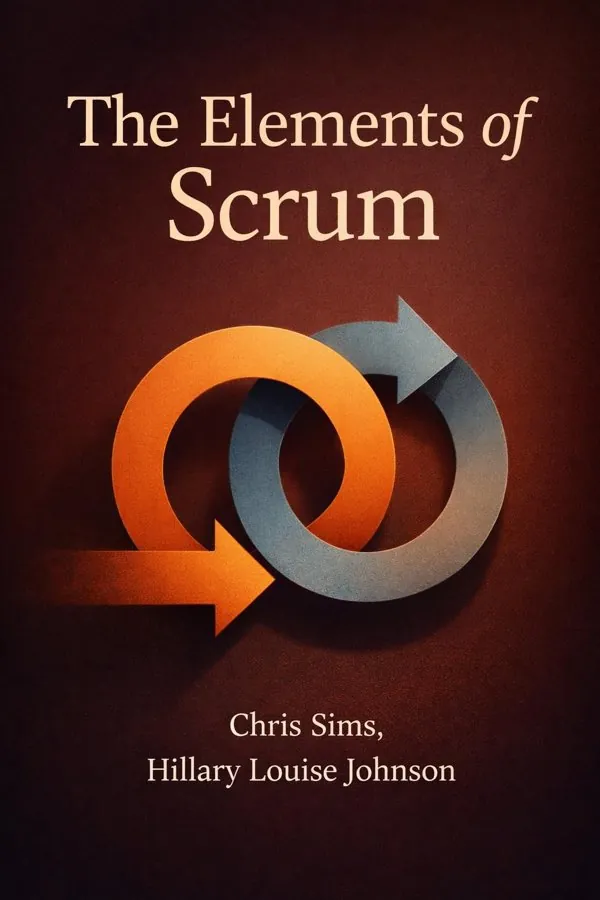
The Elements of Scrum: Summary & Key Insights
by Chris Sims, Hillary Louise Johnson
 10 min5 chaptersAudio available
What Is The Elements of Scrum About?
The Elements of Scrum by Chris Sims, Hillary Louise Johnson is a productivity book spanning 5 pages. The Elements of Scrum is a concise and practical guide to the Scrum framework, explaining its core principles, roles, and processes. It provides clear examples and real-world insights to help teams adopt agile practices effectively and deliver high-quality software through iterative development and collaboration.
This FizzRead summary covers all 5 key chapters of The Elements of Scrum in approximately 10 minutes, distilling the most important ideas, arguments, and takeaways from Chris Sims, Hillary Louise Johnson's work. Also available as an audio summary and Key Quotes Podcast.
The Elements of Scrum
The Elements of Scrum is a concise and practical guide to the Scrum framework, explaining its core principles, roles, and processes. It provides clear examples and real-world insights to help teams adopt agile practices effectively and deliver high-quality software through iterative development and collaboration.
Who Should Read The Elements of Scrum?
This book is perfect for anyone interested in productivity and looking to gain actionable insights in a short read. Whether you're a student, professional, or lifelong learner, the key ideas from The Elements of Scrum by Chris Sims, Hillary Louise Johnson will help you think differently.
- ✓Readers who enjoy productivity and want practical takeaways
- ✓Professionals looking to apply new ideas to their work and life
- ✓Anyone who wants the core insights of The Elements of Scrum in just 10 minutes
Want the full summary?
Get instant access to this book summary and 100K+ more with Fizz Moment.
Get Free SummaryAvailable on App Store • Free to download
Key Chapters
Before we can understand Scrum, we need to understand the movement that gave it life: Agile. In the early 2000s, a group of experienced software practitioners gathered in Snowbird, Utah, to craft the Agile Manifesto. They had grown weary of projects bloated with documentation and paralyzed by rigid planning. What they saw missing was agility — the ability to respond to change and deliver value continuously. They articulated four core values: individuals and interactions over processes and tools, working software over comprehensive documentation, customer collaboration over contract negotiation, and responding to change over following a plan.
Scrum grew directly from these principles. Ken Schwaber and Jeff Sutherland, two early pioneers, recognized that the traditional project management models were ill-suited to the unpredictable nature of complex work. The linear by-the-book methods assumed that requirements were known upfront, yet in software or any creative endeavor, requirements evolve. Thus, they drew inspiration from lean manufacturing and empirical process control to create Scrum — a lightweight, adaptive framework that trusts teams to inspect, learn, and adjust iteratively.
When I teach Scrum, I remind people that it’s closer to science than to administration. It is a system built on hypotheses and feedback. You don’t predict success by elaborate schedules; you *experiment* toward it through short, transparent cycles called sprints. In every sprint, progress is inspected, and adaptation follows naturally. That’s how agility becomes sustainable: not as chaos, but as disciplined learning.
Scrum defines three key roles: Product Owner, ScrumMaster, and Development Team. Simplicity is intentional. Each role carries clear responsibilities to prevent ambiguity and ensure accountability.
The Product Owner is responsible for maximizing the value of the product. They don’t dictate every detail but curate the vision, deciding what should be built and in what order. The Product Backlog is their tool — an evolving list of priorities shaped by customer feedback, business goals, and insights from the team. A good Product Owner listens more than they speak. They connect strategy to daily work by constantly asking, “What outcome matters most right now?”
The ScrumMaster is often misunderstood as a project manager. They are not. Their mission is to serve the team, protect Scrum’s integrity, and remove impediments. They ensure that collaboration thrives, that meetings have purpose, and that people improve their own system over time. A great ScrumMaster balances empathy with persistence. They guide with questions, not orders.
Then we have the Development Team — the engine of Scrum. These are the people who do the work of turning ideas into tangible increments. They are cross-functional, self-organizing, and collectively responsible for outcomes. No one assigns tasks; the team decides how to accomplish the sprint goal. The respect given to autonomy is not naïve — it’s built on trust, skill, and transparency. When everyone owns everything, the sense of shared accountability strengthens. As a coach, I’ve seen teams transform once they stop waiting for permission to succeed.
+ 3 more chapters — available in the FizzRead app
All Chapters in The Elements of Scrum
About the Authors
Chris Sims is an agile coach and founder of Agile Learning Labs, specializing in Scrum and agile training. Hillary Louise Johnson is a writer and editor with experience in technology and business topics, collaborating with Sims to make agile concepts accessible to a broad audience.
Get This Summary in Your Preferred Format
Read or listen to the The Elements of Scrum summary by Chris Sims, Hillary Louise Johnson anytime, anywhere. FizzRead offers multiple formats so you can learn on your terms — all free.
Available formats: App · Audio · PDF · EPUB — All included free with FizzRead
Download The Elements of Scrum PDF and EPUB Summary
Key Quotes from The Elements of Scrum
“Before we can understand Scrum, we need to understand the movement that gave it life: Agile.”
“Scrum defines three key roles: Product Owner, ScrumMaster, and Development Team.”
Frequently Asked Questions about The Elements of Scrum
The Elements of Scrum by Chris Sims, Hillary Louise Johnson is a productivity book that explores key ideas across 5 chapters. The Elements of Scrum is a concise and practical guide to the Scrum framework, explaining its core principles, roles, and processes. It provides clear examples and real-world insights to help teams adopt agile practices effectively and deliver high-quality software through iterative development and collaboration.
You Might Also Like


Browse by Category
Ready to read The Elements of Scrum?
Get the full summary and 100K+ more books with Fizz Moment.