
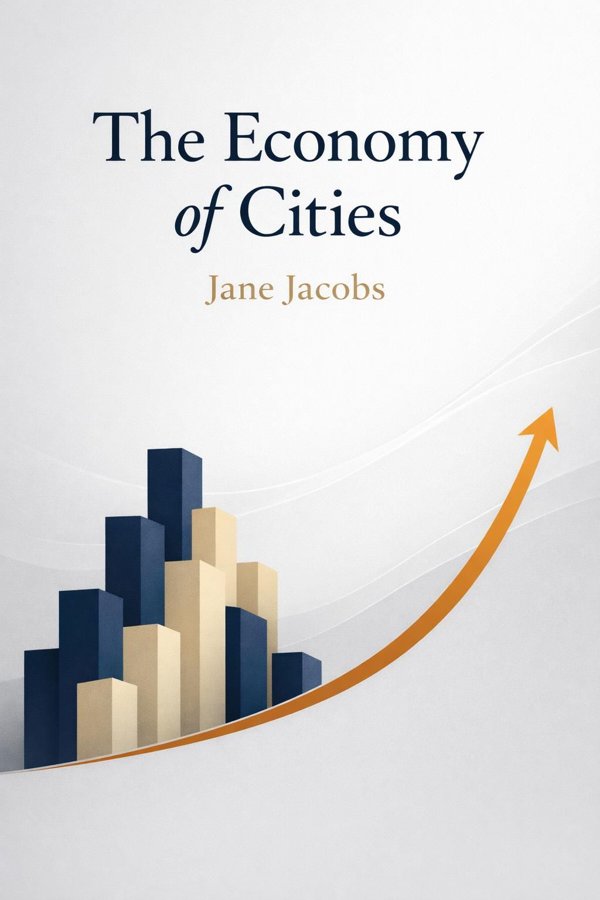
The Economy of Cities: Summary & Key Insights
by Jane Jacobs
 10 min10 chaptersAudio available
Key Takeaways from The Economy of Cities
The most important economic question is not how to produce more of the same, but how a society begins doing something genuinely new.
It is tempting to imagine that rural production comes first and cities merely organize the surplus.
A city becomes economically stronger when it stops merely buying from elsewhere and begins making for itself.
Food may seem like the obvious foundation of economic life, but Jacobs insists that agriculture itself often advances in response to urban forces.
An economy built on one dominant activity may look efficient, but it is often fragile.
What Is The Economy of Cities About?
The Economy of Cities by Jane Jacobs is a economics book spanning 10 pages. What if economic growth does not begin in farms, natural resources, or national plans, but in the messy, crowded, inventive life of cities? In The Economy of Cities, Jane Jacobs makes exactly that case. She argues that cities are the true engines of development because they constantly generate “new work”: new products, new skills, new businesses, and new ways of solving problems. Instead of treating cities as secondary outcomes of economic growth, Jacobs places them at the center of it. This idea matters because it overturns conventional economic thinking. Rather than seeing progress as something delivered by large industries, governments, or rural production, Jacobs shows how innovation emerges from dense networks of trade, imitation, experimentation, and local adaptation. Her examples stretch across history and geography, revealing patterns that standard economic models often miss. Jacobs writes with the authority of a sharp urban observer rather than a conventional academic economist. That is precisely what makes the book powerful. She notices how economies actually evolve on the ground. The result is a bold, provocative work that reshapes how we think about cities, prosperity, and the origins of economic life itself.
This FizzRead summary covers all 10 key chapters of The Economy of Cities in approximately 10 minutes, distilling the most important ideas, arguments, and takeaways from Jane Jacobs's work. Also available as an audio summary and Key Quotes Podcast.
The Economy of Cities
What if economic growth does not begin in farms, natural resources, or national plans, but in the messy, crowded, inventive life of cities? In The Economy of Cities, Jane Jacobs makes exactly that case. She argues that cities are the true engines of development because they constantly generate “new work”: new products, new skills, new businesses, and new ways of solving problems. Instead of treating cities as secondary outcomes of economic growth, Jacobs places them at the center of it.
This idea matters because it overturns conventional economic thinking. Rather than seeing progress as something delivered by large industries, governments, or rural production, Jacobs shows how innovation emerges from dense networks of trade, imitation, experimentation, and local adaptation. Her examples stretch across history and geography, revealing patterns that standard economic models often miss.
Jacobs writes with the authority of a sharp urban observer rather than a conventional academic economist. That is precisely what makes the book powerful. She notices how economies actually evolve on the ground. The result is a bold, provocative work that reshapes how we think about cities, prosperity, and the origins of economic life itself.
Who Should Read The Economy of Cities?
This book is perfect for anyone interested in economics and looking to gain actionable insights in a short read. Whether you're a student, professional, or lifelong learner, the key ideas from The Economy of Cities by Jane Jacobs will help you think differently.
- ✓Readers who enjoy economics and want practical takeaways
- ✓Professionals looking to apply new ideas to their work and life
- ✓Anyone who wants the core insights of The Economy of Cities in just 10 minutes
Want the full summary?
Get instant access to this book summary and 100K+ more with Fizz Moment.
Get Free SummaryAvailable on App Store • Free to download
Key Chapters
The most important economic question is not how to produce more of the same, but how a society begins doing something genuinely new. Jane Jacobs argues that economic development is best understood as the continual creation of “new work.” A place develops when it learns to make goods or services it previously had to import, then builds further innovations on top of that new capability.
This shifts the focus of economics away from static measures like output, land, or even accumulated capital alone. A city grows not simply because it has resources, but because people within it combine ideas, tools, and needs in novel ways. A merchant notices that imported fabric could be dyed locally. A repair shop starts producing replacement parts. A food market inspires packaging, storage, and transport services. One new activity sparks another.
Jacobs emphasizes that this process is cumulative. New work creates skills, suppliers, customers, and know-how that make additional new work easier. Development is therefore organic and evolutionary, not something that can be fully engineered from above. It emerges through trial, error, copying, adaptation, and opportunism.
You can see this today in startup ecosystems, maker communities, and even neighborhood business districts. A local coffee roaster leads to custom equipment repair, branding services, logistics support, and specialty food ventures. The economic value is not just in one product, but in the web of capabilities that forms around it.
The practical lesson is simple: if you want to judge whether a place is developing, look for evidence of new work being born locally. Track what it used to import and what it now creates itself. Support environments where experimentation is easy, small enterprises can emerge, and skills can circulate. Economic health begins with a city’s ability to keep inventing what comes next.
It is tempting to imagine that rural production comes first and cities merely organize the surplus. Jacobs challenges that story. She argues that throughout history, cities have often been the prime movers of economic change, with rural transformation following urban demand, innovation, and exchange.
Her historical perspective is radical because it reverses a familiar sequence. Standard accounts often say agriculture created stable settlements, which later became cities. Jacobs suggests instead that early trade centers and proto-urban concentrations may have stimulated the intensification of agriculture. In other words, the presence of a city-like market for goods, exchange, specialization, and experimentation can encourage farming improvements rather than simply result from them.
This argument matters because it changes how we understand the origins of prosperity. Cities are not passive containers of wealth generated elsewhere. They are active systems that coordinate exchange, spread knowledge, and make specialization worthwhile. Once people gather in dense, diverse networks, they begin solving more problems, noticing more opportunities, and creating more kinds of work than scattered settlements usually can.
Historical city centers such as ancient trading hubs, port cities, and manufacturing towns illustrate this pattern. They did not only distribute rural output; they transformed production itself. Their markets encouraged better storage, transportation, tools, finance, and eventually agricultural improvements in surrounding regions.
In modern terms, think of how urban demand drives food innovation, logistics systems, fintech, education, and design. Rural and regional economies often become more productive because cities create markets and techniques that make new production worthwhile.
The actionable takeaway is to stop treating cities as economic afterthoughts. When evaluating regional or national growth, ask how urban centers are shaping surrounding production, knowledge, and demand. Strong cities do not drain prosperity from the countryside; properly functioning, they often help generate it.
A city becomes economically stronger when it stops merely buying from elsewhere and begins making for itself. Jacobs calls this process import replacement, and she treats it as one of the central mechanisms of development. A city first depends on outside suppliers. Then local entrepreneurs, workers, and firms learn to produce some of those same goods or services nearby. That shift creates skills, industries, and confidence that can lead to further innovation.
Import replacement is not just about copying. It often starts with imitation, but it rarely ends there. Once local producers understand how something works, they adapt it to local needs, improve it, lower costs, combine it with other activities, or create related products. What begins as substitution can become invention.
Consider a city importing furniture. A local workshop starts repairing pieces, then making simple versions, then sourcing wood more efficiently, then designing its own lines, then exporting to other places. Or imagine a city importing software tools. Local developers begin customizing them for local businesses, then launch entirely new products suited to regional markets. In both cases, dependence turns into capability.
Jacobs also shows why cities are especially good at this. They have concentrated demand, varied skills, and many opportunities for cross-pollination. Producers can observe what is being imported, identify gaps, and experiment with alternatives because customers and collaborators are close by.
This idea has practical implications for business leaders and policymakers. Instead of chasing only large external investment, a city can examine its import profile and ask: what do we buy that we could begin producing locally? Which sectors already have partial capabilities? Where could small firms gain traction?
The key takeaway is to treat imports as clues. They reveal unmet opportunities for local learning, production, and innovation. Economic development often starts not with grand plans, but with noticing what arrives from elsewhere and asking, “Why not make it here?”
Food may seem like the obvious foundation of economic life, but Jacobs insists that agriculture itself often advances in response to urban forces. This is one of her most surprising claims. Rather than seeing cities as downstream beneficiaries of farming surplus, she argues that urban markets, specialization, and experimentation can stimulate agricultural change.
Why would that happen? Cities create concentrated demand. They encourage regular exchange, storage systems, transport improvements, and the need for more reliable and varied supplies. Once a city forms, nearby producers face incentives to increase output, diversify crops, improve techniques, and coordinate distribution. Urban consumers do not just need grain; they need meat, vegetables, preserved foods, fibers, and countless processed goods. That demand encourages innovation in the countryside.
Agriculture, in this view, is not a timeless base but part of a larger economic network shaped by urban life. Farmers respond to market signals, available tools, transport links, and opportunities for specialization, many of which are strengthened by cities. The city is where tools are improved, financing emerges, merchants coordinate exchange, and new tastes spread.
You can still see this pattern today. Metropolitan food systems drive greenhouse farming, cold-chain logistics, specialty agriculture, organic production, and direct-to-consumer models. Urban restaurants and retailers often create demand that transforms regional farming practices. Even agricultural technology startups frequently emerge from cities, where engineers, investors, and markets are concentrated.
Jacobs’s point is not that farming is unimportant. It is that agriculture and cities evolve together, and often the city is the more dynamic source of change. That matters for development policy because it warns against separating rural productivity from urban vitality.
The practical takeaway is to view agriculture as part of an urban-regional system. If you want stronger farming, strengthen the cities that generate demand, infrastructure, experimentation, and market depth. Productive countryside and innovative cities are partners, not rivals.
An economy built on one dominant activity may look efficient, but it is often fragile. Jacobs argues that diversity is one of the great strengths of cities because varied economic activities create adaptability, cross-fertilization, and resilience. A city with many kinds of enterprises can absorb shocks better and generate more new work than a city dependent on a single industry.
Diversity matters for several reasons. First, it spreads risk. If one sector declines, others may still provide jobs, demand, and investment. Second, it creates opportunities for industries to learn from one another. Techniques developed in manufacturing may help healthcare. Logistics expertise may improve retail. Digital tools may transform education. Third, diverse cities create a wider range of entry points for entrepreneurs, workers, and small firms.
Jacobs sees this diversity not as random variety but as a living system of interdependence. Small suppliers serve multiple industries. Skilled workers move between fields. Customers create overlapping demand. New firms emerge by borrowing ideas from existing ones. This dense mixture gives cities their generative power.
Modern examples are easy to find. Compare a city reliant almost entirely on oil, tourism, or one giant employer with a city that combines universities, healthcare, food production, design, tech, logistics, and local manufacturing. The latter is usually better positioned to adapt when markets shift.
This has implications beyond cities themselves. Organizations can apply the same principle. A business with one customer segment, one product line, or one revenue model is vulnerable. Teams with varied skills often solve problems more creatively than narrowly specialized groups.
The actionable takeaway is to value variety as productive infrastructure. Whether you are planning a city, building a business ecosystem, or shaping your own career, avoid overdependence on one engine. Encourage multiple sectors, mixed uses, and overlapping capabilities. Diversity is not economic clutter; it is the basis of endurance and renewal.
Trade is often described as a way to move existing goods more efficiently. Jacobs asks us to see something deeper: trade expands what an economy is capable of becoming. Cities engaged in trade do not merely exchange surplus. They encounter new materials, methods, tastes, demands, and competitive pressures that provoke further innovation.
In Jacobs’s framework, trade and development reinforce each other. A city imports goods it cannot yet produce. Exposure to those imports reveals techniques and standards. Local firms begin repairing, modifying, or reproducing them. Over time, import replacement generates new local capabilities, which then feed back into trade as the city exports more complex products or services. Trade is therefore not the end point of specialization; it is part of a developmental cycle.
This helps explain why cities connected to wider networks often become more inventive. Ports, market towns, and commercial crossroads tend to accumulate not only merchandise but knowledge. People compare prices, designs, packaging, tools, and organizational methods. Exposure broadens ambition.
A present-day example is a city deeply integrated into global supply chains. At first it may assemble imported components. Later it develops local suppliers, quality-control services, software, financing, and branding. Eventually it may create original products. International trade, in this sense, becomes a classroom for local economic learning.
Jacobs’s insight also warns against simplistic localism. Producing locally matters, but total isolation would reduce the very stimuli that generate new work. The healthiest cities combine openness with the ability to internalize and build upon what they import.
The practical takeaway is to treat trade relationships as developmental opportunities. Ask not only what your city or business can sell, but what it can learn, adapt, and eventually make better. Trade is most valuable when it enlarges capability, not merely volume.
Cities do not decline only because they lose money, resources, or population. According to Jacobs, they decline when they stop generating new work. Stagnation sets in when an economy becomes too rigid, too specialized, too dependent, or too complacent to replace imports, diversify activities, and adapt to changing circumstances.
This view is powerful because it frames decline as a developmental failure rather than a simple downturn. A city can appear prosperous for a time while underlying capabilities erode. If major industries age without spawning related new sectors, if local firms stop experimenting, or if decision-makers rely on old successes, the economy gradually loses its regenerative power.
Jacobs shows that healthy economies constantly renew themselves from within. When they fail to do so, they become vulnerable to external shocks, shifting trade patterns, technological change, or political disruptions. The danger is greatest in places organized around one dominant export, one large employer, or one inherited advantage. Once that pillar weakens, there may be little else to sustain momentum.
You can see this in former manufacturing centers that failed to cultivate new industries, or in resource-rich regions that enjoyed booms without building broader capabilities. The lesson also applies at smaller scales. A company that relies too long on a single successful product may appear strong until the market changes. A professional who stops learning may face the same problem.
Jacobs does not present decline as inevitable. Renewal is possible if a city restores the conditions that allow experimentation, local enterprise, and diverse production to emerge again.
The actionable takeaway is to watch for early signs of stagnation: shrinking business variety, dependence on legacy sectors, weak local supply chains, and declining entrepreneurial activity. Prosperity lasts only when a place keeps creating the next layer of work before the previous one fades.
Innovation rarely appears out of nowhere. It grows out of a dense web of suppliers, skills, services, customers, and informal knowledge-sharing. Jacobs’s broader argument implies that cities succeed not because they host isolated stars, but because they build ecosystems in which many small and medium activities support one another.
This is why urban density matters economically. In a city, a manufacturer can find repair services, toolmakers, designers, accountants, transport providers, marketers, and trained workers nearby. A restaurant relies on food distributors, equipment maintenance, cleaners, graphic designers, delivery networks, and neighboring foot traffic. A startup may begin with little capital, but if the surrounding city offers legal help, freelance talent, investors, pilot customers, and shared infrastructure, its odds improve dramatically.
These capability webs also explain why copying a successful industry cluster is hard. You cannot create the effect simply by constructing office parks or attracting one big employer. What matters is the underlying texture of many interdependent functions. Jacobs values mixed-use urban life for similar reasons: variety creates contact, and contact creates possibility.
For policymakers, this means economic development should focus less on isolated megaprojects and more on the everyday conditions that let local networks thicken. Affordable commercial spaces, transport links, vocational training, flexible zoning, and support for small firms often matter more than flashy prestige investments.
For individuals, the same principle applies to careers. Being located in a rich network of collaborators, clients, and adjacent skills can matter as much as raw talent.
The practical takeaway is to strengthen the connective tissue of an economy. Ask what suppliers, services, spaces, and institutions help local ideas turn into sustained activity. Great cities are not just collections of firms; they are systems of capability where one enterprise makes many others possible.
When nations become wealthier, we often credit national policy, exports, or industrial strategy. Jacobs redirects attention to cities. She argues that the real drivers of prosperity are urban economies that continuously create new work, deepen capability, and reshape surrounding regions. National growth, in many cases, is the aggregated result of what successful cities are doing.
This is especially important for developing countries. Governments often attempt to modernize through centralized plans, prestige infrastructure, or large-scale industrial projects while neglecting the organic economic life of cities. Jacobs suggests this misses the real source of development. Without cities that can generate import replacement, support varied enterprise, and accumulate practical know-how, national plans may remain brittle or dependent.
Urbanization by itself is not enough. Simply moving people into cities does not guarantee development. The key is whether those cities function as creative economic systems rather than administrative centers or labor reservoirs. A city that merely consumes imported goods without building local capabilities will struggle. A city that nurtures local production, exchange, and adaptation becomes a development engine.
This insight helps explain why some countries with major urban populations still experience weak broad-based growth, while others with dynamic city networks flourish. The issue is not city size alone but urban economic vitality.
Today, this remains highly relevant. Policymakers discussing industrial policy, climate transition, migration, or regional inequality need to understand how urban systems generate innovation and resilience. Supporting cities is not a narrow urban issue; it is central to national development.
The actionable takeaway is to evaluate economic policy through an urban lens. Ask whether laws, infrastructure, finance, and education are helping cities become places where new work can emerge. If cities stagnate, national prosperity will likely stagnate with them.
One of Jacobs’s most enduring lessons is that economic development cannot be manufactured through rigid top-down formulas. Because new work arises from countless local interactions, policies should create fertile conditions rather than attempt to script outcomes in detail. Governments matter, but their role is often to enable urban vitality, not replace it.
This means supporting the basics that let cities experiment: infrastructure that connects people and goods, regulatory systems that do not suffocate small enterprise, education that builds adaptable skills, and public environments where mixed economic activity can thrive. It also means avoiding policies that overconcentrate resources in a few favored sectors or megaprojects while neglecting the broader ecosystem.
Jacobs is skeptical of development strategies that assume experts can identify and engineer growth from above without understanding local complexity. A subsidized industrial zone may fail if it lacks nearby suppliers, services, workers, and customers. By contrast, modest support for existing clusters, neighborhood commerce, light manufacturing, logistics, and local entrepreneurship can produce compounding effects.
This perspective remains highly practical. City leaders can analyze what local firms already do, where import replacement opportunities exist, and which regulatory barriers prevent expansion. They can encourage mixed-use districts, affordable workspace, transportation access, and procurement systems that give smaller local firms a chance to grow.
For organizations, the parallel is clear: innovation cultures emerge when leaders create room for initiative, collaboration, and feedback rather than controlling every step.
The takeaway is to design policy around emergence. Instead of asking, “What industry should we impose?” ask, “What conditions help many forms of new work appear?” The best economic policy often looks less like command and more like cultivation.
All Chapters in The Economy of Cities
About the Author
Jane Jacobs (1916–2006) was an American-born writer, urban theorist, and activist who later became a Canadian citizen. She is widely regarded as one of the most influential thinkers on cities in the twentieth century. Jacobs rose to prominence with The Death and Life of Great American Cities, a landmark critique of top-down urban planning and a defense of lively, mixed-use neighborhoods. Though not formally trained as an economist or planner, she brought exceptional observational skill and intellectual independence to questions of urban life, economic development, and social organization. In The Economy of Cities, she extended her insights into economics, arguing that cities are the primary engines of innovation and growth. Her work continues to shape debates in planning, development, and public policy around the world.
Get This Summary in Your Preferred Format
Read or listen to the The Economy of Cities summary by Jane Jacobs anytime, anywhere. FizzRead offers multiple formats so you can learn on your terms — all free.
Available formats: App · Audio · PDF · EPUB — All included free with FizzRead
Download The Economy of Cities PDF and EPUB Summary
Key Quotes from The Economy of Cities
“The most important economic question is not how to produce more of the same, but how a society begins doing something genuinely new.”
“It is tempting to imagine that rural production comes first and cities merely organize the surplus.”
“A city becomes economically stronger when it stops merely buying from elsewhere and begins making for itself.”
“Food may seem like the obvious foundation of economic life, but Jacobs insists that agriculture itself often advances in response to urban forces.”
“An economy built on one dominant activity may look efficient, but it is often fragile.”
Frequently Asked Questions about The Economy of Cities
The Economy of Cities by Jane Jacobs is a economics book that explores key ideas across 10 chapters. What if economic growth does not begin in farms, natural resources, or national plans, but in the messy, crowded, inventive life of cities? In The Economy of Cities, Jane Jacobs makes exactly that case. She argues that cities are the true engines of development because they constantly generate “new work”: new products, new skills, new businesses, and new ways of solving problems. Instead of treating cities as secondary outcomes of economic growth, Jacobs places them at the center of it. This idea matters because it overturns conventional economic thinking. Rather than seeing progress as something delivered by large industries, governments, or rural production, Jacobs shows how innovation emerges from dense networks of trade, imitation, experimentation, and local adaptation. Her examples stretch across history and geography, revealing patterns that standard economic models often miss. Jacobs writes with the authority of a sharp urban observer rather than a conventional academic economist. That is precisely what makes the book powerful. She notices how economies actually evolve on the ground. The result is a bold, provocative work that reshapes how we think about cities, prosperity, and the origins of economic life itself.
More by Jane Jacobs
You Might Also Like

Business Adventures
John Brooks
10 min
Nudge
Richard H. Thaler, Cass R. Sunstein
10 min
The Hitchhiker"s Guide to the Galaxy
Douglas Adams
10 minThe Muqaddimah
Ibn Khaldun
10 minThe Outsiders
William N. Thorndike
10 min
A Little History of Economics
Niall Kishtainy
10 minBrowse by Category
Ready to read The Economy of Cities?
Get the full summary and 100K+ more books with Fizz Moment.