
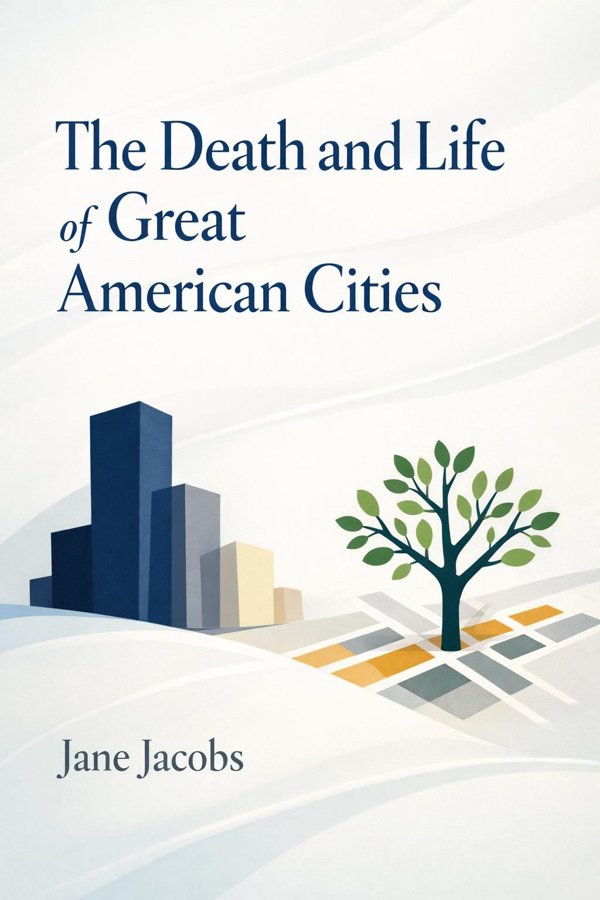
The Death and Life of Great American Cities: Summary & Key Insights
by Jane Jacobs
 10 min9 chaptersAudio available
Key Takeaways from The Death and Life of Great American Cities
A city street feels safest not when it is heavily controlled, but when it is continuously watched by ordinary people going about ordinary life.
Strong communities are not built only through deep friendships; they are often built through countless small encounters.
A park is not successful simply because it exists.
Jacobs argues that lively city districts depend on a specific combination of conditions that generate diversity in people, activities, and economic life.
The deepest mistake in modern planning, Jacobs argues, is treating cities as if they were simple problems.
What Is The Death and Life of Great American Cities About?
The Death and Life of Great American Cities by Jane Jacobs is a urban_studies book spanning 4 pages. Jane Jacobs’ The Death and Life of Great American Cities is one of the most influential books ever written about how cities really work. First published in 1961, it challenged the dominant urban planning ideas of its time: superblocks, strict zoning, highway expansion, and large-scale “urban renewal” projects that often destroyed the very neighborhoods they claimed to improve. Instead of treating the city as a machine to be redesigned from above, Jacobs looked closely at ordinary streets, storefronts, parks, and sidewalks to understand why some places feel safe, lively, and resilient while others become empty, unsafe, or lifeless. What makes the book endure is Jacobs’ method as much as her message. She writes not as an abstract theorist but as a sharp observer of everyday urban life, drawing on neighborhoods in New York and other North American cities. Her authority comes from seeing what planners often ignored: that successful city districts depend on density, mixed uses, short blocks, old and new buildings, and constant human presence. This book matters because its core insight still shapes debates about housing, walkability, public space, and community power. It remains essential reading for anyone who wants to understand why vibrant cities cannot be engineered through simplicity alone.
This FizzRead summary covers all 9 key chapters of The Death and Life of Great American Cities in approximately 10 minutes, distilling the most important ideas, arguments, and takeaways from Jane Jacobs's work. Also available as an audio summary and Key Quotes Podcast.
The Death and Life of Great American Cities
Jane Jacobs’ The Death and Life of Great American Cities is one of the most influential books ever written about how cities really work. First published in 1961, it challenged the dominant urban planning ideas of its time: superblocks, strict zoning, highway expansion, and large-scale “urban renewal” projects that often destroyed the very neighborhoods they claimed to improve. Instead of treating the city as a machine to be redesigned from above, Jacobs looked closely at ordinary streets, storefronts, parks, and sidewalks to understand why some places feel safe, lively, and resilient while others become empty, unsafe, or lifeless.
What makes the book endure is Jacobs’ method as much as her message. She writes not as an abstract theorist but as a sharp observer of everyday urban life, drawing on neighborhoods in New York and other North American cities. Her authority comes from seeing what planners often ignored: that successful city districts depend on density, mixed uses, short blocks, old and new buildings, and constant human presence. This book matters because its core insight still shapes debates about housing, walkability, public space, and community power. It remains essential reading for anyone who wants to understand why vibrant cities cannot be engineered through simplicity alone.
Who Should Read The Death and Life of Great American Cities?
This book is perfect for anyone interested in urban_studies and looking to gain actionable insights in a short read. Whether you're a student, professional, or lifelong learner, the key ideas from The Death and Life of Great American Cities by Jane Jacobs will help you think differently.
- ✓Readers who enjoy urban_studies and want practical takeaways
- ✓Professionals looking to apply new ideas to their work and life
- ✓Anyone who wants the core insights of The Death and Life of Great American Cities in just 10 minutes
Want the full summary?
Get instant access to this book summary and 100K+ more with Fizz Moment.
Get Free SummaryAvailable on App Store • Free to download
Key Chapters
A city street feels safest not when it is heavily controlled, but when it is continuously watched by ordinary people going about ordinary life. Jane Jacobs’ famous insight is that safety emerges from “eyes on the street”: shopkeepers, residents, passersby, delivery workers, and customers all creating a natural system of observation. This is not surveillance in a formal sense. It is a social condition produced when public space is active, visible, and well used throughout the day and evening.
Jacobs argues that many planners misunderstood urban safety. They focused on separation, emptiness, and order from above, believing that wide setbacks, isolated housing towers, or single-purpose districts would reduce danger. But deserted spaces often become more threatening precisely because no one is there to notice what is happening. A safe street usually has clear public-private boundaries, doors and windows facing the sidewalk, and a steady stream of legitimate users.
Think of a neighborhood shopping street with apartments above stores. In the morning, parents walk children to school. At lunch, workers buy food. In the evening, residents stop at a café or pharmacy. Because people have reasons to be there at different times, the street remains informally supervised. By contrast, a business district that empties after 6 p.m. may feel far less secure, even if it is wealthier and newer.
This idea has practical implications for planners, business owners, and residents. Safety can be strengthened by preserving storefronts, encouraging active ground floors, improving walkability, and supporting mixed-use development rather than isolating functions. The takeaway: if you want safer neighborhoods, design places where people naturally and regularly appear, watch, and participate in public life.
Strong communities are not built only through deep friendships; they are often built through countless small encounters. Jacobs emphasizes that sidewalks create a network of casual public contact that helps strangers live together with trust and familiarity. These brief interactions—nodding to a neighbor, greeting the grocer, making small talk outside a building—may seem trivial, but they form the social glue of urban life.
This kind of contact matters because cities are places of proximity without intimacy. Most residents do not want everyone around them to become close friends, nor is that realistic. What they do need is a dependable public culture: people who recognize one another, exchange minor courtesies, and develop a sense of shared stewardship. These weak ties help residents ask for help, share information, notice changes, and respond when something seems wrong.
A busy sidewalk in front of a bakery illustrates this perfectly. Someone hears about a local meeting from a neighbor in line. A parent learns which after-school program is reliable from another parent on the corner. An elderly resident becomes known to nearby shopkeepers, who notice if she has not appeared in several days. None of these relationships are dramatic, but together they create resilience.
Jacobs contrasts this with environments where people are physically present but socially disconnected, such as inward-facing housing complexes or areas without street-level activity. When there are fewer opportunities for spontaneous encounter, trust thins out and local knowledge declines.
For today’s cities, this suggests that benches, storefronts, walkable streets, and mixed-use blocks are not luxuries; they are social infrastructure. The takeaway: create environments that invite regular, low-pressure public interaction, because civic trust often begins with the smallest daily exchanges.
A park is not successful simply because it exists. Jacobs argues that neighborhood parks thrive only when they are embedded in a lively urban district that continually feeds them users. Many planners treated parks as automatic cures for city problems, assuming that green space would uplift any neighborhood by its mere presence. Jacobs counters that parks reflect the quality of their surroundings more than they transform them on their own.
A well-used park has diverse users at different times: office workers at lunch, caregivers with children in the morning, teenagers in the afternoon, dog walkers in the evening, and residents passing through all day. This variety depends on adjacent density, mixed uses, and easy accessibility. If the surrounding district is monotonous, empty, or poorly connected, the park will often feel deserted, underused, or unsafe.
Consider two small urban parks. One sits amid shops, apartments, schools, and cafés, with frequent foot traffic entering from several directions. People stop there naturally while moving through the neighborhood. The other is bordered by blank institutional walls, empty lawns, or superblocks with few entrances. Even if it has better landscaping, it may remain lifeless because no broader urban rhythm supports it.
Jacobs also stresses that parks need clear purposes and varied settings. A park should not try to be everything at once. Some succeed as playgrounds, others as quiet sitting areas, market spaces, or promenades. Their design should match neighborhood needs and patterns of use.
For modern planners, the lesson is to stop treating public space as an isolated object. A park’s success depends on the city around it. The takeaway: when evaluating or improving a park, focus as much on surrounding streets, land uses, and user patterns as on the park’s internal design.
Urban vitality is not random. Jacobs argues that lively city districts depend on a specific combination of conditions that generate diversity in people, activities, and economic life. Her four classic conditions are mixed primary uses, short blocks, buildings of varying ages and conditions, and sufficient density. Together, these create the constant circulation and variety that make neighborhoods adaptable and alive.
Mixed primary uses mean that a district serves more than one main purpose—such as housing, work, shopping, education, and leisure—so different kinds of people use the area throughout the day. Short blocks increase the number of possible routes, encouraging movement, chance encounters, and commercial visibility. Buildings of different ages allow a range of rents, making space for both established businesses and new, less profitable ventures. Density provides the critical mass of people needed to support local services, transit, and active public life.
Imagine a neighborhood with apartments, offices, restaurants, schools, and small shops spread across interconnected blocks. A startup rents an older building with lower costs, while a pharmacy occupies a busier corner. Residents walk to buy groceries, workers eat lunch nearby, and children fill sidewalks after school. Contrast this with a single-use office park or a luxury district of uniform new construction: both may appear orderly, but neither generates the same layered urban ecosystem.
Jacobs’ framework remains highly practical. Cities trying to revive districts often focus on one variable—beautification, redevelopment, or a flagship project—while ignoring the broader mix that sustains life over time.
The takeaway: when assessing neighborhood health, ask whether multiple uses, permeable streets, mixed building stock, and real density are working together. Urban diversity is a system, not a slogan.
The deepest mistake in modern planning, Jacobs argues, is treating cities as if they were simple problems. A city is not a machine with a few controllable parts, nor is it a static blueprint waiting to be imposed. It is a form of organized complexity: a dense web of interdependent relationships among streets, buildings, businesses, institutions, and people. That means urban success cannot be reduced to neat formulas detached from lived reality.
This insight explains why many rational-looking plans fail. A planner might separate housing from commerce to reduce congestion, clear older buildings to remove “blight,” or create superblocks to simplify circulation. On paper, each move seems efficient. In practice, each may remove the very interactions that sustain neighborhood life. Because city elements depend on one another, changing one part can produce unintended effects elsewhere.
For example, replacing a mixed neighborhood with towers in open space may improve sunlight and order from an aerial perspective. But if it removes corner stores, short walking routes, varied rents, and sidewalk activity, the district may become less social, less convenient, and less economically resilient. The problem is not only bad execution. It is misunderstanding the nature of the system.
Jacobs invites readers to observe cities inductively, starting with real places and patterns instead of abstract models. This method remains valuable in today’s debates over housing, transportation, and public space. Data matters, but so does fine-grained local knowledge.
The takeaway: approach urban problems with humility. Before redesigning a place, study how its many parts already interact, because healthy cities depend on relationships that cannot be captured by simplistic planning logic.
Urban vitality depends in part on how easily people can move through a place. Jacobs champions short blocks because they create more intersections, more route choices, and more opportunities for pedestrian circulation. This may sound like a small design detail, but it has major consequences for social life, commerce, and convenience.
When blocks are short, people can turn frequently, vary their paths, and encounter more streets and storefronts. Foot traffic spreads more evenly, businesses gain visibility from multiple directions, and sidewalks remain animated. Short blocks also help a neighborhood feel connected rather than segmented. They invite wandering, make errands easier, and increase the chance of incidental discovery.
By contrast, long blocks and superblocks reduce permeability. They channel pedestrians into limited paths, discourage exploration, and create dead zones between destinations. Even where buildings are dense, oversized blocks can make streets feel repetitive and hostile. A resident may avoid walking to a nearby service simply because the route is too indirect or unpleasant.
Picture an older city grid where each corner offers a decision: continue straight, turn toward a café, cut past a school, or head to the subway. Now compare that with a modern development where a single massive block forces everyone around its edges. The first setting supports diversity and spontaneity; the second suppresses it.
This principle applies beyond historic neighborhoods. New districts can be designed with frequent crossings, mid-block passages, active frontages, and multiple entry points. Even suburban retrofits can improve walkability by reconnecting severed street networks.
The takeaway: if you want more pedestrian life and stronger local commerce, increase permeability. Cities become more useful and interesting when people have many small choices about how to move through them.
One of Jacobs’ most overlooked but powerful insights is that cities need old buildings—not just for charm or heritage, but for economic diversity. New construction is expensive, and those costs usually require higher rents. That means only well-capitalized businesses, chain stores, or high-margin enterprises can afford the space. Older buildings, by contrast, often have lower overhead and can house experiments, startups, cultural venues, repair shops, and local businesses that would not survive in premium real estate.
A healthy district includes a mixture of building ages and conditions. This mix allows a broad range of activities to coexist. A new office tower may support major employers, while a nearby older storefront houses a family restaurant, a used bookstore, or a dance studio. Without these lower-cost spaces, a neighborhood becomes economically narrow and socially thinner.
Jacobs is not romanticizing decay. She is making a structural point: innovation often needs cheap space. Many beloved urban institutions begin in modest quarters. Artists, immigrant entrepreneurs, community nonprofits, and experimental retailers rarely launch in the newest, most expensive properties.
This matters greatly in contemporary cities where redevelopment pressure can produce uniform landscapes of luxury apartments and chain retail. Such districts may look prosperous, but they often lose adaptability. They become places where only a limited range of users and enterprises can remain.
Policy implications include preserving smaller commercial spaces, encouraging adaptive reuse, allowing incremental renovation, and resisting unnecessary clearance of older districts. The goal is not to freeze cities in time, but to maintain room for economic variety.
The takeaway: support a mix of old and new buildings, because urban creativity and local business growth often depend on spaces that are affordable, flexible, and imperfect.
Density is often blamed for urban problems, but Jacobs argues that density itself is not the enemy. In fact, sufficient concentration of people is necessary for vibrant streets, efficient transit, thriving local businesses, and shared public amenities. The real issue is not density versus no density, but good density versus badly organized concentration.
Jacobs pushes back against the assumption that lower density automatically produces healthier living. Sparse areas may offer space, but they often cannot support corner stores, frequent buses, active sidewalks, or diverse institutions within walking distance. When too few people occupy a district, public life weakens because there is not enough demand to sustain it.
A dense neighborhood with mixed uses can support a grocery store, dry cleaner, daycare, café, pharmacy, and bus line all within a short walk. It can generate enough foot traffic for streets to feel lively and safe. In contrast, a district of isolated towers surrounded by open land may have many residents on paper but still function poorly if daily life is dispersed and disconnected.
Jacobs also distinguishes urban density from overcrowding. Overcrowding refers to too many people in inadequate space, often linked to poverty and poor housing conditions. Density, by itself, is simply concentration. Properly designed and socially supported, it can enhance urban opportunity rather than diminish it.
Today, as cities face housing shortages and sustainability challenges, Jacobs’ defense of density is especially relevant. Compact urban form can reduce car dependence and make services more accessible.
The takeaway: judge density by what it enables. If concentration supports walkability, variety, and public life, it is not a problem to eliminate but a resource to shape well.
Perhaps Jacobs’ most enduring political argument is that cities cannot be understood only from expert offices, traffic models, or grand redevelopment schemes. The people who live and work in neighborhoods possess essential knowledge about how places function: which corners are active, when parks are used, where children walk, which stores anchor the block, and what rhythms hold a district together. Planning that ignores this local intelligence often destroys value it does not even recognize.
Jacobs criticizes top-down urban renewal for sweeping away functioning neighborhoods under abstract categories like slum clearance or modernization. Many such projects measured success through physical replacement rather than social continuity. But a neighborhood is not just its buildings. It is also a network of habits, relationships, routines, and small-scale adaptations that outsiders may miss.
A planner may see an aging mixed-use block and conclude that it should be replaced with something cleaner and more orderly. Residents, however, may know that the corner diner informally watches schoolchildren, that a hardware store serves local repair needs, or that staggered business hours keep sidewalks active all evening. Remove these elements, and the district may lose more than it gains.
This does not mean every resident preference should dictate policy or that change is impossible. It means serious planning should begin with observation, participation, and respect for situated knowledge. Community engagement should be substantive, not symbolic.
For contemporary city-building, this principle supports participatory design, neighborhood-level consultation, and incremental improvements over disruptive clearance. The takeaway: before redesigning a place, learn from the people who already make it work. Effective planning listens first and intervenes second.
All Chapters in The Death and Life of Great American Cities
About the Author
Jane Jacobs (1916–2006) was an American-born writer, public intellectual, and activist who became one of the most influential thinkers in urban studies. Though not formally trained as a planner, she reshaped the field through sharp observation, clear argument, and fierce opposition to destructive urban renewal policies. Her 1961 classic The Death and Life of Great American Cities challenged the planning orthodoxies of its day and helped establish new ways of thinking about density, walkability, mixed uses, neighborhood life, and community participation. Jacobs was also active in civic struggles against highway projects and large-scale redevelopment, especially in New York City. Later settling in Toronto, she continued writing on cities, economics, and political life. Her legacy endures wherever people argue for human-scale, locally informed, and socially vibrant urban design.
Get This Summary in Your Preferred Format
Read or listen to the The Death and Life of Great American Cities summary by Jane Jacobs anytime, anywhere. FizzRead offers multiple formats so you can learn on your terms — all free.
Available formats: App · Audio · PDF · EPUB — All included free with FizzRead
Download The Death and Life of Great American Cities PDF and EPUB Summary
Key Quotes from The Death and Life of Great American Cities
“A city street feels safest not when it is heavily controlled, but when it is continuously watched by ordinary people going about ordinary life.”
“Strong communities are not built only through deep friendships; they are often built through countless small encounters.”
“A park is not successful simply because it exists.”
“Jacobs argues that lively city districts depend on a specific combination of conditions that generate diversity in people, activities, and economic life.”
“The deepest mistake in modern planning, Jacobs argues, is treating cities as if they were simple problems.”
Frequently Asked Questions about The Death and Life of Great American Cities
The Death and Life of Great American Cities by Jane Jacobs is a urban_studies book that explores key ideas across 9 chapters. Jane Jacobs’ The Death and Life of Great American Cities is one of the most influential books ever written about how cities really work. First published in 1961, it challenged the dominant urban planning ideas of its time: superblocks, strict zoning, highway expansion, and large-scale “urban renewal” projects that often destroyed the very neighborhoods they claimed to improve. Instead of treating the city as a machine to be redesigned from above, Jacobs looked closely at ordinary streets, storefronts, parks, and sidewalks to understand why some places feel safe, lively, and resilient while others become empty, unsafe, or lifeless. What makes the book endure is Jacobs’ method as much as her message. She writes not as an abstract theorist but as a sharp observer of everyday urban life, drawing on neighborhoods in New York and other North American cities. Her authority comes from seeing what planners often ignored: that successful city districts depend on density, mixed uses, short blocks, old and new buildings, and constant human presence. This book matters because its core insight still shapes debates about housing, walkability, public space, and community power. It remains essential reading for anyone who wants to understand why vibrant cities cannot be engineered through simplicity alone.
More by Jane Jacobs
Browse by Category
Ready to read The Death and Life of Great American Cities?
Get the full summary and 100K+ more books with Fizz Moment.