
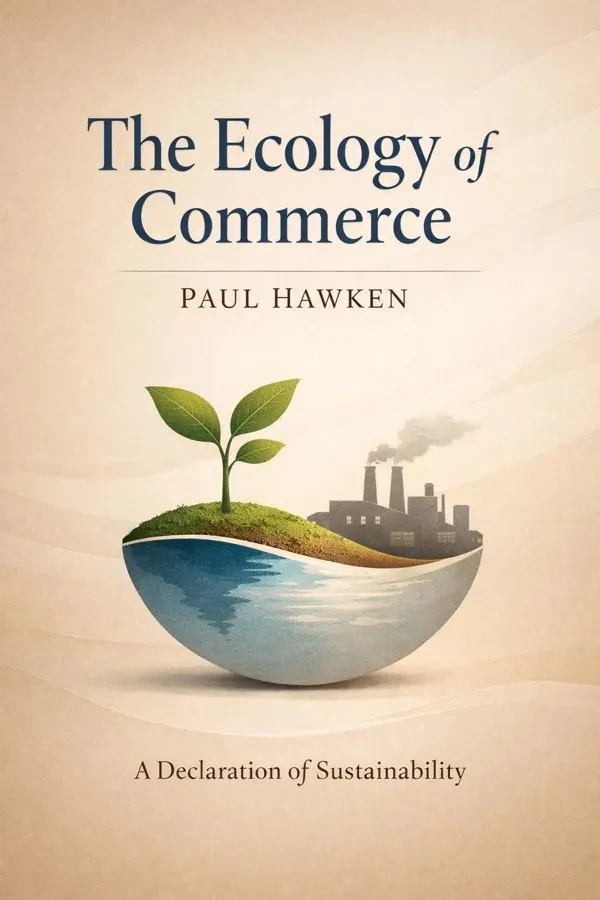
The Ecology of Commerce: A Declaration of Sustainability: Summary & Key Insights
by Paul Hawken
 10 min9 chaptersAudio available
What Is The Ecology of Commerce: A Declaration of Sustainability About?
The Ecology of Commerce: A Declaration of Sustainability by Paul Hawken is a environment book spanning 9 pages. In this influential work, Paul Hawken explores how business and environmental sustainability can coexist. He argues that commerce must evolve to restore the environment rather than deplete it, proposing a vision of an economy that values ecological health as much as profit. The book outlines practical strategies for transforming industries and redefining success in terms of long-term ecological balance.
This FizzRead summary covers all 9 key chapters of The Ecology of Commerce: A Declaration of Sustainability in approximately 10 minutes, distilling the most important ideas, arguments, and takeaways from Paul Hawken's work. Also available as an audio summary and Key Quotes Podcast.
The Ecology of Commerce: A Declaration of Sustainability
In this influential work, Paul Hawken explores how business and environmental sustainability can coexist. He argues that commerce must evolve to restore the environment rather than deplete it, proposing a vision of an economy that values ecological health as much as profit. The book outlines practical strategies for transforming industries and redefining success in terms of long-term ecological balance.
Who Should Read The Ecology of Commerce: A Declaration of Sustainability?
This book is perfect for anyone interested in environment and looking to gain actionable insights in a short read. Whether you're a student, professional, or lifelong learner, the key ideas from The Ecology of Commerce: A Declaration of Sustainability by Paul Hawken will help you think differently.
- ✓Readers who enjoy environment and want practical takeaways
- ✓Professionals looking to apply new ideas to their work and life
- ✓Anyone who wants the core insights of The Ecology of Commerce: A Declaration of Sustainability in just 10 minutes
Want the full summary?
Get instant access to this book summary and 100K+ more with Fizz Moment.
Get Free SummaryAvailable on App Store • Free to download
Key Chapters
To understand why our present system of commerce is unsustainable, we must trace how it evolved. The industrial revolution was celebrated for its triumphs—machines liberated human labor, markets spread across continents, and production soared. But its underlying logic was one of linear extraction: take resources, make products, discard waste. This logic ignored the cycles of renewal that govern life itself.
I describe in the book how classical economics, from Adam Smith onward, separated the idea of wealth creation from ecological dependence. Nature was treated as a repository of raw materials—free, infinite, and external to the economy. Factories multiplied, populations grew, and wealth concentrated. Yet beneath the prosperity was a hidden cost: the depletion of soils, forests, and waters; the poisoning of air and oceans; the loss of species.
By the late twentieth century, the industrial model had matured into a global network of consumption, yet its ecological footprint had become unbearable. The true measure of our success turned out to be the rate at which we converted living systems into waste. Every metric—GDP growth, industrial output, energy consumption—was celebrated as progress, even though each implied degradation somewhere else. In this context, the ecology of commerce emerges as a moral and practical response to centuries of imbalance. The historical trajectory is clear: the faster business grows under the old paradigm, the faster the biosphere declines. The choice before us is whether we will learn from the industrial past and build an economy that restores rather than consumes.
The idea that infinite growth can occur within a finite system is the central fallacy of modern economics. In *The Ecology of Commerce*, I explore how our pursuit of perpetual expansion has collided with the reality of ecological limits. We live on a planet that regenerates resources—soil, water, forests—at a certain rate. When industrial systems exceed that regeneration, depletion and pollution result.
The signs are everywhere: climate change, topsoil erosion, freshwater scarcity, collapsing fisheries, and the extinction of species. These are not isolated problems but symptoms of the same cause—the treatment of ecology as subordinate to economy. Growth, as measured by production and consumption, tells us nothing about whether life is improving. It can even mask the destruction of genuine wealth: the health of living systems.
Yet growth remains addictive, partly because it seems inseparable from employment and stability. The challenge, therefore, is not to abandon growth but to redefine it. I argue for a concept of qualitative growth—expanding knowledge, efficiency, and regenerative capacity rather than material throughput. Ecological economic thought acknowledges thermodynamic reality: the more energy and matter we waste, the poorer we ultimately become. Only by respecting these limits can commerce begin to design itself for longevity rather than short-term profit.
+ 7 more chapters — available in the FizzRead app
All Chapters in The Ecology of Commerce: A Declaration of Sustainability
About the Author
Paul Hawken is an American environmentalist, entrepreneur, and author known for his work on sustainability and ecological business practices. He has founded several companies focused on natural foods and sustainable living and has written extensively on the intersection of commerce and the environment.
Get This Summary in Your Preferred Format
Read or listen to the The Ecology of Commerce: A Declaration of Sustainability summary by Paul Hawken anytime, anywhere. FizzRead offers multiple formats so you can learn on your terms — all free.
Available formats: App · Audio · PDF · EPUB — All included free with FizzRead
Download The Ecology of Commerce: A Declaration of Sustainability PDF and EPUB Summary
Key Quotes from The Ecology of Commerce: A Declaration of Sustainability
“To understand why our present system of commerce is unsustainable, we must trace how it evolved.”
“The idea that infinite growth can occur within a finite system is the central fallacy of modern economics.”
Frequently Asked Questions about The Ecology of Commerce: A Declaration of Sustainability
The Ecology of Commerce: A Declaration of Sustainability by Paul Hawken is a environment book that explores key ideas across 9 chapters. In this influential work, Paul Hawken explores how business and environmental sustainability can coexist. He argues that commerce must evolve to restore the environment rather than deplete it, proposing a vision of an economy that values ecological health as much as profit. The book outlines practical strategies for transforming industries and redefining success in terms of long-term ecological balance.
More by Paul Hawken
You Might Also Like
A Life on Our Planet: My Witness Statement and a Vision for the Future
David Attenborough
10 min
A Sky Full Of Birds
Matt Merritt
10 min
Carbon Zero: Imagining Cities That Can Save the Planet
Alex Steffen
10 min
Eaarth: Making a Life on a Tough New Planet
Bill McKibben
10 min
The Social Contract and Environmental Governance
Various Editors
10 min
The Wild Places
Robert Macfarlane
10 minBrowse by Category
Ready to read The Ecology of Commerce: A Declaration of Sustainability?
Get the full summary and 100K+ more books with Fizz Moment.