
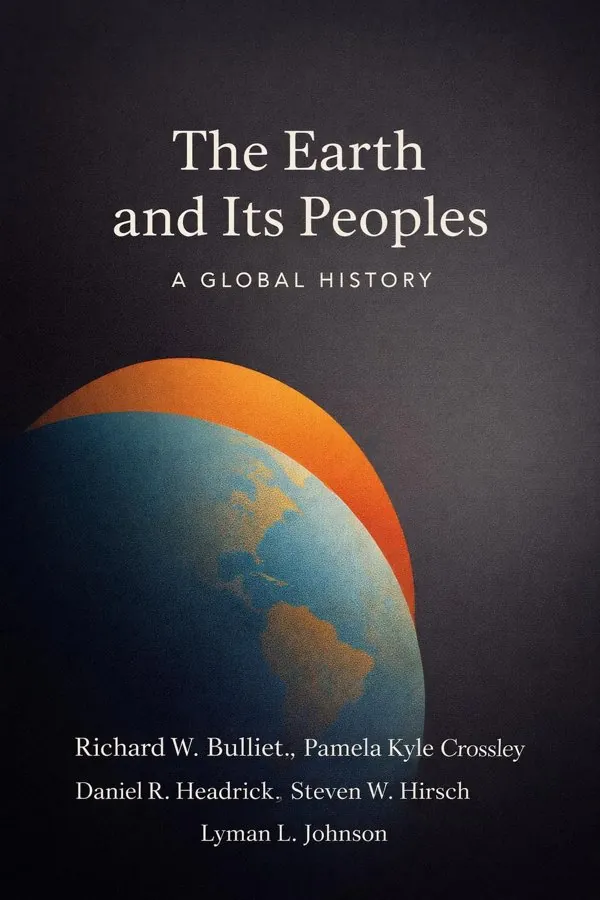
The Earth and Its Peoples: A Global History: Summary & Key Insights
by Richard W. Bulliet, Pamela Kyle Crossley, Daniel R. Headrick, Steven W. Hirsch, Lyman L. Johnson
 10 min7 chaptersAudio available
What Is The Earth and Its Peoples: A Global History About?
The Earth and Its Peoples: A Global History by Richard W. Bulliet, Pamela Kyle Crossley, Daniel R. Headrick, Steven W. Hirsch, Lyman L. Johnson is a world_history book spanning 7 pages. This comprehensive world history textbook presents a global perspective on human societies from prehistory to the present. It emphasizes cross-cultural interactions, trade, migration, and the interconnectedness of civilizations. The authors integrate political, social, economic, and cultural developments to illustrate how peoples across the world have shaped and been shaped by global processes.
This FizzRead summary covers all 7 key chapters of The Earth and Its Peoples: A Global History in approximately 10 minutes, distilling the most important ideas, arguments, and takeaways from Richard W. Bulliet, Pamela Kyle Crossley, Daniel R. Headrick, Steven W. Hirsch, Lyman L. Johnson's work. Also available as an audio summary and Key Quotes Podcast.
The Earth and Its Peoples: A Global History
This comprehensive world history textbook presents a global perspective on human societies from prehistory to the present. It emphasizes cross-cultural interactions, trade, migration, and the interconnectedness of civilizations. The authors integrate political, social, economic, and cultural developments to illustrate how peoples across the world have shaped and been shaped by global processes.
Who Should Read The Earth and Its Peoples: A Global History?
This book is perfect for anyone interested in world_history and looking to gain actionable insights in a short read. Whether you're a student, professional, or lifelong learner, the key ideas from The Earth and Its Peoples: A Global History by Richard W. Bulliet, Pamela Kyle Crossley, Daniel R. Headrick, Steven W. Hirsch, Lyman L. Johnson will help you think differently.
- ✓Readers who enjoy world_history and want practical takeaways
- ✓Professionals looking to apply new ideas to their work and life
- ✓Anyone who wants the core insights of The Earth and Its Peoples: A Global History in just 10 minutes
Want the full summary?
Get instant access to this book summary and 100K+ more with Fizz Moment.
Get Free SummaryAvailable on App Store • Free to download
Key Chapters
The story of humanity begins long before writing and settled communities, in a world of movement and adaptation. In our first chapters, we trace how Homo sapiens emerged from the hominid lineage, beginning in Africa roughly two hundred thousand years ago, equipped not just with physical endurance but with an extraordinary cognitive flexibility. Migration, not stagnation, defines our earliest history: from Africa, humans spread into Eurasia, Australia, and the Americas, constantly reshaping their environments and themselves.
We emphasize that early human societies were not primitive in a simplistic sense—they demonstrated profound intelligence in managing their surroundings. From fire control to cooperative hunting and symbolic art, these communities laid the foundation for social organization and technological innovation. The development of agriculture around ten thousand years ago did not happen in a single place but emerged independently in multiple regions—Mesopotamia, the Indus Valley, China, Mesoamerica, and the Andes—each adapting local flora and fauna to human needs. This simultaneous innovation underscores the global ingenuity of humanity.
As an author, I highlight how agriculture transformed everything: it brought stability and surplus, but also hierarchy and conflict. Farming gave rise to property, division of labor, and political authority. Villages grew into city-states, and spiritual beliefs evolved to justify order and fertility. Yet, as these agricultural societies flourished, they remained connected through migration and exchange. Even the earliest villages traded obsidian tools, shells, and pigments across long distances. Thus, from the beginning, humanity was global—not in scale, but in spirit.
In this section, we unfold the rise of complex civilizations in Mesopotamia, Egypt, the Indus Valley, and China—the first societies to construct monumental architecture, codify laws, and extend political power through organized states. It is tempting to describe them separately, but we insist that they were never truly isolated. Rivers carried more than water; they carried goods, ideas, and technologies that shaped worlds beyond their banks.
Mesopotamia’s cuneiform was not just a writing system—it was an administrative tool that influenced neighboring peoples. Egyptian hieroglyphs mirrored similar ambitions of recording divine and royal authority. The Indus Valley traded textiles and spices as far as Mesopotamia, while early Chinese dynasties drew bronze-working techniques through cross-regional contacts. As these societies evolved, their overlapping connections created a transregional dialogue about governance, faith, and identity.
Trade fostered more than wealth—it engendered shared cosmologies and artistic inspiration. When I studied the temple economies of ancient worlds, I saw how similar spiritual economies emerged in diverse regions. Priests in Sumer, Egypt, and Zhou China all mediated between heaven and earth through ritual, linking political legitimacy with divine communication. The roots of statecraft and religion thus grew side by side, nourished by exchange.
+ 5 more chapters — available in the FizzRead app
All Chapters in The Earth and Its Peoples: A Global History
About the Authors
Richard W. Bulliet is a historian and professor emeritus at Columbia University, specializing in Middle Eastern history and world history. His co-authors—Pamela Kyle Crossley, Daniel R. Headrick, Steven W. Hirsch, and Lyman L. Johnson—are distinguished scholars in global and regional history.
Get This Summary in Your Preferred Format
Read or listen to the The Earth and Its Peoples: A Global History summary by Richard W. Bulliet, Pamela Kyle Crossley, Daniel R. Headrick, Steven W. Hirsch, Lyman L. Johnson anytime, anywhere. FizzRead offers multiple formats so you can learn on your terms — all free.
Available formats: App · Audio · PDF · EPUB — All included free with FizzRead
Download The Earth and Its Peoples: A Global History PDF and EPUB Summary
Key Quotes from The Earth and Its Peoples: A Global History
“The story of humanity begins long before writing and settled communities, in a world of movement and adaptation.”
“It is tempting to describe them separately, but we insist that they were never truly isolated.”
Frequently Asked Questions about The Earth and Its Peoples: A Global History
The Earth and Its Peoples: A Global History by Richard W. Bulliet, Pamela Kyle Crossley, Daniel R. Headrick, Steven W. Hirsch, Lyman L. Johnson is a world_history book that explores key ideas across 7 chapters. This comprehensive world history textbook presents a global perspective on human societies from prehistory to the present. It emphasizes cross-cultural interactions, trade, migration, and the interconnectedness of civilizations. The authors integrate political, social, economic, and cultural developments to illustrate how peoples across the world have shaped and been shaped by global processes.
You Might Also Like
The Age of Capital
Eric Hobsbawm
10 min
The Gulag Archipelago
Aleksandr Solzhenitsyn
10 min
Jerusalem: The Biography
Simon Sebag Montefiore
10 min
The Anglo-Saxons
James Campbell
10 min
The Boer War
Thomas Pakenham
10 min
The Industrial Revolutionaries: The Making of the Modern World 1776–1914
Gavin Weightman
10 minBrowse by Category
Ready to read The Earth and Its Peoples: A Global History?
Get the full summary and 100K+ more books with Fizz Moment.