
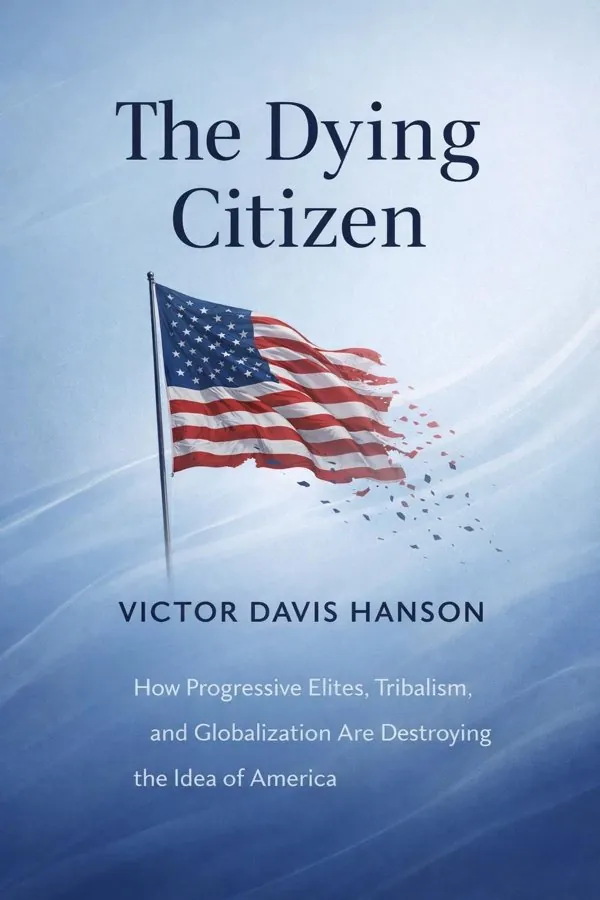
The Dying Citizen: How Progressive Elites, Tribalism, and Globalization Are Destroying the Idea of America: Summary & Key Insights
 10 min7 chaptersAudio available
What Is The Dying Citizen: How Progressive Elites, Tribalism, and Globalization Are Destroying the Idea of America About?
The Dying Citizen: How Progressive Elites, Tribalism, and Globalization Are Destroying the Idea of America by Victor Davis Hanson is a politics book spanning 7 pages. In The Dying Citizen, historian Victor Davis Hanson argues that the concept of citizenship, once the foundation of Western democracy, is being eroded by globalism, tribalism, and the rise of unelected elites. Drawing on historical and political analysis, Hanson explores how the decline of civic responsibility and national identity threatens the survival of the American republic.
This FizzRead summary covers all 7 key chapters of The Dying Citizen: How Progressive Elites, Tribalism, and Globalization Are Destroying the Idea of America in approximately 10 minutes, distilling the most important ideas, arguments, and takeaways from Victor Davis Hanson's work. Also available as an audio summary and Key Quotes Podcast.
The Dying Citizen: How Progressive Elites, Tribalism, and Globalization Are Destroying the Idea of America
In The Dying Citizen, historian Victor Davis Hanson argues that the concept of citizenship, once the foundation of Western democracy, is being eroded by globalism, tribalism, and the rise of unelected elites. Drawing on historical and political analysis, Hanson explores how the decline of civic responsibility and national identity threatens the survival of the American republic.
Who Should Read The Dying Citizen: How Progressive Elites, Tribalism, and Globalization Are Destroying the Idea of America?
This book is perfect for anyone interested in politics and looking to gain actionable insights in a short read. Whether you're a student, professional, or lifelong learner, the key ideas from The Dying Citizen: How Progressive Elites, Tribalism, and Globalization Are Destroying the Idea of America by Victor Davis Hanson will help you think differently.
- ✓Readers who enjoy politics and want practical takeaways
- ✓Professionals looking to apply new ideas to their work and life
- ✓Anyone who wants the core insights of The Dying Citizen: How Progressive Elites, Tribalism, and Globalization Are Destroying the Idea of America in just 10 minutes
Want the full summary?
Get instant access to this book summary and 100K+ more with Fizz Moment.
Get Free SummaryAvailable on App Store • Free to download
Key Chapters
Our story begins long before the American republic. In the ancient city-states of Greece and later Rome, citizenship was an innovation that upended older notions of belonging. No longer were individuals mere subjects of a king or members of a tribe; they were autonomous actors responsible for their political community. In Athens, the citizen took part in the assembly, defended the polis in war, and shouldered the moral obligation to deliberate on public affairs. In Rome, the republican heritage fused civic duty with property ownership and military service, producing the concept of the citizen-soldier.
These early forms were fragile but powerful. They taught that freedom was inseparable from responsibility. If you owned land, you had a tangible stake in the order of society. If you bore arms, you affirmed that governance was not someone else’s burden. These traditions influenced the English commonwealth experience, the Protestant sense of individual conscience, and ultimately America’s founding generation, who drew explicitly from classical models in crafting republican institutions.
For centuries, this lineage emphasized locality, self-reliance, and merit. Citizenship was not simply granted by birth or law; it was earned through participation. It required education in history and familiarity with civic virtue. Without this moral dimension, the citizen becomes a mere resident—a consumer of rights rather than a defender of them. By understanding these origins, we can see how modern tendencies toward passivity and entitlement betray a civilization that once regarded citizenship as the highest form of human dignity.
The first great internal assault on the old conception of citizenship came not from an external enemy but from the modern administrative state. As bureaucracies expanded across the twentieth century, the citizen’s sphere of responsibility narrowed. Professional managers, regulators, and experts began to make decisions once determined by local communities or elected representatives. Government’s reach extended into every aspect of life, creating dependency rather than participation.
I do not deny the achievements of modern administration—public health, education, infrastructure—but the cost has been steep. The citizen no longer feels ownership of government. Instead of self-governance, we face a labyrinthine system in which power is exercised by people we neither elect nor hold accountable. Bureaucratization erodes civic spirit by convincing individuals that their voices no longer matter.
In ancient and early modern republics, the challenge was apathy or corruption; in our age, it is procedural suffocation. Decisions are made by commissions, not assemblies; policies arise from memos, not debates. The very skills and moral habits that once sustained the citizen—prudence, compromise, courage—atrophy when replaced by forms, audits, and mandates. This is not mere nostalgia. The bureaucratic state infantilizes the populace, treating citizens as clients or wards. Once they internalize that lesson, the idea of common ownership of the republic begins to collapse.
+ 5 more chapters — available in the FizzRead app
All Chapters in The Dying Citizen: How Progressive Elites, Tribalism, and Globalization Are Destroying the Idea of America
About the Author
Victor Davis Hanson is an American classicist, military historian, and political commentator. He is a senior fellow at the Hoover Institution at Stanford University and has written extensively on ancient warfare, Western civilization, and contemporary politics.
Get This Summary in Your Preferred Format
Read or listen to the The Dying Citizen: How Progressive Elites, Tribalism, and Globalization Are Destroying the Idea of America summary by Victor Davis Hanson anytime, anywhere. FizzRead offers multiple formats so you can learn on your terms — all free.
Available formats: App · Audio · PDF · EPUB — All included free with FizzRead
Download The Dying Citizen: How Progressive Elites, Tribalism, and Globalization Are Destroying the Idea of America PDF and EPUB Summary
Key Quotes from The Dying Citizen: How Progressive Elites, Tribalism, and Globalization Are Destroying the Idea of America
“Our story begins long before the American republic.”
“The first great internal assault on the old conception of citizenship came not from an external enemy but from the modern administrative state.”
Frequently Asked Questions about The Dying Citizen: How Progressive Elites, Tribalism, and Globalization Are Destroying the Idea of America
The Dying Citizen: How Progressive Elites, Tribalism, and Globalization Are Destroying the Idea of America by Victor Davis Hanson is a politics book that explores key ideas across 7 chapters. In The Dying Citizen, historian Victor Davis Hanson argues that the concept of citizenship, once the foundation of Western democracy, is being eroded by globalism, tribalism, and the rise of unelected elites. Drawing on historical and political analysis, Hanson explores how the decline of civic responsibility and national identity threatens the survival of the American republic.
More by Victor Davis Hanson
You Might Also Like
Antifa: The Anti-Fascist Handbook
Mark Bray
10 min
Attack from Within: How Disinformation Is Sabotaging America
Barbara McQuade
10 min
Coercion, Capital, and European States, AD 990–1992
Charles Tilly
10 min
Digital Democracy: Concepts, Methodologies, Tools, and Applications
Various Authors
10 min
Fascism
Stanley G. Payne
10 min
Fire And Fury: Inside The Trump White House
Michael Wolff
10 minBrowse by Category
Ready to read The Dying Citizen: How Progressive Elites, Tribalism, and Globalization Are Destroying the Idea of America?
Get the full summary and 100K+ more books with Fizz Moment.