
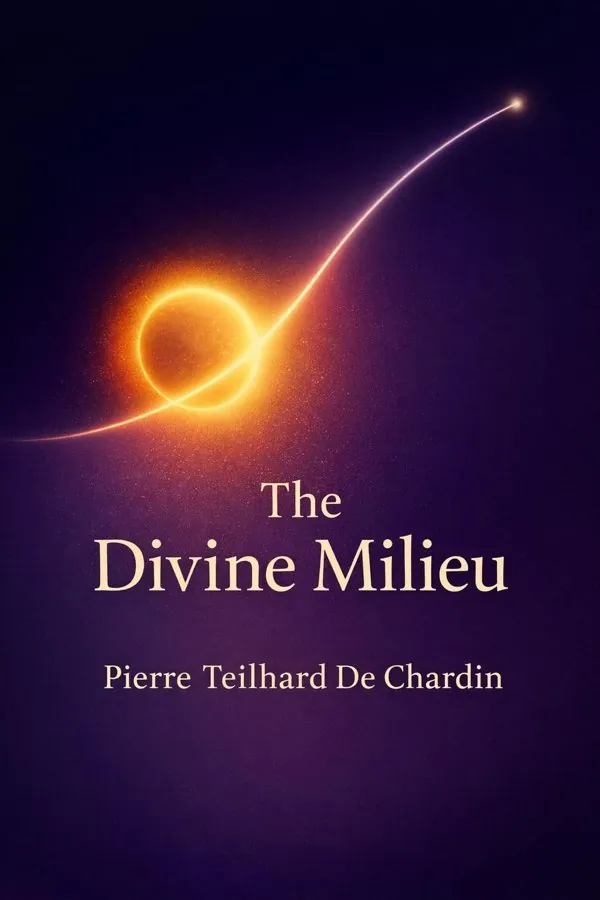
The Divine Milieu: Summary & Key Insights
 10 min10 chaptersAudio available
Key Takeaways from The Divine Milieu
Human life feels divided because we experience ourselves as both earthly and transcendent.
One of Teilhard’s most radical insights is that matter is not spiritually empty.
Evolution, in Teilhard’s hands, becomes more than a biological theory; it becomes a way of understanding the drama of creation.
Teilhard insists that action is one of the primary places where the divine is encountered.
For Teilhard, the spiritual life is not an escape from reality but a deepening of it.
What Is The Divine Milieu About?
The Divine Milieu by Pierre Teilhard De Chardin is a western_phil book spanning 10 pages. The Divine Milieu is Pierre Teilhard de Chardin’s bold attempt to show that spiritual life does not require withdrawal from the world, but deeper participation in it. Writing as both a Jesuit priest and a scientist, Teilhard argues that God is not absent from matter, labor, struggle, and human progress. Instead, the divine is encountered in the very texture of ordinary life—in work, relationships, suffering, thought, and the long movement of evolution itself. At the center of the book is a daring claim: creation is not static, but unfolding toward greater consciousness, unity, and fulfillment in God. What makes this book enduring is its refusal to accept a split between faith and modern knowledge. Teilhard does not ask readers to choose between science and spirituality, action and contemplation, the world and God. He presents a vision in which all authentic human effort can become sacred when offered consciously within the divine presence. For readers wrestling with how to live spiritually in a technological, restless, and evolving world, The Divine Milieu remains one of the most original and inspiring works of twentieth-century religious philosophy.
This FizzRead summary covers all 10 key chapters of The Divine Milieu in approximately 10 minutes, distilling the most important ideas, arguments, and takeaways from Pierre Teilhard De Chardin's work. Also available as an audio summary and Key Quotes Podcast.
The Divine Milieu
The Divine Milieu is Pierre Teilhard de Chardin’s bold attempt to show that spiritual life does not require withdrawal from the world, but deeper participation in it. Writing as both a Jesuit priest and a scientist, Teilhard argues that God is not absent from matter, labor, struggle, and human progress. Instead, the divine is encountered in the very texture of ordinary life—in work, relationships, suffering, thought, and the long movement of evolution itself. At the center of the book is a daring claim: creation is not static, but unfolding toward greater consciousness, unity, and fulfillment in God.
What makes this book enduring is its refusal to accept a split between faith and modern knowledge. Teilhard does not ask readers to choose between science and spirituality, action and contemplation, the world and God. He presents a vision in which all authentic human effort can become sacred when offered consciously within the divine presence. For readers wrestling with how to live spiritually in a technological, restless, and evolving world, The Divine Milieu remains one of the most original and inspiring works of twentieth-century religious philosophy.
Who Should Read The Divine Milieu?
This book is perfect for anyone interested in western_phil and looking to gain actionable insights in a short read. Whether you're a student, professional, or lifelong learner, the key ideas from The Divine Milieu by Pierre Teilhard De Chardin will help you think differently.
- ✓Readers who enjoy western_phil and want practical takeaways
- ✓Professionals looking to apply new ideas to their work and life
- ✓Anyone who wants the core insights of The Divine Milieu in just 10 minutes
Want the full summary?
Get instant access to this book summary and 100K+ more with Fizz Moment.
Get Free SummaryAvailable on App Store • Free to download
Key Chapters
Human life feels divided because we experience ourselves as both earthly and transcendent. We are bound to bodies, routines, labor, and limits, yet we also long for meaning, unity, and something beyond ourselves. Teilhard begins with this tension not to resolve it by denying one side, but to show that the human condition is precisely the place where matter and spirit meet. We are not souls trapped in a material prison, nor merely biological machines. We are beings in whom the world becomes conscious of itself and begins to reach toward God.
This idea reframes ordinary existence. The conflicts we feel between ambition and prayer, action and contemplation, science and faith, are not necessarily signs of failure. They may be the very arena of spiritual growth. A teacher shaping minds, a parent raising children, a researcher pursuing truth, or an artist making beauty can all be living at this frontier between visible and invisible realities. In Teilhard’s vision, our daily tasks are not distractions from the spiritual life. They are where spirit is forged within matter.
The practical implication is profound: spiritual maturity does not come from rejecting our embodied, historical life, but from inhabiting it more deeply. When we engage work, thought, and responsibility with awareness, we allow our material circumstances to become vehicles of grace. Rather than asking how to escape the world, Teilhard asks how to discover God at the heart of it.
Actionable takeaway: When you feel torn between worldly obligations and spiritual longing, pause and ask how this very tension might be the place where your deepest growth is happening.
One of Teilhard’s most radical insights is that matter is not spiritually empty. Many religious outlooks treat the physical world as secondary, dangerous, or at best temporary. Teilhard pushes back. Matter, for him, is the field in which divine action unfolds. It is not outside God’s concern, but the very medium through which consciousness, complexity, and union emerge. The world is not a stage set to be discarded. It is a living process charged with spiritual significance.
This does not mean that everything material is automatically holy in a sentimental sense. Rather, the material world is unfinished, dynamic, and full of potential. Technology, culture, scientific discovery, political institutions, and even bodily existence belong to the history of becoming through which the divine works. A laboratory, a construction site, a hospital ward, or a kitchen can be places of encounter with God when they are entered with reverence and purpose.
In practical terms, this idea calls readers to reject false dualisms. Caring for the body, pursuing knowledge, building communities, and improving social conditions are not lesser activities compared with prayer. They can participate in the sanctification of the world. At the same time, Teilhard warns that matter must be integrated, not idolized. The material world reveals God most fully when it is directed toward greater consciousness, love, and unity.
Actionable takeaway: Choose one ordinary physical setting—your desk, commute, gym, or home—and practice seeing it not as spiritually neutral, but as a place where divine meaning can be discovered through attention and intention.
Evolution, in Teilhard’s hands, becomes more than a biological theory; it becomes a way of understanding the drama of creation. He sees the universe as moving from simplicity toward complexity, from inert matter toward life, thought, and eventually spiritual convergence. Humanity is not an accident dropped into an indifferent cosmos. It is a decisive threshold in the universe’s awakening. Consciousness has emerged, and with it the capacity for reflection, freedom, love, and worship.
This perspective allows Teilhard to reconcile faith with the scientific story of development. Instead of imagining God only at the beginning, as a distant creator who once acted and then withdrew, he emphasizes God as the attracting center drawing creation forward. The universe is not merely made; it is being fulfilled. This future-oriented vision transforms the meaning of history. Human progress, intellectual discovery, and moral struggle are not random episodes but dimensions of an unfinished cosmic movement.
The idea has practical force for modern readers. If reality is still becoming, then our choices matter within a larger arc. Education, innovation, artistic creation, ethical reform, and community-building all contribute to the world’s increasing depth and connectedness. Even personal growth can be seen as participation in evolution at the level of spirit. We are called not just to endure existence, but to help shape its ascent.
Actionable takeaway: View one area of your life—career, relationships, learning, or inner growth—not as static, but as part of an unfinished process. Ask what next step would move it toward greater awareness, integration, and generosity.
Teilhard insists that action is one of the primary places where the divine is encountered. Many people assume that God is found mainly in silence, worship, or retreat from worldly involvement. Teilhard does not reject those paths, but he expands them. Every effort that enlarges life, truth, beauty, justice, or love can become a site of communion with God. Work is not simply a necessity to survive; it can be a form of co-creation.
This insight dignifies the active life. Writing a report well, teaching with patience, organizing a team, caring for a sick relative, repairing a home, or building a public institution can all become spiritually meaningful. What matters is not only the external task, but the interior orientation brought to it. When action is offered consciously, it is gathered into a larger movement toward divine fulfillment. The worker, then, is not isolated in private effort, but joined to a cosmic labor.
At the same time, Teilhard recognizes that modern work can become fragmented, exhausting, and impersonal. His answer is not escape but transformation through intention. The smallest duty, if embraced as participation in something greater, gains depth. This does not romanticize exploitation or burnout. Rather, it invites people to reconnect effort with purpose and to see labor as a possible expression of love.
Actionable takeaway: Before beginning your next major task, take ten seconds to dedicate it to something beyond personal gain—truth, service, healing, beauty, or God. Let that intention reshape how you work.
For Teilhard, the spiritual life is not an escape from reality but a deepening of it. Interior life matters because the world does not evolve only through external change. It also advances through intensification of consciousness. Attention, desire, prayer, discernment, and self-offering are not private luxuries; they are ways the human person becomes more fully alive and more capable of union with others and with God.
This means the hidden dimensions of life are essential. A person may seem outwardly ordinary while inwardly undergoing a profound reordering of values and loves. A quiet act of forgiveness, a disciplined habit of contemplation, or a sincere effort to purify motives can have greater spiritual significance than visible achievement. Teilhard’s vision gives dignity to inner work because he believes reality is structured from within as much as from without.
Practically, this insight speaks to a distracted age. Constant activity can flatten experience and make the soul superficial. The interior life restores depth. Reflection after conflict, gratitude during routine, meditation before decisions, or prayer in the midst of work can gather scattered energy into a more unified self. This inner integration then changes how a person acts in the world.
Teilhard does not separate contemplation from engagement. The goal is not to choose one over the other, but to let interior awareness infuse outward action. The person who is inwardly centered can bring more clarity, patience, courage, and love to ordinary responsibilities.
Actionable takeaway: Build one small daily interior practice—five minutes of silence, journaling, examen, or prayer—to reconnect your outer activity with your deeper center.
Suffering is one of the hardest tests of any spiritual worldview, and Teilhard faces it directly. He does not deny pain, injustice, limitation, aging, failure, or death. Nor does he offer easy consolation. Instead, he argues that while suffering is never good simply because it hurts, it can be taken up into a larger process of transformation. What resists our plans can still become material for union with God.
Teilhard distinguishes between active and passive dimensions of life. In active life, we shape the world through effort. In passive life, things happen to us: illness, disappointment, dependence, loss. Spiritual maturity requires learning how to offer both. When our power is limited, we are not spiritually useless. The surrender of what cannot be controlled may open an even deeper participation in the divine than success does.
This has practical relevance for anyone facing frustration or grief. A failed career move, chronic pain, relational betrayal, or forced slowdown can produce bitterness or numbness. Teilhard invites another possibility: to unite suffering with love, patience, and trust so that it is not meaningless. This does not remove the pain, but it changes its horizon. The person is no longer merely crushed by circumstance, but inwardly consenting to a deeper work.
His message is demanding because it asks not only how we act when strong, but how we remain open when weak. Yet it also offers dignity to every form of limitation.
Actionable takeaway: In the midst of one current hardship, stop asking only how to eliminate it. Also ask what kind of person you are being invited to become through it.
At the heart of The Divine Milieu is a Christ-centered vision of the universe. For Teilhard, Christ is not only a historical religious figure or private savior of individual souls. Christ is the living center in whom the whole cosmos holds together and toward whom it moves. This is what gives Teilhard’s spirituality its specifically Christian shape. The divine presence in the world is not vague spirituality; it is personal, incarnate, and unifying.
This vision expands the meaning of union with Christ. It is not confined to prayer, moral obedience, or church life, though it includes all of them. To be united with Christ is to be drawn into the very movement by which creation is gathered, elevated, and fulfilled. The believer’s work, suffering, desire, and love are not isolated experiences. They can be incorporated into Christ’s universal action.
Practically, this helps readers connect devotion with daily life. A scientist searching for truth, a nurse caring for bodies, a citizen working for justice, or a parent nurturing a child can all understand those acts as ways of participating in Christ’s work of unification. This widens religious consciousness beyond the sacred-secular divide.
Teilhard’s language can feel cosmic, but its result is personal. If Christ is at the center of all becoming, then no sincere movement toward truth, love, and wholeness is outside divine concern. Faith becomes less about withdrawal and more about alignment with the deepest pattern of reality.
Actionable takeaway: In prayer or reflection, connect one concrete responsibility in your life to a larger spiritual purpose by asking how it might participate in healing, reconciling, or unifying the world.
Teilhard’s idea of the world as sacramental means that creation can mediate divine presence. He does not reduce formal religious sacraments, but he broadens spiritual perception so that the whole world becomes translucent with meaning. Nature, labor, culture, relationships, and history can all become signs through which God is encountered. The holy is not locked in isolated religious moments; it shimmers through existence itself.
This way of seeing changes how we inhabit life. Meals are no longer merely fuel, conversation no longer mere exchange, study no longer mere utility. Each can become a threshold into deeper awareness. Even the unfinished, broken quality of the world can point beyond itself toward fulfillment. The sacramental imagination trains us to look for grace not only in worship, but in process, encounter, and material reality.
A practical example is gratitude. When a person begins to receive common things—a sunrise, a shared task, a difficult conversation, a page of insight—as meaningful gifts rather than empty events, the texture of life changes. Reverence grows. Attention sharpens. The world becomes less disposable. This vision also encourages ethical responsibility, because if reality bears divine significance, then exploitation of people and nature becomes spiritually serious.
Teilhard’s sacramental worldview is especially relevant in a disenchanted age. It does not ask us to deny science or complexity. It asks us to perceive depth within them. The world remains real, historical, and evolving, yet also charged with divine nearness.
Actionable takeaway: Practice sacramental attention for one day by treating every ordinary encounter as potentially meaningful. At night, note three moments that felt unexpectedly full of presence.
Teilhard rejects the idea that spiritual life is passive waiting for another world. He believes human effort matters because history itself is the arena in which consciousness and communion develop. Civilization, knowledge, solidarity, and moral progress are not spiritually irrelevant. They are part of the long labor by which the world is gradually spiritualized. To build, organize, discover, and connect are all potentially sacred tasks.
This does not mean every form of progress is good. Teilhard is not blindly optimistic about technology or institutions. Progress becomes meaningful only when it serves deeper unity rather than domination, fragmentation, or vanity. A society can become more powerful while becoming less human. Spiritualization means directing human energy toward integration, dignity, and shared flourishing.
This idea invites responsibility. Professionals, thinkers, leaders, and citizens should ask not only whether they are succeeding, but what kind of future they are helping create. A business can increase efficiency while eroding meaning; a digital platform can connect people while deepening loneliness. Teilhard’s framework pushes us to evaluate human effort by its contribution to consciousness, relationship, and higher forms of life.
In personal terms, this means our work has historical weight. The systems we build, the knowledge we share, and the communities we sustain can all serve the world’s movement toward greater unity. Spiritual life therefore includes cultural and social participation, not just individual inwardness.
Actionable takeaway: Look at one project you are contributing to and ask a hard question: does this make people more fragmented or more human? Adjust your effort toward the latter.
Modern life often produces either naive optimism or exhausted cynicism. Teilhard offers a different stance: hope grounded in a meaningful future. He believes the universe is moving toward an ultimate point of convergence, often called the Omega Point, where creation reaches fulfillment in God. This gives history direction without eliminating struggle. The future is neither guaranteed by human power alone nor rendered meaningless by chaos. It is drawn by a transcendent center.
This perspective matters because people need a reason to persevere. Without some horizon of meaning, effort collapses into routine, and suffering becomes unbearable. Teilhard’s faith in the future does not deny catastrophe, conflict, or ambiguity. Rather, it insists that these do not have final authority. Even incomplete human endeavors can be gathered into a greater completion.
Practically, this encourages resilient engagement. A teacher may never see the full effect of their influence. A reformer may die before change arrives. A person trying to heal family patterns may encounter repeated setbacks. Teilhard’s vision says such labor is still worthwhile because reality is oriented toward fulfillment beyond immediate results. Faith becomes a way of working intensely without being imprisoned by short-term outcomes.
For contemporary readers facing ecological anxiety, political instability, and spiritual fatigue, this is one of the book’s most powerful gifts. It offers neither denial nor despair, but a disciplined confidence that meaning exceeds visible success.
Actionable takeaway: When facing discouragement, reconnect your effort to a long horizon. Ask not only, “Is this working now?” but also, “What future am I faithfully serving through this work?”
All Chapters in The Divine Milieu
About the Author
Pierre Teilhard de Chardin was a French Jesuit priest, paleontologist, and philosopher born in 1881. Trained in both science and theology, he became one of the twentieth century’s most distinctive religious thinkers by trying to unite Christian faith with the evolutionary view of the universe. His scientific work included research in geology and paleontology, and he participated in important fossil studies in Asia. At the same time, his writings developed a sweeping spiritual vision in which creation evolves toward greater consciousness and ultimate union in God. Because some of his ideas were controversial, several of his major works were not widely published during his lifetime. After his death in 1955, his influence grew significantly among theologians, philosophers, and spiritually minded readers interested in reconciling science, modernity, and faith.
Get This Summary in Your Preferred Format
Read or listen to the The Divine Milieu summary by Pierre Teilhard De Chardin anytime, anywhere. FizzRead offers multiple formats so you can learn on your terms — all free.
Available formats: App · Audio · PDF · EPUB — All included free with FizzRead
Download The Divine Milieu PDF and EPUB Summary
Key Quotes from The Divine Milieu
“Human life feels divided because we experience ourselves as both earthly and transcendent.”
“One of Teilhard’s most radical insights is that matter is not spiritually empty.”
“Evolution, in Teilhard’s hands, becomes more than a biological theory; it becomes a way of understanding the drama of creation.”
“Teilhard insists that action is one of the primary places where the divine is encountered.”
“For Teilhard, the spiritual life is not an escape from reality but a deepening of it.”
Frequently Asked Questions about The Divine Milieu
The Divine Milieu by Pierre Teilhard De Chardin is a western_phil book that explores key ideas across 10 chapters. The Divine Milieu is Pierre Teilhard de Chardin’s bold attempt to show that spiritual life does not require withdrawal from the world, but deeper participation in it. Writing as both a Jesuit priest and a scientist, Teilhard argues that God is not absent from matter, labor, struggle, and human progress. Instead, the divine is encountered in the very texture of ordinary life—in work, relationships, suffering, thought, and the long movement of evolution itself. At the center of the book is a daring claim: creation is not static, but unfolding toward greater consciousness, unity, and fulfillment in God. What makes this book enduring is its refusal to accept a split between faith and modern knowledge. Teilhard does not ask readers to choose between science and spirituality, action and contemplation, the world and God. He presents a vision in which all authentic human effort can become sacred when offered consciously within the divine presence. For readers wrestling with how to live spiritually in a technological, restless, and evolving world, The Divine Milieu remains one of the most original and inspiring works of twentieth-century religious philosophy.
More by Pierre Teilhard De Chardin
You Might Also Like
A Little History of Philosophy
Nigel Warburton
10 min
Areopagitica
John Milton
10 min
How To Think Like A Philosopher: Essential Principles For Clear Thinking
Peter Cave
10 min
Language, Truth and Logic
A. J. Ayer
10 min
The Age of Reason
Thomas Paine
10 min
The Essays
Michel De Montaigne
10 minBrowse by Category
Ready to read The Divine Milieu?
Get the full summary and 100K+ more books with Fizz Moment.