
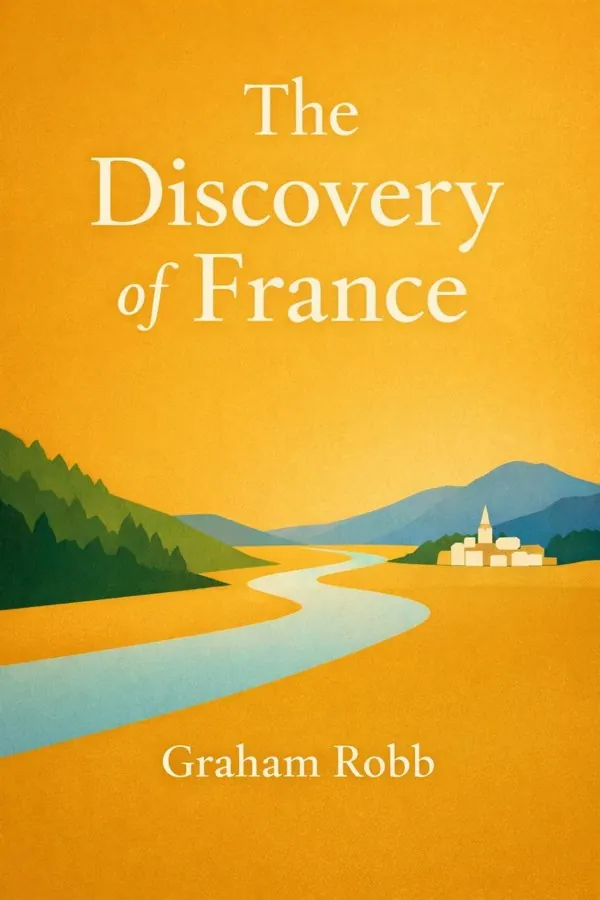
The Discovery of France: A Historical Geography from the Revolution to the First World War: Summary & Key Insights
by Graham Robb
 10 min12 chaptersAudio available
What Is The Discovery of France: A Historical Geography from the Revolution to the First World War About?
The Discovery of France: A Historical Geography from the Revolution to the First World War by Graham Robb is a world_history book spanning 12 pages. A groundbreaking exploration of how the diverse regions, languages, and peoples of France came together to form a modern nation. Graham Robb reconstructs the forgotten landscapes, dialects, and local identities that shaped France before the dominance of Parisian culture, revealing a country far more fragmented and surprising than the unified image it later projected.
This FizzRead summary covers all 12 key chapters of The Discovery of France: A Historical Geography from the Revolution to the First World War in approximately 10 minutes, distilling the most important ideas, arguments, and takeaways from Graham Robb's work. Also available as an audio summary and Key Quotes Podcast.
The Discovery of France: A Historical Geography from the Revolution to the First World War
A groundbreaking exploration of how the diverse regions, languages, and peoples of France came together to form a modern nation. Graham Robb reconstructs the forgotten landscapes, dialects, and local identities that shaped France before the dominance of Parisian culture, revealing a country far more fragmented and surprising than the unified image it later projected.
Who Should Read The Discovery of France: A Historical Geography from the Revolution to the First World War?
This book is perfect for anyone interested in world_history and looking to gain actionable insights in a short read. Whether you're a student, professional, or lifelong learner, the key ideas from The Discovery of France: A Historical Geography from the Revolution to the First World War by Graham Robb will help you think differently.
- ✓Readers who enjoy world_history and want practical takeaways
- ✓Professionals looking to apply new ideas to their work and life
- ✓Anyone who wants the core insights of The Discovery of France: A Historical Geography from the Revolution to the First World War in just 10 minutes
Want the full summary?
Get instant access to this book summary and 100K+ more with Fizz Moment.
Get Free SummaryAvailable on App Store • Free to download
Key Chapters
Before the Revolution, France was less a country than an archipelago of territories separated by physical and linguistic frontiers. To cross from one valley to the next was to encounter a new language, a new unit of measure, a new way of life. The people were not ignorant or backward—they were deeply rooted in the logic of their environments. In the mountain hamlet, survival meant knowing every contour of terrain; in the forest region, it meant trusting inherited stories of spirits and saints who governed nature’s mysteries.
To travel through pre-revolutionary France was to understand how isolation preserved identity. Local customs evolved independently for centuries. Many villages were practically self-sufficient, with economies based on barter and faith rather than commerce or bureaucracy. Parish records show how even neighboring communities often regarded one another with suspicion, as though separated by invisible national borders.
Languages mirrored this fragmentation. France had hundreds of dialects and patois, from Occitan to Picard, Breton to Gascon. To speak French as we know it today was, in many places, an exotic skill reserved for clerics or aristocrats. The linguistic diversity represented not confusion but a rich reflection of regional life—the rhythm and flavor of the land expressed through sound.
This France, more medieval than modern, was structured by local experience and seasonal rhythms. The roads were poor, communication limited, and central authority weak. Yet it was precisely this partitioned texture—this tapestry of local worlds—that would make the coming upheaval so profound, for when revolution arrived, it sought to remake not only institutions but the very map of human understanding.
The French Revolution aimed to erase the old boundaries, both literal and metaphorical. Its ideals of liberty and unity promised to transform a people divided by dialects into citizens of a single republic. In theory, it was an awakening; in practice, it was also an assault on local knowledge. The revolutionaries looked upon local customs as remnants of superstition and oppression, obstacles to enlightenment and progress.
Through administrative reforms, France was divided into departments—a rational grid replacing the organic contours of provinces. Paris became not merely a capital but the central mind determining how France should think, measure, and behave. In doing so, the Revolution began the process of homogenization that would gradually erase centuries of diversity.
But real life resisted abstraction. In the provinces, old loyalties persisted. Many communities barely understood the decrees that reached them, written in a language they did not recognize. Villagers in the Vendée rose in rebellion not because they opposed freedom, but because they saw the attack on religion and regional autonomy as an assault on their way of life. Thus, beneath the rhetoric of unity, France remained stubbornly plural.
The Revolution, paradoxically, created two Frances—the imagined and the real. The imagined France was neat, centralized, and heroic, a republic of citizens proclaiming one voice. The real France was still the France of forest paths and forgotten dialects. The struggle between these visions, as this book unfolds, defines the making of modern France.
+ 10 more chapters — available in the FizzRead app
All Chapters in The Discovery of France: A Historical Geography from the Revolution to the First World War
About the Author
Graham Robb is a British author and scholar known for his works on French history and literature. A former fellow of Exeter College, Oxford, he has written acclaimed biographies of Balzac, Hugo, and Rimbaud, and has received several literary awards for his historical and biographical works.
Get This Summary in Your Preferred Format
Read or listen to the The Discovery of France: A Historical Geography from the Revolution to the First World War summary by Graham Robb anytime, anywhere. FizzRead offers multiple formats so you can learn on your terms — all free.
Available formats: App · Audio · PDF · EPUB — All included free with FizzRead
Download The Discovery of France: A Historical Geography from the Revolution to the First World War PDF and EPUB Summary
Key Quotes from The Discovery of France: A Historical Geography from the Revolution to the First World War
“Before the Revolution, France was less a country than an archipelago of territories separated by physical and linguistic frontiers.”
“The French Revolution aimed to erase the old boundaries, both literal and metaphorical.”
Frequently Asked Questions about The Discovery of France: A Historical Geography from the Revolution to the First World War
The Discovery of France: A Historical Geography from the Revolution to the First World War by Graham Robb is a world_history book that explores key ideas across 12 chapters. A groundbreaking exploration of how the diverse regions, languages, and peoples of France came together to form a modern nation. Graham Robb reconstructs the forgotten landscapes, dialects, and local identities that shaped France before the dominance of Parisian culture, revealing a country far more fragmented and surprising than the unified image it later projected.
You Might Also Like
The Age of Capital
Eric Hobsbawm
10 min
The Gulag Archipelago
Aleksandr Solzhenitsyn
10 min
Jerusalem: The Biography
Simon Sebag Montefiore
10 min
The Anglo-Saxons
James Campbell
10 min
The Boer War
Thomas Pakenham
10 min
The Industrial Revolutionaries: The Making of the Modern World 1776–1914
Gavin Weightman
10 minBrowse by Category
Ready to read The Discovery of France: A Historical Geography from the Revolution to the First World War?
Get the full summary and 100K+ more books with Fizz Moment.