
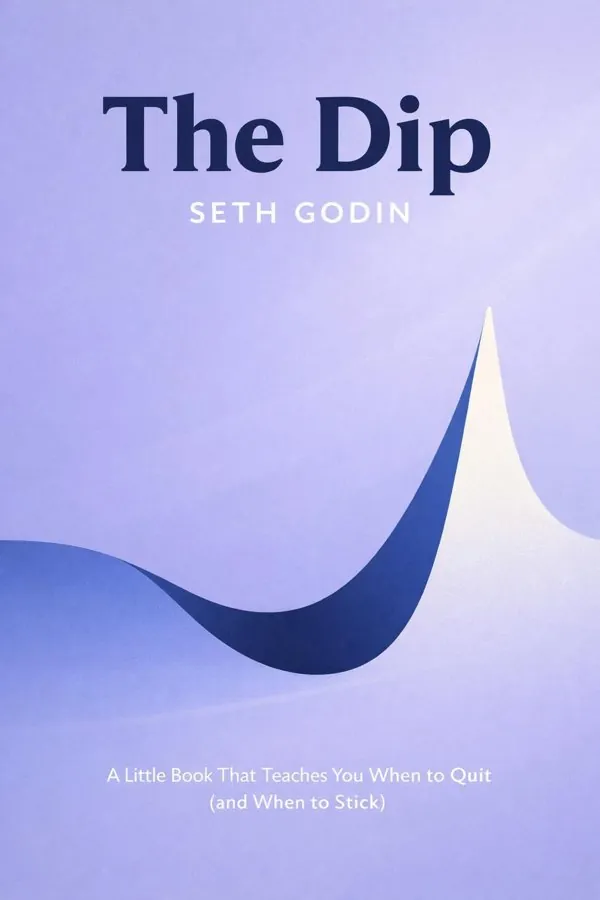
The Dip: A Little Book That Teaches You When to Quit (and When to Stick): Summary & Key Insights
by Seth Godin
 10 min4 chaptersAudio available
What Is The Dip: A Little Book That Teaches You When to Quit (and When to Stick) About?
The Dip: A Little Book That Teaches You When to Quit (and When to Stick) by Seth Godin is a mindset book spanning 4 pages. The Dip is a concise motivational book by Seth Godin that explores the concept of strategic quitting. Godin argues that winners quit fast, quit often, and quit without guilt—when they realize they are in a dead end. The book helps readers identify when perseverance will pay off and when it is wiser to quit and redirect effort toward more promising opportunities.
This FizzRead summary covers all 4 key chapters of The Dip: A Little Book That Teaches You When to Quit (and When to Stick) in approximately 10 minutes, distilling the most important ideas, arguments, and takeaways from Seth Godin's work. Also available as an audio summary and Key Quotes Podcast.
The Dip: A Little Book That Teaches You When to Quit (and When to Stick)
The Dip is a concise motivational book by Seth Godin that explores the concept of strategic quitting. Godin argues that winners quit fast, quit often, and quit without guilt—when they realize they are in a dead end. The book helps readers identify when perseverance will pay off and when it is wiser to quit and redirect effort toward more promising opportunities.
Who Should Read The Dip: A Little Book That Teaches You When to Quit (and When to Stick)?
This book is perfect for anyone interested in mindset and looking to gain actionable insights in a short read. Whether you're a student, professional, or lifelong learner, the key ideas from The Dip: A Little Book That Teaches You When to Quit (and When to Stick) by Seth Godin will help you think differently.
- ✓Readers who enjoy mindset and want practical takeaways
- ✓Professionals looking to apply new ideas to their work and life
- ✓Anyone who wants the core insights of The Dip: A Little Book That Teaches You When to Quit (and When to Stick) in just 10 minutes
Want the full summary?
Get instant access to this book summary and 100K+ more with Fizz Moment.
Get Free SummaryAvailable on App Store • Free to download
Key Chapters
Every endeavor begins with enthusiasm. Starting something new feels easy because the rewards are immediate—a sense of progress, recognition, novelty. But after the honeymoon phase, reality sets in. Results don’t come as quickly, effort intensifies, and the first wave of support often fades. This is where most people stumble. They reach the Dip, that stretch of hard slog that separates mediocrity from greatness.
The Dip is not a trap—it’s a signal. It’s the universe asking how committed we truly are. Imagine a marathon: at mile five, the crowd roars; at mile twenty, it’s silent except for the sound of your own breath. That’s the Dip—the hard, lonely middle stretch where persistence is rare and therefore valuable. If it were easy, there’d be no worth in finishing.
When I first began studying markets and organizations, I noticed that everything valuable shares the same pattern. The best athletes, the top companies, the leading surgeons all push through moments of mastery where the learning curve steepens unbearably. Ordinary performers plateau because they misinterpret the Dip as failure instead of proof that they’re entering the territory where the real growth happens.
The Dip creates scarcity, and scarcity creates value. There are millions of people who can play guitar, but only a handful who endure the Dip long enough to play with mastery. The same applies to business—countless startups begin with excitement, but only a few persist through the moments when the market seems to turn away. The ones that stay the course through the Dip become remarkable precisely because others have quit.
So, when you feel stuck, don’t assume it’s a sign of doom. It might, in fact, be the invitation to excellence. The Dip is where great careers and great organizations are forged. However, to embrace it fully, you have to develop the wisdom to distinguish it from a Cul-de-Sac—the dead ends we’ll explore next.
Not every struggle leads somewhere. There are Dips worth enduring, and then there are Cul-de-Sacs—situations that go nowhere no matter how long you persist. The tragedy is that most people treat both alike. They either give up too soon on the Dip, abandoning opportunities just before the breakthrough, or they cling too long to a Cul-de-Sac, locked in a cycle of mediocrity.
The Cul-de-Sac is comfortable because it feels safe. You can coast along indefinitely, never quite failing but never growing either. It’s the job you keep because it’s stable but uninspiring; the product line your company continues selling even though no one really cares anymore; the relationship maintained by habit rather than love. The problem is that the Cul-de-Sac consumes energy without offering momentum. You invest time and attention that could have been spent elsewhere, on something with the potential to grow.
Smart quitting means recognizing these dead ends quickly. Winners quit fast, quit often, and quit without guilt—not because they are lazy, but because they understand the economics of attention. Every resource spent on a Cul-de-Sac is a resource that can’t fuel a promising Dip. Persistence is overrated when applied indiscriminately. Strategic quitting isn't failure; it’s focus.
Consider a business leader faced with declining returns from an old product line. The natural human instinct is to preserve what once worked. Yet clinging to the past in fear of loss prevents the reinvestment needed for innovation. The same logic applies individually: quitting an unpromising job or project frees you to tackle something where your talent and effort will compound.
The irony is that quitting well requires courage—the courage to accept short-term discomfort in exchange for long-term progress. While others confuse quitting with irresponsibility, true leaders see it as the discipline that creates room for the exceptional. Mastery requires pruning. You must continually ask: Is this the Dip that leads to mastery, or the Cul-de-Sac that drains my future?
+ 2 more chapters — available in the FizzRead app
All Chapters in The Dip: A Little Book That Teaches You When to Quit (and When to Stick)
About the Author
Seth Godin is an American author, entrepreneur, and marketing expert known for his influential books on marketing, leadership, and creativity, including Purple Cow and Linchpin. He is also the founder of the altMBA and Akimbo workshops, which focus on leadership and personal development.
Get This Summary in Your Preferred Format
Read or listen to the The Dip: A Little Book That Teaches You When to Quit (and When to Stick) summary by Seth Godin anytime, anywhere. FizzRead offers multiple formats so you can learn on your terms — all free.
Available formats: App · Audio · PDF · EPUB — All included free with FizzRead
Download The Dip: A Little Book That Teaches You When to Quit (and When to Stick) PDF and EPUB Summary
Key Quotes from The Dip: A Little Book That Teaches You When to Quit (and When to Stick)
“Starting something new feels easy because the rewards are immediate—a sense of progress, recognition, novelty.”
“There are Dips worth enduring, and then there are Cul-de-Sacs—situations that go nowhere no matter how long you persist.”
Frequently Asked Questions about The Dip: A Little Book That Teaches You When to Quit (and When to Stick)
The Dip: A Little Book That Teaches You When to Quit (and When to Stick) by Seth Godin is a mindset book that explores key ideas across 4 chapters. The Dip is a concise motivational book by Seth Godin that explores the concept of strategic quitting. Godin argues that winners quit fast, quit often, and quit without guilt—when they realize they are in a dead end. The book helps readers identify when perseverance will pay off and when it is wiser to quit and redirect effort toward more promising opportunities.
More by Seth Godin

You Might Also Like


Browse by Category
Ready to read The Dip: A Little Book That Teaches You When to Quit (and When to Stick)?
Get the full summary and 100K+ more books with Fizz Moment.