
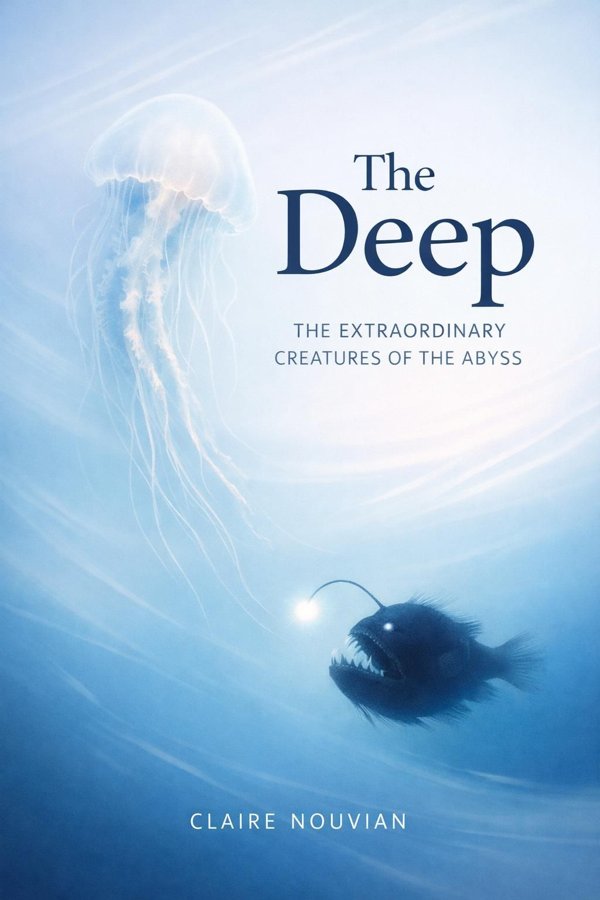
The Deep: The Extraordinary Creatures of the Abyss: Summary & Key Insights
 10 min10 chaptersAudio available
Key Takeaways from The Deep: The Extraordinary Creatures of the Abyss
The deep sea forces us to confront a humbling truth: life can flourish in conditions that seem utterly incompatible with survival.
Every great discovery begins with a new way of seeing.
One of the book’s most thrilling insights is that evolution is not conservative; when conditions demand it, life becomes wildly inventive.
Depth in the ocean is not just a measure of distance; it is a sequence of radically different worlds.
In the deep sea, light is not a backdrop.
What Is The Deep: The Extraordinary Creatures of the Abyss About?
The Deep: The Extraordinary Creatures of the Abyss by Claire Nouvian is a environment book spanning 10 pages. Claire Nouvian’s The Deep: The Extraordinary Creatures of the Abyss is a breathtaking exploration of one of Earth’s last great frontiers: the deep ocean. Blending scientific insight, environmental urgency, and extraordinary photography, the book reveals a world that exists far beyond ordinary human experience—a realm of crushing pressure, perpetual darkness, and astonishingly inventive life. Here, transparent predators drift like living glass, fish manufacture their own light, and ecosystems thrive without any dependence on sunlight. Nouvian’s achievement is to make this hidden universe feel both emotionally immediate and intellectually transformative. What makes the book matter is not only its beauty, but its argument: the deep sea is not an abstract wilderness detached from human life. It is a vital part of the planetary system, deeply connected to climate, biodiversity, and the health of the oceans as a whole. Nouvian writes with the authority of a journalist, documentary maker, and marine advocate who has devoted her career to making the unseen visible. The result is a work that inspires wonder while asking readers to rethink humanity’s relationship with the most remote habitats on Earth.
This FizzRead summary covers all 10 key chapters of The Deep: The Extraordinary Creatures of the Abyss in approximately 10 minutes, distilling the most important ideas, arguments, and takeaways from Claire Nouvian's work. Also available as an audio summary and Key Quotes Podcast.
The Deep: The Extraordinary Creatures of the Abyss
Claire Nouvian’s The Deep: The Extraordinary Creatures of the Abyss is a breathtaking exploration of one of Earth’s last great frontiers: the deep ocean. Blending scientific insight, environmental urgency, and extraordinary photography, the book reveals a world that exists far beyond ordinary human experience—a realm of crushing pressure, perpetual darkness, and astonishingly inventive life. Here, transparent predators drift like living glass, fish manufacture their own light, and ecosystems thrive without any dependence on sunlight. Nouvian’s achievement is to make this hidden universe feel both emotionally immediate and intellectually transformative.
What makes the book matter is not only its beauty, but its argument: the deep sea is not an abstract wilderness detached from human life. It is a vital part of the planetary system, deeply connected to climate, biodiversity, and the health of the oceans as a whole. Nouvian writes with the authority of a journalist, documentary maker, and marine advocate who has devoted her career to making the unseen visible. The result is a work that inspires wonder while asking readers to rethink humanity’s relationship with the most remote habitats on Earth.
Who Should Read The Deep: The Extraordinary Creatures of the Abyss?
This book is perfect for anyone interested in environment and looking to gain actionable insights in a short read. Whether you're a student, professional, or lifelong learner, the key ideas from The Deep: The Extraordinary Creatures of the Abyss by Claire Nouvian will help you think differently.
- ✓Readers who enjoy environment and want practical takeaways
- ✓Professionals looking to apply new ideas to their work and life
- ✓Anyone who wants the core insights of The Deep: The Extraordinary Creatures of the Abyss in just 10 minutes
Want the full summary?
Get instant access to this book summary and 100K+ more with Fizz Moment.
Get Free SummaryAvailable on App Store • Free to download
Key Chapters
The deep sea forces us to confront a humbling truth: life can flourish in conditions that seem utterly incompatible with survival. In the abyss, darkness is complete, temperatures are often near freezing, food is scarce, and pressure rises to levels that would instantly destroy unprotected human bodies. Yet this hostile environment is not empty. It is crowded with organisms whose existence expands our understanding of what life is capable of doing.
Nouvian shows that the abyss is not simply a deeper version of the familiar ocean. It is a fundamentally different world governed by scarcity, slowness, and extreme physical constraints. Creatures here have evolved soft bodies, flexible skeletons, low-energy lifestyles, and remarkable sensory systems suited to a place where sight may be useless and food may arrive only rarely. What appears barren to us is, from the perspective of evolution, a laboratory of radical adaptation.
This idea matters beyond marine biology. The deep sea reminds us that human intuitions are shaped by a narrow range of surface conditions. When policymakers, educators, or environmental communicators treat the ocean as a uniform space, they erase the complexity of habitats that differ as much as deserts differ from rainforests. For students, this chapter reframes biology as a study of possibility rather than normality. For conservationists, it offers a warning: fragile systems can be overlooked precisely because they are hard to imagine.
A useful way to apply this lesson is to challenge assumptions about “empty” places. Whether discussing oceans, wetlands, or polar regions, ask what hidden forms of life and interdependence may be present. The actionable takeaway: replace the word “remote” with “important” whenever you think about the deep ocean.
Every great discovery begins with a new way of seeing. For centuries, the deep ocean remained largely a space of speculation because humans lacked the tools to enter it. Nouvian emphasizes that our understanding of abyssal life did not expand through imagination alone, but through engineering: submersibles, remotely operated vehicles, high-sensitivity cameras, pressure-resistant lights, and sampling systems capable of functioning in extreme depths.
These technologies did more than confirm that life existed below. They transformed deep-sea research from fragmentary guesswork into direct observation. Instead of hauling damaged specimens to the surface and trying to infer how they lived, scientists could observe animals in motion, in context, and in relationship with their surroundings. Behavior suddenly mattered as much as anatomy. We could witness glowing signals, hunting strategies, drifting movements, and interactions around vents and seafloor habitats that would otherwise remain invisible.
Nouvian also makes a subtler point: tools shape knowledge. The cameras we build, the environments we can illuminate, and the species we can follow all influence what stories science tells. This has practical implications for research funding and public policy. When governments underinvest in ocean exploration, they are not merely delaying data collection; they are limiting humanity’s ability to understand a major part of its own planet.
Readers can apply this idea by recognizing the link between visibility and value. What cannot be seen is often easier to exploit or ignore. Supporting science museums, marine research institutions, educational media, and evidence-based conservation campaigns helps widen public vision. The actionable takeaway: whenever you encounter environmental debates, ask what technologies made the evidence possible and what remains unseen because the tools do not yet exist.
One of the book’s most thrilling insights is that evolution is not conservative; when conditions demand it, life becomes wildly inventive. Deep-sea creatures often look surreal because they are shaped by problems almost no surface animal must solve. How do you attract prey in total darkness? How do you find a mate when individuals are scattered across enormous distances? How do you conserve energy when food arrives unpredictably? The answers can seem fantastical: expandable jaws, transparent bodies, dangling bioluminescent lures, oversized teeth, gelatinous tissues, and reproductive strategies unlike anything seen on land.
Nouvian presents these forms not as curiosities but as logical responses to environmental constraints. The “monstrous” becomes elegant once we understand function. A fish with a huge mouth is not grotesque; it is designed to seize rare feeding opportunities. A nearly invisible jelly-like animal is not primitive; it is exquisitely adapted to drifting and surviving in a low-energy ecosystem. The deep sea teaches us to look past aesthetic bias and ask what an organism’s form allows it to do.
This perspective has applications far beyond ocean life. It sharpens systems thinking. In business, design, and ecology, unusual forms often emerge from unusual constraints. If you only judge outcomes by familiar standards, you miss the intelligence embedded in adaptation. Educators can use deep-sea organisms as compelling case studies in natural selection, resource efficiency, and problem solving under severe limitations.
The practical takeaway is simple: when something looks strange, ask what challenge it solves before judging it. In nature and in human systems, apparent oddity often signals a highly specialized solution.
Depth in the ocean is not just a measure of distance; it is a sequence of radically different worlds. Nouvian helps readers understand the deep not as a single undifferentiated abyss, but as layered ecological zones, each with its own rules. Below the sunlit surface lies the twilight zone, where light fades and vision begins to fail. Deeper still are the midnight waters, then the abyssal plains, and finally the hadal trenches—extreme depressions that form some of the most inaccessible habitats on Earth.
Each zone reshapes life. In the twilight zone, many animals still depend on dim silhouettes and vertical migration, rising toward the surface at night to feed and descending by day to avoid predators. In the true deep, sunlight disappears entirely, and bioluminescence becomes a critical language. On the abyssal seafloor, food may arrive as a slow rain of organic debris. In trenches, isolation, pressure, and sediment dynamics create highly specialized communities. The farther one descends, the less useful surface analogies become.
This zoning matters because it changes how we think about ocean management. A policy suitable for coastal fisheries may be irrelevant to mesopelagic communities or trench ecosystems. It also matters scientifically: climate change, carbon cycling, and biodiversity loss play out differently at different depths. The ocean is vertical as much as horizontal.
A practical way to use this insight is to adopt layered thinking in environmental discussions. Instead of speaking about “the ocean” as one place, ask: which depth, which zone, which ecological process? The actionable takeaway: train yourself to see environmental systems in layers, because meaningful understanding often begins when broad categories are broken into distinct habitats.
In the deep sea, light is not a backdrop. It is a tool, a trap, a shield, and sometimes a conversation. Nouvian treats bioluminescence as one of the defining innovations of abyssal life, showing how countless organisms produce light to navigate darkness in ways that are both beautiful and ruthlessly practical. Some species flash to startle predators. Others glow to attract prey. Some use counterillumination, lighting their undersides to erase their silhouettes when viewed from below. In a world without sunlight, self-made light becomes an evolutionary advantage of extraordinary versatility.
What makes this idea especially powerful is that it changes the way we understand communication. Bioluminescence is not merely decoration. It can signal species identity, reproductive readiness, territorial presence, or danger. It may function as a coded exchange visible only to certain eyes. Nouvian’s portraits of luminous creatures remind us that communication systems evolve from environmental constraints. The messages are inseparable from the medium.
There are useful parallels in human life. Organizations, educators, and leaders also communicate under conditions of limited attention and uncertainty. In such environments, signals must be clear, efficient, and adapted to context. Deep-sea bioluminescence becomes a metaphor for strategic expression: reveal only what helps survival, persuasion, or connection. Scientists, too, can learn from this clarity when translating complex research for public audiences.
The actionable takeaway is to examine your own signaling. Whether in writing, teaching, or advocacy, ask what your audience can actually perceive in a noisy environment. Like deep-sea creatures, communicate with precision, not excess.
Abundance is not the default condition of life. In much of the deep ocean, survival depends on coping with chronic shortage. Nouvian explains that away from hydrothermal vents and other exceptional habitats, most deep-sea ecosystems rely on what drifts down from above: marine snow, sinking carcasses, fecal pellets, and fragments of organic matter produced in sunlit waters. This slow rain of energy supports a food web built around patience, opportunism, and efficiency.
Because food is limited, deep-sea animals often have low metabolic rates and highly specialized feeding strategies. Some drift and wait. Some scavenge anything edible. Some can gorge when food appears and endure long intervals without eating. Even a whale fall—a dead whale sinking to the seafloor—can become a temporary feast that sustains an entire succession of organisms for years. In this world, energy is precious, and waste is minimized by necessity.
The broader lesson is ecological and moral. Surface societies often behave as if resources are endless, but the deep sea demonstrates the opposite principle: systems endure when energy use is efficient and when organisms are adapted to scarcity rather than excess. This has implications for sustainability, circular economies, and food systems. Waste on land and at sea looks especially reckless when viewed against ecosystems where every particle matters.
Readers can apply this insight by becoming more aware of resource flows. Ask where food, materials, and energy come from, how much is lost, and who depends on what is discarded. The actionable takeaway: practice respect for limited resources, because the deep sea shows that resilience often begins with learning how to live well under constraint.
Few discoveries have been as intellectually disruptive as hydrothermal vents. Nouvian presents them as a scientific revelation because they overturned one of biology’s deepest assumptions: that complex ecosystems ultimately depend on sunlight. Around these fissures in the seafloor, superheated, mineral-rich fluids gush into cold dark water, and entire communities thrive not through photosynthesis but through chemosynthesis. Bacteria convert chemical energy into organic matter, forming the base of food webs populated by tube worms, clams, crustaceans, and other specialized organisms.
This discovery changed more than marine science. It altered our picture of life’s flexibility, Earth’s biogeochemistry, and even the search for extraterrestrial life. If ecosystems can flourish in darkness using chemical energy, then habitable environments may exist in places once dismissed as impossible, including subsurface oceans on icy moons. Hydrothermal vents also reveal how narrow human assumptions can be. We often mistake the conditions familiar to us for the conditions required by life itself.
At a practical level, vent systems teach a valuable lesson about paradigm shifts. Breakthroughs often occur when an observation does not fit the prevailing model and scientists remain curious instead of defensive. This mindset is relevant in research, business innovation, and public policy. When facts destabilize a comfortable worldview, the right response is not denial but revision.
The actionable takeaway: seek out examples that challenge your core assumptions. The deep sea’s vent communities remind us that reality is often larger, stranger, and more generative than the frameworks we inherit.
The deep sea is often imagined as silent and still, but Nouvian reveals it as a place of intense biological drama. Predation in the abyss is shaped by darkness and scarcity, creating strategies that are at once brutal and exquisitely refined. Ambush predators use glowing lures. Opportunistic hunters exploit rare encounters. Some species possess giant mouths or distensible stomachs, allowing them to seize prey larger than themselves because the next chance to feed may be far away. In an energy-poor environment, hesitation can be fatal.
Yet predation also reveals interdependence. Predator and prey shape each other over evolutionary time. Defensive transparency, bioluminescent decoys, camouflage, toxin production, and erratic movement all emerge in response to hunting pressure. Nouvian’s images and descriptions highlight not just violence, but adaptation as relationship. Survival is never solitary. Every body in the deep carries the imprint of other bodies trying to eat it, avoid it, or outwit it.
This idea offers a broader lesson about competition. We often imagine competition as a separate force from cooperation, but in ecosystems the two are intertwined within a network of mutual shaping. Even adversarial relationships drive innovation and complexity. In human systems, markets, institutions, and communities also evolve through pressure, feedback, and adaptation.
A practical application is to view challenge not only as threat, but as information. Pressure can reveal weaknesses, sharpen capabilities, and stimulate redesign. The actionable takeaway: when facing competition or adversity, ask what adaptation the environment is demanding from you rather than merely trying to preserve the status quo.
To see clearly is often the first step toward caring deeply. Nouvian’s book is not only a scientific account of abyssal life; it is an argument for the power of images. Photography, especially in the context of deep-sea exploration, does more than illustrate facts. It alters emotional distance. Creatures that might otherwise remain abstract become singular, vivid, and unforgettable. A translucent jelly, a glowing siphonophore, or a fish with improbable anatomy can provoke wonder before any explanation begins.
This matters because environmental concern is rarely generated by data alone. Statistics can inform, but images can convert indifference into attention. Nouvian understands that awe is not superficial; it can be ethically productive. When we perceive beauty, strangeness, and vulnerability in a hidden ecosystem, we become more willing to defend it. Art and science, rather than opposing each other, become partners in truth-telling.
There is a practical lesson here for communicators of all kinds. If you want people to engage with complexity, do not rely only on argument. Use forms that make the unseen perceptible and the distant personal. Visual storytelling, metaphor, design, and narrative can carry knowledge across emotional barriers. This is especially important in conservation, where many of the most urgent threats affect places ordinary citizens will never visit.
The actionable takeaway: when you learn something important, ask how it can be made visible to others. Facts persuade the mind, but images and stories often open the door through which facts can enter.
All Chapters in The Deep: The Extraordinary Creatures of the Abyss
About the Author
Claire Nouvian is a French journalist, documentary filmmaker, author, and environmental activist whose work focuses on marine biodiversity and ocean protection. She became widely known for bringing the hidden life of the deep sea to public attention through a combination of scientific rigor and striking visual storytelling. Nouvian has a gift for translating specialized research into narratives that are accessible, memorable, and emotionally powerful. Beyond her writing, she is the founder of BLOOM, a nonprofit organization dedicated to conserving marine ecosystems and challenging destructive fishing practices. Her career bridges journalism, advocacy, and education, giving her unusual authority in environmental communication. In The Deep, she draws on these strengths to reveal the abyss not as a distant curiosity, but as a vital and vulnerable part of Earth’s living system.
Get This Summary in Your Preferred Format
Read or listen to the The Deep: The Extraordinary Creatures of the Abyss summary by Claire Nouvian anytime, anywhere. FizzRead offers multiple formats so you can learn on your terms — all free.
Available formats: App · Audio · PDF · EPUB — All included free with FizzRead
Download The Deep: The Extraordinary Creatures of the Abyss PDF and EPUB Summary
Key Quotes from The Deep: The Extraordinary Creatures of the Abyss
“The deep sea forces us to confront a humbling truth: life can flourish in conditions that seem utterly incompatible with survival.”
“Every great discovery begins with a new way of seeing.”
“One of the book’s most thrilling insights is that evolution is not conservative; when conditions demand it, life becomes wildly inventive.”
“Depth in the ocean is not just a measure of distance; it is a sequence of radically different worlds.”
“In the deep sea, light is not a backdrop.”
Frequently Asked Questions about The Deep: The Extraordinary Creatures of the Abyss
The Deep: The Extraordinary Creatures of the Abyss by Claire Nouvian is a environment book that explores key ideas across 10 chapters. Claire Nouvian’s The Deep: The Extraordinary Creatures of the Abyss is a breathtaking exploration of one of Earth’s last great frontiers: the deep ocean. Blending scientific insight, environmental urgency, and extraordinary photography, the book reveals a world that exists far beyond ordinary human experience—a realm of crushing pressure, perpetual darkness, and astonishingly inventive life. Here, transparent predators drift like living glass, fish manufacture their own light, and ecosystems thrive without any dependence on sunlight. Nouvian’s achievement is to make this hidden universe feel both emotionally immediate and intellectually transformative. What makes the book matter is not only its beauty, but its argument: the deep sea is not an abstract wilderness detached from human life. It is a vital part of the planetary system, deeply connected to climate, biodiversity, and the health of the oceans as a whole. Nouvian writes with the authority of a journalist, documentary maker, and marine advocate who has devoted her career to making the unseen visible. The result is a work that inspires wonder while asking readers to rethink humanity’s relationship with the most remote habitats on Earth.
You Might Also Like
A Life on Our Planet: My Witness Statement and a Vision for the Future
David Attenborough
10 min
A Sky Full Of Birds
Matt Merritt
10 min
Carbon Zero: Imagining Cities That Can Save the Planet
Alex Steffen
10 min
Eaarth: Making a Life on a Tough New Planet
Bill McKibben
10 min
The Social Contract and Environmental Governance
Various Editors
10 min
The Wild Places
Robert Macfarlane
10 minBrowse by Category
Ready to read The Deep: The Extraordinary Creatures of the Abyss?
Get the full summary and 100K+ more books with Fizz Moment.