
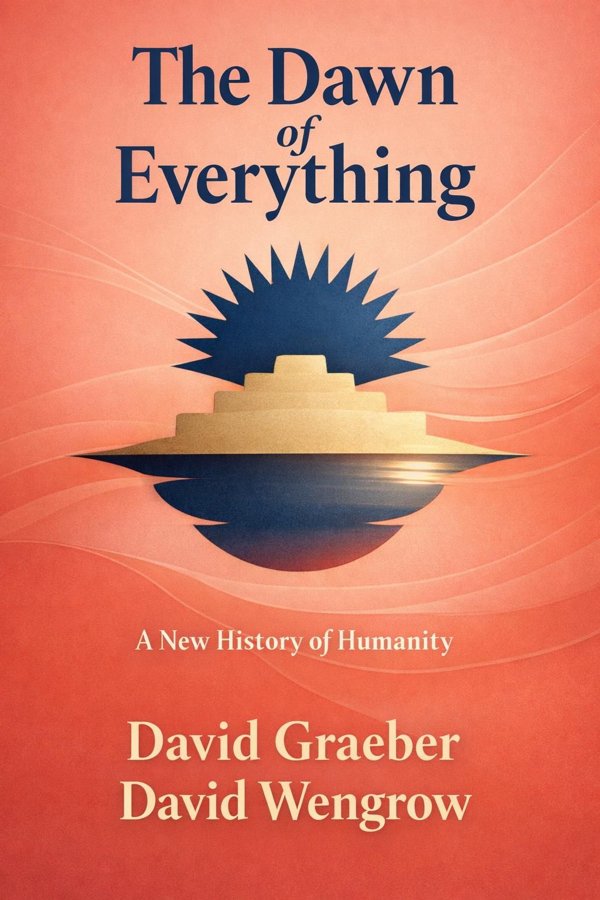
The Dawn of Everything: A New History of Humanity: Summary & Key Insights
by David Graeber, David Wengrow
 10 min13 chaptersAudio available
What Is The Dawn of Everything: A New History of Humanity About?
The Dawn of Everything: A New History of Humanity by David Graeber, David Wengrow is a civilization book spanning 13 pages. A groundbreaking reinterpretation of human history that challenges conventional narratives about the origins of civilization, inequality, and social organization. Anthropologist David Graeber and archaeologist David Wengrow draw on recent archaeological and anthropological discoveries to argue that early human societies were far more diverse, experimental, and egalitarian than previously believed. The book invites readers to rethink the story of humanity’s past and the possibilities for its future.
This FizzRead summary covers all 13 key chapters of The Dawn of Everything: A New History of Humanity in approximately 10 minutes, distilling the most important ideas, arguments, and takeaways from David Graeber, David Wengrow's work. Also available as an audio summary and Key Quotes Podcast.
The Dawn of Everything: A New History of Humanity
A groundbreaking reinterpretation of human history that challenges conventional narratives about the origins of civilization, inequality, and social organization. Anthropologist David Graeber and archaeologist David Wengrow draw on recent archaeological and anthropological discoveries to argue that early human societies were far more diverse, experimental, and egalitarian than previously believed. The book invites readers to rethink the story of humanity’s past and the possibilities for its future.
Who Should Read The Dawn of Everything: A New History of Humanity?
This book is perfect for anyone interested in civilization and looking to gain actionable insights in a short read. Whether you're a student, professional, or lifelong learner, the key ideas from The Dawn of Everything: A New History of Humanity by David Graeber, David Wengrow will help you think differently.
- ✓Readers who enjoy civilization and want practical takeaways
- ✓Professionals looking to apply new ideas to their work and life
- ✓Anyone who wants the core insights of The Dawn of Everything: A New History of Humanity in just 10 minutes
Want the full summary?
Get instant access to this book summary and 100K+ more with Fizz Moment.
Get Free SummaryAvailable on App Store • Free to download
Key Chapters
For centuries, Western thought traced the birth of inequality to a fable — the myth of humanity’s fall from some pristine state of nature. Philosophers like Rousseau imagined early humans as simple, innocent beings who were corrupted by property and civilization. That story is deceptively comforting because it tells us that our struggles began long ago and that we are prisoners of progress. I argue that this narrative, born out of the Enlightenment’s own contradictions, has been mistaken for fact.
When European thinkers debated the 'state of nature', they were not describing archaeological evidence. They were processing encounters with Indigenous societies in North America, where observers like Lahontan and others were astonished by communities that lived without kings yet practiced complex forms of governance and debate. Those Indigenous intellectuals, especially Wendat leaders, critiqued European inequality directly, pointing out its absurdities — how could people who called themselves 'free' tolerate servitude and destitution in their midst?
Thus, what Rousseau and his contemporaries called the 'state of nature' was never a scientific model; it was a reaction to political critique from beyond Europe. Our task, then, is not to romanticize equality as lost innocence but to see it as a conscious, recurring social choice. Inequality did not begin once and forever; it was constructed repeatedly, and sometimes dismantled. The real origin story of inequality is not about the moment we built hierarchies but the many moments we built alternatives and then abandoned them. That flexibility, not helplessness, defines the human condition.
The older social evolutionary ladder — from bands to tribes to chiefdoms to states — still dominates classrooms and policy discussions alike. Yet, when we look closely at archaeological and ethnographic data, that linear model collapses. Gone is the notion that small societies were inherently egalitarian and large ones doomed to bureaucracy. Across time, we find cities without rulers, bands with aristocrats, and states that swung back toward decentralization.
Human history doesn’t move in one direction. It resembles a tapestry woven from reversals and experiments. In the ancient world, there were countless communities that evolved more than once — sometimes abandoning central authority, sometimes reinventing it. The people of the Ohio River Valley built monumental earthen mounds only to leave them behind. The inhabitants of Çatalhöyük lived in densely packed neighborhoods for centuries without temples or palaces. This variety is not the residue of transition; it is the evidence of agency. People weren’t waiting for the 'next stage' to arrive — they were playing with the possibilities of how to live together.
The evolutionary model’s tragedy is that it confines imagination. When we insist that modern complexity requires hierarchy, we forget the complexity of societies that rejected rulers altogether. The book urges you to unlearn that chain of command within historical thought. Once you do, the past brims with evidence of conscious design, of communities shaping and reshaping themselves — not progressing, but experimenting. That is our true lineage.
+ 11 more chapters — available in the FizzRead app
All Chapters in The Dawn of Everything: A New History of Humanity
About the Authors
David Graeber (1961–2020) was an American anthropologist and activist known for his influential works on social theory and economics, including 'Debt: The First 5,000 Years'. David Wengrow is a British archaeologist and professor at University College London, specializing in the archaeology of early societies and the origins of inequality.
Get This Summary in Your Preferred Format
Read or listen to the The Dawn of Everything: A New History of Humanity summary by David Graeber, David Wengrow anytime, anywhere. FizzRead offers multiple formats so you can learn on your terms — all free.
Available formats: App · Audio · PDF · EPUB — All included free with FizzRead
Download The Dawn of Everything: A New History of Humanity PDF and EPUB Summary
Key Quotes from The Dawn of Everything: A New History of Humanity
“For centuries, Western thought traced the birth of inequality to a fable — the myth of humanity’s fall from some pristine state of nature.”
“The older social evolutionary ladder — from bands to tribes to chiefdoms to states — still dominates classrooms and policy discussions alike.”
Frequently Asked Questions about The Dawn of Everything: A New History of Humanity
The Dawn of Everything: A New History of Humanity by David Graeber, David Wengrow is a civilization book that explores key ideas across 13 chapters. A groundbreaking reinterpretation of human history that challenges conventional narratives about the origins of civilization, inequality, and social organization. Anthropologist David Graeber and archaeologist David Wengrow draw on recent archaeological and anthropological discoveries to argue that early human societies were far more diverse, experimental, and egalitarian than previously believed. The book invites readers to rethink the story of humanity’s past and the possibilities for its future.
You Might Also Like
The Structure of Scientific Revolutions
Thomas S. Kuhn
10 min
Genius
Harold Bloom
10 min
A Cultural History of the Medieval Age
Various Editors
10 min
A History of God: The 4,000-Year Quest of Judaism, Christianity and Islam
Karen Armstrong
10 min
A History of the World in 10½ Chapters
Julian Barnes
10 min
A Short History of Progress
Ronald Wright
10 minBrowse by Category
Ready to read The Dawn of Everything: A New History of Humanity?
Get the full summary and 100K+ more books with Fizz Moment.