
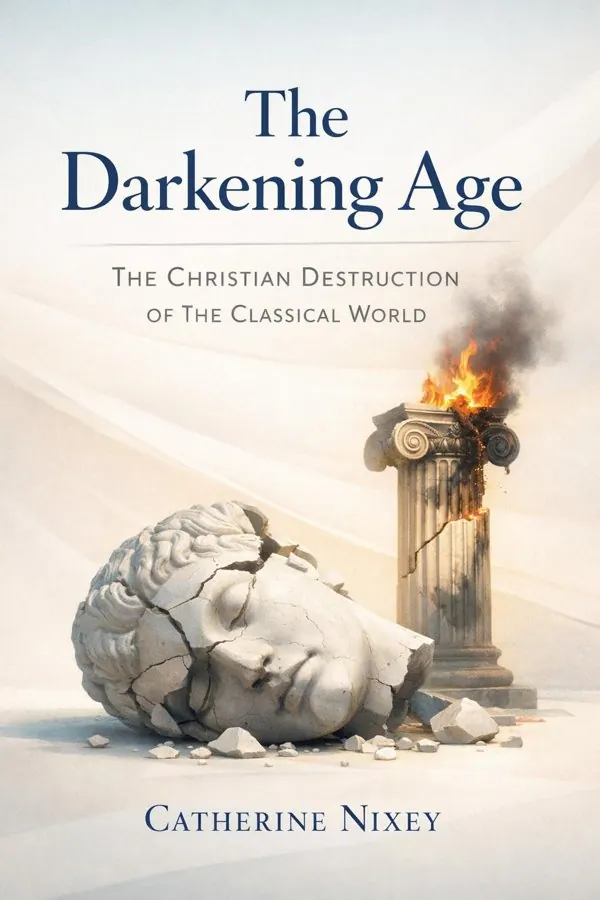
The Darkening Age: The Christian Destruction of the Classical World: Summary & Key Insights
 10 min10 chaptersAudio available
What Is The Darkening Age: The Christian Destruction of the Classical World About?
The Darkening Age: The Christian Destruction of the Classical World by Catherine Nixey is a civilization book spanning 10 pages. A provocative history that explores how early Christian zealots systematically destroyed the art, literature, and philosophy of classical antiquity. Catherine Nixey reveals how the rise of Christianity led to the suppression of pagan culture, the closure of philosophical schools, and the loss of much of the ancient world’s intellectual heritage.
This FizzRead summary covers all 10 key chapters of The Darkening Age: The Christian Destruction of the Classical World in approximately 10 minutes, distilling the most important ideas, arguments, and takeaways from Catherine Nixey's work. Also available as an audio summary and Key Quotes Podcast.
The Darkening Age: The Christian Destruction of the Classical World
A provocative history that explores how early Christian zealots systematically destroyed the art, literature, and philosophy of classical antiquity. Catherine Nixey reveals how the rise of Christianity led to the suppression of pagan culture, the closure of philosophical schools, and the loss of much of the ancient world’s intellectual heritage.
Who Should Read The Darkening Age: The Christian Destruction of the Classical World?
This book is perfect for anyone interested in civilization and looking to gain actionable insights in a short read. Whether you're a student, professional, or lifelong learner, the key ideas from The Darkening Age: The Christian Destruction of the Classical World by Catherine Nixey will help you think differently.
- ✓Readers who enjoy civilization and want practical takeaways
- ✓Professionals looking to apply new ideas to their work and life
- ✓Anyone who wants the core insights of The Darkening Age: The Christian Destruction of the Classical World in just 10 minutes
Want the full summary?
Get instant access to this book summary and 100K+ more with Fizz Moment.
Get Free SummaryAvailable on App Store • Free to download
Key Chapters
Before Christianity rose to power, the Greco-Roman world teemed with intellectual ferment and aesthetic brilliance. It was a civilization where philosophers engaged in public debate, sculptors raised marble into gods, and poets sang of humanity’s noblest and darkest passions. The gods themselves — playful, flawed, and deeply human — reflected a universe of multiplicity and paradox. This was a society that embraced questioning as a form of reverence; to doubt was to think, and to think was to honor reason.
In this world, temples were not merely places of worship but spaces of civic pride and artistic display. The city of Athens still shimmered with the memory of Socrates and Plato, while Alexandria stood as the beacon of learning, its libraries housing hundreds of thousands of manuscripts. Freedom of thought was not universal, but it was cherished. Philosophy was not peripheral — it was the heartbeat of existence. The Stoics urged virtue as harmony with reason; the Epicureans sought peace through understanding nature. Such ideas shaped policy, art, and even scientific inquiry.
Yet this vibrancy also bore seeds of fragility. The empire’s tolerance was double-edged. The pagan world was expansive, but it was not immune to disillusionment. As social hierarchies hardened and injustice grew, many turned toward spiritual purity and moral renewal. Into this landscape of yearning stepped Christianity, offering a compelling simplicity: one truth, one God, and one salvation. The pluralistic order that had defined classical civilization would soon meet its most determined opponent.
Christianity’s early progress through the Roman Empire was uneven but relentless. At first persecuted as a sect of subversive mystics, Christians gradually built a counterculture grounded in exclusivity. Their refusal to honor the pagan gods was both courageous and destabilizing. The Roman state, which relied on religious pluralism for social cohesion, found Christian defiance nearly intolerable. Yet persecution bred resilience. The faith’s message — that the poor and humble would inherit eternity — appealed to the downtrodden. Its structure, centered on community and martyrdom, appealed to those seeking moral certainty in a decaying world.
When Emperor Constantine legalized Christianity in the early fourth century, the faith’s transformation from minority to majority began in earnest. With imperial backing came unprecedented power — and the tone changed from defensive to aggressive. The symbols of Rome were baptized, the churches rose over temples, and the images of ancient gods were dismantled or rebranded as demons. Christianity was no longer one sect among many; it was the new orthodoxy, destined to dominate — and to purge what it found dangerous.
But what had been born in persecution would become a persecutor itself. Constantine’s successors — from Theodosius to Justinian — fused faith and state into one machinery of orthodoxy. With that, the old world’s concepts of inquiry and artistic reverence would collapse under the weight of divine certainty.
+ 8 more chapters — available in the FizzRead app
All Chapters in The Darkening Age: The Christian Destruction of the Classical World
About the Author
Catherine Nixey is a British journalist and author, formerly a classics scholar at Cambridge University. She writes for The Economist and is known for her engaging works on history and culture, particularly focusing on the intersection of religion and classical civilization.
Get This Summary in Your Preferred Format
Read or listen to the The Darkening Age: The Christian Destruction of the Classical World summary by Catherine Nixey anytime, anywhere. FizzRead offers multiple formats so you can learn on your terms — all free.
Available formats: App · Audio · PDF · EPUB — All included free with FizzRead
Download The Darkening Age: The Christian Destruction of the Classical World PDF and EPUB Summary
Key Quotes from The Darkening Age: The Christian Destruction of the Classical World
“Before Christianity rose to power, the Greco-Roman world teemed with intellectual ferment and aesthetic brilliance.”
“Christianity’s early progress through the Roman Empire was uneven but relentless.”
Frequently Asked Questions about The Darkening Age: The Christian Destruction of the Classical World
The Darkening Age: The Christian Destruction of the Classical World by Catherine Nixey is a civilization book that explores key ideas across 10 chapters. A provocative history that explores how early Christian zealots systematically destroyed the art, literature, and philosophy of classical antiquity. Catherine Nixey reveals how the rise of Christianity led to the suppression of pagan culture, the closure of philosophical schools, and the loss of much of the ancient world’s intellectual heritage.
You Might Also Like
The Structure of Scientific Revolutions
Thomas S. Kuhn
10 min
Genius
Harold Bloom
10 min
A Cultural History of the Medieval Age
Various Editors
10 min
A History of God: The 4,000-Year Quest of Judaism, Christianity and Islam
Karen Armstrong
10 min
A History of the World in 10½ Chapters
Julian Barnes
10 min
A Short History of Progress
Ronald Wright
10 minBrowse by Category
Ready to read The Darkening Age: The Christian Destruction of the Classical World?
Get the full summary and 100K+ more books with Fizz Moment.