
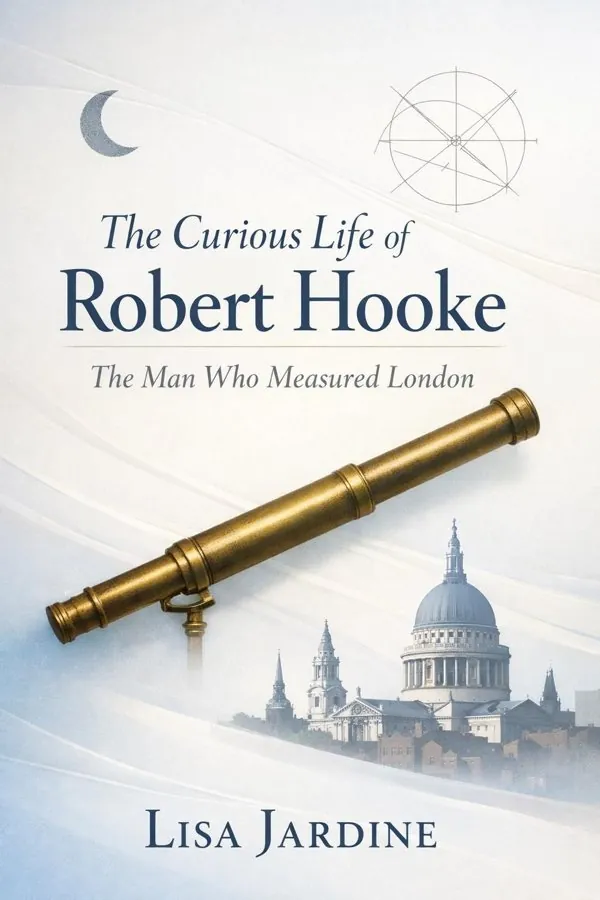
The Curious Life of Robert Hooke: The Man Who Measured London: Summary & Key Insights
by Lisa Jardine
 10 min8 chaptersAudio available
What Is The Curious Life of Robert Hooke: The Man Who Measured London About?
The Curious Life of Robert Hooke: The Man Who Measured London by Lisa Jardine is a biographies book spanning 8 pages. This biography explores the life and scientific contributions of Robert Hooke, a seventeenth-century English polymath known for his work in physics, biology, and architecture. Jardine presents Hooke as a complex figure whose curiosity and ingenuity shaped the early scientific revolution, highlighting his collaborations and rivalries with figures such as Isaac Newton and Christopher Wren.
This FizzRead summary covers all 8 key chapters of The Curious Life of Robert Hooke: The Man Who Measured London in approximately 10 minutes, distilling the most important ideas, arguments, and takeaways from Lisa Jardine's work. Also available as an audio summary and Key Quotes Podcast.
The Curious Life of Robert Hooke: The Man Who Measured London
This biography explores the life and scientific contributions of Robert Hooke, a seventeenth-century English polymath known for his work in physics, biology, and architecture. Jardine presents Hooke as a complex figure whose curiosity and ingenuity shaped the early scientific revolution, highlighting his collaborations and rivalries with figures such as Isaac Newton and Christopher Wren.
Who Should Read The Curious Life of Robert Hooke: The Man Who Measured London?
This book is perfect for anyone interested in biographies and looking to gain actionable insights in a short read. Whether you're a student, professional, or lifelong learner, the key ideas from The Curious Life of Robert Hooke: The Man Who Measured London by Lisa Jardine will help you think differently.
- ✓Readers who enjoy biographies and want practical takeaways
- ✓Professionals looking to apply new ideas to their work and life
- ✓Anyone who wants the core insights of The Curious Life of Robert Hooke: The Man Who Measured London in just 10 minutes
Want the full summary?
Get instant access to this book summary and 100K+ more with Fizz Moment.
Get Free SummaryAvailable on App Store • Free to download
Key Chapters
Robert Hooke’s childhood on the Isle of Wight is often romanticized as an idyll of mechanical play, but in reality it was a struggle marked by fragility and introspection. Frail in body but fierce in curiosity, Hooke disassembled clocks, toys, and even the mechanisms of his household simply to understand their secret workings. That compulsion to uncover function—never to take for granted the appearances of things—would define his entire life. At Westminster School, under the stern guidance of Richard Busby, he discovered mathematics and drawing. His extraordinary capacity for observation was evident even then: he could copy complex designs from memory, sketch anatomical details with precision, and render architectural perspectives that seemed almost prophetic. Those early skills, born of isolation and relentless self-training, made him the perfect bridge between the artisanal and the intellectual worlds of the seventeenth century. In Hooke’s young hands, the new philosophy of experiment would one day find its most practical craftsman.
Oxford in the 1650s was not only a university but a crucible. Hooke’s years there, working under Robert Boyle, reveal the collaborative and experimental spirit that powered the new science. He was not a gentleman-scholar but a working intellect—a technician who made instruments, repaired lenses, and constructed the very devices through which theoretical claims could be tested. The air pump project demonstrated this perfectly. Boyle provided the ideas and the funds; Hooke designed and built the machine capable of creating a vacuum, allowing them to observe the behavior of air and life under pressure. Out of this partnership came Boyle’s Law—one of the fundamental relationships in physics—but Hooke’s role was not merely mechanical. He supplied insight, refinement, and a critical instinct for proof. This period confirmed for him that knowledge demands apparatus, that the hands are as crucial as the mind in making discovery possible. It was in Boyle’s laboratory that Hooke became conscious of himself not just as a helper, but as a philosopher-engineer, one who could both imagine and demonstrate nature’s laws.
+ 6 more chapters — available in the FizzRead app
All Chapters in The Curious Life of Robert Hooke: The Man Who Measured London
About the Author
Lisa Jardine (1944–2015) was a British historian of science and Renaissance scholar. She served as Professor of Renaissance Studies at University College London and was known for her accessible works on early modern science and culture.
Get This Summary in Your Preferred Format
Read or listen to the The Curious Life of Robert Hooke: The Man Who Measured London summary by Lisa Jardine anytime, anywhere. FizzRead offers multiple formats so you can learn on your terms — all free.
Available formats: App · Audio · PDF · EPUB — All included free with FizzRead
Download The Curious Life of Robert Hooke: The Man Who Measured London PDF and EPUB Summary
Key Quotes from The Curious Life of Robert Hooke: The Man Who Measured London
“Robert Hooke’s childhood on the Isle of Wight is often romanticized as an idyll of mechanical play, but in reality it was a struggle marked by fragility and introspection.”
“Oxford in the 1650s was not only a university but a crucible.”
Frequently Asked Questions about The Curious Life of Robert Hooke: The Man Who Measured London
The Curious Life of Robert Hooke: The Man Who Measured London by Lisa Jardine is a biographies book that explores key ideas across 8 chapters. This biography explores the life and scientific contributions of Robert Hooke, a seventeenth-century English polymath known for his work in physics, biology, and architecture. Jardine presents Hooke as a complex figure whose curiosity and ingenuity shaped the early scientific revolution, highlighting his collaborations and rivalries with figures such as Isaac Newton and Christopher Wren.
You Might Also Like

An American Marriage
Tayari Jones
10 min
Benjamin Franklin: An American Life
Walter Isaacson
10 min
I Know Why The Caged Bird Sings
Maya Angelou
10 min
Long Walk to Freedom
Nelson Mandela
10 min
Persepolis
Marjane Satrapi
10 min
Surely You're Joking, Mr. Feynman!
Richard P. Feynman
10 minBrowse by Category
Ready to read The Curious Life of Robert Hooke: The Man Who Measured London?
Get the full summary and 100K+ more books with Fizz Moment.