
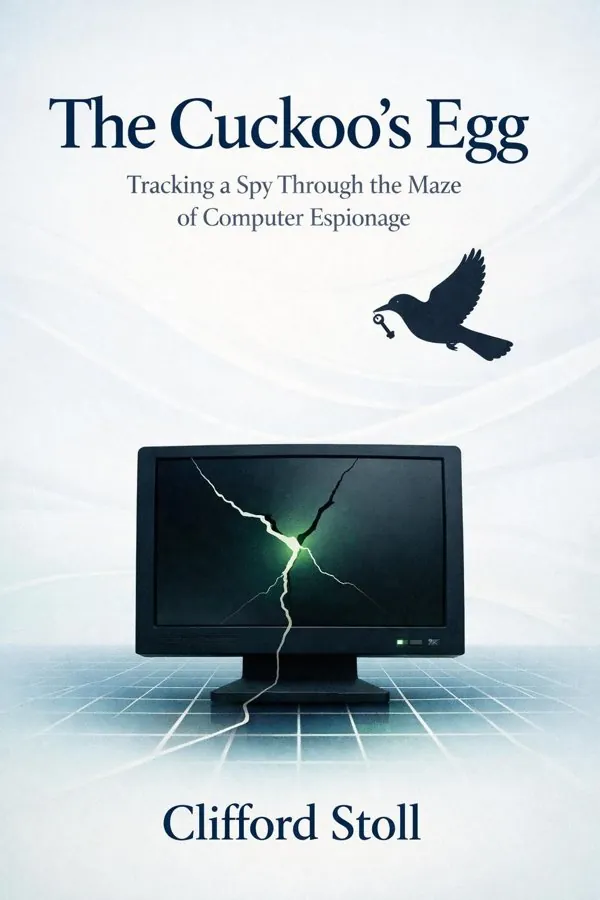
The Cuckoo’s Egg: Tracking a Spy Through the Maze of Computer Espionage: Summary & Key Insights
 10 min5 chaptersAudio available
What Is The Cuckoo’s Egg: Tracking a Spy Through the Maze of Computer Espionage About?
The Cuckoo’s Egg: Tracking a Spy Through the Maze of Computer Espionage by Clifford Stoll is a law_crime book spanning 5 pages. The Cuckoo’s Egg is a nonfiction account by astronomer and systems administrator Clifford Stoll, who uncovered one of the first documented cases of computer espionage. The book recounts how Stoll discovered a 75-cent accounting error at Lawrence Berkeley Laboratory in 1986, which led him to track a hacker infiltrating U.S. computer networks and selling information to the KGB. The narrative combines technical investigation, Cold War intrigue, and the early culture of the Internet, offering a vivid look at the dawn of cybersecurity.
This FizzRead summary covers all 5 key chapters of The Cuckoo’s Egg: Tracking a Spy Through the Maze of Computer Espionage in approximately 10 minutes, distilling the most important ideas, arguments, and takeaways from Clifford Stoll's work. Also available as an audio summary and Key Quotes Podcast.
The Cuckoo’s Egg: Tracking a Spy Through the Maze of Computer Espionage
The Cuckoo’s Egg is a nonfiction account by astronomer and systems administrator Clifford Stoll, who uncovered one of the first documented cases of computer espionage. The book recounts how Stoll discovered a 75-cent accounting error at Lawrence Berkeley Laboratory in 1986, which led him to track a hacker infiltrating U.S. computer networks and selling information to the KGB. The narrative combines technical investigation, Cold War intrigue, and the early culture of the Internet, offering a vivid look at the dawn of cybersecurity.
Who Should Read The Cuckoo’s Egg: Tracking a Spy Through the Maze of Computer Espionage?
This book is perfect for anyone interested in law_crime and looking to gain actionable insights in a short read. Whether you're a student, professional, or lifelong learner, the key ideas from The Cuckoo’s Egg: Tracking a Spy Through the Maze of Computer Espionage by Clifford Stoll will help you think differently.
- ✓Readers who enjoy law_crime and want practical takeaways
- ✓Professionals looking to apply new ideas to their work and life
- ✓Anyone who wants the core insights of The Cuckoo’s Egg: Tracking a Spy Through the Maze of Computer Espionage in just 10 minutes
Want the full summary?
Get instant access to this book summary and 100K+ more with Fizz Moment.
Get Free SummaryAvailable on App Store • Free to download
Key Chapters
It began almost absurdly. Our laboratory computing center billed users for system time, and one day, while reviewing the usage logs, I noticed an unexplained discrepancy—75 cents missing from the accounts. No one else cared. After all, seventy-five cents wouldn’t even buy a cup of coffee. But I cared, because errors meant something was off, and computers don’t just misplace cents for fun. That insignificant number became the clue to a mystery that consumed me for more than a year.
I combed through old records, tracing every logged user, every entry, and every machine accessing our PDP-10 computer. The pattern showed an elusive, unauthorized user connecting through a dial-up line. We were in the age of terminals and telephone modems, so a modem’s hum was like the heartbeat of connectivity. This intruder’s pulse appeared in our logs night after night. Whoever it was, they had broken into our system—and perhaps other systems—without anyone noticing.
The moment I realized what I was seeing wasn’t an accident but a deliberate intrusion, everything changed. The small accounting glitch became a doorway into an underground network of compromised computers. The hacker wasn’t stealing money; he was stealing information. I felt both alarmed and exhilarated: alarmed because no one else seemed to grasp the danger, and exhilarated because each clue drew me deeper into a puzzle only I seemed willing to solve.
Those early days taught me that science and detective work share a common thread: both demand patience and precision. You don’t need to know everything about the machinery to find the truth; you only need curiosity strong enough to follow the noise. That unwavering curiosity was my constant companion as I built scripts, logged sessions, and began plotting every keystroke of my mysterious visitor.
Once I set up my monitoring tools, the pattern became clear—the hacker was bouncing from system to system, exploiting weak passwords and security loopholes across multiple institutions. The Internet, or more precisely the ARPANET, was a small world then, mostly universities and research agencies tied together by trust. Security was practically an afterthought; every system assumed its users were friendly scientists sharing data for research. That culture of openness was exactly what the intruder preyed upon.
I watched as he probed military networks, explored files marked ‘classified,’ and mapped out directories to steal research related to missile guidance and nuclear systems. Each new trace expanded the scope. He wasn’t just wandering through our machine—he was gliding through dozens of them, using our laboratory’s network as a stepping stone. It felt like standing at the edge of a storm, watching lightning illuminate connections that everyone else thought were invisible.
I worked with colleagues to trace IP addresses, although at the time, they weren’t the stable identifiers they are today. Routes were fluid and logs inconsistent; tracing an electronic signal was as much art as science. Nights stretched into mornings as we pieced together the hacker’s path. What amazed me most was how primitive yet powerful these digital footprints were—a few lines of text showing who connected, from where, and when. The data was fragile, yet it spoke loudly of intent.
Every step of the chase confirmed a growing truth: our network was porous, vulnerable by design. The hacker’s success was a warning that this new digital landscape, driven by curiosity and openness, could also harbor malice. And as I watched him slip from one machine to the next, I realized that the line between researcher and spy was becoming terrifyingly thin.
+ 3 more chapters — available in the FizzRead app
All Chapters in The Cuckoo’s Egg: Tracking a Spy Through the Maze of Computer Espionage
About the Author
Clifford Stoll is an American astronomer, author, and teacher known for his work in computer security and his engaging science communication. He earned a Ph.D. in astronomy from the University of Arizona and worked at Lawrence Berkeley National Laboratory, where he uncovered a major espionage case that inspired The Cuckoo’s Egg. Stoll has since written several books and is recognized for his advocacy of hands-on learning and skepticism toward digital overreliance.
Get This Summary in Your Preferred Format
Read or listen to the The Cuckoo’s Egg: Tracking a Spy Through the Maze of Computer Espionage summary by Clifford Stoll anytime, anywhere. FizzRead offers multiple formats so you can learn on your terms — all free.
Available formats: App · Audio · PDF · EPUB — All included free with FizzRead
Download The Cuckoo’s Egg: Tracking a Spy Through the Maze of Computer Espionage PDF and EPUB Summary
Key Quotes from The Cuckoo’s Egg: Tracking a Spy Through the Maze of Computer Espionage
“Our laboratory computing center billed users for system time, and one day, while reviewing the usage logs, I noticed an unexplained discrepancy—75 cents missing from the accounts.”
“Once I set up my monitoring tools, the pattern became clear—the hacker was bouncing from system to system, exploiting weak passwords and security loopholes across multiple institutions.”
Frequently Asked Questions about The Cuckoo’s Egg: Tracking a Spy Through the Maze of Computer Espionage
The Cuckoo’s Egg: Tracking a Spy Through the Maze of Computer Espionage by Clifford Stoll is a law_crime book that explores key ideas across 5 chapters. The Cuckoo’s Egg is a nonfiction account by astronomer and systems administrator Clifford Stoll, who uncovered one of the first documented cases of computer espionage. The book recounts how Stoll discovered a 75-cent accounting error at Lawrence Berkeley Laboratory in 1986, which led him to track a hacker infiltrating U.S. computer networks and selling information to the KGB. The narrative combines technical investigation, Cold War intrigue, and the early culture of the Internet, offering a vivid look at the dawn of cybersecurity.
You Might Also Like

Abortion and the Law in America: Roe v. Wade to the Present
Mary Ziegler
10 min
Black Edge: Inside Information, Dirty Money, and the Quest to Bring Down the Most Wanted Man on Wall Street
Sheelah Kolhatkar
10 min
Blood Feud: The Man Who Blew the Whistle on One of the Deadliest Prescription Drugs Ever
Kathleen Sharp
10 min
Catch and Kill: Lies, Spies, and a Conspiracy to Protect Predators
Ronan Farrow
10 min
Chaos: Charles Manson, the CIA, and the Secret History of the Sixties
Tom O'Neill with Dan Piepenbring
10 min
Code and Other Laws of Cyberspace
Lawrence Lessig
10 minBrowse by Category
Ready to read The Cuckoo’s Egg: Tracking a Spy Through the Maze of Computer Espionage?
Get the full summary and 100K+ more books with Fizz Moment.