
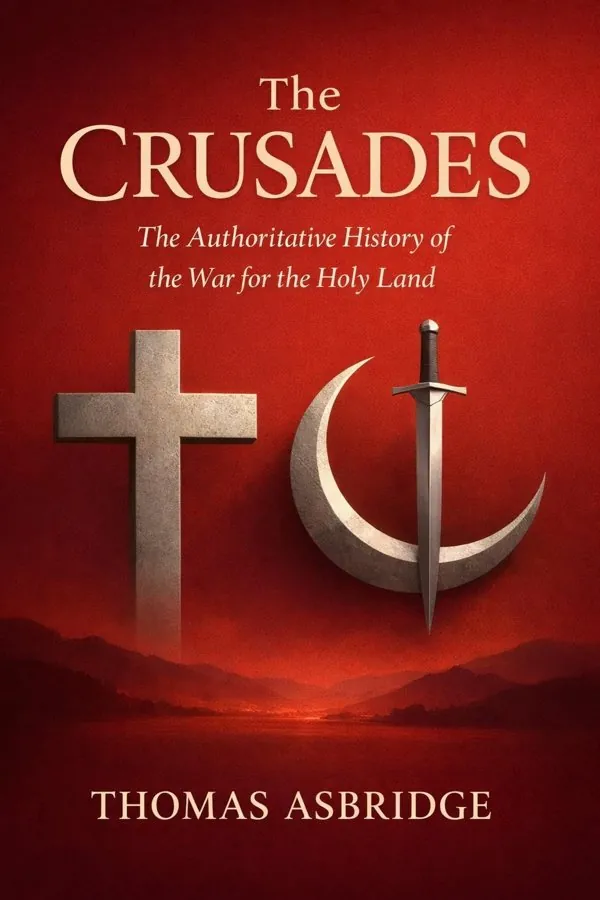
The Crusades: The Authoritative History of the War for the Holy Land: Summary & Key Insights
 10 min11 chaptersAudio available
What Is The Crusades: The Authoritative History of the War for the Holy Land About?
The Crusades: The Authoritative History of the War for the Holy Land by Thomas Asbridge is a world_history book spanning 11 pages. An authoritative, accessible single-volume history of the brutal struggle for the Holy Land in the Middle Ages. Thomas Asbridge explores the religious motivations, key figures, and cultural consequences of the Crusades, revealing how these holy wars reshaped the medieval world and the relationship between Christianity and Islam.
This FizzRead summary covers all 11 key chapters of The Crusades: The Authoritative History of the War for the Holy Land in approximately 10 minutes, distilling the most important ideas, arguments, and takeaways from Thomas Asbridge's work. Also available as an audio summary and Key Quotes Podcast.
The Crusades: The Authoritative History of the War for the Holy Land
An authoritative, accessible single-volume history of the brutal struggle for the Holy Land in the Middle Ages. Thomas Asbridge explores the religious motivations, key figures, and cultural consequences of the Crusades, revealing how these holy wars reshaped the medieval world and the relationship between Christianity and Islam.
Who Should Read The Crusades: The Authoritative History of the War for the Holy Land?
This book is perfect for anyone interested in world_history and looking to gain actionable insights in a short read. Whether you're a student, professional, or lifelong learner, the key ideas from The Crusades: The Authoritative History of the War for the Holy Land by Thomas Asbridge will help you think differently.
- ✓Readers who enjoy world_history and want practical takeaways
- ✓Professionals looking to apply new ideas to their work and life
- ✓Anyone who wants the core insights of The Crusades: The Authoritative History of the War for the Holy Land in just 10 minutes
Want the full summary?
Get instant access to this book summary and 100K+ more with Fizz Moment.
Get Free SummaryAvailable on App Store • Free to download
Key Chapters
The Crusades sprang from a confluence of devotional energy, feudal ambition, and papal strategy. In the decades before 1095, Western Europe was undergoing profound transformation. The Church sought to consolidate moral authority over a violent, aristocratic society. The Gregorian Reform movement was reasserting spiritual discipline, yet knightly warfare remained unchecked. When Pope Urban II called the Council of Clermont, he did so in a landscape haunted by both fear of sin and hunger for redemption.
I portray Urban not as a cynical manipulator but as a man who genuinely believed in the sanctity of his mission. His appeal to Christians to liberate Jerusalem was couched in spiritual terms—a penitential pilgrimage armed for battle. Responding to a plea from the Byzantine emperor Alexios I Komnenos, Urban saw in the East both an opportunity to heal the schism between Latin and Greek Christianity and to project the moral energy of the West onto a cosmic struggle.
The result was explosive. Thousands answered the call: nobles, peasants, monks, and adventurers. They were not unified by command, only by purpose. For some, it was faith; for others, land or status. But all were drawn into a movement that redefined what it meant to wage a holy war. The crusade fused the spiritual journey of pilgrimage with the temporal violence of feudal conflict—a paradox that would echo through centuries.
The First Crusade unfolded as a breathtaking story of endurance, brutality, and belief. In these pages, I wanted readers to feel the extraordinary ordeal of the march eastward. The crusaders passed through the Byzantine Empire, alternately distrusted and manipulated by Emperor Alexios, and then plunged into Anatolia, a landscape of famine, disease, and unrelenting battle against the Seljuk Turks. The campaign was not orchestrated by a single commander; rather, it resembled a chaotic, improvised coalition of warlords held together by faith and desperation.
The siege of Antioch became the crucible of this movement. For months, hunger and suspicion tore through the ranks. When the city finally fell, the crusaders themselves were besieged by a Muslim relief army. I reveal how religious vision—and the discovery of what was claimed to be the Holy Lance—reinvigorated their will to fight. Faith here functions not simply as ideology but as a physical force that could turn exhaustion into ecstasy.
The capture of Jerusalem in 1099 marked both triumph and atrocity. Christian chroniclers rejoiced, describing victory as divine justice, while Muslim and Jewish accounts recorded unspeakable slaughter. In presenting these moments, I wanted readers to confront the dissonance between piety and violence—the way spiritual certainty can sanctify horror. Yet for contemporaries, Jerusalem was proof that God intervened in history. The Crusade fulfilled its promise, but it also planted the seeds of continuous war.
+ 9 more chapters — available in the FizzRead app
All Chapters in The Crusades: The Authoritative History of the War for the Holy Land
About the Author
Thomas Asbridge is a British historian and senior lecturer at Queen Mary University of London. He specializes in the history of the Crusades and the medieval Middle East and is known for his engaging historical writing and television documentaries.
Get This Summary in Your Preferred Format
Read or listen to the The Crusades: The Authoritative History of the War for the Holy Land summary by Thomas Asbridge anytime, anywhere. FizzRead offers multiple formats so you can learn on your terms — all free.
Available formats: App · Audio · PDF · EPUB — All included free with FizzRead
Download The Crusades: The Authoritative History of the War for the Holy Land PDF and EPUB Summary
Key Quotes from The Crusades: The Authoritative History of the War for the Holy Land
“The Crusades sprang from a confluence of devotional energy, feudal ambition, and papal strategy.”
“The First Crusade unfolded as a breathtaking story of endurance, brutality, and belief.”
Frequently Asked Questions about The Crusades: The Authoritative History of the War for the Holy Land
The Crusades: The Authoritative History of the War for the Holy Land by Thomas Asbridge is a world_history book that explores key ideas across 11 chapters. An authoritative, accessible single-volume history of the brutal struggle for the Holy Land in the Middle Ages. Thomas Asbridge explores the religious motivations, key figures, and cultural consequences of the Crusades, revealing how these holy wars reshaped the medieval world and the relationship between Christianity and Islam.
You Might Also Like
The Age of Capital
Eric Hobsbawm
10 min
The Gulag Archipelago
Aleksandr Solzhenitsyn
10 min
Jerusalem: The Biography
Simon Sebag Montefiore
10 min
The Anglo-Saxons
James Campbell
10 min
The Boer War
Thomas Pakenham
10 min
The Industrial Revolutionaries: The Making of the Modern World 1776–1914
Gavin Weightman
10 minBrowse by Category
Ready to read The Crusades: The Authoritative History of the War for the Holy Land?
Get the full summary and 100K+ more books with Fizz Moment.