
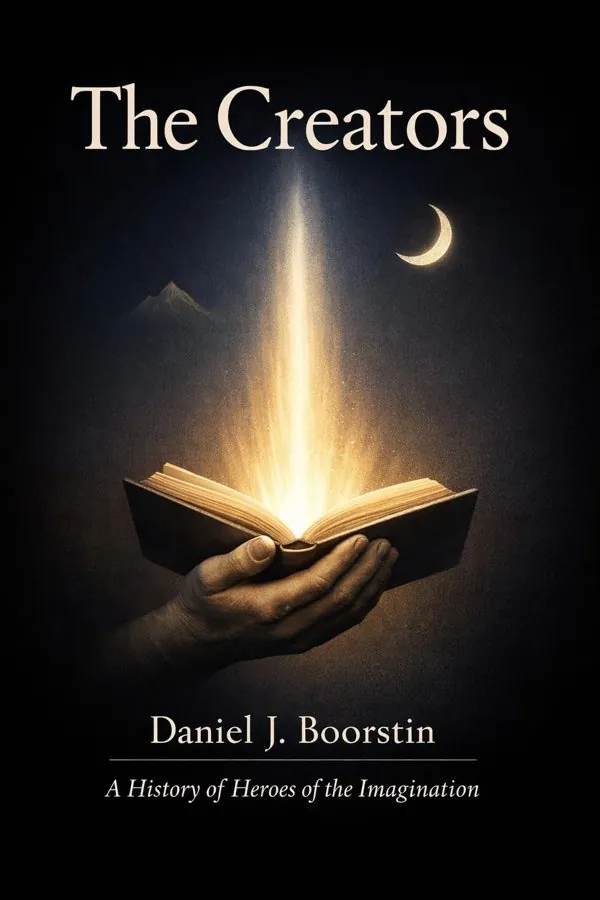
The Creators: A History of Heroes of the Imagination: Summary & Key Insights
 10 min10 chaptersAudio available
Key Takeaways from The Creators: A History of Heroes of the Imagination
Before civilization could erect temples, codify laws, or compose philosophy, it had to learn how to tell meaningful stories.
A civilization reveals its ideals in what it chooses to perfect.
Human creativity changed dramatically when art began serving eternity.
Every rebirth begins with a new image of what a human being can become.
A culture changes when words become portable, repeatable, and widely shared.
What Is The Creators: A History of Heroes of the Imagination About?
The Creators: A History of Heroes of the Imagination by Daniel J. Boorstin is a civilization book spanning 11 pages. The Creators: A History of Heroes of the Imagination is Daniel J. Boorstin’s grand history of human creativity, from the first mythmakers to the artists, scientists, composers, architects, novelists, and inventors who reshaped civilization. Rather than treating culture as a series of isolated masterpieces, Boorstin asks a bigger question: how did human beings learn to imagine worlds beyond immediate survival and turn those visions into durable forms—stories, cathedrals, symphonies, paintings, theories, machines, and modern identities? His answer is sweeping, humane, and deeply learned. He shows that creativity is never simply the triumph of individual genius; it grows from traditions, institutions, technologies, and spiritual needs that make new forms possible. This matters because it reframes civilization itself as a history of imagination in action. Boorstin writes with the authority of a major historian and former Librarian of Congress, combining scholarship with narrative clarity. The result is a rich guide to how culture is made—and a reminder that every age must rediscover what it means to create rather than merely consume.
This FizzRead summary covers all 10 key chapters of The Creators: A History of Heroes of the Imagination in approximately 10 minutes, distilling the most important ideas, arguments, and takeaways from Daniel J. Boorstin's work. Also available as an audio summary and Key Quotes Podcast.
The Creators: A History of Heroes of the Imagination
The Creators: A History of Heroes of the Imagination is Daniel J. Boorstin’s grand history of human creativity, from the first mythmakers to the artists, scientists, composers, architects, novelists, and inventors who reshaped civilization. Rather than treating culture as a series of isolated masterpieces, Boorstin asks a bigger question: how did human beings learn to imagine worlds beyond immediate survival and turn those visions into durable forms—stories, cathedrals, symphonies, paintings, theories, machines, and modern identities? His answer is sweeping, humane, and deeply learned. He shows that creativity is never simply the triumph of individual genius; it grows from traditions, institutions, technologies, and spiritual needs that make new forms possible. This matters because it reframes civilization itself as a history of imagination in action. Boorstin writes with the authority of a major historian and former Librarian of Congress, combining scholarship with narrative clarity. The result is a rich guide to how culture is made—and a reminder that every age must rediscover what it means to create rather than merely consume.
Who Should Read The Creators: A History of Heroes of the Imagination?
This book is perfect for anyone interested in civilization and looking to gain actionable insights in a short read. Whether you're a student, professional, or lifelong learner, the key ideas from The Creators: A History of Heroes of the Imagination by Daniel J. Boorstin will help you think differently.
- ✓Readers who enjoy civilization and want practical takeaways
- ✓Professionals looking to apply new ideas to their work and life
- ✓Anyone who wants the core insights of The Creators: A History of Heroes of the Imagination in just 10 minutes
Want the full summary?
Get instant access to this book summary and 100K+ more with Fizz Moment.
Get Free SummaryAvailable on App Store • Free to download
Key Chapters
Before civilization could erect temples, codify laws, or compose philosophy, it had to learn how to tell meaningful stories. Boorstin begins with the ancient mythmakers because imagination first appeared not as entertainment but as a way of making the world intelligible. In Mesopotamia, Egypt, India, and other early civilizations, anonymous poets and storytellers gave shape to fear, hope, death, fertility, kingship, and cosmic order. These myths were not primitive mistakes waiting to be replaced by reason. They were early acts of creation that transformed chaos into shared meaning.
What makes this important is that myth gave people a mental architecture before they had formal science or historical method. A people who can imagine gods, origins, heroes, and moral drama can also imagine institutions, identities, and futures. Epics like Gilgamesh did more than narrate adventure; they explored mortality and power. Sacred stories linked individual life to cosmic purpose. Through ritual repetition, these stories became civilization’s memory.
In practical terms, Boorstin shows that creativity often begins with narrative framing. Modern organizations still rely on founding stories. Nations are held together by civic myths. Families preserve identity through repeated tales. Even entrepreneurs pitch visions through story before a product fully exists.
The lesson is simple but powerful: imagination starts when we move from raw experience to shared meaning. If you want to create something lasting, begin by asking what story gives your work coherence. Actionable takeaway: define the central story behind your project, team, or life goal, because people commit more deeply to meaning than to information.
A civilization reveals its ideals in what it chooses to perfect. For the Greeks, creativity was not merely self-expression but the disciplined discovery of form, proportion, and harmony. Boorstin shows how Greek artists, dramatists, philosophers, and architects transformed imagination into a conscious craft. They did not see creation as rebellion against nature so much as an effort to reveal the hidden order already present within it.
This classical achievement matters because it established standards that would shape centuries of Western art. Sculptors such as Phidias sought beauty through balance and idealized form. Tragedians like Aeschylus, Sophocles, and Euripides dramatized moral conflict within a structured universe. Architects designed temples whose symmetry embodied civic and cosmic order. Philosophers gave language to questions about mimesis, truth, and beauty. The Greeks effectively taught later cultures that imagination could be disciplined without being diminished.
Boorstin’s deeper point is that limits can strengthen creation. Meter sharpened poetry. Architectural rules elevated design. Public performance refined drama. Great creators often work best when they inherit standards worth mastering before they try to innovate beyond them.
This remains practical today. A musician studies scales before improvising. A designer learns composition before breaking visual conventions. A writer benefits from understanding narrative structure before experimenting with fragmentation.
The Greek example reminds us that originality is often born from apprenticeship, not spontaneity. Actionable takeaway: choose one classical discipline in your field—structure, form, proportion, method—and practice it deeply, because creativity grows stronger when it has something solid to push against.
Human creativity changed dramatically when art began serving eternity. In Boorstin’s account, the Christian imagination widened the emotional and symbolic range of creation by orienting it toward transcendence, salvation, suffering, and sacred history. The classical world had celebrated order and beauty; Christianity added inwardness, spiritual drama, and the dignity of the ordinary soul.
This shift reshaped nearly every art form. Architecture reached upward in basilicas and cathedrals, turning stone into theology. Icon painters, manuscript illuminators, and sculptors made invisible truths visible for largely illiterate populations. Music became a vehicle for worship and contemplation. Narrative art centered not on heroic self-assertion alone but on sacrifice, redemption, and divine mystery. In this world, the imagination served not only civic life but the soul’s relation to God.
Boorstin emphasizes that medieval creativity is often misunderstood as derivative or constrained. In fact, those constraints produced astonishing innovation. Shared beliefs created common symbols that artists could elaborate with endless variation. Guilds, monasteries, and churches offered institutions that preserved knowledge and commissioned ambitious work. A cathedral was a collective creation spanning generations, proof that imagination can be communal rather than individualistic.
Modern readers can apply this insight by rethinking the source of meaningful work. Creativity becomes deeper when connected to a purpose larger than personal recognition. Whether in education, design, service, or leadership, people create more powerfully when they feel their work participates in something enduring.
Actionable takeaway: connect your creative effort to a larger moral, spiritual, or communal purpose, because work gains force when it points beyond the self.
Every rebirth begins with a new image of what a human being can become. Boorstin presents the Renaissance as more than a revival of classical learning; it was a radical reawakening of confidence in human powers of observation, invention, and self-fashioning. Artists and thinkers did not merely imitate Greece and Rome. They used recovered traditions to expand the scope of individual possibility.
Figures like Leonardo da Vinci, Michelangelo, Alberti, and Erasmus embodied this change. The artist was no longer just an anonymous craftsman within a tradition but a visible creator with a unique vision. Perspective transformed painting by placing the viewer inside a newly organized visual world. Anatomy sharpened realism. Print accelerated the circulation of ideas. Patronage systems funded ambitious experiments. The result was a culture that linked beauty, knowledge, and technical skill in unprecedented ways.
Boorstin’s key contribution here is to show how creativity flourishes when old knowledge becomes available in new conditions. Rediscovery is often the seedbed of innovation. The Renaissance succeeded because it combined reverence for the past with confidence in present capacities.
That pattern still applies. Breakthroughs often occur when people revisit neglected sources and reinterpret them for contemporary needs. A startup revives an old craft with new tools. A teacher updates classical rhetoric for digital media. A scientist reexamines a shelved theory using modern methods.
The Renaissance reminds us that progress is not amnesia. Actionable takeaway: revisit one foundational source in your field and ask how it can be reimagined with today’s tools, because creative leaps often come from renewing rather than rejecting tradition.
A culture changes when words become portable, repeatable, and widely shared. Boorstin treats the rise of print and the expanding power of language as one of the decisive turning points in the history of imagination. Once texts could be reproduced at scale, creativity was no longer confined to courts, monasteries, or elite circles. Authors could address unknown readers across distance and time, and readers could build inner worlds without direct contact with teachers or institutions.
The consequences were enormous. The printed Bible reshaped religious life. Essays, pamphlets, plays, and novels created new public spheres. Writers such as Cervantes, Shakespeare, Milton, and later novelists developed forms capable of capturing irony, interiority, and social complexity. Language itself became a tool for building not only stories but identities and communities. The age of the word enabled individuals to think privately while participating in collective debate.
Boorstin’s insight is that media technologies do not just spread content; they alter what can be imagined. Print encouraged authorship, criticism, standardization, and cultural memory. It also widened access, making the imagination less dependent on physical proximity to artistic centers.
This is highly relevant in our own media environment. Digital platforms, like print before them, change both expression and attention. The challenge is not merely to publish more, but to use language with enough clarity and force to matter in a crowded field.
Actionable takeaway: treat your writing as a tool of world-building—whether in emails, essays, scripts, or posts—because the words you shape determine the reality others are able to see.
Some of the deepest human achievements cannot be paraphrased. In Boorstin’s history, music occupies a special place because it demonstrates that imagination does not depend solely on images or words. Music creates forms of order, tension, emotion, and transcendence that bypass literal explanation. It turns time itself into a medium of meaning.
Boorstin traces how Western music evolved from liturgical chant to polyphony, from courtly and sacred traditions to the expansive emotional architecture of composers like Bach, Mozart, Beethoven, and beyond. Each phase enlarged what music could express. Counterpoint made simultaneous complexity intelligible. Harmonic development intensified emotional movement. Public concerts and improved instruments expanded both audience and ambition. Music became one of civilization’s most refined ways of exploring inner life.
The practical significance of this is broader than music alone. Great creators learn how to shape experience over time. A speech, a film, a classroom lesson, a product launch, or a negotiation all have rhythm, pacing, climax, and resolution. Music teaches us that form is not static arrangement but unfolding energy.
Boorstin also suggests that music exemplifies the collaboration between strict structure and emotional freedom. The composer works inside systems, yet produces profound originality. This is a model for any field where mastery and intuition must cooperate.
Actionable takeaway: pay attention to the rhythm and emotional arc of anything you create—a presentation, article, meeting, or course—because people remember experiences that move with structure, not just those packed with information.
A society changes when the individual becomes a primary subject of art. Boorstin argues that modern creativity increasingly turned inward, making personal experience, psychological conflict, memory, and identity central themes of artistic life. Novelists, poets, painters, and later filmmakers no longer focused mainly on cosmic order, public ritual, or inherited archetypes. They explored consciousness itself.
This transformation can be seen in the rise of the novel, romanticism, autobiography, modern painting, and eventually psychoanalytic and existential sensibilities. The modern creator often became both maker and subject. Instead of presenting a universally shared symbolic world, art began to dramatize fragmentation, alienation, desire, and private perception. This expanded expressive freedom, but it also introduced new instability. The self became a site of endless exploration—and endless uncertainty.
Boorstin does not dismiss this inward turn. He shows its richness: subtle character psychology, lyrical intensity, formal experimentation, and a deeper recognition of individual dignity. But he also warns that a culture too absorbed in self-expression can lose touch with common forms, shared standards, and communal meaning.
That tension defines much of contemporary life. Social media encourages constant performance of identity. Workplaces stress authenticity yet struggle to build shared purpose. Artists and professionals alike must learn how to honor individual perspective without becoming trapped inside it.
Actionable takeaway: use self-expression as a starting point, not an endpoint—translate personal insight into something others can inhabit, because the most powerful creativity turns private feeling into shared recognition.
New tools do more than speed up production; they change the very scale and shape of imagination. Boorstin extends the history of creators beyond artists and writers to include inventors, engineers, industrial designers, and technological pioneers. In the modern age, the creators of machines, systems, and infrastructures became as influential as painters or poets because they redefined the conditions of everyday life.
Industrial production, photography, film, recording, mass publishing, transportation, and communications technologies opened new creative possibilities while also creating new pressures. An image could be reproduced endlessly. A song could travel without the musician. A building could be engineered at unprecedented heights. Design moved from handcrafted singularity to scalable form. The modern creator increasingly had to think about audience, distribution, replication, and systems.
Boorstin’s insight is double-edged. Technology can democratize access and expand creative power, but it can also encourage uniformity, distraction, and a culture of consumption detached from deep making. The challenge is not whether tools are good or bad; it is whether human beings use them to enlarge meaning or merely accelerate novelty.
This is especially relevant now. Digital tools make everyone a publisher, editor, designer, and broadcaster. Yet abundance of means can produce shallowness of ends. Real creators must still supply judgment, taste, and purpose.
Actionable takeaway: adopt new tools aggressively, but define the human value they are meant to serve, because technology strengthens creativity only when it amplifies intention rather than replacing it.
The greatest threat to creativity may not be censorship or scarcity, but excess. Boorstin ends on a sobering modern theme: as societies become richer in media, images, options, and expressive freedom, they do not automatically become more creative. In fact, abundance can weaken attention, dissolve standards, and blur the distinction between genuine creation and endless production.
This crisis appears when novelty becomes a substitute for depth. Modern culture often celebrates disruption without memory, expression without craft, and visibility without substance. The creator risks becoming a performer for markets and mass audiences rather than a builder of lasting forms. Institutions that once sustained demanding work—religious communities, classical education, apprenticeships, patronage structures, stable publics—lose authority, leaving individuals freer but also more isolated.
Boorstin does not call for nostalgia or cultural pessimism. His warning is more useful than that. He asks readers to recover the conditions under which true creativity flourishes: discipline, inheritance, standards, community, and purposeful freedom. A civilization must teach people not only how to consume culture, but how to make, judge, and sustain it.
This applies personally as well as socially. Anyone trying to do meaningful work today faces the temptations of distraction, branding, and premature exposure. The answer is to cultivate depth before display and craftsmanship before applause.
Actionable takeaway: create systems that protect sustained attention—time blocks, study, revision, mentorship, and fewer inputs—because in an age of excess, the rarest creative resource is not talent but concentration.
All Chapters in The Creators: A History of Heroes of the Imagination
About the Author
Daniel J. Boorstin (1914–2004) was a distinguished American historian, educator, and writer known for making large cultural and intellectual histories accessible to broad audiences. Born in Atlanta and educated at Harvard, Oxford, and Yale, he taught history at the University of Chicago before serving as Librarian of Congress from 1975 to 1987. Boorstin wrote widely on American life, ideas, and civilization, often focusing on how people discover meaning, knowledge, and identity. He is especially celebrated for his ambitious historical trilogy: The Discoverers, The Seekers, and The Creators. His work combines scholarly range with elegant, readable prose, and he remains one of the most influential interpreters of how human beings shape history through curiosity, belief, and imagination.
Get This Summary in Your Preferred Format
Read or listen to the The Creators: A History of Heroes of the Imagination summary by Daniel J. Boorstin anytime, anywhere. FizzRead offers multiple formats so you can learn on your terms — all free.
Available formats: App · Audio · PDF · EPUB — All included free with FizzRead
Download The Creators: A History of Heroes of the Imagination PDF and EPUB Summary
Key Quotes from The Creators: A History of Heroes of the Imagination
“Before civilization could erect temples, codify laws, or compose philosophy, it had to learn how to tell meaningful stories.”
“A civilization reveals its ideals in what it chooses to perfect.”
“Human creativity changed dramatically when art began serving eternity.”
“Every rebirth begins with a new image of what a human being can become.”
“A culture changes when words become portable, repeatable, and widely shared.”
Frequently Asked Questions about The Creators: A History of Heroes of the Imagination
The Creators: A History of Heroes of the Imagination by Daniel J. Boorstin is a civilization book that explores key ideas across 10 chapters. The Creators: A History of Heroes of the Imagination is Daniel J. Boorstin’s grand history of human creativity, from the first mythmakers to the artists, scientists, composers, architects, novelists, and inventors who reshaped civilization. Rather than treating culture as a series of isolated masterpieces, Boorstin asks a bigger question: how did human beings learn to imagine worlds beyond immediate survival and turn those visions into durable forms—stories, cathedrals, symphonies, paintings, theories, machines, and modern identities? His answer is sweeping, humane, and deeply learned. He shows that creativity is never simply the triumph of individual genius; it grows from traditions, institutions, technologies, and spiritual needs that make new forms possible. This matters because it reframes civilization itself as a history of imagination in action. Boorstin writes with the authority of a major historian and former Librarian of Congress, combining scholarship with narrative clarity. The result is a rich guide to how culture is made—and a reminder that every age must rediscover what it means to create rather than merely consume.
More by Daniel J. Boorstin
You Might Also Like
The Structure of Scientific Revolutions
Thomas S. Kuhn
10 min
Genius
Harold Bloom
10 min
A Cultural History of the Medieval Age
Various Editors
10 min
A History of God: The 4,000-Year Quest of Judaism, Christianity and Islam
Karen Armstrong
10 min
A History of the World in 10½ Chapters
Julian Barnes
10 min
A Short History of Progress
Ronald Wright
10 minBrowse by Category
Ready to read The Creators: A History of Heroes of the Imagination?
Get the full summary and 100K+ more books with Fizz Moment.