
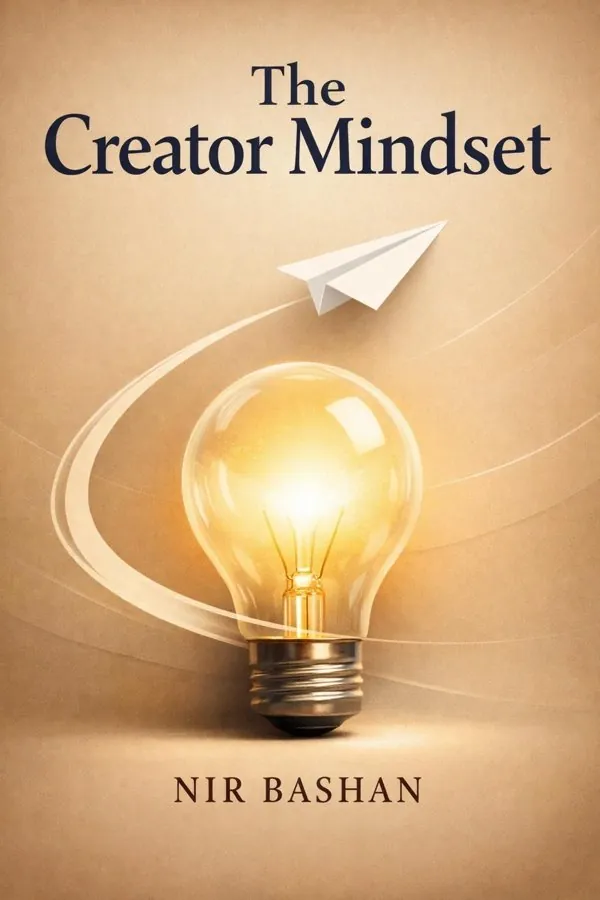
The Creator Mindset: 92 Tools to Unlock the Secrets to Innovation, Growth, and Sustainability: Summary & Key Insights
by Nir Bashan
 10 min10 chaptersAudio available
Key Takeaways from The Creator Mindset: 92 Tools to Unlock the Secrets to Innovation, Growth, and Sustainability
The most limiting myth about creativity is that it belongs to other people.
Organizations often praise innovation while rewarding only certainty.
Most people do not struggle with a lack of ideas.
Confidence is often mistaken for a personality trait, but Bashan shows that creative confidence is built through action, not inherited at birth.
Great ideas often begin not with inspiration, but with attention.
What Is The Creator Mindset: 92 Tools to Unlock the Secrets to Innovation, Growth, and Sustainability About?
The Creator Mindset: 92 Tools to Unlock the Secrets to Innovation, Growth, and Sustainability by Nir Bashan is a creativity book spanning 10 pages. The Creator Mindset argues that creativity is not a rare talent reserved for artists, inventors, or a handful of visionary founders. It is a practical human capability that can be developed, trained, and used to solve real problems in business and life. In this book, Nir Bashan distills years of work with executives, entrepreneurs, teams, and global organizations into 92 tools designed to make innovation more accessible, repeatable, and useful. His central claim is simple but powerful: when people learn to think like creators, they become better at navigating uncertainty, generating value, and building sustainable growth. What makes the book matter is its refusal to treat creativity as vague inspiration. Bashan frames it as a disciplined mindset rooted in curiosity, empathy, courage, and action. He shows how fear suppresses ideas, how rigid systems reward safe thinking, and how leaders can create conditions where better ideas actually emerge. For readers who feel stuck, over-analytical, or convinced they are “not creative,” this book offers a practical reintroduction to their own capacity to imagine, adapt, and build something new.
This FizzRead summary covers all 10 key chapters of The Creator Mindset: 92 Tools to Unlock the Secrets to Innovation, Growth, and Sustainability in approximately 10 minutes, distilling the most important ideas, arguments, and takeaways from Nir Bashan's work. Also available as an audio summary and Key Quotes Podcast.
The Creator Mindset: 92 Tools to Unlock the Secrets to Innovation, Growth, and Sustainability
The Creator Mindset argues that creativity is not a rare talent reserved for artists, inventors, or a handful of visionary founders. It is a practical human capability that can be developed, trained, and used to solve real problems in business and life. In this book, Nir Bashan distills years of work with executives, entrepreneurs, teams, and global organizations into 92 tools designed to make innovation more accessible, repeatable, and useful. His central claim is simple but powerful: when people learn to think like creators, they become better at navigating uncertainty, generating value, and building sustainable growth.
What makes the book matter is its refusal to treat creativity as vague inspiration. Bashan frames it as a disciplined mindset rooted in curiosity, empathy, courage, and action. He shows how fear suppresses ideas, how rigid systems reward safe thinking, and how leaders can create conditions where better ideas actually emerge. For readers who feel stuck, over-analytical, or convinced they are “not creative,” this book offers a practical reintroduction to their own capacity to imagine, adapt, and build something new.
Who Should Read The Creator Mindset: 92 Tools to Unlock the Secrets to Innovation, Growth, and Sustainability?
This book is perfect for anyone interested in creativity and looking to gain actionable insights in a short read. Whether you're a student, professional, or lifelong learner, the key ideas from The Creator Mindset: 92 Tools to Unlock the Secrets to Innovation, Growth, and Sustainability by Nir Bashan will help you think differently.
- ✓Readers who enjoy creativity and want practical takeaways
- ✓Professionals looking to apply new ideas to their work and life
- ✓Anyone who wants the core insights of The Creator Mindset: 92 Tools to Unlock the Secrets to Innovation, Growth, and Sustainability in just 10 minutes
Want the full summary?
Get instant access to this book summary and 100K+ more with Fizz Moment.
Get Free SummaryAvailable on App Store • Free to download
Key Chapters
The most limiting myth about creativity is that it belongs to other people. Many of us grow up believing that creativity means painting a masterpiece, writing a novel, or having sudden flashes of genius. Nir Bashan challenges that assumption from the start. He argues that creativity is not a mysterious gift handed to a chosen few. It is a practical skill that every person uses whenever they solve a problem in a new way, connect unrelated ideas, or respond adaptively to change.
This reframing matters because the label we give creativity determines whether we ever try to develop it. If we think creativity is rare, we wait for inspiration. If we see it as trainable, we start practicing. In Bashan’s view, a parent calming a child, an entrepreneur designing a customer experience, a teacher reworking a lesson, and a manager resolving a team conflict are all using creativity. The skill is not confined to the arts. It is embedded in decision-making, communication, leadership, and strategy.
The book encourages readers to stop treating creativity as performance and start treating it as process. Instead of asking, “Am I creative?” the better question becomes, “How can I approach this challenge more creatively?” That shift moves the discussion from identity to behavior. It frees people from perfectionism and invites experimentation.
In practice, this means paying attention to moments where routine thinking has stopped working. A sales team facing stagnant results can redesign its outreach. A nonprofit with limited funding can rethink partnerships. An individual feeling trapped in a career can explore adjacent skills and unmet needs. Creative thinking is often less about wild originality and more about useful recombination.
Actionable takeaway: Replace the statement “I’m not creative” with “I haven’t practiced creative problem-solving here yet,” and identify one current challenge that could benefit from a fresh approach.
Organizations often praise innovation while rewarding only certainty. Bashan highlights a deep imbalance in modern education and business culture: analytical thinking is treated as serious, measurable, and safe, while creative thinking is viewed as subjective, risky, and difficult to justify. Analysis has obvious value, but when it dominates every decision, it can quietly suffocate invention.
Analytical thinking helps us evaluate, compare, forecast, and optimize. It is excellent for improving existing systems. But creativity does something different. It imagines possibilities that do not yet fit the spreadsheet. It notices overlooked human needs, questions assumptions, and proposes alternatives before there is proof they will work. Innovation requires both modes. Analysis refines; creativity originates.
The problem arises when teams demand evidence for ideas that are still in the exploratory stage. New concepts rarely arrive fully formed with guaranteed metrics. If every suggestion must be immediately defended with hard data, people stop offering unusual ideas. They default to incremental changes because those are easier to justify. Over time, a culture of over-analysis produces competence without originality.
Bashan’s argument is not anti-data. Rather, he insists that leaders must know when to suspend premature judgment. A new product concept, brand direction, or internal process may need imaginative exploration before analytical testing. Companies that innovate well usually create room for both divergent thinking and disciplined evaluation, instead of forcing one to replace the other.
A practical example is product development. If a team studies only current customer behavior, it may improve an existing feature. But if it also asks what frustrations customers cannot yet articulate, it may create something transformative. The first is analysis-led optimization; the second is creativity-led innovation.
Actionable takeaway: In your next brainstorming session, separate idea generation from evaluation. Spend time first producing possibilities without critique, then move into analysis only after a wider range of options exists.
Most people do not struggle with a lack of ideas. They struggle with the fear attached to expressing them. Bashan treats fear as one of the greatest obstacles to creativity because it narrows perception, encourages conformity, and convinces people to protect themselves instead of exploring. Fear of looking foolish, being wrong, wasting time, or disappointing others can shut down creativity long before failure ever occurs.
This is why many workplaces appear efficient but feel intellectually lifeless. Employees may have insights, but they self-censor because the cost of speaking up seems too high. Students choose safe answers. Founders cling to familiar models. Leaders avoid bold moves to protect their credibility. In all these cases, fear does more damage than actual failure because it prevents experimentation in the first place.
Bashan encourages readers to redefine failure as feedback rather than identity. A failed attempt does not mean the person is incapable; it simply means the approach did not work under those conditions. This distinction is crucial. When failure becomes a source of learning, people can test, adapt, and improve. When it becomes a source of shame, they stop trying.
Creative resilience depends on emotional safety as much as intellectual ability. Teams need room to propose half-formed ideas, prototypes need permission to be rough, and individuals need habits that reduce the emotional drama around imperfect outcomes. This may involve small experiments, faster iteration, and language that normalizes learning rather than punishment.
For example, a manager could replace “Who is responsible for this mistake?” with “What did this attempt teach us?” A designer can share early sketches instead of waiting for polish. An entrepreneur can run a low-cost pilot before making a major bet. These practices reduce fear by lowering the stakes of exploration.
Actionable takeaway: Identify one idea you have been withholding out of fear, and test it in the smallest, safest possible way this week so that learning becomes easier than worrying.
Confidence is often mistaken for a personality trait, but Bashan shows that creative confidence is built through action, not inherited at birth. People become more creative when they repeatedly engage the creative process and survive the discomfort that comes with uncertainty. Waiting to feel confident before beginning usually means never beginning at all.
Creative confidence comes from evidence. Each time someone notices a problem, generates options, tries a solution, and learns from the result, they strengthen their belief in their own resourcefulness. This is why even small creative wins matter. Reframing a difficult conversation, redesigning a workflow, or finding an original way to present data can all reinforce the internal message: I can create value from ambiguity.
Bashan’s approach is especially useful for people who see themselves as highly analytical or risk-averse. He does not ask them to become flamboyant or endlessly imaginative. He asks them to trust that creativity can be developed through deliberate practice. Like a muscle, it grows under use. The more often you question assumptions, explore alternatives, and act on ideas, the less intimidating the process becomes.
Leaders can nurture creative confidence in others by recognizing progress, not just brilliance. If praise is reserved only for breakthrough ideas, most people will stay quiet. But if leaders acknowledge curiosity, experimentation, and thoughtful effort, more people will participate. Confidence expands when contribution feels welcome.
On a practical level, creative confidence can be built with routines: keeping an idea journal, setting aside time for exploration, asking better questions in meetings, or trying one new solution before defaulting to habit. The goal is not constant novelty. It is increasing trust in your ability to respond inventively when needed.
Actionable takeaway: Build a weekly creativity habit, such as generating three alternative solutions to one recurring problem, and track how often you act on at least one of them.
An unexecuted idea may feel exciting, but it creates no value until it is tested in the world. Bashan treats implementation as an essential part of creativity, not a separate business skill that comes later. This is a crucial shift because many people romanticize ideation while avoiding the discipline required to turn concepts into outcomes.
Creative work moves through stages. First comes possibility: seeing a need, asking a better question, generating options. Then comes translation: shaping the strongest idea into something tangible enough to share, test, or build. Finally comes iteration: learning from reality and improving the solution over time. If any stage is skipped, creativity remains incomplete.
The implementation gap often appears because people fear imperfection. They want the idea to be polished before it meets the world. Bashan argues for the opposite. Early versions should be small, rough, and informative. A pilot program, draft proposal, landing page, prototype, or sample workshop can reveal what works faster than endless internal debate.
This approach also prevents attachment to fantasy. Once ideas are externalized, they can be improved through feedback instead of protected through imagination. A company exploring a new service can trial it with one customer segment before a full rollout. A writer can outline and share a concept before obsessing over every sentence. A department can test a revised workflow for two weeks rather than spending months discussing theory.
Implementation turns creativity into learning. It exposes assumptions, surfaces constraints, and clarifies value. It also creates momentum. Teams that habitually ship small experiments tend to outperform teams that endlessly discuss innovation without acting.
Actionable takeaway: Choose one promising idea and define the smallest testable version of it, including what you will build, who will experience it, and what signal will tell you whether to continue, revise, or stop.
People do not become creative in isolation from their environment. Bashan argues that leadership has enormous influence over whether creativity flourishes or disappears inside a team or organization. Leaders set the emotional tone, the rules of participation, the tolerance for ambiguity, and the speed with which ideas are either encouraged or crushed.
A leader who demands innovation but punishes risk sends a contradictory message. Employees quickly learn that what is rewarded is predictability, not experimentation. On the other hand, a leader who asks thoughtful questions, invites dissent, protects exploration time, and treats mistakes as information creates psychological conditions in which new ideas can emerge.
This does not mean abandoning standards. Strong creative leadership balances openness with direction. It gives people room to generate possibilities while keeping them connected to purpose. Bashan suggests that the best leaders act less like controllers of every answer and more like stewards of a fertile process. They frame important problems clearly, encourage broad participation, and help ideas move toward execution.
Creative leadership also requires humility. Good ideas can come from anywhere, not just from senior authority. A frontline employee may notice a broken customer experience before an executive does. A junior team member may offer the insight that reshapes a campaign. Leaders who believe creativity is tied to rank reduce the intelligence of the entire organization.
Simple leadership behaviors can make a major difference: asking “What are we not seeing?”, creating meetings focused on possibility rather than reporting, celebrating experiments, and ensuring that criticism improves ideas instead of humiliating contributors. These behaviors signal that creativity is part of the culture, not a slogan.
Actionable takeaway: In your next team meeting, ask one open-ended question that cannot be answered with data alone, and make sure at least three voices contribute before any evaluation begins.
Short-term wins can be manufactured through pressure, but long-term growth depends on adaptability. Bashan connects creativity not just to innovation, but to sustainability. In his view, organizations and individuals remain relevant when they continue to evolve in response to changing needs, environments, and constraints. The creator mindset supports that evolution because it encourages learning, reinvention, and value creation over rigid repetition.
Sustainability here is broader than environmental responsibility, though that may be part of it. It also refers to building systems, businesses, and careers that can endure. Companies that rely only on past success become vulnerable when markets shift. Professionals who cling to fixed identities struggle when their industry changes. Teams that optimize current performance but never explore alternatives eventually stagnate.
A creator mindset helps prevent this trap by making adaptation normal. Instead of asking, “How do we protect what we already built?” creators ask, “How do we keep responding intelligently to reality?” This includes listening to customers continuously, questioning assumptions regularly, and treating change as a design challenge rather than a threat.
For example, a brand that once succeeded through a single distribution channel may need to rethink its model as consumer behavior changes. A manager facing burnout across a team might redesign workflows instead of demanding more output. An individual whose role is being automated can creatively combine existing strengths with emerging opportunities rather than waiting passively.
Sustainable growth is not endless expansion for its own sake. It is the ability to keep generating meaningful value without exhausting people, relevance, or resilience. Bashan’s tools are meant to help readers build that kind of durability.
Actionable takeaway: Review one area of work or life that currently depends too heavily on past assumptions, and ask what needs to change now for that system to remain strong and relevant three years from today.
One of the book’s most useful contributions is its insistence that creativity can be systematized without being sterilized. Bashan’s 92 tools are designed to give readers concrete ways to access, strengthen, and apply creative thinking across different situations. Rather than presenting creativity as abstract inspiration, he breaks it into practical habits, prompts, and perspectives that can be used repeatedly.
This framework matters because people often understand creativity conceptually but fail to apply it consistently. In a workshop or after reading a motivating chapter, they may feel energized. But under pressure, deadlines, and uncertainty, they revert to routine thinking. Tools create bridges between intention and action. They make creativity more available when it is needed most.
The value of a multi-tool framework is flexibility. Different problems require different approaches. Some moments call for empathy and observation. Others require reframing the question, suspending judgment, prototyping quickly, or involving more diverse voices. Bashan’s toolkit encourages readers to stop searching for one perfect method and instead develop a wider repertoire.
This also reduces dependence on mood. If creativity is treated as a feeling, it appears unreliable. If it is treated as practice, readers can engage it deliberately. A team facing strategic confusion might use question-based tools to redefine the problem. A founder struggling with growth might use perspective-shifting tools to uncover overlooked markets. A professional experiencing stagnation might use experimentation tools to generate momentum.
The deeper message is empowering: you do not need to wait for brilliance. You need methods that help you think, notice, test, and adapt more effectively. Creativity becomes less mystical and more operational.
Actionable takeaway: Select three creativity tools or prompts that fit your current challenges, and use them repeatedly for one month so they become part of your default way of thinking rather than occasional inspiration.
A creator mindset becomes meaningful only when it leaves the page and enters ordinary decisions. Bashan’s broader message is that creativity is not a special event reserved for brainstorming sessions, innovation labs, or moments of crisis. It is a way of approaching everyday work with more curiosity, courage, and agency.
In practice, this means learning to recognize routine situations as creative opportunities. A difficult client interaction can be handled with a new conversation structure. A repetitive internal process can be simplified or automated. A department suffering from low engagement can redesign how meetings are run. A professional considering a career shift can experiment with small projects before making a drastic move. The creator mindset does not always ask for dramatic reinvention. Often it asks for better questions and more intentional responses.
This idea is especially powerful because it democratizes innovation. Creativity no longer belongs only to founders, executives, or designers. Anyone who notices friction and attempts improvement is participating in creation. That includes teachers, administrators, caregivers, engineers, freelancers, and team members at every level of an organization.
Applying the mindset also requires consistency. One inspired moment changes little if systems, habits, and incentives remain untouched. Bashan’s work encourages readers to build ongoing practices: observing more carefully, inviting more perspectives, testing faster, and reflecting on what they learn. Over time, these behaviors shape culture and identity.
The result is not constant novelty for its own sake, but a more alive and adaptive way of working. People feel less trapped by old assumptions because they begin to see themselves as capable of shaping outcomes rather than merely enduring them.
Actionable takeaway: Choose one recurring part of your week that feels stale or inefficient, and redesign it creatively within the next seven days using a small, testable change.
All Chapters in The Creator Mindset: 92 Tools to Unlock the Secrets to Innovation, Growth, and Sustainability
About the Author
Nir Bashan is a creativity expert, speaker, entrepreneur, and consultant whose work centers on helping individuals and organizations unlock innovation in practical ways. He is known for translating creativity from an abstract concept into a repeatable skill that can improve leadership, business growth, and problem-solving. Over the course of his career, Bashan has advised executives, global brands, and teams across industries, showing how creative thinking can drive meaningful results in environments that often prioritize analysis and efficiency. His approach blends mindset, strategy, and execution, making creativity accessible to people who may not see themselves as naturally imaginative. In The Creator Mindset, he draws on this experience to present tools and principles for building confidence, overcoming fear, and creating sustainable value through a more inventive way of thinking.
Get This Summary in Your Preferred Format
Read or listen to the The Creator Mindset: 92 Tools to Unlock the Secrets to Innovation, Growth, and Sustainability summary by Nir Bashan anytime, anywhere. FizzRead offers multiple formats so you can learn on your terms — all free.
Available formats: App · Audio · PDF · EPUB — All included free with FizzRead
Download The Creator Mindset: 92 Tools to Unlock the Secrets to Innovation, Growth, and Sustainability PDF and EPUB Summary
Key Quotes from The Creator Mindset: 92 Tools to Unlock the Secrets to Innovation, Growth, and Sustainability
“The most limiting myth about creativity is that it belongs to other people.”
“Organizations often praise innovation while rewarding only certainty.”
“Most people do not struggle with a lack of ideas.”
“Confidence is often mistaken for a personality trait, but Bashan shows that creative confidence is built through action, not inherited at birth.”
“Great ideas often begin not with inspiration, but with attention.”
Frequently Asked Questions about The Creator Mindset: 92 Tools to Unlock the Secrets to Innovation, Growth, and Sustainability
The Creator Mindset: 92 Tools to Unlock the Secrets to Innovation, Growth, and Sustainability by Nir Bashan is a creativity book that explores key ideas across 10 chapters. The Creator Mindset argues that creativity is not a rare talent reserved for artists, inventors, or a handful of visionary founders. It is a practical human capability that can be developed, trained, and used to solve real problems in business and life. In this book, Nir Bashan distills years of work with executives, entrepreneurs, teams, and global organizations into 92 tools designed to make innovation more accessible, repeatable, and useful. His central claim is simple but powerful: when people learn to think like creators, they become better at navigating uncertainty, generating value, and building sustainable growth. What makes the book matter is its refusal to treat creativity as vague inspiration. Bashan frames it as a disciplined mindset rooted in curiosity, empathy, courage, and action. He shows how fear suppresses ideas, how rigid systems reward safe thinking, and how leaders can create conditions where better ideas actually emerge. For readers who feel stuck, over-analytical, or convinced they are “not creative,” this book offers a practical reintroduction to their own capacity to imagine, adapt, and build something new.
You Might Also Like
Dimensions Of Creativity
Margaret A. Boden
10 min
How to Fly a Horse: The Secret History of Creation, Invention, and Discovery
Kevin Ashton
10 min
Imagine: How Creativity Works
Jonah Lehrer
10 min
The Accidental Creative: How to Be Brilliant at a Moment's Notice
Todd Henry
10 min
The Origins of Creativity
Edward O. Wilson
10 min
Wired to Create: Unraveling the Mysteries of the Creative Mind
Scott Barry Kaufman, Carolyn Gregoire
10 minBrowse by Category
Ready to read The Creator Mindset: 92 Tools to Unlock the Secrets to Innovation, Growth, and Sustainability?
Get the full summary and 100K+ more books with Fizz Moment.