
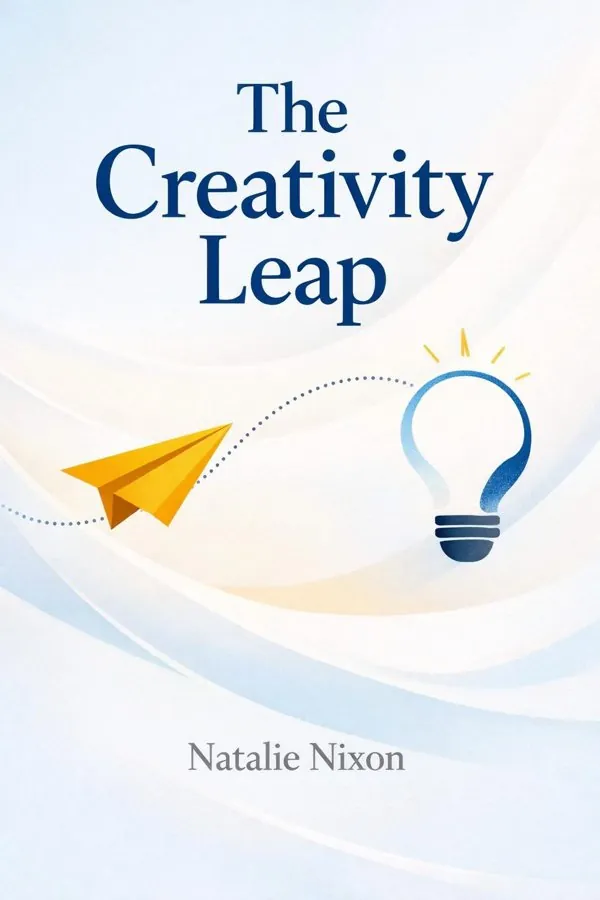
The Creativity Leap: Unleash Curiosity, Improvisation, and Intuition at Work: Summary & Key Insights
 10 min9 chaptersAudio available
Key Takeaways from The Creativity Leap: Unleash Curiosity, Improvisation, and Intuition at Work
The more routine work becomes automated, the more valuable distinctly human thinking becomes.
Every breakthrough begins with a question someone cared enough to keep asking.
A plan is useful until reality changes, which is often.
Not every important decision can be reduced to a spreadsheet.
Creativity fails when it leans too far in either direction.
What Is The Creativity Leap: Unleash Curiosity, Improvisation, and Intuition at Work About?
The Creativity Leap: Unleash Curiosity, Improvisation, and Intuition at Work by Natalie Nixon is a creativity book spanning 12 pages. In The Creativity Leap, Natalie Nixon makes a powerful case that creativity is no longer a nice-to-have soft skill but a core business capability. In a world shaped by automation, rapid change, and constant uncertainty, the real competitive advantage is not simply efficiency or expertise. It is the ability to ask better questions, adapt in real time, and make wise judgments when no clear playbook exists. Nixon argues that this kind of creativity comes from the dynamic interplay of three human capacities: curiosity, improvisation, and intuition. What makes the book especially compelling is Nixon’s unusual authority. She combines the lenses of a creativity strategist, cultural anthropologist, educator, and designer, drawing on both research and practical experience with leaders and organizations. Rather than treating creativity as a vague talent reserved for artists, she presents it as a disciplined, learnable practice that can transform how people work, lead, and innovate. The result is a fresh, highly practical guide for anyone who wants to become more adaptable, imaginative, and effective at work.
This FizzRead summary covers all 9 key chapters of The Creativity Leap: Unleash Curiosity, Improvisation, and Intuition at Work in approximately 10 minutes, distilling the most important ideas, arguments, and takeaways from Natalie Nixon's work. Also available as an audio summary and Key Quotes Podcast.
The Creativity Leap: Unleash Curiosity, Improvisation, and Intuition at Work
In The Creativity Leap, Natalie Nixon makes a powerful case that creativity is no longer a nice-to-have soft skill but a core business capability. In a world shaped by automation, rapid change, and constant uncertainty, the real competitive advantage is not simply efficiency or expertise. It is the ability to ask better questions, adapt in real time, and make wise judgments when no clear playbook exists. Nixon argues that this kind of creativity comes from the dynamic interplay of three human capacities: curiosity, improvisation, and intuition.
What makes the book especially compelling is Nixon’s unusual authority. She combines the lenses of a creativity strategist, cultural anthropologist, educator, and designer, drawing on both research and practical experience with leaders and organizations. Rather than treating creativity as a vague talent reserved for artists, she presents it as a disciplined, learnable practice that can transform how people work, lead, and innovate. The result is a fresh, highly practical guide for anyone who wants to become more adaptable, imaginative, and effective at work.
Who Should Read The Creativity Leap: Unleash Curiosity, Improvisation, and Intuition at Work?
This book is perfect for anyone interested in creativity and looking to gain actionable insights in a short read. Whether you're a student, professional, or lifelong learner, the key ideas from The Creativity Leap: Unleash Curiosity, Improvisation, and Intuition at Work by Natalie Nixon will help you think differently.
- ✓Readers who enjoy creativity and want practical takeaways
- ✓Professionals looking to apply new ideas to their work and life
- ✓Anyone who wants the core insights of The Creativity Leap: Unleash Curiosity, Improvisation, and Intuition at Work in just 10 minutes
Want the full summary?
Get instant access to this book summary and 100K+ more with Fizz Moment.
Get Free SummaryAvailable on App Store • Free to download
Key Chapters
The more routine work becomes automated, the more valuable distinctly human thinking becomes. That is the starting point of Nixon’s argument: creativity is not ornamental, and it is not limited to the arts. It is a strategic capability that helps people navigate ambiguity, generate original ideas, and respond to change with intelligence rather than panic.
Many organizations still treat creativity as something to schedule after the “real work” is done. Nixon turns that assumption upside down. In fast-moving environments, the real work is often creative work: reframing problems, connecting unrelated ideas, sensing emerging opportunities, and designing better ways forward. Technical expertise still matters, but expertise alone can become rigid. Creativity keeps knowledge alive by making it flexible and responsive.
This matters especially in workplaces shaped by AI, data, and standardization. Machines can optimize known processes, but they struggle with meaning, context, empathy, moral judgment, and imaginative leaps. Humans excel when the problem is unclear, when multiple perspectives must be integrated, or when the future cannot be predicted from the past. A product manager deciding how to serve customers with unmet needs, a teacher redesigning learning for distracted students, or a healthcare leader rethinking patient experience all rely on creativity, not just procedure.
Nixon invites readers to stop seeing creativity as a personality trait and start seeing it as a practice. Teams can create conditions that strengthen it through reflection, experimentation, cross-disciplinary learning, and psychological safety. Individuals can strengthen it by noticing assumptions, staying curious, and engaging uncertainty instead of avoiding it.
Actionable takeaway: Treat creativity as a daily business discipline. In your next project, ask not only “How do we execute?” but also “What problem are we really solving, and what new possibilities have we not yet considered?”
Every breakthrough begins with a question someone cared enough to keep asking. Nixon presents curiosity as the seedbed of creativity because it interrupts autopilot and invites exploration. Curious people resist the temptation to settle too quickly for familiar explanations. They wonder, probe, and notice what others overlook.
Curiosity matters because most organizations are built for answers, not questions. Meetings reward certainty. Deadlines encourage speed. Expertise can harden into defensiveness. Yet innovation rarely starts with immediate clarity. It starts with thoughtful uncertainty: Why do customers behave this way? What assumption are we making? What if the opposite were true? Nixon’s anthropology background reinforces this point. Like an ethnographer entering a new culture, creative professionals learn to observe carefully before they judge.
In practice, curiosity can be cultivated through intentional habits. Leaders can ask open-ended questions instead of prescribing solutions too early. Teams can spend time understanding users’ lived experiences rather than relying only on dashboards and surveys. Individuals can broaden their input by reading outside their field, talking with people from different backgrounds, or exploring unfamiliar places and disciplines. A marketer may discover a new campaign idea by studying gaming culture. A hospital administrator may improve patient communication by observing service design in hospitality.
Curiosity is not random distraction. It is disciplined wonder. It involves being present enough to see patterns, humble enough to admit you do not know, and courageous enough to keep exploring even when the answer is inconvenient. Organizations that preserve curiosity are more likely to spot weak signals before competitors do.
Actionable takeaway: Build a “better questions” habit. Before solving any problem, write down three questions that challenge your first assumption and discuss them with your team before moving into execution mode.
A plan is useful until reality changes, which is often. Nixon argues that improvisation is a core element of creativity because modern work rarely unfolds exactly as expected. Improvisation is not chaos or carelessness. It is the practiced ability to respond intelligently in the moment using whatever information, constraints, and opportunities are available.
Many people associate improvisation with jazz or theater, but Nixon expands it into a workplace skill. Whenever a leader handles an unexpected crisis, a designer adjusts to new customer feedback, or a teacher changes course mid-lesson because students are disengaged, improvisation is happening. The point is not to abandon preparation. The point is to prepare so deeply that you can adapt gracefully when conditions shift.
Improvisation requires attentiveness, trust, and a willingness to co-create. In improv theater, performers use the principle of “yes, and” to accept what emerges and build on it. In organizations, that mindset can reduce defensiveness and improve collaboration. If a team member surfaces a surprising insight, the creative response is not to shut it down because it was not in the original plan, but to explore whether it opens a better path. This can be especially valuable during product development, client work, negotiations, and strategy sessions where the most useful solutions often emerge through interaction rather than prediction.
To strengthen improvisation, teams need room for experimentation and some tolerance for unfinished thinking. Short pilots, prototypes, and live feedback loops help people practice adaptation without betting everything on one rigid solution. Leaders who model composure and curiosity under pressure make improvisation safer for others.
Actionable takeaway: In your next meeting, practice “yes, and” for ten minutes. Instead of evaluating each idea immediately, build on what others offer and see what new options emerge from collective improvisation.
Not every important decision can be reduced to a spreadsheet. Nixon rehabilitates intuition as a legitimate source of insight, especially in situations that are complex, ambiguous, and emotionally nuanced. Intuition is often misunderstood as guesswork, but in mature professionals it frequently reflects deep pattern recognition shaped by experience, observation, and embodied knowledge.
At work, intuition shows up when a leader senses that a polished proposal is missing something essential, when a recruiter detects cultural mismatch despite strong credentials, or when a designer feels that a product experience is technically correct but emotionally flat. These judgments may be difficult to quantify immediately, yet they can be highly consequential. Nixon does not suggest replacing analysis with instinct. Instead, she argues for integrating the two.
This balance matters because organizations often overvalue what can be measured and undervalue what can be sensed. Data can reveal trends, but it cannot always capture timing, tone, human motivation, or emerging significance. Intuition can help fill those gaps, especially when supported by reflection and dialogue. A useful practice is to ask, “What is the data telling us, and what is our experience telling us?” When those two sources conflict, the tension deserves examination rather than dismissal.
Intuition improves through exposure, reflection, and feedback. The more varied your experiences, the richer your internal library of patterns becomes. Journaling after key decisions, reviewing outcomes, and discussing judgments with trusted colleagues can sharpen intuitive accuracy over time. Intuition without reflection can become bias, but intuition refined by learning can become wisdom.
Actionable takeaway: The next time you face a difficult decision, document both your analytical reasoning and your intuitive reaction. Then revisit the outcome later to learn when your intuition was useful and when it needs calibration.
Creativity fails when it leans too far in either direction. Nixon’s most memorable framework is the idea that creativity lives in the tension between wonder and rigor. Wonder is expansive, curious, playful, and open-ended. Rigor is disciplined, structured, focused, and execution-oriented. Many workplaces overemphasize rigor because it feels measurable and controllable, but innovation requires both.
Without wonder, teams become efficient at repeating old solutions. They optimize existing processes but miss new possibilities. Without rigor, teams generate interesting ideas that never become useful outcomes. The creative leap happens when people can move between exploration and discipline instead of getting trapped in one mode.
This framework is practical because it helps diagnose why projects stall. If brainstorming sessions feel energetic but nothing ships, rigor is missing. If delivery is flawless but stale, wonder has been squeezed out. A product team, for example, might begin with customer observation, provocative questions, and broad concept generation, then shift into prioritization, testing, and implementation. A leader designing a new strategy might first expand the conversation with divergent thinking, then narrow it with criteria, deadlines, and accountability.
Balancing wonder and rigor also requires protecting different kinds of time. Open-ended reflection cannot happen if every hour is tightly scheduled. At the same time, exploration needs eventual constraints to become action. The goal is not perfect equilibrium at every moment but healthy movement between states depending on the stage of the work.
Actionable takeaway: Map one current project onto the wonder-rigor spectrum. Ask where the imbalance lies, then add one practice to compensate, such as a curiosity session for more wonder or a decision deadline for more rigor.
Creative people alone do not create creative organizations. Nixon emphasizes that culture, structure, and leadership either support or suppress creative capacity. If employees are punished for risk, overloaded with meetings, or expected to deliver certainty before exploration, creativity will remain rhetorical rather than real.
Organizations that enable creativity make room for experimentation, learning, and cross-pollination. They understand that innovation is social. Good ideas often emerge at the intersection of disciplines, experiences, and perspectives. This means designing systems that encourage collaboration across silos, not just celebrating individual genius. It also means valuing learning processes, not just polished outcomes.
Practical enablers include protected time for thinking, space for reflection, and mechanisms for testing ideas quickly. Teams can run low-cost pilots before scaling. Leaders can frame failure as information rather than shame, provided that learning is captured. Performance systems can reward initiative, collaboration, and insight generation alongside efficiency. Even small rituals matter: asking different departments to co-host problem-solving sessions, inviting customer stories into strategy meetings, or rotating who leads ideation sessions.
Nixon also points out that psychological safety is foundational. People will not share unconventional ideas if they expect ridicule or career damage. Creative cultures are not permissive free-for-alls; they are places where challenge and candor coexist with trust. In such environments, dissent becomes useful rather than dangerous.
An organization’s relationship with time also matters. When every task is urgent, no one can think. Creativity requires pauses, incubation, and the ability to revisit assumptions. Companies that want innovation must stop treating busyness as proof of value.
Actionable takeaway: Audit your team’s environment. Identify one structural barrier to creativity, such as excessive meetings or fear of failure, and remove or redesign it within the next month.
Leaders often ask how to get others to be more creative while signaling that they themselves already have the answers. Nixon argues that creativity in organizations rises or falls with leadership behavior. Leaders do not merely approve innovation; they set the emotional and cultural conditions that make it possible.
A creative leader demonstrates curiosity by asking better questions and listening without rushing to closure. They model improvisation by adapting when plans change instead of clinging defensively to outdated assumptions. They respect intuition by making room for judgment, reflection, and nuanced interpretation rather than pretending every choice can be reduced to metrics. Most importantly, they show that not knowing is not weakness. In volatile environments, intellectual humility is often a strength.
This has direct implications for how leaders run meetings, evaluate people, and communicate strategy. A leader who monopolizes airtime, rewards only certainty, or treats mistakes as incompetence will teach others to stay safe and silent. A leader who invites dissent, frames ambiguity as a shared challenge, and celebrates learning will build trust and initiative. During a market disruption, for instance, a creative leader might say, “We do not yet know the best answer, but here is how we will explore it together.” That stance can unlock participation and better thinking.
Creative leadership also requires self-awareness. Many leaders have default preferences toward either wonder or rigor. Some love ideas but avoid follow-through. Others execute brilliantly but shut down exploration. Nixon’s framework helps leaders notice their bias and stretch in the opposite direction when needed.
Actionable takeaway: In your next team meeting, replace one directive with a genuine question, invite at least one dissenting perspective, and notice how the quality of thinking changes when leadership creates more space.
Creativity grows when different ways of seeing collide productively. Nixon makes an important connection between creativity and inclusion: diverse teams are not just ethically important, they are creatively stronger when differences are genuinely engaged. New ideas often emerge from perspective gaps, cultural contrast, and cognitive variety.
This point is often misunderstood. Simply assembling a diverse group does not automatically produce innovation. If the culture pressures everyone to conform to the dominant style, diversity becomes cosmetic. Creative value appears when organizations make it safe for people to contribute distinct experiences, challenge assumptions, and interpret problems differently. Nixon’s background in anthropology reinforces this insight: difference is a resource for learning, not a complication to manage away.
In practical terms, diversity can improve how teams define problems, not just how they solve them. People from different backgrounds may notice unmet customer needs, hidden biases in products, or risks that homogeneous groups overlook. A global brand trying to expand into new markets, for example, needs more than translation; it needs cultural insight. A technology team designing tools for broad public use will make better decisions when users and creators reflect varied realities.
Inclusion also matters at the level of process. Who speaks first in meetings? Whose expertise is recognized? Which communication styles are valued? Creative organizations design participation intentionally so that quieter, less senior, or less traditional voices are not filtered out. The goal is not conflict for its own sake but richer sense-making.
Actionable takeaway: For one important decision this quarter, deliberately involve people with different functions, backgrounds, or lived experiences, and ask them first to redefine the problem before proposing solutions.
The future of work will not reward people simply for what they know today. It will reward those who can keep learning, adapting, and making meaning amid constant change. Nixon closes with a forward-looking argument: creativity is essential because uncertainty is becoming normal, not exceptional.
As roles evolve and industries are reshaped by technology, workers will need more than technical upskilling. They will need the ability to reframe challenges, collaborate across boundaries, and invent responses to conditions that have no precedent. This is why Nixon’s trio of curiosity, improvisation, and intuition matters so much. Curiosity helps people keep learning. Improvisation helps them act amid change. Intuition helps them navigate complexity when information is incomplete.
This future orientation applies to both individuals and institutions. Professionals can no longer rely only on static credentials; they need dynamic capabilities. Someone in finance may need to think like a designer. Someone in healthcare may need to borrow from hospitality or behavioral science. Organizations, meanwhile, must shift from preserving stability at all costs to building resilience through experimentation and human-centered thinking.
Creativity is also deeply connected to meaningful work. People are more engaged when they can contribute ideas, exercise judgment, and shape better possibilities rather than merely follow instructions. In that sense, creativity is not just about innovation outputs. It is about human flourishing at work.
Actionable takeaway: Create a personal creativity development plan for the next 90 days: explore one unfamiliar field, run one small experiment in your work, and reflect weekly on where curiosity, improvisation, and intuition showed up.
All Chapters in The Creativity Leap: Unleash Curiosity, Improvisation, and Intuition at Work
About the Author
Natalie Nixon, Ph.D., is a creativity strategist, author, and speaker who helps organizations turn creativity into a practical advantage. She is the founder and president of Figure 8 Thinking, where she advises leaders on innovation, strategy, and the future of work. Nixon’s perspective is shaped by an unusually interdisciplinary background that includes cultural anthropology, design thinking, and fashion. She has taught in higher education, worked across industries, and become known for translating big ideas about creativity into concrete business practices. Her work focuses on how curiosity, improvisation, and intuition can help people solve complex problems and create more meaningful work. Through her writing and consulting, Nixon has become a leading voice on why human creativity matters more, not less, in an age of automation.
Get This Summary in Your Preferred Format
Read or listen to the The Creativity Leap: Unleash Curiosity, Improvisation, and Intuition at Work summary by Natalie Nixon anytime, anywhere. FizzRead offers multiple formats so you can learn on your terms — all free.
Available formats: App · Audio · PDF · EPUB — All included free with FizzRead
Download The Creativity Leap: Unleash Curiosity, Improvisation, and Intuition at Work PDF and EPUB Summary
Key Quotes from The Creativity Leap: Unleash Curiosity, Improvisation, and Intuition at Work
“The more routine work becomes automated, the more valuable distinctly human thinking becomes.”
“Every breakthrough begins with a question someone cared enough to keep asking.”
“A plan is useful until reality changes, which is often.”
“Not every important decision can be reduced to a spreadsheet.”
“Creativity fails when it leans too far in either direction.”
Frequently Asked Questions about The Creativity Leap: Unleash Curiosity, Improvisation, and Intuition at Work
The Creativity Leap: Unleash Curiosity, Improvisation, and Intuition at Work by Natalie Nixon is a creativity book that explores key ideas across 9 chapters. In The Creativity Leap, Natalie Nixon makes a powerful case that creativity is no longer a nice-to-have soft skill but a core business capability. In a world shaped by automation, rapid change, and constant uncertainty, the real competitive advantage is not simply efficiency or expertise. It is the ability to ask better questions, adapt in real time, and make wise judgments when no clear playbook exists. Nixon argues that this kind of creativity comes from the dynamic interplay of three human capacities: curiosity, improvisation, and intuition. What makes the book especially compelling is Nixon’s unusual authority. She combines the lenses of a creativity strategist, cultural anthropologist, educator, and designer, drawing on both research and practical experience with leaders and organizations. Rather than treating creativity as a vague talent reserved for artists, she presents it as a disciplined, learnable practice that can transform how people work, lead, and innovate. The result is a fresh, highly practical guide for anyone who wants to become more adaptable, imaginative, and effective at work.
You Might Also Like
Dimensions Of Creativity
Margaret A. Boden
10 min
How to Fly a Horse: The Secret History of Creation, Invention, and Discovery
Kevin Ashton
10 min
Imagine: How Creativity Works
Jonah Lehrer
10 min
The Accidental Creative: How to Be Brilliant at a Moment's Notice
Todd Henry
10 min
The Origins of Creativity
Edward O. Wilson
10 min
Wired to Create: Unraveling the Mysteries of the Creative Mind
Scott Barry Kaufman, Carolyn Gregoire
10 minBrowse by Category
Ready to read The Creativity Leap: Unleash Curiosity, Improvisation, and Intuition at Work?
Get the full summary and 100K+ more books with Fizz Moment.