
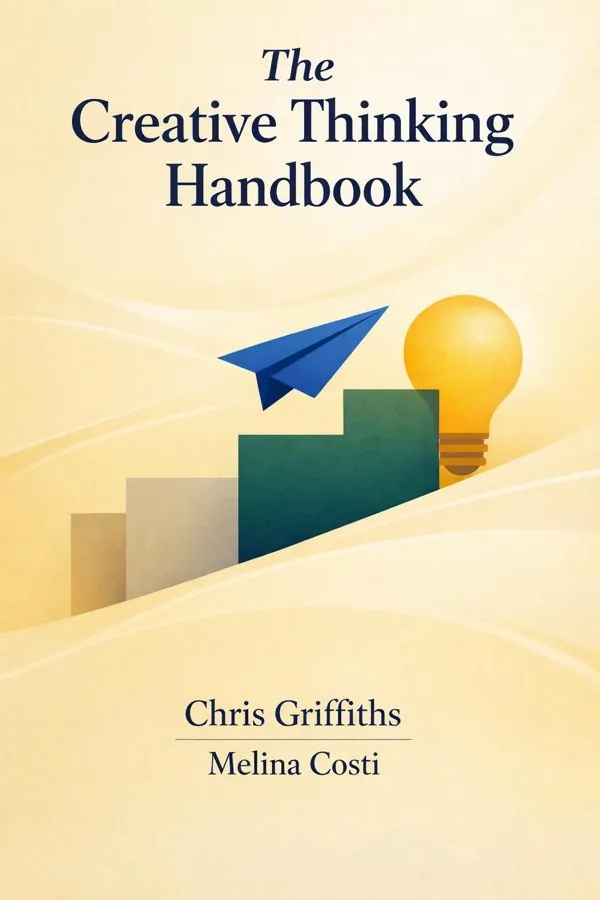
The Creative Thinking Handbook: Your Step-by-Step Guide to Problem Solving in Business: Summary & Key Insights
by Chris Griffiths, Melina Costi
 10 min8 chaptersAudio available
What Is The Creative Thinking Handbook: Your Step-by-Step Guide to Problem Solving in Business About?
The Creative Thinking Handbook: Your Step-by-Step Guide to Problem Solving in Business by Chris Griffiths, Melina Costi is a creativity book spanning 8 pages. The Creative Thinking Handbook provides a structured approach to developing creativity and innovation in business. It offers practical tools and exercises to help individuals and teams generate ideas, solve problems, and make better decisions. The book emphasizes the importance of creative thinking as a skill that can be learned and applied systematically to achieve business success.
This FizzRead summary covers all 8 key chapters of The Creative Thinking Handbook: Your Step-by-Step Guide to Problem Solving in Business in approximately 10 minutes, distilling the most important ideas, arguments, and takeaways from Chris Griffiths, Melina Costi's work. Also available as an audio summary and Key Quotes Podcast.
The Creative Thinking Handbook: Your Step-by-Step Guide to Problem Solving in Business
The Creative Thinking Handbook provides a structured approach to developing creativity and innovation in business. It offers practical tools and exercises to help individuals and teams generate ideas, solve problems, and make better decisions. The book emphasizes the importance of creative thinking as a skill that can be learned and applied systematically to achieve business success.
Who Should Read The Creative Thinking Handbook: Your Step-by-Step Guide to Problem Solving in Business?
This book is perfect for anyone interested in creativity and looking to gain actionable insights in a short read. Whether you're a student, professional, or lifelong learner, the key ideas from The Creative Thinking Handbook: Your Step-by-Step Guide to Problem Solving in Business by Chris Griffiths, Melina Costi will help you think differently.
- ✓Readers who enjoy creativity and want practical takeaways
- ✓Professionals looking to apply new ideas to their work and life
- ✓Anyone who wants the core insights of The Creative Thinking Handbook: Your Step-by-Step Guide to Problem Solving in Business in just 10 minutes
Want the full summary?
Get instant access to this book summary and 100K+ more with Fizz Moment.
Get Free SummaryAvailable on App Store • Free to download
Key Chapters
To unlock creativity, you must first redefine what it means. Creative thinking is not random brainstorming or unrestrained imagination; it is the ability to generate ideas that are both novel and practical. In business, creativity must deliver value—it has to solve problems, create efficiencies, and uncover new possibilities.
I often describe creativity as an engine powered by curiosity and guided by clarity. It differs from analytical thinking—which tends to break problems down into smaller, familiar parts—by instead seeking connections across unrelated fields. Analytical thought sustains what already exists; creative thought invents what might be.
Companies often fail not because they lack intelligence but because they lack creative courage. Organizational inertia, rigid hierarchies, and an obsession with short-term metrics suppress the very spark required for progress. The first step toward creative mastery, then, is awareness: recognizing that your current approach may not be enough for the challenges ahead.
When teams embrace creativity, they redefine the possible. A marketing team may reimagine customer engagement, an operations leader might uncover untapped efficiencies, or a start-up founder could turn an apparent problem into their most lucrative innovation. Creativity, when cultivated systematically, transforms the way you lead, decide, and compete.
Even the most naturally inquisitive minds encounter obstacles. These barriers can be internal—habits of thought, fear of failure, over-reliance on logic—or external, such as organizational culture and time pressures. Most of us live within the confines of mental models we’ve unconsciously built over time. They keep us efficient but also predictable.
In my workshops, I often ask people why they think they’re not creative. The answers are remarkably consistent: “I’m not the ideas person,” or “I’ve never been good at art,” or “I’m more analytical than creative.” These are self-imposed limitations. Creativity is not a personality trait; it is a process, and like any process, it improves with practice.
Organizations add their own constraints. Hierarchies stifle freedom, performance evaluations reward conformity, and meetings are dominated by immediate deliverables rather than imaginative exploration. To break these barriers, one must deliberately carve out space for open thinking. That means giving permission—to yourself and to others—to ask different questions, to play with possibilities without attaching judgment too soon.
When these barriers fall away, something miraculous happens: teams rediscover their natural resourcefulness. People who have spent years operating within rigid boundaries start approaching problems with renewed energy. The key is not to remove all structure but to create the right kind of structure—one that supports experimentation while maintaining focus. This controlled openness is the foundation for sustainable innovation.
+ 6 more chapters — available in the FizzRead app
All Chapters in The Creative Thinking Handbook: Your Step-by-Step Guide to Problem Solving in Business
About the Authors
Chris Griffiths is an entrepreneur and expert in innovation and creative thinking, known for his work in helping organizations enhance their problem-solving capabilities. Melina Costi is a professional writer specializing in business and marketing communications.
Get This Summary in Your Preferred Format
Read or listen to the The Creative Thinking Handbook: Your Step-by-Step Guide to Problem Solving in Business summary by Chris Griffiths, Melina Costi anytime, anywhere. FizzRead offers multiple formats so you can learn on your terms — all free.
Available formats: App · Audio · PDF · EPUB — All included free with FizzRead
Download The Creative Thinking Handbook: Your Step-by-Step Guide to Problem Solving in Business PDF and EPUB Summary
Key Quotes from The Creative Thinking Handbook: Your Step-by-Step Guide to Problem Solving in Business
“To unlock creativity, you must first redefine what it means.”
“Even the most naturally inquisitive minds encounter obstacles.”
Frequently Asked Questions about The Creative Thinking Handbook: Your Step-by-Step Guide to Problem Solving in Business
The Creative Thinking Handbook: Your Step-by-Step Guide to Problem Solving in Business by Chris Griffiths, Melina Costi is a creativity book that explores key ideas across 8 chapters. The Creative Thinking Handbook provides a structured approach to developing creativity and innovation in business. It offers practical tools and exercises to help individuals and teams generate ideas, solve problems, and make better decisions. The book emphasizes the importance of creative thinking as a skill that can be learned and applied systematically to achieve business success.
You Might Also Like
Dimensions Of Creativity
Margaret A. Boden
10 min
How to Fly a Horse: The Secret History of Creation, Invention, and Discovery
Kevin Ashton
10 min
Imagine: How Creativity Works
Jonah Lehrer
10 min
The Accidental Creative: How to Be Brilliant at a Moment's Notice
Todd Henry
10 min
The Origins of Creativity
Edward O. Wilson
10 min
Wired to Create: Unraveling the Mysteries of the Creative Mind
Scott Barry Kaufman, Carolyn Gregoire
10 minBrowse by Category
Ready to read The Creative Thinking Handbook: Your Step-by-Step Guide to Problem Solving in Business?
Get the full summary and 100K+ more books with Fizz Moment.