
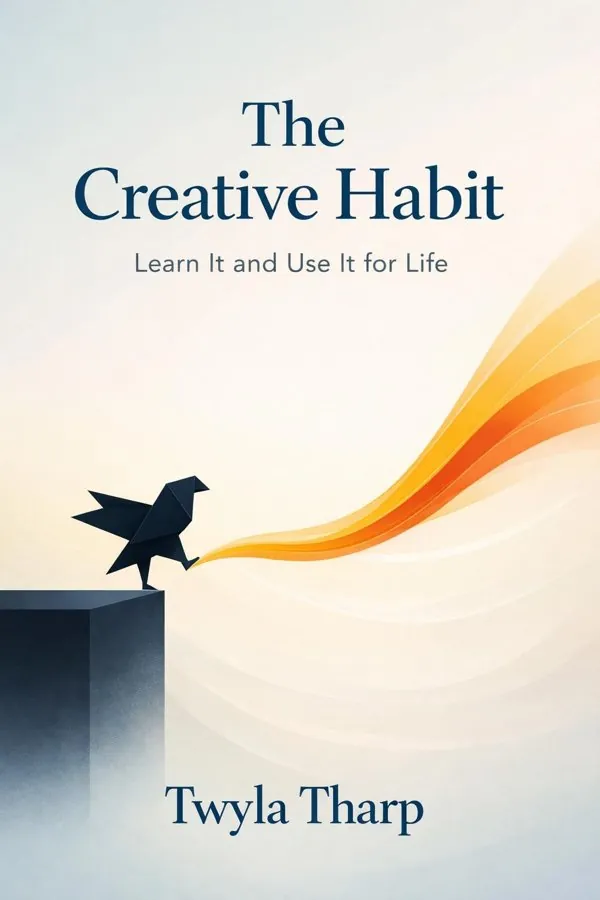
The Creative Habit: Learn It and Use It for Life: Summary & Key Insights
by Twyla Tharp
 10 min9 chaptersAudio available
Key Takeaways from The Creative Habit: Learn It and Use It for Life
Creative work becomes stronger the moment it is given a home.
Most people wait to feel creative before they start working.
Great ideas rarely arrive whole; more often, they are found by scratching around in the world for material.
Many breakthroughs begin as mistakes we were smart enough not to discard.
Every strong project has a spine: a central idea, drive, question, or structural principle that holds everything together.
What Is The Creative Habit: Learn It and Use It for Life About?
The Creative Habit: Learn It and Use It for Life by Twyla Tharp is a creativity book spanning 11 pages. In The Creative Habit, legendary choreographer Twyla Tharp argues that creativity is not a mysterious gift reserved for a talented few. It is a discipline: something built through routine, attention, preparation, and repeated practice. Drawing on decades of work in dance, theater, film, and music, Tharp shows how creative excellence comes less from waiting for inspiration and more from designing a life that makes inspiration more likely to appear. That is what makes this book so enduring and so useful. It replaces romantic myths about the muse with concrete methods for generating ideas, organizing material, overcoming self-doubt, and turning raw impulses into finished work. Although Tharp writes from the perspective of an artist, her lessons apply far beyond the studio. Writers, entrepreneurs, designers, teachers, students, and anyone trying to do original work will find a practical system here. This is not simply a book about making art. It is a book about building the habits, rituals, and resilience required to create consistently over a lifetime.
This FizzRead summary covers all 9 key chapters of The Creative Habit: Learn It and Use It for Life in approximately 10 minutes, distilling the most important ideas, arguments, and takeaways from Twyla Tharp's work. Also available as an audio summary and Key Quotes Podcast.
The Creative Habit: Learn It and Use It for Life
In The Creative Habit, legendary choreographer Twyla Tharp argues that creativity is not a mysterious gift reserved for a talented few. It is a discipline: something built through routine, attention, preparation, and repeated practice. Drawing on decades of work in dance, theater, film, and music, Tharp shows how creative excellence comes less from waiting for inspiration and more from designing a life that makes inspiration more likely to appear. That is what makes this book so enduring and so useful. It replaces romantic myths about the muse with concrete methods for generating ideas, organizing material, overcoming self-doubt, and turning raw impulses into finished work. Although Tharp writes from the perspective of an artist, her lessons apply far beyond the studio. Writers, entrepreneurs, designers, teachers, students, and anyone trying to do original work will find a practical system here. This is not simply a book about making art. It is a book about building the habits, rituals, and resilience required to create consistently over a lifetime.
Who Should Read The Creative Habit: Learn It and Use It for Life?
This book is perfect for anyone interested in creativity and looking to gain actionable insights in a short read. Whether you're a student, professional, or lifelong learner, the key ideas from The Creative Habit: Learn It and Use It for Life by Twyla Tharp will help you think differently.
- ✓Readers who enjoy creativity and want practical takeaways
- ✓Professionals looking to apply new ideas to their work and life
- ✓Anyone who wants the core insights of The Creative Habit: Learn It and Use It for Life in just 10 minutes
Want the full summary?
Get instant access to this book summary and 100K+ more with Fizz Moment.
Get Free SummaryAvailable on App Store • Free to download
Key Chapters
Creative work becomes stronger the moment it is given a home. One of Twyla Tharp’s most memorable practices is the “box”: a physical container for everything connected to a project. Notes, clippings, sketches, research, recordings, scraps of dialogue, images, and half-formed ideas all go into it. The box is more than storage. It is a declaration that the work has begun, even before it is fully understood.
This matters because creativity often feels vague and slippery. Ideas arrive in fragments, and without a system they disappear just as quickly. The box solves that problem by creating a single place where the project can accumulate density and momentum. It also reduces the anxiety of feeling that nothing is happening. Even when no finished product exists yet, the box proves that material is gathering. Over time, it becomes a visible record of engagement.
You do not need to be a choreographer to use this method. A writer can create a digital folder or notebook for a novel. A product designer can collect screenshots, user feedback, prototypes, and competitor examples. A student can build a project file with questions, sources, and emerging arguments. The important part is not the form of the box but the commitment to collecting everything in one place.
Tharp’s larger point is that organization is not the enemy of imagination. It is what gives imagination somewhere to land. Actionable takeaway: create a dedicated box, folder, or workspace for your next project today, and put one meaningful item into it before the day ends.
Most people wait to feel creative before they start working. Tharp reverses that order: start first, and let the ritual carry you into creative focus. She famously describes the simple act of getting into a cab on the way to the gym as the first step in her daily practice. The ritual is not magical in itself. Its power comes from repetition. It signals to the mind and body that it is time to shift from ordinary life into creative labor.
Rituals matter because beginning is often the hardest part. We hesitate, procrastinate, second-guess ourselves, and confuse preparation with progress. A reliable routine reduces that friction. Instead of debating whether to work, you follow a sequence. Over time, that sequence becomes automatic, and creativity has a predictable entry point.
The ritual does not need to be elaborate. It might be making coffee, clearing your desk, opening the same playlist, taking a ten-minute walk, stretching, reviewing yesterday’s notes, or writing one ugly paragraph before trying to write a good one. What matters is consistency. A ritual should be simple enough to repeat and distinct enough to create a mental threshold.
Tharp also suggests that rituals protect us from the myth that creativity depends on perfect conditions. Professionals work because they have built systems that help them enter the work despite mood, distraction, or uncertainty. Actionable takeaway: choose a three-step pre-work ritual you can repeat every day for the next week, and use it to begin before you feel fully ready.
Great ideas rarely arrive whole; more often, they are found by scratching around in the world for material. Tharp uses the word “scratching” to describe the active hunt for inspiration, references, questions, and provocative fragments. Creativity begins not with originality in a vacuum, but with curiosity in motion.
This is a crucial correction to how many people think about invention. They imagine creators sitting alone until something brilliant appears. Tharp shows that creative people are gatherers. They collect impressions, stories, movements, sounds, images, contradictions, overheard lines, and cultural debris. Then they test combinations until something clicks. Scratching is both exploratory and disciplined: you expose yourself to more inputs, but you do so with alertness and purpose.
In practical terms, scratching might mean reading outside your field, visiting museums, listening to unfamiliar music, interviewing users, clipping articles, photographing textures, freewriting around a problem, or asking strange “what if” questions. A marketer scratching for campaign ideas might study street fashion, memes, political slogans, and customer complaints. A novelist might gather family stories, maps, visual references, and bits of speech. The raw material does not need to look useful at first.
Tharp’s deeper lesson is that originality often comes from the quality of your search and the boldness of your combinations. If your inputs are stale, your output likely will be too. Actionable takeaway: schedule one deliberate scratching session this week and collect at least ten pieces of unexpected material related to your current challenge.
Many breakthroughs begin as mistakes we were smart enough not to discard. Tharp treats accidents not as interruptions to creativity but as one of its richest sources. In any serious creative process, things go wrong: an unexpected movement appears, a sentence twists into a better idea, a technical failure changes the form, or a misunderstanding reveals a hidden theme. The key question is not how to eliminate accidents, but how to recognize their potential.
This mindset requires humility. When we are too attached to a plan, we interpret every deviation as a problem. But accidents can expose assumptions, loosen rigid habits, and introduce freshness we could not have designed intentionally. They can also force us to respond more honestly. A dancer slipping, a painter mislayering color, or a founder hearing users misuse a product may stumble onto something more alive than the original design.
That does not mean every error is valuable. Tharp is not celebrating carelessness. She is arguing for adaptive intelligence: the ability to pause and ask whether the accident contains energy worth pursuing. In practice, this means documenting unexpected outcomes, testing variations, and resisting the urge to correct too quickly. In brainstorming, leave room for wrong turns. In drafting, keep surprising lines. In collaboration, explore off-script contributions before shutting them down.
Creative maturity includes knowing when to salvage, when to transform, and when to abandon. But no one can do that if they panic at the first disruption. Actionable takeaway: the next time something goes “wrong” in your work, do not fix it immediately; first list three ways it might improve the project.
Every strong project has a spine: a central idea, drive, question, or structural principle that holds everything together. Without it, creative work may contain talent and effort, but it drifts. Tharp uses the concept of the spine to identify what a piece is really about and what gives it movement from beginning to end.
The spine is not always the obvious subject. A dance may appear to be about motion but be driven by grief, rebellion, or seduction. A business presentation may seem to be about numbers but actually be organized around trust. A novel may contain multiple subplots but still be powered by one core longing. Finding the spine gives creators a decision-making tool. It helps determine what belongs, what distracts, and what should be cut.
This idea is especially useful when a project becomes crowded with good but unrelated material. Research expands, ideas multiply, and ambition grows. The spine prevents accumulation from turning into confusion. It asks: what is the governing necessity here? What is the one thing this work cannot betray? Once that becomes clear, revision gets easier because every choice can be measured against that standard.
To find a spine, try summarizing your project in one sentence, naming the emotional engine, or identifying the tension you most care about. If you cannot do that yet, the project may still be in discovery mode. That is fine, but eventually the spine must emerge. Actionable takeaway: write one sentence completing this prompt for your current project: “At its core, this work is driven by ______.”
Creativity is often praised while skill is taken for granted, yet Tharp insists that skill is what allows imagination to become real. Ideas alone are cheap. To execute them, you need craft: the trained ability to shape, refine, and deliver what you envision. In dance, that means physical discipline. In writing, it means command of language and structure. In business, it might mean analytical clarity, communication, and strategic judgment.
This matters because people sometimes use “being creative” as a way to avoid the harder work of competence. They want originality without repetition, expression without technique, and innovation without fundamentals. Tharp rejects that fantasy. Skill is not a constraint on creativity; it is the very thing that expands your options. The more technique you have, the more precisely you can respond to an idea and the more confidently you can improvise.
Skill also protects you from paralysis. When inspiration fades, trained habits can still carry you forward. A pianist practices scales so that emotion can later flow through reliable hands. A designer learns typography and hierarchy so intuition has something to build on. A founder studies operations and finance so vision can survive contact with reality.
The encouraging part is that skill can be developed by almost anyone willing to endure repetition. Tharp’s broader philosophy is democratic: creativity is available to those who train for it. Actionable takeaway: identify one core skill your creative work depends on, then commit to a short daily practice that strengthens that foundation rather than waiting to improve through inspiration alone.
Generating ideas is only half the battle; the other half is selecting, ordering, and refining them. Tharp calls this process “combing,” a vivid image for sorting through the mess of raw material until patterns, tangles, and usable strands become visible. Creative work usually begins in abundance, not clarity. Combing is how abundance becomes form.
This stage is emotionally difficult because it demands judgment. During early creation, everything can feel promising. But a project cannot contain every possibility. To comb is to compare, remove, sequence, and reconnect. You revisit your notes, drafts, movements, sketches, or research and ask: what repeats? what surprises? what belongs together? what weakens the whole? In this sense, editing is not separate from creativity. It is creativity under sharper standards.
Practical combing can take many forms. A writer prints pages and highlights recurring themes. A choreographer rearranges phrases to test momentum. A strategist groups ideas on sticky notes and names clusters. A student outlines arguments from scattered research. The point is to make the material visible enough that structure can emerge.
Tharp reminds us that creators must be both collectors and curators. If you only generate, you drown in possibility. If you only judge, you stop before anything exists. Mature creativity alternates between openness and selection. Actionable takeaway: take one existing project and spend thirty uninterrupted minutes combing it—group related material, remove one weak element, and name the strongest pattern you discover.
When a project feels unclear, metaphor can become a bridge between instinct and understanding. Tharp shows how metaphor helps creators grasp what they are trying to make by comparing it to something more familiar. A piece may move like a storm, build like an argument, unfold like a confession, or operate like a machine. These comparisons are not decorative. They provide structure, emotion, and direction.
Metaphor matters because creative work often begins before it can be fully explained. You may sense the energy of an idea without knowing its form. A useful metaphor gives shape to that intuition. It can guide rhythm, tone, sequence, and even collaboration. If you tell a team that a product experience should feel like “a trusted guide rather than a manual,” you instantly clarify dozens of design choices. If a speech should land “like a wave, not a lecture,” you know something about pacing and repetition.
Metaphor also expands problem-solving. It encourages lateral thinking by importing logic from another domain. If your process is stuck, ask what else this resembles. Is your chapter a journey, a duel, a mosaic, a trial, a dance? The answers may reveal missing transitions or unnecessary parts.
For Tharp, metaphor is one more tool that turns vague inspiration into workable decisions. It translates feeling into form. Actionable takeaway: choose your current project and finish this sentence three different ways: “This work is like ______.” Then use the strongest metaphor to revise one element of the project.
A long creative life depends not on constant brilliance but on the ability to survive stagnation, disappointment, and repetition. Tharp distinguishes between ruts and grooves: a groove is a productive pattern that supports your work, while a rut is a dead pattern that traps it. The challenge is learning when routine is serving you and when it has become automatic in the worst sense.
Ruts often appear when success hardens into formula. We repeat what once worked, protect ourselves from risk, and mistake familiarity for mastery. To escape, Tharp recommends disruption: changing inputs, altering methods, collaborating differently, moving your body, shifting constraints, or returning to beginner questions. The goal is not random novelty, but renewed aliveness.
Failure plays a crucial role here. Tharp’s idea of earning “an A in failure” means treating failed attempts as part of the curriculum rather than evidence that you should stop. Productive failure teaches timing, limits, audience, and self-knowledge. It also toughens the ego in healthy ways. People who create over decades are not the ones who avoid mistakes; they are the ones who metabolize them.
This leads to her final emphasis on the long run. Creative habit is a lifetime practice, not a short sprint. There will be dry periods, uneven projects, and seasons when progress is hard to see. The discipline is to keep showing up, learning, and adjusting. Actionable takeaway: identify one area where you are in a rut, change one working condition this week, and write down one lesson from a recent failure that can improve your next attempt.
All Chapters in The Creative Habit: Learn It and Use It for Life
About the Author
Twyla Tharp is an American choreographer, dancer, and author whose career has shaped contemporary performance for decades. Born in 1941, she trained in multiple dance traditions and became known for combining classical ballet, modern dance, jazz, and popular movement into a style that is both intellectually rigorous and physically dynamic. She founded Twyla Tharp Dance in 1965 and went on to create more than 160 works for her own company as well as for major ballet companies, Broadway productions, film, and television. Her work has earned numerous honors, including Emmy and Tony recognition. Beyond choreography, Tharp is admired for her disciplined approach to craft and creative process. In her writing, she translates lessons from a lifetime in the arts into practical guidance for anyone seeking to build a more productive and imaginative life.
Get This Summary in Your Preferred Format
Read or listen to the The Creative Habit: Learn It and Use It for Life summary by Twyla Tharp anytime, anywhere. FizzRead offers multiple formats so you can learn on your terms — all free.
Available formats: App · Audio · PDF · EPUB — All included free with FizzRead
Download The Creative Habit: Learn It and Use It for Life PDF and EPUB Summary
Key Quotes from The Creative Habit: Learn It and Use It for Life
“Creative work becomes stronger the moment it is given a home.”
“Most people wait to feel creative before they start working.”
“Great ideas rarely arrive whole; more often, they are found by scratching around in the world for material.”
“Many breakthroughs begin as mistakes we were smart enough not to discard.”
“Every strong project has a spine: a central idea, drive, question, or structural principle that holds everything together.”
Frequently Asked Questions about The Creative Habit: Learn It and Use It for Life
The Creative Habit: Learn It and Use It for Life by Twyla Tharp is a creativity book that explores key ideas across 9 chapters. In The Creative Habit, legendary choreographer Twyla Tharp argues that creativity is not a mysterious gift reserved for a talented few. It is a discipline: something built through routine, attention, preparation, and repeated practice. Drawing on decades of work in dance, theater, film, and music, Tharp shows how creative excellence comes less from waiting for inspiration and more from designing a life that makes inspiration more likely to appear. That is what makes this book so enduring and so useful. It replaces romantic myths about the muse with concrete methods for generating ideas, organizing material, overcoming self-doubt, and turning raw impulses into finished work. Although Tharp writes from the perspective of an artist, her lessons apply far beyond the studio. Writers, entrepreneurs, designers, teachers, students, and anyone trying to do original work will find a practical system here. This is not simply a book about making art. It is a book about building the habits, rituals, and resilience required to create consistently over a lifetime.
You Might Also Like
Dimensions Of Creativity
Margaret A. Boden
10 min
How to Fly a Horse: The Secret History of Creation, Invention, and Discovery
Kevin Ashton
10 min
Imagine: How Creativity Works
Jonah Lehrer
10 min
The Accidental Creative: How to Be Brilliant at a Moment's Notice
Todd Henry
10 min
The Origins of Creativity
Edward O. Wilson
10 min
Wired to Create: Unraveling the Mysteries of the Creative Mind
Scott Barry Kaufman, Carolyn Gregoire
10 minBrowse by Category
Ready to read The Creative Habit: Learn It and Use It for Life?
Get the full summary and 100K+ more books with Fizz Moment.