
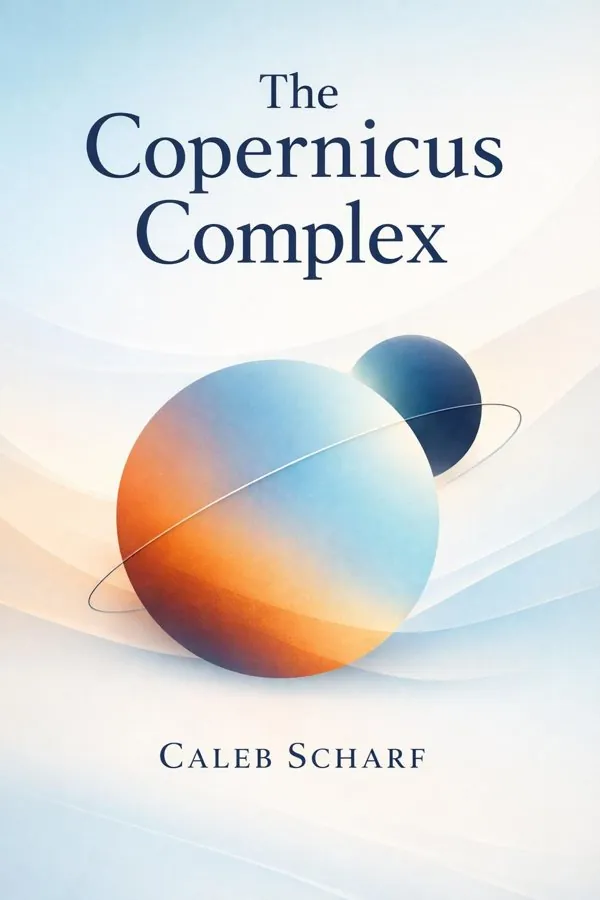
The Copernicus Complex: Our Cosmic Significance in a Universe of Planets and Probabilities: Summary & Key Insights
by Caleb Scharf
 10 min7 chaptersAudio available
What Is The Copernicus Complex: Our Cosmic Significance in a Universe of Planets and Probabilities About?
The Copernicus Complex: Our Cosmic Significance in a Universe of Planets and Probabilities by Caleb Scharf is a popular_sci book spanning 7 pages. In The Copernicus Complex, astrophysicist Caleb Scharf explores humanity’s place in the cosmos, challenging the traditional Copernican principle that we are not special. Drawing on the latest discoveries in exoplanet research, cosmology, and astrobiology, Scharf examines whether intelligent life is a rare cosmic accident or a common outcome of universal laws. The book blends scientific insight with philosophical reflection, offering a nuanced view of our cosmic significance.
This FizzRead summary covers all 7 key chapters of The Copernicus Complex: Our Cosmic Significance in a Universe of Planets and Probabilities in approximately 10 minutes, distilling the most important ideas, arguments, and takeaways from Caleb Scharf's work. Also available as an audio summary and Key Quotes Podcast.
The Copernicus Complex: Our Cosmic Significance in a Universe of Planets and Probabilities
In The Copernicus Complex, astrophysicist Caleb Scharf explores humanity’s place in the cosmos, challenging the traditional Copernican principle that we are not special. Drawing on the latest discoveries in exoplanet research, cosmology, and astrobiology, Scharf examines whether intelligent life is a rare cosmic accident or a common outcome of universal laws. The book blends scientific insight with philosophical reflection, offering a nuanced view of our cosmic significance.
Who Should Read The Copernicus Complex: Our Cosmic Significance in a Universe of Planets and Probabilities?
This book is perfect for anyone interested in popular_sci and looking to gain actionable insights in a short read. Whether you're a student, professional, or lifelong learner, the key ideas from The Copernicus Complex: Our Cosmic Significance in a Universe of Planets and Probabilities by Caleb Scharf will help you think differently.
- ✓Readers who enjoy popular_sci and want practical takeaways
- ✓Professionals looking to apply new ideas to their work and life
- ✓Anyone who wants the core insights of The Copernicus Complex: Our Cosmic Significance in a Universe of Planets and Probabilities in just 10 minutes
Want the full summary?
Get instant access to this book summary and 100K+ more with Fizz Moment.
Get Free SummaryAvailable on App Store • Free to download
Key Chapters
To understand our place in the cosmos, we must first revisit the idea that started it all. The Copernican principle was once a rebellion against human-centered belief, displacing Earth from the center of creation and replacing pride with perspective. Over time, however, the principle hardened into dogma: the assumption that everything we observe is typical, that we occupy no privileged place or condition. But does science truly support this kind of mediocrity?
Throughout history, each shift in observational power — from the telescope to the space probe — has confirmed that Earth is not physically central. Yet, at the same time, we’ve discovered environments and conditions finely tuned for complexity. Our Sun is not an average star; it is unusually stable, luminous, and long-lived. Our planet’s orbit, its moon, its magnetic field, and even its geological cycles represent a convergence of factors that encouraged the sustained evolution of life. As I argue, being non-central does not mean being non-special. Quite the opposite — it means that specialness emerges from the probabilistic fabric of reality itself.
So the Copernican principle, far from negating our significance, opens the door to a richer interpretation: that complexity, intelligence, and consciousness may be rare yet lawful outcomes of cosmic evolution. In this light, the principle becomes a framework for inquiry, not an instrument of denial. It invites us to search, compare, and measure — to use mediocrity as a null hypothesis we continue to test rather than accept.
In the modern era of astronomy, the discovery of exoplanets has transformed our view of the universe. When I look through the data from surveys like Kepler or observations from radial velocity measurements, I see a pattern emerging — planetary systems are not anomalies but expectations. The universe seems predisposed to make planets. Yet this abundance leads to new questions about probability and outcome.
Statistically speaking, if planetary formation follows the probabilistic rules of matter condensation, then life-bearing worlds should also exist elsewhere. But here is where nuance matters: the probability of any one planet developing complexity is not evenly distributed. Slight differences in chemistry, orbital mechanics, or stellar radiation can tip the balance dramatically. When you multiply those complex factors across billions of stars, the outcome isn't simple repetition — it’s a spectrum of possibilities, most of which don’t resemble Earth.
This recognition underscores the delicate dance between chance and necessity. Cosmic laws create planets the way gravity draws raindrops from clouds, yet the conditions that make a world habitable are more like the precise choreography of lightning striking a specific point on Earth. Probability determines the playing field, but fine-tuned coincidence marks the rare emergence of observers. Thus the Copernicus complex is not a contradiction but a probability curve with peaks and valleys — and humanity occupies one of those improbable high points.
+ 5 more chapters — available in the FizzRead app
All Chapters in The Copernicus Complex: Our Cosmic Significance in a Universe of Planets and Probabilities
About the Author
Caleb Scharf is a British-American astrophysicist and the director of astrobiology at Columbia University. His research focuses on exoplanets, cosmology, and the origins of life in the universe. Scharf is also a science communicator and author of several acclaimed books on astrophysics and the search for life beyond Earth.
Get This Summary in Your Preferred Format
Read or listen to the The Copernicus Complex: Our Cosmic Significance in a Universe of Planets and Probabilities summary by Caleb Scharf anytime, anywhere. FizzRead offers multiple formats so you can learn on your terms — all free.
Available formats: App · Audio · PDF · EPUB — All included free with FizzRead
Download The Copernicus Complex: Our Cosmic Significance in a Universe of Planets and Probabilities PDF and EPUB Summary
Key Quotes from The Copernicus Complex: Our Cosmic Significance in a Universe of Planets and Probabilities
“To understand our place in the cosmos, we must first revisit the idea that started it all.”
“In the modern era of astronomy, the discovery of exoplanets has transformed our view of the universe.”
Frequently Asked Questions about The Copernicus Complex: Our Cosmic Significance in a Universe of Planets and Probabilities
The Copernicus Complex: Our Cosmic Significance in a Universe of Planets and Probabilities by Caleb Scharf is a popular_sci book that explores key ideas across 7 chapters. In The Copernicus Complex, astrophysicist Caleb Scharf explores humanity’s place in the cosmos, challenging the traditional Copernican principle that we are not special. Drawing on the latest discoveries in exoplanet research, cosmology, and astrobiology, Scharf examines whether intelligent life is a rare cosmic accident or a common outcome of universal laws. The book blends scientific insight with philosophical reflection, offering a nuanced view of our cosmic significance.
More by Caleb Scharf
You Might Also Like

Structures: Or Why Things Don"t Fall Down
J.E. Gordon
10 min
The Road to Wigan Pier
George Orwell
10 min
Bonk: The Curious Coupling of Science and Sex
Mary Roach
10 min
First Bite: How We Learn to Eat
Bee Wilson
10 min
In Pursuit Of The Unknown: 17 Equations That Changed The World
Ian Stewart
10 min
Napoleon's Buttons: 17 Molecules That Changed History
Penny Le Couteur and Jay Burreson
10 minBrowse by Category
Ready to read The Copernicus Complex: Our Cosmic Significance in a Universe of Planets and Probabilities?
Get the full summary and 100K+ more books with Fizz Moment.