
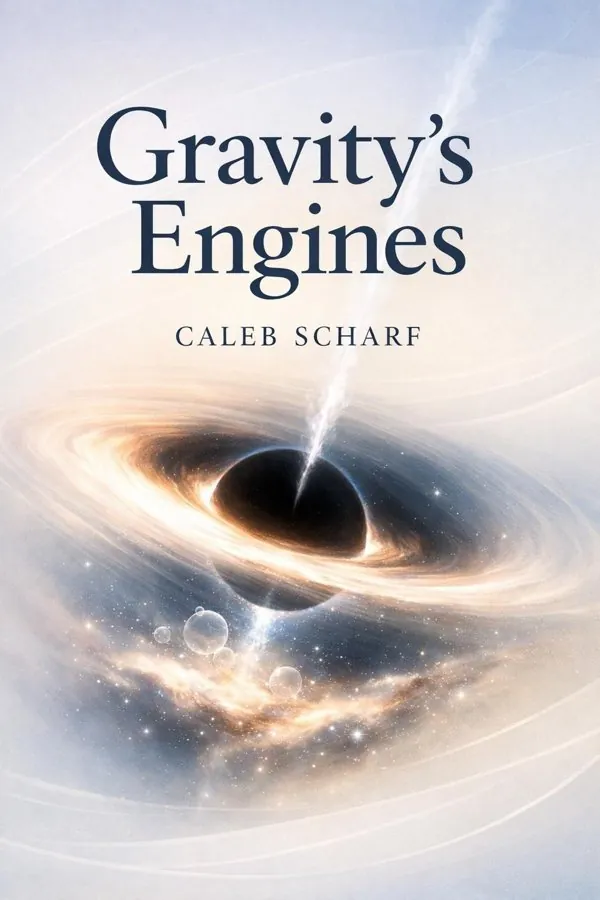
Gravity’s Engines: How Bubble-Blowing Black Holes Rule Galaxies, Stars, and Life in the Cosmos: Summary & Key Insights
by Caleb Scharf
 10 min6 chaptersAudio available
What Is Gravity’s Engines: How Bubble-Blowing Black Holes Rule Galaxies, Stars, and Life in the Cosmos About?
Gravity’s Engines: How Bubble-Blowing Black Holes Rule Galaxies, Stars, and Life in the Cosmos by Caleb Scharf is a popular_sci book spanning 6 pages. In this book, astrophysicist Caleb Scharf explores the profound influence of black holes on the universe. Far from being mere cosmic vacuum cleaners, black holes are shown to be dynamic engines that shape galaxies, regulate star formation, and even influence the conditions necessary for life. Scharf combines cutting-edge research with accessible explanations to reveal how these mysterious objects drive the evolution of the cosmos.
This FizzRead summary covers all 6 key chapters of Gravity’s Engines: How Bubble-Blowing Black Holes Rule Galaxies, Stars, and Life in the Cosmos in approximately 10 minutes, distilling the most important ideas, arguments, and takeaways from Caleb Scharf's work. Also available as an audio summary and Key Quotes Podcast.
Gravity’s Engines: How Bubble-Blowing Black Holes Rule Galaxies, Stars, and Life in the Cosmos
In this book, astrophysicist Caleb Scharf explores the profound influence of black holes on the universe. Far from being mere cosmic vacuum cleaners, black holes are shown to be dynamic engines that shape galaxies, regulate star formation, and even influence the conditions necessary for life. Scharf combines cutting-edge research with accessible explanations to reveal how these mysterious objects drive the evolution of the cosmos.
Who Should Read Gravity’s Engines: How Bubble-Blowing Black Holes Rule Galaxies, Stars, and Life in the Cosmos?
This book is perfect for anyone interested in popular_sci and looking to gain actionable insights in a short read. Whether you're a student, professional, or lifelong learner, the key ideas from Gravity’s Engines: How Bubble-Blowing Black Holes Rule Galaxies, Stars, and Life in the Cosmos by Caleb Scharf will help you think differently.
- ✓Readers who enjoy popular_sci and want practical takeaways
- ✓Professionals looking to apply new ideas to their work and life
- ✓Anyone who wants the core insights of Gravity’s Engines: How Bubble-Blowing Black Holes Rule Galaxies, Stars, and Life in the Cosmos in just 10 minutes
Want the full summary?
Get instant access to this book summary and 100K+ more with Fizz Moment.
Get Free SummaryAvailable on App Store • Free to download
Key Chapters
The history of black holes reads like a chronicle of disbelief turning into awe. At first, the idea seemed absurd. When Karl Schwarzschild solved Einstein’s equations during the turmoil of World War I, the notion of a region where gravity became infinite was treated as a mathematical oddity, not a physical reality. Even Einstein himself doubted the existence of such extremes. But as the twentieth century progressed, evidence began to build—from X-ray binaries to quasars blazing at cosmic distances—that something extraordinary was happening in the hearts of galaxies.
When early radio astronomers discovered quasars, their luminosities defied explanation. A star could never shine that bright. Nuclear fusion, the greatest power known in astrophysics, could not produce such energy sustainably. The answer lay in gravity—the most ancient and yet most patient of forces. As matter fell toward a dense gravitational well, its potential energy converted into heat and radiation, releasing torrents of power far beyond the reach of stellar fusion. These were the signatures of accretion onto black holes, the slow feeding process that transformed these objects from passive sinks into active cosmic machines.
Over decades, the theoretical understanding coevolved with technological progress. Telescopes like Hubble, Chandra, and later ground-based interferometers exposed the environments around supermassive black holes with increasing clarity. What we found was a delicate balance of destruction and creation—a ballet of inflowing and outflowing matter. The early skepticism gave way to astonishment. Theoretical shadows became empirical monuments. And as I often remind readers, this shift mirrors the broader evolution of human inquiry: we tend to fear what we cannot see, until we learn to listen to its subtle whispers through physics.
A black hole on its own, without its environment, would be difficult to detect. It emits no light, no sound, no direct signal of its presence. Yet when we surround it with matter, everything changes. Dust, gas, and even entire stars spiral toward the gravitational abyss. As they fall, they accelerate, compress, and heat, unleashing radiation that paints the universe in X-rays and ultraviolet light. This is accretion—the act of feeding gravity, turning invisible entities into blazing beacons.
Through accretion, gravitational potential energy transforms into electromagnetic power with astonishing efficiency. A few percent of the rest mass energy of infalling matter can be released—far surpassing the efficiency of nuclear fusion. To visualize this, imagine an atom falling toward a supermassive black hole at the galaxy’s center. Before being consumed, it glows with a brilliance that could outshine millions of suns. But just as astonishing is the regulation that follows: accretion does not continue indefinitely. The outflow from this process—winds, jets, shock waves—pushes back on the same material that sustains it. Black holes, it turns out, can throttle their own feeding.
In galaxies like M87 or Centaurus A, we observe these feedback loops in action. The jets emanating from their cores extend for thousands of light-years, pumping energy into the surrounding interstellar medium. They shape the temperature, pressure, and chemical composition of their host galaxies, ensuring that the cosmos remains neither static nor chaotic. In this cycle, black holes emerge as central regulators—not just destroyers but moderators of cosmic sustainability. Their hunger and restraint are two sides of a single, elegant coin.
+ 4 more chapters — available in the FizzRead app
All Chapters in Gravity’s Engines: How Bubble-Blowing Black Holes Rule Galaxies, Stars, and Life in the Cosmos
About the Author
Caleb Scharf is a British-American astrophysicist and the director of astrobiology at Columbia University. His research focuses on exoplanets, cosmology, and the origins of life in the universe. He is also a noted science communicator and author of several popular science books.
Get This Summary in Your Preferred Format
Read or listen to the Gravity’s Engines: How Bubble-Blowing Black Holes Rule Galaxies, Stars, and Life in the Cosmos summary by Caleb Scharf anytime, anywhere. FizzRead offers multiple formats so you can learn on your terms — all free.
Available formats: App · Audio · PDF · EPUB — All included free with FizzRead
Download Gravity’s Engines: How Bubble-Blowing Black Holes Rule Galaxies, Stars, and Life in the Cosmos PDF and EPUB Summary
Key Quotes from Gravity’s Engines: How Bubble-Blowing Black Holes Rule Galaxies, Stars, and Life in the Cosmos
“The history of black holes reads like a chronicle of disbelief turning into awe.”
“A black hole on its own, without its environment, would be difficult to detect.”
Frequently Asked Questions about Gravity’s Engines: How Bubble-Blowing Black Holes Rule Galaxies, Stars, and Life in the Cosmos
Gravity’s Engines: How Bubble-Blowing Black Holes Rule Galaxies, Stars, and Life in the Cosmos by Caleb Scharf is a popular_sci book that explores key ideas across 6 chapters. In this book, astrophysicist Caleb Scharf explores the profound influence of black holes on the universe. Far from being mere cosmic vacuum cleaners, black holes are shown to be dynamic engines that shape galaxies, regulate star formation, and even influence the conditions necessary for life. Scharf combines cutting-edge research with accessible explanations to reveal how these mysterious objects drive the evolution of the cosmos.
More by Caleb Scharf
You Might Also Like

Structures: Or Why Things Don"t Fall Down
J.E. Gordon
10 min
The Road to Wigan Pier
George Orwell
10 min
Bonk: The Curious Coupling of Science and Sex
Mary Roach
10 min
First Bite: How We Learn to Eat
Bee Wilson
10 min
In Pursuit Of The Unknown: 17 Equations That Changed The World
Ian Stewart
10 min
Napoleon's Buttons: 17 Molecules That Changed History
Penny Le Couteur and Jay Burreson
10 minBrowse by Category
Ready to read Gravity’s Engines: How Bubble-Blowing Black Holes Rule Galaxies, Stars, and Life in the Cosmos?
Get the full summary and 100K+ more books with Fizz Moment.