
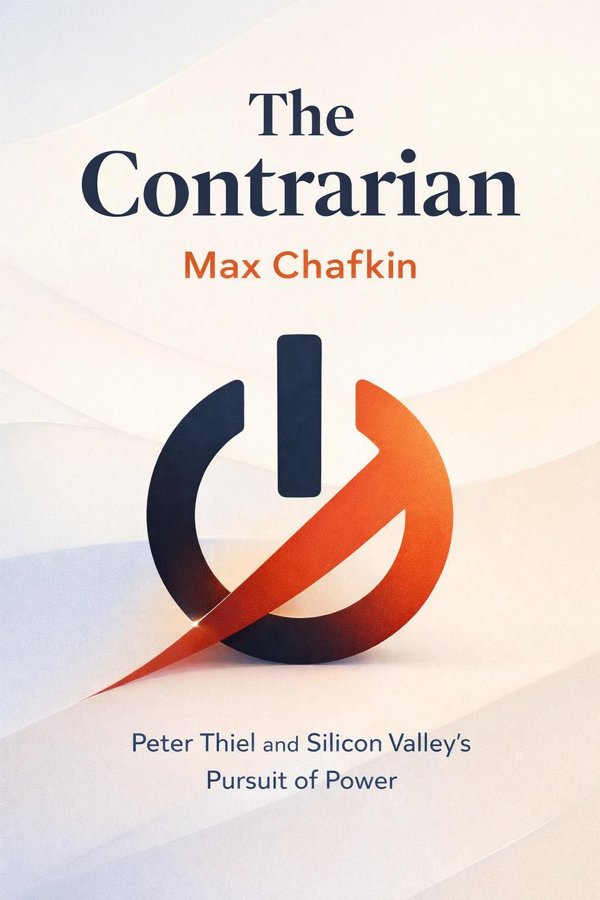
The Contrarian: Peter Thiel and Silicon Valley's Pursuit of Power: Summary & Key Insights
by Max Chafkin
 10 min5 chaptersAudio available
What Is The Contrarian: Peter Thiel and Silicon Valley's Pursuit of Power About?
The Contrarian: Peter Thiel and Silicon Valley's Pursuit of Power by Max Chafkin is a biographies book spanning 5 pages. A biography of venture capitalist and PayPal co-founder Peter Thiel, exploring his influence on Silicon Valley, his political activities, and his contrarian worldview that shaped the tech industry and beyond.
This FizzRead summary covers all 5 key chapters of The Contrarian: Peter Thiel and Silicon Valley's Pursuit of Power in approximately 10 minutes, distilling the most important ideas, arguments, and takeaways from Max Chafkin's work. Also available as an audio summary and Key Quotes Podcast.
The Contrarian: Peter Thiel and Silicon Valley's Pursuit of Power
A biography of venture capitalist and PayPal co-founder Peter Thiel, exploring his influence on Silicon Valley, his political activities, and his contrarian worldview that shaped the tech industry and beyond.
Who Should Read The Contrarian: Peter Thiel and Silicon Valley's Pursuit of Power?
This book is perfect for anyone interested in biographies and looking to gain actionable insights in a short read. Whether you're a student, professional, or lifelong learner, the key ideas from The Contrarian: Peter Thiel and Silicon Valley's Pursuit of Power by Max Chafkin will help you think differently.
- ✓Readers who enjoy biographies and want practical takeaways
- ✓Professionals looking to apply new ideas to their work and life
- ✓Anyone who wants the core insights of The Contrarian: Peter Thiel and Silicon Valley's Pursuit of Power in just 10 minutes
Want the full summary?
Get instant access to this book summary and 100K+ more with Fizz Moment.
Get Free SummaryAvailable on App Store • Free to download
Key Chapters
Peter Thiel’s life began far from the iconoclastic world he would later come to dominate. Born in Germany and raised in California, he grew up in a household where intellectual ambition and skepticism toward authority were quietly nurtured. His parents, both engineers, encouraged a disciplined, analytical mindset. But it was at Stanford University that Thiel’s contrarian edge truly emerged.
At Stanford, Thiel immersed himself in the study of philosophy and law — and it was here he developed a deep distrust of prevailing orthodoxies. The campus of the 1980s and early 1990s was a crucible of political correctness, and Thiel positioned himself in total opposition to it. He co-founded the 'Stanford Review,' a newspaper that lambasted what he saw as liberal groupthink on campus. The experience honed both his rhetorical skill and his appetite for ideological combat.
Thiel’s intellectual heroes ranged from René Girard, whose theory of mimetic desire argued that humans imitate the desires of others, to Nietzsche, whose call for exceptional individuals to transcend the masses resonated deeply with him. These influences would later define both his view of business and politics. For Thiel, the pursuit of truth meant rebelling against consensus — and the consensus, in his mind, was always wrong.
By the time he graduated from Stanford Law School, Thiel had grown disillusioned with conventional career paths. He spent a brief stint at a law firm and on Wall Street, but he found both worlds uninspiring and hierarchical. His yearning was for a less regulated playground — one where intellect and will could rewrite the rules. That playground turned out to be Silicon Valley.
Thiel’s leap into entrepreneurship took shape in the mid-1990s, when he teamed up with young programmers and dreamers to launch what would become PayPal. At its core, PayPal was a radical idea: a system that could move money online with the same ease as email. It seemed insane to traditional bankers, but splendidly obvious to Thiel.
From the start, Thiel saw PayPal as more than a payment processor — it was a test of his deepest theories about competition, growth, and human behavior. He believed in a kind of Darwinian capitalism, where only those who could imagine a radically different world would survive. Inside PayPal, chaos and creativity reigned. The company’s early employees formed an exceptional network: Elon Musk, Reid Hoffman, Max Levchin, and other future titans of Silicon Valley. Thiel cultivated in them the idea that success came not from consensus, but from dissent.
When eBay acquired PayPal in 2002, Thiel walked away with about $55 million. But the greater prize was the network of fiercely loyal entrepreneurs who had been molded by his contrarian ethos. The 'PayPal Mafia' would go on to found or fund a generation of transformative companies — Facebook, LinkedIn, YouTube, Palantir — embedding Thiel’s intellectual DNA into the architecture of the internet economy.
PayPal’s story reveals something crucial about Thiel’s approach: he prized speed, boldness, and the willingness to offend conventional wisdom. Every setback, he believed, was an opportunity to prove his faith that the smartest minds thrived outside the mainstream. In PayPal’s success, Thiel found proof that his worldview could be monetized — that rebellion itself was profitable.
+ 3 more chapters — available in the FizzRead app
All Chapters in The Contrarian: Peter Thiel and Silicon Valley's Pursuit of Power
About the Author
Max Chafkin is a journalist and senior writer for Bloomberg Businessweek, known for his in-depth reporting on technology, business, and influential figures in Silicon Valley.
Get This Summary in Your Preferred Format
Read or listen to the The Contrarian: Peter Thiel and Silicon Valley's Pursuit of Power summary by Max Chafkin anytime, anywhere. FizzRead offers multiple formats so you can learn on your terms — all free.
Available formats: App · Audio · PDF · EPUB — All included free with FizzRead
Download The Contrarian: Peter Thiel and Silicon Valley's Pursuit of Power PDF and EPUB Summary
Key Quotes from The Contrarian: Peter Thiel and Silicon Valley's Pursuit of Power
“Peter Thiel’s life began far from the iconoclastic world he would later come to dominate.”
“Thiel’s leap into entrepreneurship took shape in the mid-1990s, when he teamed up with young programmers and dreamers to launch what would become PayPal.”
Frequently Asked Questions about The Contrarian: Peter Thiel and Silicon Valley's Pursuit of Power
The Contrarian: Peter Thiel and Silicon Valley's Pursuit of Power by Max Chafkin is a biographies book that explores key ideas across 5 chapters. A biography of venture capitalist and PayPal co-founder Peter Thiel, exploring his influence on Silicon Valley, his political activities, and his contrarian worldview that shaped the tech industry and beyond.
You Might Also Like

An American Marriage
Tayari Jones
10 min
Benjamin Franklin: An American Life
Walter Isaacson
10 min
I Know Why The Caged Bird Sings
Maya Angelou
10 min
Long Walk to Freedom
Nelson Mandela
10 min
Persepolis
Marjane Satrapi
10 min
Surely You're Joking, Mr. Feynman!
Richard P. Feynman
10 minBrowse by Category
Ready to read The Contrarian: Peter Thiel and Silicon Valley's Pursuit of Power?
Get the full summary and 100K+ more books with Fizz Moment.