
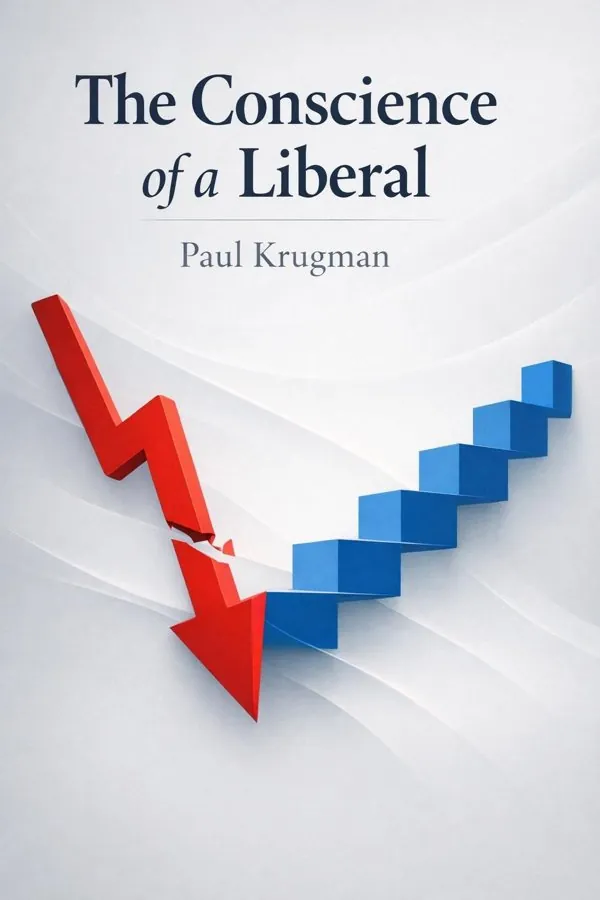
The Conscience of a Liberal: Summary & Key Insights
by Paul Krugman
 10 min9 chaptersAudio available
What Is The Conscience of a Liberal About?
The Conscience of a Liberal by Paul Krugman is a economics book spanning 9 pages. In this influential work, Nobel laureate economist Paul Krugman examines the political and economic history of the United States from the New Deal to the present, arguing for a return to liberal values that promote equality and social justice. He explores how conservative policies have widened inequality and calls for renewed progressive reform to restore the middle class and strengthen democracy.
This FizzRead summary covers all 9 key chapters of The Conscience of a Liberal in approximately 10 minutes, distilling the most important ideas, arguments, and takeaways from Paul Krugman's work. Also available as an audio summary and Key Quotes Podcast.
The Conscience of a Liberal
In this influential work, Nobel laureate economist Paul Krugman examines the political and economic history of the United States from the New Deal to the present, arguing for a return to liberal values that promote equality and social justice. He explores how conservative policies have widened inequality and calls for renewed progressive reform to restore the middle class and strengthen democracy.
Who Should Read The Conscience of a Liberal?
This book is perfect for anyone interested in economics and looking to gain actionable insights in a short read. Whether you're a student, professional, or lifelong learner, the key ideas from The Conscience of a Liberal by Paul Krugman will help you think differently.
- ✓Readers who enjoy economics and want practical takeaways
- ✓Professionals looking to apply new ideas to their work and life
- ✓Anyone who wants the core insights of The Conscience of a Liberal in just 10 minutes
Want the full summary?
Get instant access to this book summary and 100K+ more with Fizz Moment.
Get Free SummaryAvailable on App Store • Free to download
Key Chapters
The story of modern American equality begins with the New Deal and what I call the Great Compression—the extraordinary narrowing of income inequality that took place from the 1930s through the 1950s. Before Franklin Roosevelt, the United States was a nation of extremes: a small wealthy elite and a vast working class with few protections. The New Deal was not just a series of emergency measures to fight the Great Depression; it was a profound transformation of the relationship between citizens and their government. Through progressive taxation, strict financial regulation, and the birth of the social safety net, Roosevelt and his allies created the conditions for shared prosperity.
By the postwar years, that transformation had matured. The labor movement became an essential partner in sustaining fair wages and worker rights. Corporations accepted the legitimacy of unions, and executive pay was restrained not by law but by prevailing social norms. From about 1947 to 1973, productivity and wages rose together—a period that economists now recognize as unique in American history. I call this the Great Compression because the gap between the rich and the poor narrowed dramatically. The income differences that had defined America’s Gilded Age faded, replaced by a relatively cohesive middle-class nation.
This wasn’t an accidental product of economic forces. Government policy was at the heart of it. The GI Bill opened higher education to millions of veterans, while Social Security guaranteed dignity in old age. Corporate taxes were high, but businesses still flourished because mass consumption drove profits. It was a virtuous cycle that reflected liberal principles at work: government enabling opportunity rather than suppressing it. The Great Compression proved that democratic institutions could tame capitalism’s excesses without extinguishing its dynamism. When I look back at that era, I see not nostalgia but evidence—a living proof that conscious political choices can produce equality, growth, and stability simultaneously.
The decades following World War II stand as the Golden Age of Equality in America. If you were born in the 1950s or 1960s, you entered a world in which middle-class life seemed attainable. Median families could buy homes, send children to college, and retire with security. What sustained this era was an implicit social contract: prosperity was shared broadly, and government stepped in where markets failed. Liberals then were proud pragmatists—they believed in capitalism but insisted on rules that made it humane.
Unions were emblematic of that balance. Organized labor didn’t merely negotiate wages; it shaped political conversation around fairness. Meanwhile, public investment in education and infrastructure accelerated mobility. Government regulation kept finance stable and prevented speculative bubbles. And though marginal tax rates on top incomes were very high by today’s standards, inequality was low, and most Americans felt the system worked for them.
This period wasn’t perfect—racial segregation persisted, and many groups were excluded from full participation—but its economic architecture was robust. The prosperity of the time was born out of deliberate policy design, not luck. It refuted the conservative claim that equality kills growth. On the contrary, the relative equality of the mid-century fueled confidence, consumer demand, and innovation. America’s strength came from solidarity.
From my standpoint, this Golden Age wasn’t just a phase of affluence; it was a demonstration that liberal governance could fulfill both moral and practical aims. The same principles that made the postwar economy thrive remain crucial today: progressive taxation, strong social programs, and a political system committed to shared welfare. When those principles are forgotten, prosperity loses its moral foundation and fractures under the weight of inequity. Our challenge now is to remember what that age taught—that fairness is not a hindrance to progress but its engine.
+ 7 more chapters — available in the FizzRead app
All Chapters in The Conscience of a Liberal
About the Author
Paul Krugman is an American economist, columnist, and professor known for his work on international economics and economic geography. He received the Nobel Prize in Economic Sciences in 2008 and writes regularly for The New York Times, where he analyzes economic policy and political issues.
Get This Summary in Your Preferred Format
Read or listen to the The Conscience of a Liberal summary by Paul Krugman anytime, anywhere. FizzRead offers multiple formats so you can learn on your terms — all free.
Available formats: App · Audio · PDF · EPUB — All included free with FizzRead
Download The Conscience of a Liberal PDF and EPUB Summary
Key Quotes from The Conscience of a Liberal
“The story of modern American equality begins with the New Deal and what I call the Great Compression—the extraordinary narrowing of income inequality that took place from the 1930s through the 1950s.”
“The decades following World War II stand as the Golden Age of Equality in America.”
Frequently Asked Questions about The Conscience of a Liberal
The Conscience of a Liberal by Paul Krugman is a economics book that explores key ideas across 9 chapters. In this influential work, Nobel laureate economist Paul Krugman examines the political and economic history of the United States from the New Deal to the present, arguing for a return to liberal values that promote equality and social justice. He explores how conservative policies have widened inequality and calls for renewed progressive reform to restore the middle class and strengthen democracy.
More by Paul Krugman
You Might Also Like
Business Adventures
John Brooks
10 min
Nudge
Richard H. Thaler, Cass R. Sunstein
10 min
The Hitchhiker"s Guide to the Galaxy
Douglas Adams
10 minThe Muqaddimah
Ibn Khaldun
10 minThe Outsiders
William N. Thorndike
10 min
A Little History of Economics
Niall Kishtainy
10 minBrowse by Category
Ready to read The Conscience of a Liberal?
Get the full summary and 100K+ more books with Fizz Moment.