
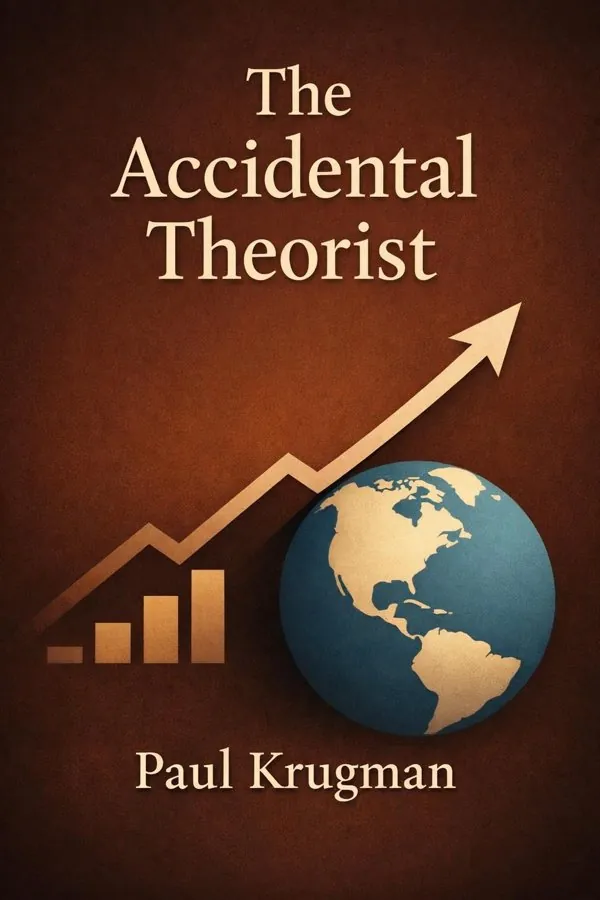
The Accidental Theorist: And Other Dispatches from the Dismal Science: Summary & Key Insights
by Paul Krugman
 10 min10 chaptersAudio available
Key Takeaways from The Accidental Theorist: And Other Dispatches from the Dismal Science
A society becomes richer not by working harder forever, but by producing more value with the same effort.
One of the most important ideas in economics sounds wrong until you truly understand it.
Globalization is neither the utopia its boosters promise nor the disaster its critics fear.
When economic anxiety rises, people search for a visible culprit.
Economic nonsense survives not because it is persuasive to experts, but because it is useful to politicians, pundits, and interest groups.
What Is The Accidental Theorist: And Other Dispatches from the Dismal Science About?
The Accidental Theorist: And Other Dispatches from the Dismal Science by Paul Krugman is a economics book spanning 10 pages. The Accidental Theorist is Paul Krugman at his most accessible: sharp, funny, and relentlessly committed to explaining why sound economics so often loses out to comforting myths. This collection of essays gathers his reflections on trade, technology, political spin, social policy, and financial turmoil in the late twentieth century, but its real subject is broader than any single event. Krugman shows how economic reasoning can cut through public confusion, revealing that many widely repeated claims about jobs, globalization, competitiveness, and government policy collapse under careful analysis. What makes the book matter is not just its commentary on its era, but its demonstration of how to think clearly when public debate becomes noisy, emotional, or ideological. Krugman writes as both a leading academic economist and a gifted public intellectual. Long before receiving the Nobel Prize in Economic Sciences, he had already earned a reputation for transforming complex ideas into arguments ordinary readers could follow. This book remains valuable because it teaches more than economics. It teaches intellectual discipline: how to question fashionable narratives, respect evidence, and understand that good policy begins with seeing the world as it is, not as we wish it to be.
This FizzRead summary covers all 10 key chapters of The Accidental Theorist: And Other Dispatches from the Dismal Science in approximately 10 minutes, distilling the most important ideas, arguments, and takeaways from Paul Krugman's work. Also available as an audio summary and Key Quotes Podcast.
The Accidental Theorist: And Other Dispatches from the Dismal Science
The Accidental Theorist is Paul Krugman at his most accessible: sharp, funny, and relentlessly committed to explaining why sound economics so often loses out to comforting myths. This collection of essays gathers his reflections on trade, technology, political spin, social policy, and financial turmoil in the late twentieth century, but its real subject is broader than any single event. Krugman shows how economic reasoning can cut through public confusion, revealing that many widely repeated claims about jobs, globalization, competitiveness, and government policy collapse under careful analysis. What makes the book matter is not just its commentary on its era, but its demonstration of how to think clearly when public debate becomes noisy, emotional, or ideological. Krugman writes as both a leading academic economist and a gifted public intellectual. Long before receiving the Nobel Prize in Economic Sciences, he had already earned a reputation for transforming complex ideas into arguments ordinary readers could follow. This book remains valuable because it teaches more than economics. It teaches intellectual discipline: how to question fashionable narratives, respect evidence, and understand that good policy begins with seeing the world as it is, not as we wish it to be.
Who Should Read The Accidental Theorist: And Other Dispatches from the Dismal Science?
This book is perfect for anyone interested in economics and looking to gain actionable insights in a short read. Whether you're a student, professional, or lifelong learner, the key ideas from The Accidental Theorist: And Other Dispatches from the Dismal Science by Paul Krugman will help you think differently.
- ✓Readers who enjoy economics and want practical takeaways
- ✓Professionals looking to apply new ideas to their work and life
- ✓Anyone who wants the core insights of The Accidental Theorist: And Other Dispatches from the Dismal Science in just 10 minutes
Want the full summary?
Get instant access to this book summary and 100K+ more with Fizz Moment.
Get Free SummaryAvailable on App Store • Free to download
Key Chapters
A society becomes richer not by working harder forever, but by producing more value with the same effort. That simple truth sounds obvious, yet public debate often treats productivity growth as a threat. In the essay that gives the book its title, Krugman responds to a recurring fear: if machines and efficiency improvements reduce the need for labor, won’t workers be left behind? He argues that this view mistakes a short-run adjustment problem for a long-run catastrophe. Over time, higher productivity is the source of rising living standards. If workers can produce more per hour, society has more income, more goods, and ultimately more possibilities.
Krugman does not deny that technological change can be disruptive. A factory may automate, a clerical task may disappear, or an industry may shrink. But the broader economy is not a fixed pie of jobs. Productivity gains lower costs, raise real incomes, and create demand elsewhere. Historical experience supports this: agriculture once employed huge shares of the population, yet as productivity rose, labor moved into manufacturing and services rather than into permanent unemployment.
The practical lesson is especially useful whenever headlines warn that innovation will “destroy all jobs.” Businesses adopting software, robotics, or AI may indeed reshape specific roles, but the real policy question is how to manage transition: retraining, mobility, income support, and education. The answer is not to fear productivity itself.
Actionable takeaway: When evaluating claims about technology and jobs, separate short-term disruption from long-term prosperity, and focus on policies that help people adapt rather than resisting innovation altogether.
One of the most important ideas in economics sounds wrong until you truly understand it. Krugman revisits David Ricardo’s theory of comparative advantage to show why trade can benefit countries even when one nation is better at producing everything. The key is not absolute superiority but relative efficiency. If each country specializes in what it does comparatively better and trades for the rest, total output rises and both can gain.
This idea remains hard for the public to accept because everyday thinking frames competition in winner-take-all terms. If one country is more productive across the board, many assume the weaker country has nothing to offer. Krugman shows why that conclusion fails. Trade is not a sporting event with one champion and one loser; it is a way to organize production more efficiently. Even a highly productive economy still benefits by importing goods that other countries produce at lower opportunity cost.
Consider a modern example. A wealthy country may excel in advanced software, pharmaceuticals, and finance, while another may be relatively better at textiles or assembly. Even if the richer country could produce clothing too, doing so might divert labor and capital from industries where its advantage is much greater. Trade allows both sides to specialize and consume more than they could in isolation.
Krugman’s deeper point is that public resistance to trade often comes from misunderstanding basic logic. Trade can create winners and losers within countries, but that is different from saying trade is nationally harmful.
Actionable takeaway: When hearing arguments about imports “stealing” prosperity, ask not who is best overall, but where each side has the strongest relative advantage and how the gains from trade are being distributed.
Globalization is neither the utopia its boosters promise nor the disaster its critics fear. Krugman treats it as an economic process with real benefits, real disruptions, and frequent exaggerations on all sides. He pushes back against the idea that global trade and integration are the sole explanation for wage stagnation or industrial decline in advanced economies. In many cases, he argues, technology, domestic institutions, and policy choices matter at least as much.
At the same time, he does not present globalization as painless. When production shifts across borders, some communities lose factories, workers face downward pressure, and political resentment builds. The mistake is to turn these genuine costs into a sweeping indictment of all international integration. Lower prices, larger markets, and more efficient production can improve living standards broadly, especially for consumers and export-oriented sectors.
A practical way to see this is through everyday goods. Imported electronics, clothing, and household items often become cheaper because of global supply chains. That benefits consumers, especially lower-income households. But if a region depends heavily on a manufacturing niche exposed to foreign competition, the local pain can be severe. Krugman’s point is that the right response is not simplistic anti-trade rhetoric, but serious domestic adjustment policy.
This remains highly relevant today. Debates over outsourcing, tariffs, and economic nationalism often skip over the distinction between national aggregate gains and localized losses. Both can be true at once.
Actionable takeaway: Evaluate globalization in two steps: recognize its overall efficiency gains, then ask what policies are needed to support workers and regions that bear concentrated adjustment costs.
When economic anxiety rises, people search for a visible culprit. Foreign competition is politically convenient, but Krugman argues that technological change often explains more than trade does. Changes in wages, job composition, and productivity frequently result from new production methods, software, automation, and shifts in business organization rather than imports alone.
This matters because misdiagnosis leads to bad policy. If politicians blame trade for trends mainly driven by technology, they may impose tariffs that do little to restore jobs while making consumers poorer. Meanwhile, the real challenge, helping workers gain skills and move into more productive roles, goes unaddressed. Krugman encourages readers to distinguish between changes in who makes goods and changes in how goods are made.
A useful example is retail. Many store closures are blamed on globalization, yet e-commerce, logistics software, and changing consumer behavior have been at least as important. Similarly, manufacturing output can remain strong even while manufacturing employment falls, because factories produce more with fewer workers. That is a technology story more than a trade story.
Krugman’s point is not that trade is irrelevant, but that public debate tends to overstate its role because it is easier to dramatize ships, borders, and foreign rivals than algorithms and process innovation. Sound economic reasoning demands proportion.
For managers, workers, and policymakers, this perspective changes what adaptation looks like. The focus should be on education, lifelong learning, labor market flexibility, and social insurance, not only on border measures.
Actionable takeaway: Before accepting a popular explanation for job losses, ask whether the deeper driver is foreign competition or productivity-enhancing technology, and tailor solutions accordingly.
Economic nonsense survives not because it is persuasive to experts, but because it is useful to politicians, pundits, and interest groups. One of Krugman’s recurring themes is that public debate rewards emotionally satisfying stories over analytically sound ones. Nations are described as if they were corporations competing for market share. Trade deficits are treated like scorecards of failure. Productivity is portrayed as dangerous. These ideas persist because they are easy to grasp, rhetorically powerful, and often aligned with someone’s agenda.
Krugman’s essays are dispatches from this battlefield between careful reasoning and seductive simplification. He shows that many policy arguments rely on category errors, misleading metaphors, or selective evidence. A country is not a business trying to outperform rivals in a single marketplace. National prosperity depends more on domestic productivity and institutions than on “beating” other nations. Likewise, calls for protection or industrial rescue are often dressed up as common sense even when the underlying economics is weak.
This insight has everyday applications beyond macroeconomics. Whenever a commentator reduces a complex issue to one villain or one obvious fix, skepticism is warranted. If an argument sounds intuitive but ignores trade-offs, incentives, or distributional effects, it may be politically effective but economically shallow.
Krugman’s style is especially valuable here. He does not merely say an argument is wrong; he explains why it is appealing and where it goes off track. That makes the reader better equipped to resist future fallacies.
Actionable takeaway: Treat grand economic claims the way a scientist treats a hypothesis: ask what assumptions they make, what evidence supports them, and what trade-offs they leave out.
The public often expects economists to behave like fortune-tellers, but Krugman argues that their more important role is to provide a disciplined framework for thinking. Good economics does not eliminate uncertainty or produce perfect predictions. Instead, it identifies the relevant mechanisms, tests popular claims against logic and evidence, and shows where intuition goes wrong.
This is why Krugman places such importance on theory. To many outsiders, theory sounds detached or ideological. In his hands, it is practical. Theory is what lets us understand why trade can help both sides, why productivity raises living standards, why some crises spread, or why incentives matter. Without theory, debate becomes a contest of anecdotes and slogans.
Imagine a policymaker deciding whether to subsidize an industry, impose a tariff, or expand welfare benefits. Raw data alone cannot answer the question. An economist asks: What behavior will change? Who bears the cost? What unintended effects may follow? What counterfactual are we comparing this to? These are theoretical questions in the best sense, because they organize thought before ideology rushes in.
Krugman also reminds readers that economists should be humble. Models simplify reality, and certainty is dangerous. But disciplined simplification is still far superior to uninformed improvisation. The value of economics lies less in omniscience than in structured skepticism.
For readers, this reframes what expertise means. An economist is not most useful when making dramatic predictions, but when exposing flawed assumptions and clarifying the likely consequences of choices.
Actionable takeaway: Use economics as a tool for asking better questions, not as a source of easy certainty, especially when policy debates become emotionally charged.
If good economics were enough, many bad policies would disappear. Krugman understands that policy outcomes are shaped not only by ideas but by institutions, incentives, and political power. Sound economic analysis may identify the efficient solution, yet elected officials must still navigate voter fears, lobbying pressure, ideology, and media narratives.
This tension runs through many essays in the collection. Policies that economists might favor in principle, such as freer trade paired with stronger adjustment assistance, often become politically unstable because the gains are diffuse while the losses are concentrated and visible. Consumers benefit from lower prices, but displaced workers know exactly what they have lost. As a result, politicians often embrace symbolic gestures or simplistic blame rather than economically coherent packages.
A familiar example is trade policy. It is politically easier to promise factory revival through tariffs than to build robust retraining systems, wage insurance, regional investment, and transitional support. The former offers a slogan; the latter requires administrative competence and long-term commitment. Krugman’s realism lies in showing that public policy is rarely a clean application of textbook logic.
This does not make economics irrelevant. On the contrary, it makes economic clarity more necessary, because politics naturally distorts incentives. Citizens need frameworks that help them see when a proposal solves a real problem and when it merely exploits public frustration.
For anyone working in government, journalism, business, or advocacy, this is a crucial lesson: the best policy arguments must be both analytically sound and politically aware.
Actionable takeaway: Judge policy proposals not only by whether they sound compassionate or tough, but by whether their economic logic survives contact with incentives, institutions, and political reality.
Prosperity can look solid right up until the moment confidence breaks. In discussing episodes such as the Asian financial crisis, Krugman highlights how global capital flows can amplify instability. Economies that appear dynamic and successful may still be vulnerable if they accumulate fragile debt structures, depend heavily on foreign capital, or maintain exchange rate arrangements that investors suddenly doubt.
Krugman’s treatment of crisis emphasizes that financial markets are not always self-correcting in calm, rational ways. When investors panic, the reversal can be swift and self-reinforcing. Currency pressure, capital flight, collapsing asset prices, and balance-sheet stress feed on one another. Countries can move quickly from celebrated growth stories to emergency cases.
The broader lesson is that integration into global finance brings both opportunities and risks. Access to capital can support development, infrastructure, and business expansion. But weak regulation, currency mismatches, and excessive short-term borrowing can turn openness into vulnerability. A government that appears prudent in boom times may discover it lacks room to maneuver in crisis.
Modern parallels are easy to find, from sudden market selloffs to debt distress in emerging economies. Krugman’s essays encourage readers to look beneath surface growth rates and ask whether an economy’s foundations are resilient.
For businesses, investors, and policymakers, this means paying attention to leverage, external balances, and institutional credibility rather than assuming rapid growth is proof of safety. Stability is often most fragile when confidence is highest.
Actionable takeaway: When assessing an economy or market, look beyond headline growth and examine debt, currency exposure, and financial structure, because hidden fragility matters most when conditions turn.
A strong social safety net is not the enemy of capitalism; in many cases, it makes capitalism more humane, stable, and politically sustainable. Krugman challenges the reflexive assumption that welfare programs are simply distortions that weaken growth. While poorly designed policies can create bad incentives, social insurance also protects people from risks that markets handle imperfectly: unemployment, illness, old age, disability, and regional decline.
This matters because modern economies are dynamic. Workers change jobs, industries rise and fall, and globalization or technology can displace people through no fault of their own. Without some form of support, the insecurity created by market change can fuel backlash against openness, innovation, and reform. A welfare state can therefore complement efficiency by making adjustment bearable.
Consider unemployment insurance, public healthcare, earned-income supplements, or retraining subsidies. These policies do not eliminate market forces, but they reduce the cost of living through disruption. In practical terms, a worker is more likely to accept change, relocate, retrain, or experiment with new opportunities if failure does not mean catastrophe.
Krugman’s view is rooted in balance. The issue is not government versus markets in the abstract, but whether institutions help societies combine efficiency with fairness. A market economy that generates wealth but leaves large groups exposed to severe shocks invites political instability and moral failure.
For readers today, this lesson remains powerful amid debates about inequality, precarious work, and post-industrial transition.
Actionable takeaway: Evaluate social programs not only by their fiscal cost, but by how well they reduce insecurity, support mobility, and make economic change politically and socially sustainable.
Democracy works better when citizens can recognize the difference between a hard truth and a comforting illusion. One of Krugman’s deepest concerns in this collection is not a single policy error but the poor quality of economic discourse itself. When debates are dominated by clichés about competitiveness, fear of imports, hostility to expertise, or confusion about growth, societies become easier to mislead and harder to govern well.
Krugman does not argue that everyone must become a professional economist. He argues for a more modest and more achievable goal: basic economic literacy. Citizens should understand trade-offs, opportunity cost, comparative advantage, the role of productivity, and the difference between aggregate outcomes and individual hardship. With even that foundation, many bad-faith arguments lose their power.
This is practical in daily life. Voters hear claims about deficits, wages, immigration, automation, trade, inflation, or subsidies constantly. Without a basic framework, they must rely on tribal cues or emotional resonance. With one, they can ask better questions: Who benefits? What incentives change? Is this a short-term shock or long-term trend? What evidence would prove this claim wrong?
Krugman’s essays model this kind of citizenship. They take readers seriously enough to explain rather than merely persuade. In doing so, they defend the idea that public reasoning can improve.
That may be the book’s most durable contribution. Economics here is not just a set of conclusions. It is a habit of mind that resists easy narratives and respects complexity without surrendering to confusion.
Actionable takeaway: Build your economic literacy around a few core principles, then use them actively when consuming news, voting, or evaluating policy claims.
All Chapters in The Accidental Theorist: And Other Dispatches from the Dismal Science
About the Author
Paul Krugman is an American economist, author, professor, and public intellectual known for bringing complex economic ideas into mainstream debate. He built his academic reputation through influential work on international trade, economic geography, and increasing returns, helping reshape how economists understand why industries cluster and how nations benefit from specialization. In 2008, he received the Nobel Prize in Economic Sciences for these contributions. Beyond academia, Krugman became widely known through his books, essays, and newspaper columns, especially his long-running commentary on economic policy and politics. He has taught at leading universities including Princeton and the City University of New York. Krugman’s writing is distinguished by analytical clarity, sharp wit, and a willingness to challenge fashionable but misleading economic arguments in public life.
Get This Summary in Your Preferred Format
Read or listen to the The Accidental Theorist: And Other Dispatches from the Dismal Science summary by Paul Krugman anytime, anywhere. FizzRead offers multiple formats so you can learn on your terms — all free.
Available formats: App · Audio · PDF · EPUB — All included free with FizzRead
Download The Accidental Theorist: And Other Dispatches from the Dismal Science PDF and EPUB Summary
Key Quotes from The Accidental Theorist: And Other Dispatches from the Dismal Science
“A society becomes richer not by working harder forever, but by producing more value with the same effort.”
“One of the most important ideas in economics sounds wrong until you truly understand it.”
“Globalization is neither the utopia its boosters promise nor the disaster its critics fear.”
“When economic anxiety rises, people search for a visible culprit.”
“Economic nonsense survives not because it is persuasive to experts, but because it is useful to politicians, pundits, and interest groups.”
Frequently Asked Questions about The Accidental Theorist: And Other Dispatches from the Dismal Science
The Accidental Theorist: And Other Dispatches from the Dismal Science by Paul Krugman is a economics book that explores key ideas across 10 chapters. The Accidental Theorist is Paul Krugman at his most accessible: sharp, funny, and relentlessly committed to explaining why sound economics so often loses out to comforting myths. This collection of essays gathers his reflections on trade, technology, political spin, social policy, and financial turmoil in the late twentieth century, but its real subject is broader than any single event. Krugman shows how economic reasoning can cut through public confusion, revealing that many widely repeated claims about jobs, globalization, competitiveness, and government policy collapse under careful analysis. What makes the book matter is not just its commentary on its era, but its demonstration of how to think clearly when public debate becomes noisy, emotional, or ideological. Krugman writes as both a leading academic economist and a gifted public intellectual. Long before receiving the Nobel Prize in Economic Sciences, he had already earned a reputation for transforming complex ideas into arguments ordinary readers could follow. This book remains valuable because it teaches more than economics. It teaches intellectual discipline: how to question fashionable narratives, respect evidence, and understand that good policy begins with seeing the world as it is, not as we wish it to be.
More by Paul Krugman
You Might Also Like
Business Adventures
John Brooks
10 min
Nudge
Richard H. Thaler, Cass R. Sunstein
10 min
The Hitchhiker"s Guide to the Galaxy
Douglas Adams
10 minThe Muqaddimah
Ibn Khaldun
10 minThe Outsiders
William N. Thorndike
10 min
A Little History of Economics
Niall Kishtainy
10 minBrowse by Category
Ready to read The Accidental Theorist: And Other Dispatches from the Dismal Science?
Get the full summary and 100K+ more books with Fizz Moment.