
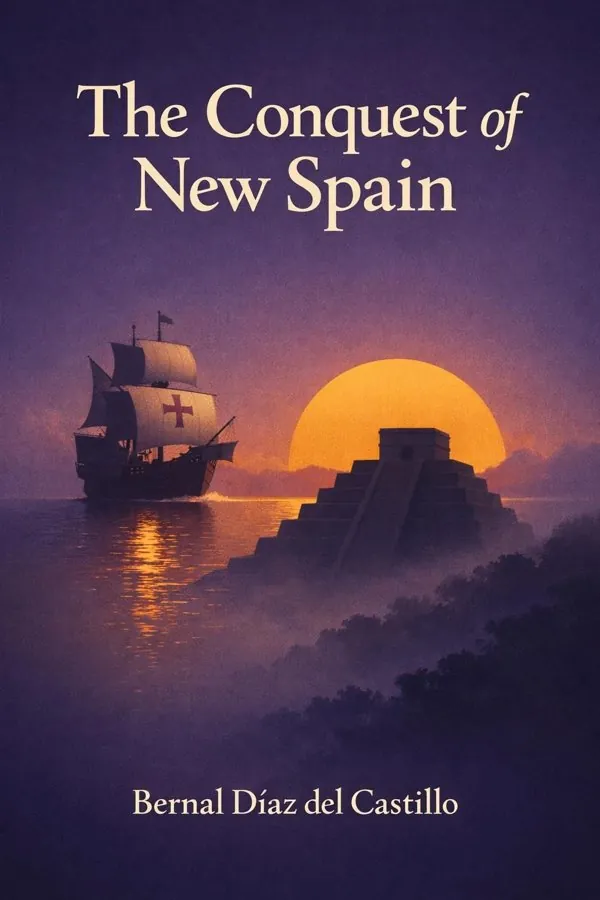
The Conquest of New Spain: Summary & Key Insights
 10 min5 chaptersAudio available
What Is The Conquest of New Spain About?
The Conquest of New Spain by Bernal Díaz del Castillo is a world_history book spanning 5 pages. A first-person account of the overthrow of Montezuma's doomed Aztec Empire by Hernán Cortés. Written by Bernal Díaz del Castillo, a soldier under Cortés, this vivid and powerful narrative offers a detailed description of the Spanish landing in Mexico in 1520 and the subsequent conquest of the Aztec Empire. It remains one of the most important firsthand chronicles of the Spanish colonization of the Americas.
This FizzRead summary covers all 5 key chapters of The Conquest of New Spain in approximately 10 minutes, distilling the most important ideas, arguments, and takeaways from Bernal Díaz del Castillo's work. Also available as an audio summary and Key Quotes Podcast.
The Conquest of New Spain
A first-person account of the overthrow of Montezuma's doomed Aztec Empire by Hernán Cortés. Written by Bernal Díaz del Castillo, a soldier under Cortés, this vivid and powerful narrative offers a detailed description of the Spanish landing in Mexico in 1520 and the subsequent conquest of the Aztec Empire. It remains one of the most important firsthand chronicles of the Spanish colonization of the Americas.
Who Should Read The Conquest of New Spain?
This book is perfect for anyone interested in world_history and looking to gain actionable insights in a short read. Whether you're a student, professional, or lifelong learner, the key ideas from The Conquest of New Spain by Bernal Díaz del Castillo will help you think differently.
- ✓Readers who enjoy world_history and want practical takeaways
- ✓Professionals looking to apply new ideas to their work and life
- ✓Anyone who wants the core insights of The Conquest of New Spain in just 10 minutes
Want the full summary?
Get instant access to this book summary and 100K+ more with Fizz Moment.
Get Free SummaryAvailable on App Store • Free to download
Key Chapters
Before Cortés, there were others who glimpsed the promise and peril of these lands. I remember well hearing of Francisco Hernández de Córdoba’s first voyage to the Yucatán in 1517, how he returned battered and scarred, his men talking of temples of stone and warriors who fought like lions. Then came Juan de Grijalva in 1518, who sailed further, trading trinkets for gold and hearing the name of a mighty ruler called Montezuma. Those reports reached the ears of Cuba’s governor, Diego Velázquez, igniting both prospect and jealousy. It was in that ferment that Hernán Cortés emerged—a figure of ambition and courage who understood, better than most, that fortune favors boldness.
I saw in him from the beginning a man born to command. Yet, even as we prepared our ships and gathered men from across Cuba, rumors and rivalries shadowed us. Velázquez, suspicious of Cortés’s independence, sought to curb his mission. But Cortés, ever shrewd, seized the moment. By the time royal orders reached him to desist, our sails were already catching the wind toward destiny.
It was not just ships and soldiers we gathered; it was faith and fear, greed and hope. When we embarked from Havana in February 1519, it was as if all Spain’s restless spirit had taken form in us. We did not know what awaited us across the gulf—only that beyond those waters lay a world unlike any we had ever known.
When we first sighted the coast of Mexico, the air seemed to shimmer with promise. We came ashore near what would become Veracruz, where emissaries of Montezuma brought us gifts of gold and fine cloth. To us, it was both marvel and omen: gold was the lure that had drawn us, but these offerings were not tribute—they were warnings from a distant king who wished us gone. Cortés saw the meaning clearly. If Montezuma feared our presence, then his fear could be turned to advantage.
At Veracruz we built, in both stone and spirit, a new foundation. Cortés declared allegiance not to Governor Velázquez but to the Emperor Charles himself, severing all claim Cuba’s governor had upon us. I stood with him when we read the proclamation of independence. That moment changed everything. We were no longer an expedition dependent on a governor's favor—we were, in a sense, an autonomous arm of the empire itself.
We forged alliances too—first with the Totonacs, who suffered under the Aztec tribute system. Their willingness to aid us provided crucial intelligence and manpower. It was here that diplomacy began to intertwine with conquest. For every battle we fought with swords, we fought another through whispers, promises, and calculated gestures. We named the town Villa Rica de la Vera Cruz—the Rich Town of the True Cross—thinking both of gold and of salvation. None of us yet understood how profoundly this crossing of destinies would alter the world.
+ 3 more chapters — available in the FizzRead app
All Chapters in The Conquest of New Spain
About the Author
Bernal Díaz del Castillo (c. 1492–1584) was a Spanish conquistador and chronicler who participated in Hernán Cortés's expedition that led to the fall of the Aztec Empire. In his later years, he wrote 'The Conquest of New Spain' to provide a personal and corrective account of the events, emphasizing the experiences of ordinary soldiers.
Get This Summary in Your Preferred Format
Read or listen to the The Conquest of New Spain summary by Bernal Díaz del Castillo anytime, anywhere. FizzRead offers multiple formats so you can learn on your terms — all free.
Available formats: App · Audio · PDF · EPUB — All included free with FizzRead
Download The Conquest of New Spain PDF and EPUB Summary
Key Quotes from The Conquest of New Spain
“Before Cortés, there were others who glimpsed the promise and peril of these lands.”
“When we first sighted the coast of Mexico, the air seemed to shimmer with promise.”
Frequently Asked Questions about The Conquest of New Spain
The Conquest of New Spain by Bernal Díaz del Castillo is a world_history book that explores key ideas across 5 chapters. A first-person account of the overthrow of Montezuma's doomed Aztec Empire by Hernán Cortés. Written by Bernal Díaz del Castillo, a soldier under Cortés, this vivid and powerful narrative offers a detailed description of the Spanish landing in Mexico in 1520 and the subsequent conquest of the Aztec Empire. It remains one of the most important firsthand chronicles of the Spanish colonization of the Americas.
You Might Also Like

The Age of Capital
Eric Hobsbawm
10 min
The Gulag Archipelago
Aleksandr Solzhenitsyn
10 min
Jerusalem: The Biography
Simon Sebag Montefiore
10 min
The Anglo-Saxons
James Campbell
10 min
The Boer War
Thomas Pakenham
10 min
The Industrial Revolutionaries: The Making of the Modern World 1776–1914
Gavin Weightman
10 minBrowse by Category
Ready to read The Conquest of New Spain?
Get the full summary and 100K+ more books with Fizz Moment.