
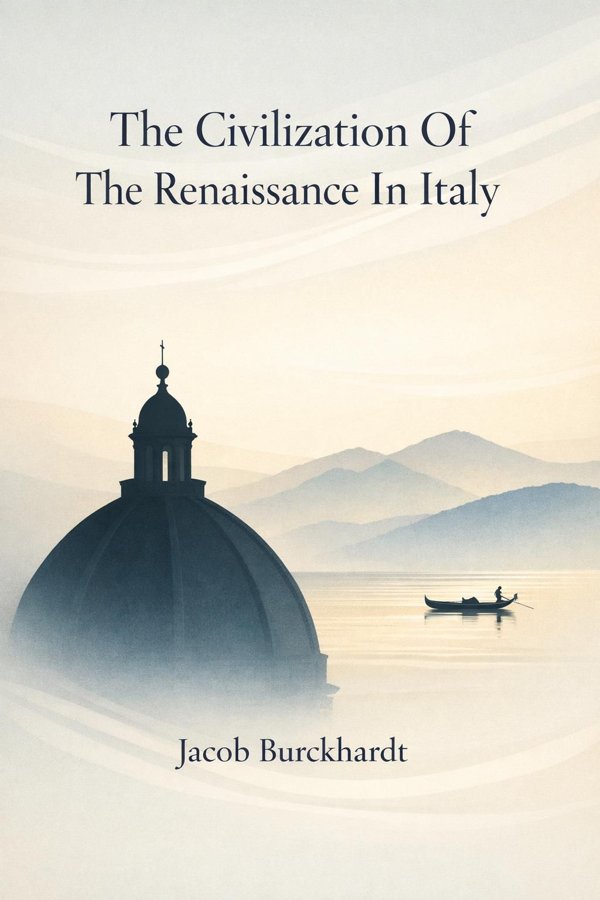
The Civilization Of The Renaissance In Italy: Summary & Key Insights
 10 min8 chaptersAudio available
What Is The Civilization Of The Renaissance In Italy About?
The Civilization Of The Renaissance In Italy by Jacob Burckhardt is a civilization book spanning 8 pages. In this landmark work, Jacob Burckhardt depicts the Italian city-states of Florence, Venice, and Rome as the cradle of a new form of society. He traces the rise of individualism and the flowering of art, politics, and culture that defined the Renaissance, offering one of the earliest and most influential interpretations of this pivotal era in Western history.
This FizzRead summary covers all 8 key chapters of The Civilization Of The Renaissance In Italy in approximately 10 minutes, distilling the most important ideas, arguments, and takeaways from Jacob Burckhardt's work. Also available as an audio summary and Key Quotes Podcast.
The Civilization Of The Renaissance In Italy
In this landmark work, Jacob Burckhardt depicts the Italian city-states of Florence, Venice, and Rome as the cradle of a new form of society. He traces the rise of individualism and the flowering of art, politics, and culture that defined the Renaissance, offering one of the earliest and most influential interpretations of this pivotal era in Western history.
Who Should Read The Civilization Of The Renaissance In Italy?
This book is perfect for anyone interested in civilization and looking to gain actionable insights in a short read. Whether you're a student, professional, or lifelong learner, the key ideas from The Civilization Of The Renaissance In Italy by Jacob Burckhardt will help you think differently.
- ✓Readers who enjoy civilization and want practical takeaways
- ✓Professionals looking to apply new ideas to their work and life
- ✓Anyone who wants the core insights of The Civilization Of The Renaissance In Italy in just 10 minutes
Want the full summary?
Get instant access to this book summary and 100K+ more with Fizz Moment.
Get Free SummaryAvailable on App Store • Free to download
Key Chapters
In Italy, politics ceased to be a mere mechanism of administration and became something grander—a canvas upon which intelligence and ambition painted their designs. Each city-state, whether a republic or a principality, displayed the Renaissance passion for artful creation through its governance. Florence, under the Medici, blended commerce and culture into a fluid expression of civic identity. Venice, a maritime republic, forged a government so intricate and balanced that it seemed carved by a sculptor’s hand. In Milan and Rome, rulers such as the Sforza and the Borgias transformed the exercise of power into theatrical performance, where diplomacy and spectacle were instruments of art.
Here, the political sphere revealed something quintessentially new in human history: rulers saw themselves as creators, not custodians. Governance was judged by aesthetic principles—grace, proportion, ingenuity. Even tyranny wore the robe of innovation. Amid intrigue and rivalry, the state became the workshop for the modern mind—a place where reason, rather than divine mandate, defined legitimacy.
This aestheticization of power carried profound consequences. It trained men to think strategically and individually. The politician, once a servant of the hierarchy, now acted as a visionary artist. Civic architecture, monumental commissions, and the patronage of art were themselves political expressions. Thus the Renaissance state embodied my thesis: the birth of individuality through creation. When politics is understood as art, man no longer hides behind collective dogma; he stands exposed as both maker and subject of history.
The transformation of politics naturally gave rise to a transformation of the human being. In the Italian Renaissance, man finally discovered himself as an autonomous personality. I observed how artists, scholars, and statesmen began to write, paint, sculpt, and speak in ways that declared: ‘I am.’ This declaration was revolutionary, for the medieval spirit had been absorbed into community and faith, its individual voice muffled beneath doctrine. But now, whether in Petrarch’s introspection, Leonardo’s multidimensional curiosity, or Machiavelli’s fearless analysis of human power, individuals stood forth with unprecedented self-awareness.
The Renaissance individual did not merely seek freedom; he explored the depths of his own nature. Portraiture emerged as an art of inner revelation; diaries and letters became mirrors of private thought; and civic acts were bound up with personal reputation. The human soul, once subdued by collective creed, now demanded recognition as the measure of all things.
I drew attention to how this awakening carried ambivalence. Personal ambition often led to moral peril; the cult of individuality produced both greatness and excess. Yet therein lies modern humanity’s distinct character—we are defined by our struggle between autonomy and responsibility. Renaissance man embraced that duality: he lived brilliantly amid contradictions, daring to shape his destiny in a world newly conscious of its complexity.
Thus, the Renaissance gave us not merely the artist or scholar, but the psychological modern—the person aware of the boundaries and infinities of his own mind. The echo of that discovery resounds through every subsequent moment in Western civilization.
+ 6 more chapters — available in the FizzRead app
All Chapters in The Civilization Of The Renaissance In Italy
About the Author
Jacob Burckhardt (1818–1897) was a Swiss historian and cultural critic, widely regarded as one of the founders of cultural history. He taught at the University of Basel and is best known for his works on the Renaissance and classical antiquity, which profoundly shaped modern understanding of art and civilization.
Get This Summary in Your Preferred Format
Read or listen to the The Civilization Of The Renaissance In Italy summary by Jacob Burckhardt anytime, anywhere. FizzRead offers multiple formats so you can learn on your terms — all free.
Available formats: App · Audio · PDF · EPUB — All included free with FizzRead
Download The Civilization Of The Renaissance In Italy PDF and EPUB Summary
Key Quotes from The Civilization Of The Renaissance In Italy
“In Italy, politics ceased to be a mere mechanism of administration and became something grander—a canvas upon which intelligence and ambition painted their designs.”
“The transformation of politics naturally gave rise to a transformation of the human being.”
Frequently Asked Questions about The Civilization Of The Renaissance In Italy
The Civilization Of The Renaissance In Italy by Jacob Burckhardt is a civilization book that explores key ideas across 8 chapters. In this landmark work, Jacob Burckhardt depicts the Italian city-states of Florence, Venice, and Rome as the cradle of a new form of society. He traces the rise of individualism and the flowering of art, politics, and culture that defined the Renaissance, offering one of the earliest and most influential interpretations of this pivotal era in Western history.
You Might Also Like

The Structure of Scientific Revolutions
Thomas S. Kuhn
10 min
Genius
Harold Bloom
10 min
A Cultural History of the Medieval Age
Various Editors
10 min
A History of God: The 4,000-Year Quest of Judaism, Christianity and Islam
Karen Armstrong
10 min
A History of the World in 10½ Chapters
Julian Barnes
10 min
A Short History of Progress
Ronald Wright
10 minBrowse by Category
Ready to read The Civilization Of The Renaissance In Italy?
Get the full summary and 100K+ more books with Fizz Moment.