
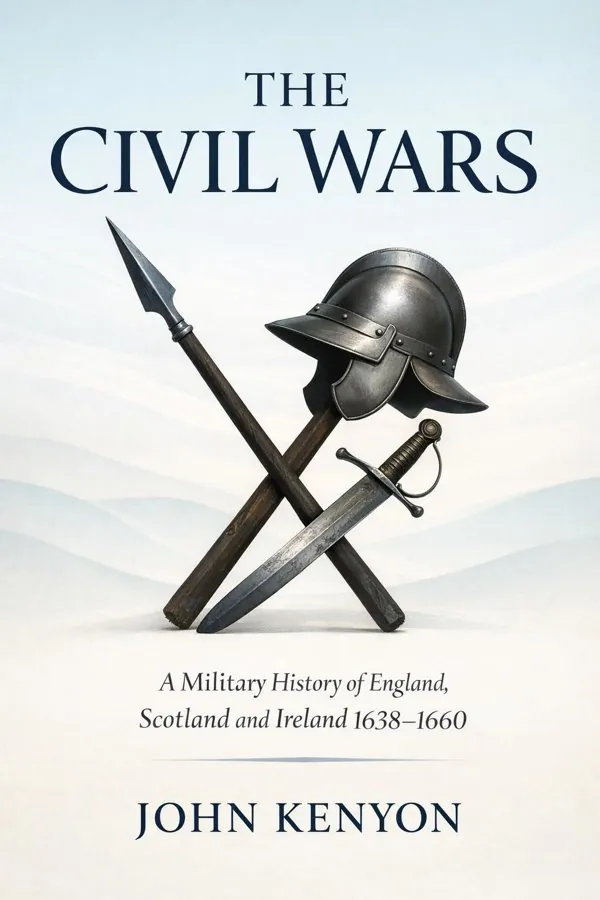
The Civil Wars: A Military History of England, Scotland and Ireland 1638–1660: Summary & Key Insights
by John Kenyon
 10 min9 chaptersAudio available
What Is The Civil Wars: A Military History of England, Scotland and Ireland 1638–1660 About?
The Civil Wars: A Military History of England, Scotland and Ireland 1638–1660 by John Kenyon is a world_history book spanning 9 pages. This book provides a comprehensive military history of the British Civil Wars, covering the conflicts that engulfed England, Scotland, and Ireland between 1638 and 1660. John Kenyon examines the political, social, and military dimensions of the wars, analyzing the strategies, battles, and key figures that shaped the outcome of this turbulent period in British history.
This FizzRead summary covers all 9 key chapters of The Civil Wars: A Military History of England, Scotland and Ireland 1638–1660 in approximately 10 minutes, distilling the most important ideas, arguments, and takeaways from John Kenyon's work. Also available as an audio summary and Key Quotes Podcast.
The Civil Wars: A Military History of England, Scotland and Ireland 1638–1660
This book provides a comprehensive military history of the British Civil Wars, covering the conflicts that engulfed England, Scotland, and Ireland between 1638 and 1660. John Kenyon examines the political, social, and military dimensions of the wars, analyzing the strategies, battles, and key figures that shaped the outcome of this turbulent period in British history.
Who Should Read The Civil Wars: A Military History of England, Scotland and Ireland 1638–1660?
This book is perfect for anyone interested in world_history and looking to gain actionable insights in a short read. Whether you're a student, professional, or lifelong learner, the key ideas from The Civil Wars: A Military History of England, Scotland and Ireland 1638–1660 by John Kenyon will help you think differently.
- ✓Readers who enjoy world_history and want practical takeaways
- ✓Professionals looking to apply new ideas to their work and life
- ✓Anyone who wants the core insights of The Civil Wars: A Military History of England, Scotland and Ireland 1638–1660 in just 10 minutes
Want the full summary?
Get instant access to this book summary and 100K+ more with Fizz Moment.
Get Free SummaryAvailable on App Store • Free to download
Key Chapters
The first act of the British civil wars unfolded in Scotland, where Charles I attempted to impose the English prayer book upon a fiercely independent kirk. To the king, religious uniformity represented divine order; to the Scots, it was tyranny dressed in holy vestments. When the National Covenant was signed in 1638, pledging resistance to both liturgical innovation and royal overreach, Charles misread the event as sedition rather than the desperate act of a people defending their spiritual autonomy.
The ensuing Bishops’ Wars were military miscalculations born from political blindness. Charles’s army, ill-trained and underfunded, stumbled northward, while the Scots—commanded by able leaders like Alexander Leslie—transformed the Covenanting movement into a disciplined fighting force. The campaigns of 1639 and 1640 revealed the hollowness of royal power. By the Treaty of Ripon, Charles was forced to pay for the maintenance of the Scottish army occupying English soil. It was a humiliation that exposed his financial and political weakness and directly led him to summon the English Parliament after eleven years of personal rule.
From this early confrontation, one truth emerged clearly: religious zeal combined with local organization could outmatch monarchical authority unmoored from consent. The Bishops’ Wars were, in essence, the prelude to greater storms, for they demonstrated how easily a question of worship could become a question of sovereignty.
+ 7 more chapters — available in the FizzRead app
All Chapters in The Civil Wars: A Military History of England, Scotland and Ireland 1638–1660
About the Author
John Philipps Kenyon (1927–1996) was a British historian specializing in seventeenth-century English history. He was a professor at the University of Hull and later at Columbia University, known for his works on the English Civil War and Restoration politics.
Get This Summary in Your Preferred Format
Read or listen to the The Civil Wars: A Military History of England, Scotland and Ireland 1638–1660 summary by John Kenyon anytime, anywhere. FizzRead offers multiple formats so you can learn on your terms — all free.
Available formats: App · Audio · PDF · EPUB — All included free with FizzRead
Download The Civil Wars: A Military History of England, Scotland and Ireland 1638–1660 PDF and EPUB Summary
Key Quotes from The Civil Wars: A Military History of England, Scotland and Ireland 1638–1660
“The first act of the British civil wars unfolded in Scotland, where Charles I attempted to impose the English prayer book upon a fiercely independent kirk.”
“In restoring Parliament, Charles I reopened a Pandora’s box of grievances long sealed during his personal rule.”
Frequently Asked Questions about The Civil Wars: A Military History of England, Scotland and Ireland 1638–1660
The Civil Wars: A Military History of England, Scotland and Ireland 1638–1660 by John Kenyon is a world_history book that explores key ideas across 9 chapters. This book provides a comprehensive military history of the British Civil Wars, covering the conflicts that engulfed England, Scotland, and Ireland between 1638 and 1660. John Kenyon examines the political, social, and military dimensions of the wars, analyzing the strategies, battles, and key figures that shaped the outcome of this turbulent period in British history.
You Might Also Like
The Age of Capital
Eric Hobsbawm
10 min
The Gulag Archipelago
Aleksandr Solzhenitsyn
10 min
Jerusalem: The Biography
Simon Sebag Montefiore
10 min
The Anglo-Saxons
James Campbell
10 min
The Boer War
Thomas Pakenham
10 min
The Industrial Revolutionaries: The Making of the Modern World 1776–1914
Gavin Weightman
10 minBrowse by Category
Ready to read The Civil Wars: A Military History of England, Scotland and Ireland 1638–1660?
Get the full summary and 100K+ more books with Fizz Moment.