
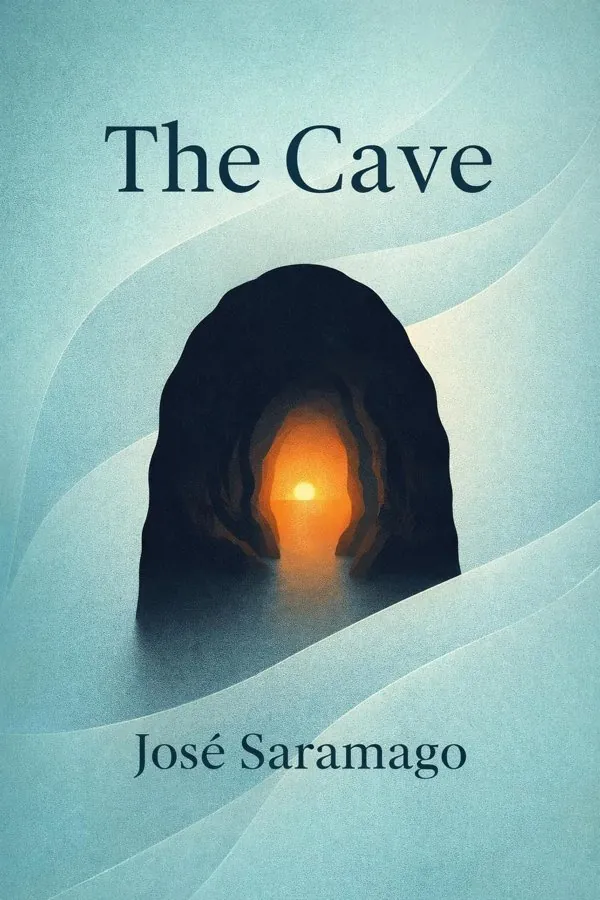
The Cave: Summary & Key Insights
 10 min9 chaptersAudio available
Key Takeaways from The Cave
Old worlds rarely disappear all at once; more often, they are quietly declared unnecessary.
The most dangerous systems are often the ones that promise comfort, security, and belonging.
Truth often appears not as a revelation of something new, but as the collapse of something we had accepted without question.
A society reveals itself by what it teaches people to want.
Not all resistance is dramatic; sometimes it looks like a family refusing to let the world define what matters.
What Is The Cave About?
The Cave by José Saramago is a classics book spanning 3 pages. What happens when a human life, shaped by patience, skill, and meaningful labor, collides with a world ruled by efficiency, spectacle, and consumption? In The Cave, José Saramago answers that question through the quiet tragedy of Cipriano Algor, an aging village potter whose handmade ceramics are rejected by the all-powerful Center, a vast commercial and residential complex that seems to absorb reality itself. What begins as the story of one craftsman’s economic decline gradually becomes a profound meditation on modern life: how institutions replace communities, how convenience disguises emptiness, and how people can mistake artificial comforts for truth. The novel matters because it speaks directly to contemporary anxieties about automation, consumer culture, and the erosion of human identity. Saramago, the Nobel Prize–winning Portuguese novelist known for blending allegory with social criticism, transforms ordinary domestic events into philosophical drama. With his signature voice—reflective, ironic, and deeply humane—he invites readers to see that the struggle to remain fully human is often fought not in grand political arenas, but in kitchens, workshops, and family decisions. The Cave is both a warning and a call to awaken.
This FizzRead summary covers all 9 key chapters of The Cave in approximately 10 minutes, distilling the most important ideas, arguments, and takeaways from José Saramago's work. Also available as an audio summary and Key Quotes Podcast.
The Cave
What happens when a human life, shaped by patience, skill, and meaningful labor, collides with a world ruled by efficiency, spectacle, and consumption? In The Cave, José Saramago answers that question through the quiet tragedy of Cipriano Algor, an aging village potter whose handmade ceramics are rejected by the all-powerful Center, a vast commercial and residential complex that seems to absorb reality itself. What begins as the story of one craftsman’s economic decline gradually becomes a profound meditation on modern life: how institutions replace communities, how convenience disguises emptiness, and how people can mistake artificial comforts for truth.
The novel matters because it speaks directly to contemporary anxieties about automation, consumer culture, and the erosion of human identity. Saramago, the Nobel Prize–winning Portuguese novelist known for blending allegory with social criticism, transforms ordinary domestic events into philosophical drama. With his signature voice—reflective, ironic, and deeply humane—he invites readers to see that the struggle to remain fully human is often fought not in grand political arenas, but in kitchens, workshops, and family decisions. The Cave is both a warning and a call to awaken.
Who Should Read The Cave?
This book is perfect for anyone interested in classics and looking to gain actionable insights in a short read. Whether you're a student, professional, or lifelong learner, the key ideas from The Cave by José Saramago will help you think differently.
- ✓Readers who enjoy classics and want practical takeaways
- ✓Professionals looking to apply new ideas to their work and life
- ✓Anyone who wants the core insights of The Cave in just 10 minutes
Want the full summary?
Get instant access to this book summary and 100K+ more with Fizz Moment.
Get Free SummaryAvailable on App Store • Free to download
Key Chapters
Old worlds rarely disappear all at once; more often, they are quietly declared unnecessary. That is the sorrow at the heart of Cipriano Algor’s life. He is an aging potter who lives with his daughter Marta in a rural village, making clay vessels by hand in a tradition that carries generations of knowledge, rhythm, and dignity. His work is not glamorous, but it is intimate. Every object he creates bears the mark of a human hand, and every sale affirms a relationship between maker, buyer, and community. When the Center—the enormous commercial institution that dominates the region—announces that it will no longer buy his pottery because consumer tastes have changed, Cipriano is not just losing income. He is watching an entire way of being judged obsolete.
Saramago uses this loss to explore how modern economies often value novelty over continuity and scale over meaning. The problem is not only that machines and markets replace artisans; it is that society begins to forget why handmade work mattered in the first place. Cipriano’s pottery represents more than utility. It symbolizes patience, inherited knowledge, and a form of living rooted in direct contact with materials and people.
This idea reaches far beyond pottery. Many people experience a similar displacement when long-practiced skills become irrelevant in a digital or corporate system. A family shop loses customers to online giants. A teacher sees human attention fragmented by screens. A worker is told efficiency matters more than judgment or care. The emotional effect is the same: people start wondering whether their value has vanished along with demand.
Saramago’s insight is that usefulness and worth are not identical. A society may stop rewarding certain forms of labor, but that does not make them meaningless. To resist dehumanization, we must remember that work is not only about output; it is also about identity, connection, and memory. Actionable takeaway: examine one skill, tradition, or daily practice in your life that promotes patience and craftsmanship, and protect it before convenience erases it.
The most dangerous systems are often the ones that promise comfort, security, and belonging. In The Cave, the Center is not merely a shopping complex or administrative hub. It is a self-contained universe, expanding constantly, reshaping social life around itself, and drawing people into its logic. When Cipriano’s son-in-law, Marçal, receives the possibility of advancement as a guard within the Center, the family begins considering a move into its residential quarters. At this point, the novel shifts from economic hardship to moral confrontation. The question is no longer simply how to survive outside the system, but what it means to live inside it.
The Center represents modern institutions that replace reality with managed experience. It offers convenience, order, entertainment, and status. Yet all of these advantages come with a hidden price: dependence. The people who live there are surrounded by commodities and surfaces, but separated from the textures of ordinary life—soil, weather, handmade objects, neighborhood ties, unpredictability, and independent thought. Saramago’s allusion to Plato’s cave becomes increasingly clear: people are tempted to mistake curated appearances for truth.
This is strikingly relevant today. Social media platforms, branded environments, corporate campuses, and algorithmic systems can all function like miniature Centers. They promise efficiency and identity while quietly narrowing our range of experience. A person may feel connected while becoming more isolated, informed while becoming more controlled, comfortable while losing autonomy.
Saramago does not suggest that modern systems are evil simply because they are large. His concern is what happens when institutions become total environments—when they define not just how we shop or work, but how we imagine reality itself. The Center’s power lies in making its inhabitants feel that there is nowhere else worth going.
The lesson is practical: whenever a system offers you everything, ask what it wants in return. Actionable takeaway: identify one environment in your life—digital, professional, or commercial—that shapes your desires, and deliberately step outside it long enough to decide whether it serves you or controls you.
Truth often appears not as a revelation of something new, but as the collapse of something we had accepted without question. The discovery near the end of The Cave gives the novel its title and its deepest philosophical force. Beneath the Center, a hidden cave containing human figures evokes Plato’s famous allegory, in which people mistake shadows for reality because they have never seen the light outside. In Saramago’s version, this is not an abstract classroom metaphor. It is a concrete, unsettling reminder that modern civilization may be built on illusions so normalized that they feel natural.
The cave exposes the Center’s true nature. It is not simply a place of commerce or residence, but a mechanism for producing managed appearances. The underground discovery acts like a mirror held up to the entire social order. The family realizes that the polished world above rests on a profound estrangement from reality, history, and human freedom. To remain there would be to accept a life of shadows.
What makes this moment powerful is that awakening is not triumphant or easy. Seeing clearly forces choice. Cipriano, Marta, and Marçal must decide whether they will continue inhabiting a system that offers security at the cost of truth. In life, similar moments occur when people recognize that a career, ideology, relationship, or social routine is organized around illusion. The recognition itself is destabilizing because false worlds are often comfortable. Leaving them may involve uncertainty, conflict, and loss.
Saramago suggests that freedom begins with discomfort. To emerge from the cave is to relinquish passive acceptance and recover the ability to judge reality for oneself. This applies to consumer narratives, institutional loyalty, and personal habits alike. We all inhabit some form of cave when we outsource perception to the systems around us.
The novel’s ending insists that seeing is not enough; one must also move. Actionable takeaway: when you uncover an illusion in your life—about success, status, or security—act on that knowledge quickly, even in a small way, before comfort persuades you to return to the shadows.
A society reveals itself by what it teaches people to want. One of Saramago’s sharpest observations in The Cave is that the problem with consumer culture is not merely excess spending; it is the transformation of value itself. Cipriano’s pottery becomes undesirable not because it stops functioning, but because it no longer aligns with market fashion. The Center does not ask whether objects are good, durable, or meaningful. It asks whether they can circulate within the endless cycle of novelty. In this world, usefulness is inferior to desirability, and desire is engineered rather than discovered.
That change has moral consequences. When people are trained to prefer what is new, fast, and standardized, they lose the capacity to recognize the worth of what is familiar, slow, and singular. Handmade pottery gives way to commodities because commodities are easier to package, scale, and market. The tragedy is not only economic. It is psychological. Human beings begin to internalize the logic of the market, judging even themselves according to demand, trend, and replaceability.
Saramago also shows how consumerism creates false solutions. After losing the pottery contract, Cipriano and Marta attempt to adapt by making clay dolls, hoping the market will accept a new product. Their effort is touching and resourceful, but it also illustrates the exhausting instability of systems in which survival depends on guessing what consumers will want next. Innovation becomes less an expression of creativity than a forced response to external pressure.
Today this dynamic appears everywhere: seasonal fashion cycles, planned obsolescence in electronics, endless content production, and careers built on personal branding. People are encouraged to remain permanently marketable, which often means permanently restless. The result is a culture that consumes objects, experiences, and identities at increasing speed.
Saramago’s alternative is not simple nostalgia. It is a recovery of genuine criteria for value: durability, care, necessity, beauty, and relationship. Actionable takeaway: before buying, replacing, or discarding something, pause to ask whether your decision reflects an actual need or a manufactured desire.
Not all resistance is dramatic; sometimes it looks like a family refusing to let the world define what matters. Amid the novel’s critique of consumerism and institutional power, The Cave remains deeply grounded in domestic life. Cipriano’s bond with his daughter Marta, his evolving relationship with his son-in-law Marçal, and the affectionate presence of Isaura all create a moral center that contrasts with the impersonality of the Center. Saramago reminds us that the first defense against dehumanization is often the ordinary intimacy of people who care for one another.
This matters because systems like the Center thrive when individuals become isolated units—workers, consumers, tenants, security personnel. Family, friendship, and neighborly attachment interrupt that logic. They preserve forms of attention that are not transactional. Cipriano is sustained not by ideology but by relationships. His grief over losing his craft is shared, interpreted, and softened by others. Marta’s practicality and emotional intelligence help transform despair into action. Even Marçal, initially more aligned with the Center because of his career ambitions, becomes capable of moral growth through his connection to the family.
Saramago does not sentimentalize domestic life. Families can be strained, uncertain, and economically vulnerable. But he presents them as places where alternative values survive: loyalty over calculation, memory over spectacle, and mutual care over profit. In a culture dominated by abstraction, the household becomes a site of concrete humanity.
Readers can apply this insight widely. When institutions become overwhelming, people often focus on large-scale solutions and overlook small-scale resilience. Yet many forms of modern alienation are countered by simple acts: cooking together, sharing skills across generations, caring for elders, and making decisions based on collective well-being instead of social pressure. These actions may seem modest, but they cultivate independence from systems that profit from loneliness and distraction.
The novel suggests that a humane life is sustained less by grand theories than by faithful relationships. Actionable takeaway: strengthen one ordinary bond in your life this week through time, attention, or shared work, and treat that connection as a serious act of resistance against impersonal living.
When people lose their work, they often lose more than income; they lose a language for understanding themselves. In The Cave, Cipriano’s identity is inseparable from pottery. His skill is not a hobby layered onto life but the form through which life has been organized. The workshop, the kiln, the clay, and the routines of production all give structure to his days and coherence to his sense of self. That is why the Center’s rejection of his goods feels so devastating. It tells him not merely that his products are unwanted, but that the world no longer has a place for the person he has become.
Saramago exposes a modern contradiction. Societies often speak of work in purely economic terms, yet individuals experience it existentially. A profession can embody memory, competence, status, discipline, and moral purpose. When labor becomes precarious or obsolete, the crisis spreads inward. People ask: Who am I if the thing I have done for decades no longer matters? Cipriano’s struggle captures this universal anxiety with extraordinary tenderness.
The novel also distinguishes between work as vocation and work as institutional assignment. Marçal’s position within the Center offers stability and advancement, but it lacks the rootedness and self-expression of Cipriano’s craft. This contrast does not mean everyone must become an artisan. Rather, Saramago asks whether our work allows us to recognize ourselves in what we do. Many modern jobs provide wages while fragmenting agency, replacing judgment with procedure and meaning with compliance.
This tension is familiar to office workers, gig workers, and professionals whose labor is increasingly measured by metrics detached from real human outcomes. A nurse burdened by bureaucracy, a writer chasing algorithms, or a builder unable to use quality materials may all feel a version of Cipriano’s estrangement.
The book invites us to reclaim a richer understanding of work—one that includes mastery, usefulness, and dignity. Actionable takeaway: reflect on one part of your work, paid or unpaid, that genuinely expresses your values, and invest more intention in it so your identity is anchored by meaning rather than by market approval alone.
Progress is not always a movement toward something better; sometimes it is a polished way of losing what we need most. The Center presents itself as the future: efficient, expansive, organized, and desirable. It integrates commerce, housing, employment, and entertainment into one seamless structure, embodying the dream of total modern convenience. Yet Saramago steadily reveals the hollowness beneath that promise. The more complete the Center becomes, the less room remains for unpredictability, locality, and genuinely human experience.
This is one of the novel’s boldest claims: that modern systems can become so successful at eliminating friction that they also eliminate life. Friction is not always bad. Waiting, repairing, traveling, improvising, and relying on others can be inconvenient, but these experiences connect us to time, place, and interdependence. The Center replaces them with smooth operations and managed environments. In doing so, it creates a world that functions brilliantly while feeling spiritually vacant.
Saramago’s critique applies to urban planning, digital platforms, and workplace culture. A city can be optimized for consumption while becoming unaffordable and socially fragmented. A service can become seamless while making users passive and invisible. A company can eliminate inefficiency while draining employees of purpose. The issue is not technology itself, but the unexamined belief that whatever is more efficient is automatically more human.
The novel asks readers to reconsider the language of advancement. Bigger, faster, and more integrated do not necessarily mean wiser, kinder, or truer. In fact, a civilization obsessed with optimization may end up impoverishing the human capacities that matter most: attention, craftsmanship, wonder, and moral judgment.
This insight is especially useful in personal decision-making. Not every shortcut saves what is worth saving. Not every upgrade improves life. Actionable takeaway: the next time you are offered a more efficient option—at work, online, or at home—ask not only what it saves in time, but also what human experience it removes.
One sign that a world has become too artificial is that it no longer knows how to value beings that cannot be reduced to profit. In The Cave, the presence of the dog Found and the recurring attention to the natural environment create an important counterpoint to the Center’s enclosed, commercial reality. Saramago uses animals and the nonhuman world not as decorative background, but as reminders of forms of life that exist outside the logic of consumption and control.
Found is especially significant because he embodies loyalty, instinct, and presence. He belongs to the household in a way that no commodity can. He is not useful in the market sense, yet he is meaningful. His place in the story highlights a truth the Center cannot understand: value often resides in relationship, not exchange. Nature and animal life also tether the family to rhythms larger than commerce—day and night, weather, movement, bodily vulnerability, and ordinary dependence.
This matters because modern societies frequently push people into environments where nearly every interaction is mediated by money, systems, or screens. As a result, many lose contact with experiences that are free, grounding, and humbling. A walk outdoors, caring for a pet, gardening, noticing seasons, or simply spending time away from commercial spaces can restore perspective. These acts remind us that not all reality is designed for sale.
Saramago suggests that the capacity to love what cannot be monetized is part of what makes us human. The natural world resists total incorporation into the Center’s artificial order. It offers a different scale of meaning—one based on presence rather than performance.
In practical terms, this idea encourages readers to seek forms of attention that are not transactional. Life becomes distorted when every hour, skill, and relationship must justify itself economically. Actionable takeaway: make space each week for one experience with nature or animal companionship that has no productive goal, and let it retrain your sense of what counts as valuable.
Seeing clearly is difficult, but leaving what you now see clearly can be even harder. The final movement of The Cave is driven by this uncomfortable truth. Once Cipriano, Marta, and Marçal grasp the implications of the cave beneath the Center, they can no longer pretend that life within the complex is neutral or benign. The revelation demands a response. Saramago shows that awakening is incomplete unless it leads to action—unless knowledge changes where and how one lives.
This is the ethical culmination of the novel. Throughout the story, the family has been pressured to adapt, comply, and seek security within the structures of the Center. Those pressures are understandable. The Center offers employment, housing, order, and social legitimacy. Leaving it means stepping into uncertainty. Yet Saramago insists that comfort purchased at the cost of truth eventually becomes intolerable. Once illusions are named, complicity feels different.
This applies to many areas of modern life. A person may realize a workplace is unethical, a social environment is corrosive, or a lifestyle built on status is spiritually empty. Often the hardest part is not recognizing the problem but abandoning the false shelter it provides. People stay because the known illusion feels safer than the unknown reality. Saramago honors that fear while refusing to glorify passivity.
Importantly, departure in The Cave is not framed as heroic individualism. The family leaves together. This suggests that liberation is often relational. We need allies, conversation, and shared courage to move beyond systems that have organized our desires and fears. Freedom is rarely a solitary act of will; it is frequently a communal decision to stop cooperating with what diminishes us.
The novel ends by affirming movement toward a more authentic life, even if that life is less certain. Actionable takeaway: if you already know that some part of your life rests on an illusion, name the first concrete step required to leave it, and take that step before familiarity hardens into permanent surrender.
All Chapters in The Cave
About the Author
José Saramago (1922–2010) was a Portuguese novelist, essayist, and playwright whose work earned him the Nobel Prize in Literature in 1998. Born into a poor rural family, he worked various jobs before gaining international recognition as a writer later in life. Saramago became known for his unmistakable prose style, marked by long, flowing sentences, sparse punctuation, irony, and philosophical depth. His fiction often blends allegory with political and moral inquiry, examining how ordinary people respond to power, suffering, faith, and social systems. Among his most celebrated books are Blindness, The Gospel According to Jesus Christ, All the Names, and The Cave. Deeply human and intellectually fearless, Saramago remains one of modern literature’s most important voices, admired for turning simple premises into profound reflections on civilization and conscience.
Get This Summary in Your Preferred Format
Read or listen to the The Cave summary by José Saramago anytime, anywhere. FizzRead offers multiple formats so you can learn on your terms — all free.
Available formats: App · Audio · PDF · EPUB — All included free with FizzRead
Download The Cave PDF and EPUB Summary
Key Quotes from The Cave
“Old worlds rarely disappear all at once; more often, they are quietly declared unnecessary.”
“The most dangerous systems are often the ones that promise comfort, security, and belonging.”
“Truth often appears not as a revelation of something new, but as the collapse of something we had accepted without question.”
“A society reveals itself by what it teaches people to want.”
“Not all resistance is dramatic; sometimes it looks like a family refusing to let the world define what matters.”
Frequently Asked Questions about The Cave
The Cave by José Saramago is a classics book that explores key ideas across 9 chapters. What happens when a human life, shaped by patience, skill, and meaningful labor, collides with a world ruled by efficiency, spectacle, and consumption? In The Cave, José Saramago answers that question through the quiet tragedy of Cipriano Algor, an aging village potter whose handmade ceramics are rejected by the all-powerful Center, a vast commercial and residential complex that seems to absorb reality itself. What begins as the story of one craftsman’s economic decline gradually becomes a profound meditation on modern life: how institutions replace communities, how convenience disguises emptiness, and how people can mistake artificial comforts for truth. The novel matters because it speaks directly to contemporary anxieties about automation, consumer culture, and the erosion of human identity. Saramago, the Nobel Prize–winning Portuguese novelist known for blending allegory with social criticism, transforms ordinary domestic events into philosophical drama. With his signature voice—reflective, ironic, and deeply humane—he invites readers to see that the struggle to remain fully human is often fought not in grand political arenas, but in kitchens, workshops, and family decisions. The Cave is both a warning and a call to awaken.
More by José Saramago

You Might Also Like




Browse by Category
Ready to read The Cave?
Get the full summary and 100K+ more books with Fizz Moment.