
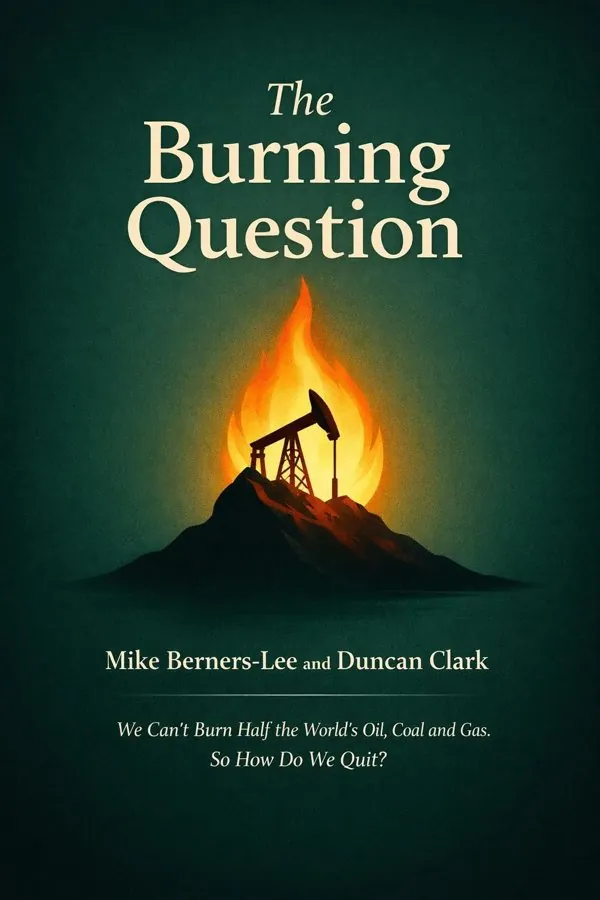
The Burning Question: We Can't Burn Half the World's Oil, Coal and Gas. So How Do We Quit?: Summary & Key Insights
by Mike Berners-Lee, Duncan Clark
 10 min10 chaptersAudio available
What Is The Burning Question: We Can't Burn Half the World's Oil, Coal and Gas. So How Do We Quit? About?
The Burning Question: We Can't Burn Half the World's Oil, Coal and Gas. So How Do We Quit? by Mike Berners-Lee and Duncan Clark is a environment book spanning 10 pages. The Burning Question explores the critical issue of climate change and the global dependence on fossil fuels. Authors Mike Berners-Lee and Duncan Clark examine why humanity continues to burn vast amounts of coal, oil, and gas despite knowing the catastrophic consequences. The book combines scientific insight with political and ethical analysis, urging readers to confront the reality that most of the world’s fossil fuel reserves must remain unburned to prevent climate disaster.
This FizzRead summary covers all 10 key chapters of The Burning Question: We Can't Burn Half the World's Oil, Coal and Gas. So How Do We Quit? in approximately 10 minutes, distilling the most important ideas, arguments, and takeaways from Mike Berners-Lee and Duncan Clark's work. Also available as an audio summary and Key Quotes Podcast.
The Burning Question: We Can't Burn Half the World's Oil, Coal and Gas. So How Do We Quit?
The Burning Question explores the critical issue of climate change and the global dependence on fossil fuels. Authors Mike Berners-Lee and Duncan Clark examine why humanity continues to burn vast amounts of coal, oil, and gas despite knowing the catastrophic consequences. The book combines scientific insight with political and ethical analysis, urging readers to confront the reality that most of the world’s fossil fuel reserves must remain unburned to prevent climate disaster.
Who Should Read The Burning Question: We Can't Burn Half the World's Oil, Coal and Gas. So How Do We Quit??
This book is perfect for anyone interested in environment and looking to gain actionable insights in a short read. Whether you're a student, professional, or lifelong learner, the key ideas from The Burning Question: We Can't Burn Half the World's Oil, Coal and Gas. So How Do We Quit? by Mike Berners-Lee and Duncan Clark will help you think differently.
- ✓Readers who enjoy environment and want practical takeaways
- ✓Professionals looking to apply new ideas to their work and life
- ✓Anyone who wants the core insights of The Burning Question: We Can't Burn Half the World's Oil, Coal and Gas. So How Do We Quit? in just 10 minutes
Want the full summary?
Get instant access to this book summary and 100K+ more with Fizz Moment.
Get Free SummaryAvailable on App Store • Free to download
Key Chapters
At the core of our argument lies a scientific principle as precise as it is unforgiving: the carbon budget. Climate science shows that to limit global warming to 2°C above pre-industrial levels—a threshold chosen to avoid runaway climatic change—humanity can emit only a fixed amount of carbon dioxide from now until the end of the century. When we calculated that figure, what emerged was an unsettling truth: the known fossil fuel reserves, if fully exploited, would release several times more carbon than this safe limit.
In discussing the carbon budget, we walk through the physics of accumulation. CO₂ stays in the atmosphere for centuries; its effects compound, not fade. Every ton must be counted. The budget becomes not a metaphor but a planetary bank account with a strict overdraft clause. There’s no negotiation with the laws of thermodynamics.
We emphasize that this concept reframes the climate conversation from one about annual emissions to one about total reserves. The implications are profound. It means that cutting emissions growth isn’t enough. We must decide what stays underground. This shift in focus—from flow to stock—upsets economic models grounded in endless extraction. During our research, we encountered scientists who described this realization as the moment when climate policy changed from a marathon of energy saving into a moral referendum on resource restraint.
The carbon budget is as simple to explain as it is politically radical: burn less than what we’ve already found. Yet simplicity in science collides with complexity in human systems.
When we examined the data on global fossil reserves, the picture was clear. The proven reserves of coal, oil, and gas—those already located and catalogued—contain roughly five times more carbon than can safely be emitted within the 2°C budget. That means over 80 percent must remain in the ground.
This fact alone reshapes our economic reality. Energy companies currently value themselves based on their capacity to exploit those reserves. Stock prices rise with proof of new oil fields or coal seams. The financial world treats underground carbon as future profit, while climate science treats it as potential devastation. The contradiction becomes self-defeating: to sustain the illusion of economic health, markets depend on assets that, if ever realized, would destroy the conditions for economic survival.
Through case studies of nations like Saudi Arabia and Australia, we show how deeply embedded this illusion has become. These economies hinge on fossil exports. Infrastructure—ports, pipelines, refineries—are designed for decades of operation. The reserves roar silently beneath them, their exploitation seen as inevitable. Yet, as we stress, inevitability is a choice disguised as physics. We could choose to cap those reserves; we could reprice them, reassess what true value means in an age of planetary limits. But to do so would require challenging not just industries but the story we tell ourselves about wealth and progress.
+ 8 more chapters — available in the FizzRead app
All Chapters in The Burning Question: We Can't Burn Half the World's Oil, Coal and Gas. So How Do We Quit?
About the Authors
Mike Berners-Lee is a researcher and writer specializing in carbon footprint analysis and sustainability. Duncan Clark is a journalist and consultant focusing on environmental issues and energy policy. Together, they provide a clear and urgent perspective on the climate crisis.
Get This Summary in Your Preferred Format
Read or listen to the The Burning Question: We Can't Burn Half the World's Oil, Coal and Gas. So How Do We Quit? summary by Mike Berners-Lee and Duncan Clark anytime, anywhere. FizzRead offers multiple formats so you can learn on your terms — all free.
Available formats: App · Audio · PDF · EPUB — All included free with FizzRead
Download The Burning Question: We Can't Burn Half the World's Oil, Coal and Gas. So How Do We Quit? PDF and EPUB Summary
Key Quotes from The Burning Question: We Can't Burn Half the World's Oil, Coal and Gas. So How Do We Quit?
“At the core of our argument lies a scientific principle as precise as it is unforgiving: the carbon budget.”
“When we examined the data on global fossil reserves, the picture was clear.”
Frequently Asked Questions about The Burning Question: We Can't Burn Half the World's Oil, Coal and Gas. So How Do We Quit?
The Burning Question: We Can't Burn Half the World's Oil, Coal and Gas. So How Do We Quit? by Mike Berners-Lee and Duncan Clark is a environment book that explores key ideas across 10 chapters. The Burning Question explores the critical issue of climate change and the global dependence on fossil fuels. Authors Mike Berners-Lee and Duncan Clark examine why humanity continues to burn vast amounts of coal, oil, and gas despite knowing the catastrophic consequences. The book combines scientific insight with political and ethical analysis, urging readers to confront the reality that most of the world’s fossil fuel reserves must remain unburned to prevent climate disaster.
You Might Also Like
A Life on Our Planet: My Witness Statement and a Vision for the Future
David Attenborough
10 min
A Sky Full Of Birds
Matt Merritt
10 min
Carbon Zero: Imagining Cities That Can Save the Planet
Alex Steffen
10 min
Eaarth: Making a Life on a Tough New Planet
Bill McKibben
10 min
The Social Contract and Environmental Governance
Various Editors
10 min
The Wild Places
Robert Macfarlane
10 minBrowse by Category
Ready to read The Burning Question: We Can't Burn Half the World's Oil, Coal and Gas. So How Do We Quit??
Get the full summary and 100K+ more books with Fizz Moment.