
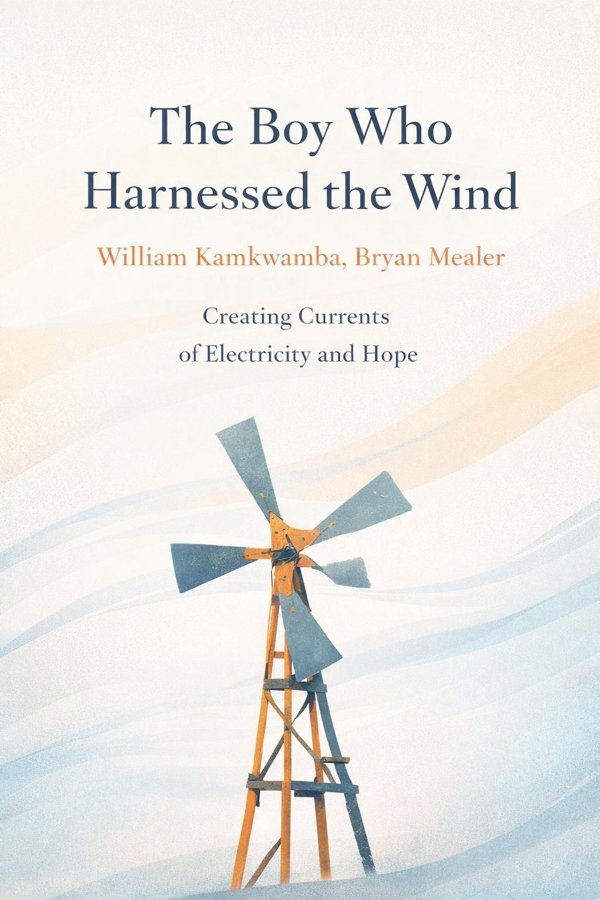
The Boy Who Harnessed the Wind: Creating Currents of Electricity and Hope: Summary & Key Insights
by William Kamkwamba, Bryan Mealer
 10 min9 chaptersAudio available
Key Takeaways from The Boy Who Harnessed the Wind: Creating Currents of Electricity and Hope
A person’s first education often comes not from a classroom but from the conditions of daily life.
Crisis has a brutal way of revealing what comfort allows people to ignore.
The most transformative learning often begins when formal access ends.
Hope often begins as a mental shift before it becomes a physical result.
Resourcefulness is the art of seeing value where others see waste.
What Is The Boy Who Harnessed the Wind: Creating Currents of Electricity and Hope About?
The Boy Who Harnessed the Wind: Creating Currents of Electricity and Hope by William Kamkwamba, Bryan Mealer is a biographies book spanning 6 pages. The Boy Who Harnessed the Wind is an extraordinary memoir about survival, invention, and the stubborn refusal to accept that poverty must define a person’s future. In this inspiring true story, William Kamkwamba recounts how he grew up in rural Malawi, where life depended on fragile harvests, limited schooling, and the unpredictable mercy of the weather. When famine devastated his family and village, William turned not to despair but to curiosity. Using library books, scraps from junkyards, and relentless experimentation, he built a windmill that brought electricity to his home and eventually helped pump water for farming. What makes this book so powerful is that it is not simply a tale of technical ingenuity. It is a deeply human account of hunger, family sacrifice, social skepticism, and the life-changing force of education. William writes with the authority of lived experience, while co-author Bryan Mealer helps shape that experience into a vivid and accessible narrative. Together, they offer a memoir that matters far beyond Malawi: it shows how imagination, knowledge, and persistence can create hope even where resources are scarce and the odds seem impossible.
This FizzRead summary covers all 9 key chapters of The Boy Who Harnessed the Wind: Creating Currents of Electricity and Hope in approximately 10 minutes, distilling the most important ideas, arguments, and takeaways from William Kamkwamba, Bryan Mealer's work. Also available as an audio summary and Key Quotes Podcast.
The Boy Who Harnessed the Wind: Creating Currents of Electricity and Hope
The Boy Who Harnessed the Wind is an extraordinary memoir about survival, invention, and the stubborn refusal to accept that poverty must define a person’s future. In this inspiring true story, William Kamkwamba recounts how he grew up in rural Malawi, where life depended on fragile harvests, limited schooling, and the unpredictable mercy of the weather. When famine devastated his family and village, William turned not to despair but to curiosity. Using library books, scraps from junkyards, and relentless experimentation, he built a windmill that brought electricity to his home and eventually helped pump water for farming.
What makes this book so powerful is that it is not simply a tale of technical ingenuity. It is a deeply human account of hunger, family sacrifice, social skepticism, and the life-changing force of education. William writes with the authority of lived experience, while co-author Bryan Mealer helps shape that experience into a vivid and accessible narrative. Together, they offer a memoir that matters far beyond Malawi: it shows how imagination, knowledge, and persistence can create hope even where resources are scarce and the odds seem impossible.
Who Should Read The Boy Who Harnessed the Wind: Creating Currents of Electricity and Hope?
This book is perfect for anyone interested in biographies and looking to gain actionable insights in a short read. Whether you're a student, professional, or lifelong learner, the key ideas from The Boy Who Harnessed the Wind: Creating Currents of Electricity and Hope by William Kamkwamba, Bryan Mealer will help you think differently.
- ✓Readers who enjoy biographies and want practical takeaways
- ✓Professionals looking to apply new ideas to their work and life
- ✓Anyone who wants the core insights of The Boy Who Harnessed the Wind: Creating Currents of Electricity and Hope in just 10 minutes
Want the full summary?
Get instant access to this book summary and 100K+ more with Fizz Moment.
Get Free SummaryAvailable on App Store • Free to download
Key Chapters
A person’s first education often comes not from a classroom but from the conditions of daily life. William Kamkwamba’s childhood in Wimbe, a farming village in Malawi, was shaped by maize fields, seasonal rains, family labor, and the constant awareness that survival depended on the land. His early world was rich in community and tradition, but it was also bounded by scarcity. Electricity was absent, money was limited, and opportunity often seemed predetermined by birth. In that environment, children learned practical responsibility early: planting, harvesting, bartering, and helping family members endure uncertain seasons.
This setting matters because it explains both the obstacles William faced and the mindset he developed. Living close to nature taught him observation. Watching weather patterns, crop health, and the mechanics of village tools sharpened the habit of looking carefully at how things worked. Even before he ever opened a science book, he was already studying systems: rain and drought, effort and reward, breakdown and repair. His curiosity did not emerge in spite of village life; in many ways, it emerged from it.
For modern readers, this idea has broad relevance. Innovation does not require ideal conditions. It often begins with intimate knowledge of a real problem. A farmer notices irrigation waste. A student sees where school resources fall short. A parent identifies a daily frustration that no product addresses well. The most meaningful solutions often come from those closest to the challenge.
William��s story reminds us that humble beginnings are not intellectual limitations. They can be a source of practical wisdom and resilience. Instead of dismissing your environment as too small, pay attention to what it is teaching you. The actionable takeaway: study the problems closest to your life, because the seeds of meaningful innovation are usually planted in the ground you already know.
Crisis has a brutal way of revealing what comfort allows people to ignore. In William’s life, the failed rains and resulting famine transformed hunger from an occasional fear into an all-consuming reality. Crops withered, prices soared, families rationed every bite, and entire communities were pushed to the edge of survival. Hunger was not merely physical pain; it reshaped relationships, routines, and possibilities. School became harder to attend. Thinking beyond the next meal felt almost impossible. The famine exposed how vulnerable rural life was to environmental change, political failures, and economic inequality.
Yet this chapter of suffering became one of William’s greatest teachers. He saw that when food systems fail, everything else begins to collapse: education, health, dignity, and hope. That realization gave urgency to his thinking. He was no longer interested in learning as an abstract exercise. He wanted knowledge that could solve life-and-death problems. Electricity could lead to light, but also to water pumps. Water pumps could support crops. Crops could mean survival. Necessity sharpened his imagination.
This lesson applies well beyond famine. Many people do their most serious problem-solving when a challenge becomes impossible to ignore: a business near collapse, a family medical emergency, a debt burden, a failing community service. Adversity is painful, but it can force clarity. It shows what truly matters and where action is most urgently needed.
The book does not romanticize hunger. It presents suffering as devastating and unjust. But it also shows that hardship can awaken determination and focus. Readers can apply this by asking: what problem in my life or community has become serious enough that I can no longer postpone action? The actionable takeaway: let urgent problems clarify your priorities, then direct your learning and effort toward solutions that address the root cause rather than the symptom.
The most transformative learning often begins when formal access ends. Because his family could no longer afford school fees, William was forced out of the classroom at the very moment he wanted to learn more. For many children, that would have meant the end of education. For him, it became the beginning of a different kind of education: self-directed, improvised, and fueled by hunger for knowledge. He kept returning to the local library, where he discovered science and engineering books that opened a new world of possibility.
One book in particular introduced him to the principles of energy and wind power. Though he did not fully understand every term at first, he studied diagrams, interpreted pictures, and slowly connected abstract concepts to physical objects around him. This is one of the memoir’s most important insights: education is not only about institutions; it is also about initiative. A library, a borrowed manual, an old radio, or a smartphone tutorial can become a gateway to mastery when paired with persistence.
This idea matters deeply today. Many people believe they need perfect conditions before they can start learning: expensive programs, elite credentials, uninterrupted time, or expert guidance. William’s story challenges that assumption. Learning can begin with limited tools if curiosity is strong enough. A mechanic can learn digital diagnostics online. A teenager can study coding on a shared device. An entrepreneur can teach herself accounting through open resources.
The key is active engagement. William did not passively consume information; he translated it into experiments. He reread, asked questions, and tested what he saw. That is how knowledge becomes power. The actionable takeaway: if formal pathways are blocked, build an informal one—find one accessible source of knowledge, study it seriously, and apply what you learn in the real world as quickly as possible.
Hope often begins as a mental shift before it becomes a physical result. For William, the discovery of possibility came when he realized that the machines described in books were not magical objects reserved for rich countries. They were built from understandable parts and governed by principles that anyone could learn. This was a profound change in worldview. Instead of seeing technology as distant and unattainable, he began to see it as something that could be recreated from local materials and adapted to local needs.
This insight is more radical than it first appears. In places marked by poverty, people are often told indirectly that innovation comes from somewhere else—from cities, foreign experts, or institutions with money. William broke that psychological barrier. He looked at bicycle parts, wire, scrap metal, tractor fans, and wooden poles not as junk but as components of a future machine. The ability to imagine a new use for ordinary materials is one of the book’s defining lessons.
In practical terms, this is the foundation of creative problem-solving. A teacher may turn discarded bottles into science lab equipment. A community group may convert an empty lot into a garden. A small business may repurpose existing tools rather than waiting for capital it does not yet have. Innovation frequently starts not with abundance but with reinterpretation.
William’s growing sense of possibility also shows the importance of mindset in technical work. Before a windmill was ever built, he had to believe that such a thing could be built by him. That belief did not remove difficulty, but it made experimentation meaningful. The actionable takeaway: when facing a difficult problem, first challenge the assumption that solutions belong only to experts or ideal conditions—train yourself to ask, “What can be built from what is already here?”
Resourcefulness is the art of seeing value where others see waste. Once William committed to building a windmill, he had to work with what his environment could provide. He scavenged junkyards, gathered bicycle parts, used blue gum trees for towers, and improvised blades and wiring from salvaged materials. The process was messy, uncertain, and often met with ridicule. Neighbors questioned him. Some thought he was foolish. Others simply could not imagine that a boy without formal training could build a functioning machine from scraps.
What makes this chapter so compelling is that the construction of the windmill is not portrayed as a single moment of genius. It is a long sequence of trial, error, observation, and correction. Parts failed. Designs had to be adjusted. William learned by doing, and each mistake improved the next attempt. This is a powerful reminder that innovation is usually iterative. Successful builders, writers, scientists, and entrepreneurs rarely get things right on the first try. They refine through friction.
There is also a social lesson here. People often resist what they do not understand, especially when it challenges familiar boundaries of status, education, or age. William had to continue despite skepticism. Many readers will recognize this dynamic in their own lives: a new business idea dismissed by friends, a career change criticized by family, or a creative project mocked before results are visible.
The windmill eventually worked because William paired vision with persistence. He did not wait for permission or perfection. He started with available materials and improved through action. That approach is useful in nearly any field. The actionable takeaway: begin your most important project with the resources you already have, expect imperfect early attempts, and treat every setback as design feedback rather than proof of failure.
A meaningful invention does more than solve one problem; it creates a chain reaction of new possibilities. William’s first windmill brought electricity to his family’s home, powering lights and small devices. In a village accustomed to darkness after sunset, this was transformative. Light extended the usable day. It changed how work, reading, and daily life could be organized. But the real significance of the windmill was broader: it proved that local innovation could improve living conditions in practical, visible ways.
William did not stop at a single success. He continued building and improving systems, including efforts to use power for pumping water. This shift from electricity to irrigation reveals how innovation matures. The first achievement demonstrates feasibility; the next asks how the same principles can solve deeper structural problems. In a farming community vulnerable to drought, water access mattered even more than lighting. Technology became a tool not for novelty but for resilience.
This is a valuable framework for anyone developing ideas. A first version of a product, process, or service should not be the end goal. It should be a proof of concept that invites expansion. A tutor who helps one student may build a broader educational model. A nurse who improves one clinic workflow may redesign patient intake across a region. Small wins can become platforms for larger impact.
William’s story also highlights the relationship between technology and learning. Light made studying easier, and studying made better technology possible. Progress fed progress. That cycle is one of the memoir’s most hopeful themes. The actionable takeaway: after solving an immediate problem, ask what second-order opportunities your solution creates—how can one improvement become the foundation for greater stability, learning, or community benefit?
No breakthrough happens in complete isolation, even when one person drives it. William’s achievement depended not only on his own determination but also on the complicated support of family and community. At times, his relatives doubted his experiments, especially when resources were scarce and his efforts seemed impractical. Yet they also made sacrifices, offered materials, and eventually stood behind him. Their support was not blind faith; it was trust built gradually through observation, persistence, and visible results.
This dynamic is important because it reflects how innovation works in real communities. New ideas can appear risky, especially where every resource matters. If a family is struggling to eat, using time and parts for a strange mechanical project can look irresponsible. William had to prove that his efforts were more than fantasy. He did so not through arguments alone but through continued work, clear intent, and tangible progress.
The lesson extends into leadership and change-making. Whether you are launching a nonprofit initiative, proposing a new workplace system, or introducing a community project, people rarely support vision on rhetoric alone. They support what they can increasingly understand and believe in. Trust grows when others see commitment, competence, and alignment with shared needs.
The book also honors the emotional dimension of support. Even skepticism can coexist with love. Families under pressure may resist unconventional paths because they fear additional loss. Understanding that tension helps innovators respond with patience rather than resentment. The actionable takeaway: if you want others to back your ideas, do not demand instant belief—earn trust step by step by showing discipline, communicating purpose, and connecting your work to real community needs.
Success can open doors, but it also changes the meaning of one’s work. After William’s windmill drew wider attention, his life expanded beyond Wimbe. Journalists, educators, and international audiences became interested in his invention and his story. Recognition brought opportunities for schooling, travel, and broader influence. A boy once excluded from education because of poverty suddenly entered spaces of global conversation about innovation, development, and youth potential.
This transition is one of the memoir’s most striking developments because it shows both the power and complexity of visibility. Recognition validated William’s talent, but it also transformed him into a symbol. He was no longer just solving his family’s problems; he was being asked to represent possibility for others. That can be empowering, but it also creates pressure. Public success often demands adaptation, humility, and a deeper sense of responsibility.
For readers, this idea offers a useful perspective on ambition. Many people dream of being noticed, promoted, funded, or widely praised. But recognition is not merely a reward; it is a platform. What matters is how that platform is used. A local teacher who receives attention can advocate for better schools. A founder who gains investment can create fairer hiring practices. A student who earns a scholarship can mentor others from similar backgrounds.
William’s story suggests that achievement is most powerful when it expands opportunity beyond the individual. His rise did not invalidate his roots; it gave him new ways to honor them. The actionable takeaway: if success brings you visibility or opportunity, treat it not only as personal advancement but as a chance to widen access, share knowledge, and remain accountable to the community that shaped you.
The deepest power of a personal story lies in how far its lessons can travel. William’s memoir begins in one Malawian village, but it reaches outward to universal questions about inequality, education, creativity, and human potential. The windmill becomes more than a machine. It becomes a metaphor for agency—the ability to generate movement, light, and hope from conditions that seem designed to keep people powerless.
The broader message of the book is not that every problem can be solved by one determined individual. Rather, it shows that talent exists everywhere, while opportunity does not. William’s journey exposes how many capable minds are limited by hunger, poor infrastructure, school fees, and global neglect. At the same time, it insists that these limits are not measures of human worth or intelligence. Given access to knowledge and even modest support, extraordinary things can happen.
This idea has practical implications for readers, educators, leaders, and policymakers. If innovation is distributed widely but opportunity is not, then the task is to build systems that unlock hidden potential: libraries, affordable schooling, maker spaces, reliable power, mentorship, and local investment. On an individual level, it means refusing to underestimate people because of geography, class, accent, or formal credentials.
William’s windmill changed his home, but the story changes minds. It asks readers to imagine what becomes possible when ingenuity meets access. That is why the memoir continues to inspire across cultures. The actionable takeaway: look for overlooked talent—in your workplace, school, neighborhood, or family—and help create one concrete pathway for that talent to develop, because potential is common even when opportunity is not.
All Chapters in The Boy Who Harnessed the Wind: Creating Currents of Electricity and Hope
About the Authors
William Kamkwamba is a Malawian inventor, engineer, and author whose life story became internationally known after he built a windmill from scrap materials as a teenager in his village of Wimbe. His invention brought electricity to his family’s home and later supported water access, turning him into a symbol of grassroots innovation, self-education, and resilience. He has since spoken globally about creativity, energy, and opportunity. Bryan Mealer is an American journalist and author known for his reporting on Africa, global conflict, and development. As William’s co-author, Mealer helped shape this memoir into a vivid and accessible narrative, combining William’s firsthand experience with strong storytelling to create a book that resonates with readers around the world.
Get This Summary in Your Preferred Format
Read or listen to the The Boy Who Harnessed the Wind: Creating Currents of Electricity and Hope summary by William Kamkwamba, Bryan Mealer anytime, anywhere. FizzRead offers multiple formats so you can learn on your terms — all free.
Available formats: App · Audio · PDF · EPUB — All included free with FizzRead
Download The Boy Who Harnessed the Wind: Creating Currents of Electricity and Hope PDF and EPUB Summary
Key Quotes from The Boy Who Harnessed the Wind: Creating Currents of Electricity and Hope
“A person’s first education often comes not from a classroom but from the conditions of daily life.”
“Crisis has a brutal way of revealing what comfort allows people to ignore.”
“The most transformative learning often begins when formal access ends.”
“Hope often begins as a mental shift before it becomes a physical result.”
“Resourcefulness is the art of seeing value where others see waste.”
Frequently Asked Questions about The Boy Who Harnessed the Wind: Creating Currents of Electricity and Hope
The Boy Who Harnessed the Wind: Creating Currents of Electricity and Hope by William Kamkwamba, Bryan Mealer is a biographies book that explores key ideas across 9 chapters. The Boy Who Harnessed the Wind is an extraordinary memoir about survival, invention, and the stubborn refusal to accept that poverty must define a person’s future. In this inspiring true story, William Kamkwamba recounts how he grew up in rural Malawi, where life depended on fragile harvests, limited schooling, and the unpredictable mercy of the weather. When famine devastated his family and village, William turned not to despair but to curiosity. Using library books, scraps from junkyards, and relentless experimentation, he built a windmill that brought electricity to his home and eventually helped pump water for farming. What makes this book so powerful is that it is not simply a tale of technical ingenuity. It is a deeply human account of hunger, family sacrifice, social skepticism, and the life-changing force of education. William writes with the authority of lived experience, while co-author Bryan Mealer helps shape that experience into a vivid and accessible narrative. Together, they offer a memoir that matters far beyond Malawi: it shows how imagination, knowledge, and persistence can create hope even where resources are scarce and the odds seem impossible.
You Might Also Like

An American Marriage
Tayari Jones
10 min
Benjamin Franklin: An American Life
Walter Isaacson
10 min
I Know Why The Caged Bird Sings
Maya Angelou
10 min
Long Walk to Freedom
Nelson Mandela
10 min
Persepolis
Marjane Satrapi
10 min
Surely You're Joking, Mr. Feynman!
Richard P. Feynman
10 minBrowse by Category
Ready to read The Boy Who Harnessed the Wind: Creating Currents of Electricity and Hope?
Get the full summary and 100K+ more books with Fizz Moment.