
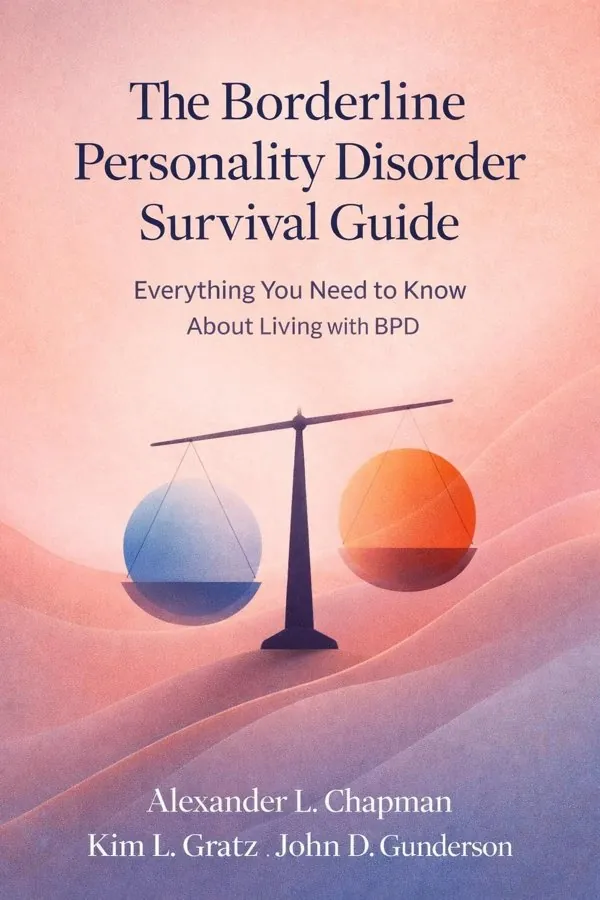
The Borderline Personality Disorder Survival Guide: Everything You Need to Know About Living with BPD: Summary & Key Insights
by Alexander L. Chapman, Kim L. Gratz, John D. Gunderson
 10 min5 chaptersAudio available
What Is The Borderline Personality Disorder Survival Guide: Everything You Need to Know About Living with BPD About?
The Borderline Personality Disorder Survival Guide: Everything You Need to Know About Living with BPD by Alexander L. Chapman, Kim L. Gratz, John D. Gunderson is a mental_health book spanning 5 pages. This comprehensive guide provides practical information and coping strategies for individuals living with borderline personality disorder (BPD) and their loved ones. Written by leading experts in the field, it explains the symptoms, causes, and evidence-based treatments for BPD, including dialectical behavior therapy (DBT). The book offers tools for managing emotions, improving relationships, and building a more stable and fulfilling life.
This FizzRead summary covers all 5 key chapters of The Borderline Personality Disorder Survival Guide: Everything You Need to Know About Living with BPD in approximately 10 minutes, distilling the most important ideas, arguments, and takeaways from Alexander L. Chapman, Kim L. Gratz, John D. Gunderson's work. Also available as an audio summary and Key Quotes Podcast.
The Borderline Personality Disorder Survival Guide: Everything You Need to Know About Living with BPD
This comprehensive guide provides practical information and coping strategies for individuals living with borderline personality disorder (BPD) and their loved ones. Written by leading experts in the field, it explains the symptoms, causes, and evidence-based treatments for BPD, including dialectical behavior therapy (DBT). The book offers tools for managing emotions, improving relationships, and building a more stable and fulfilling life.
Who Should Read The Borderline Personality Disorder Survival Guide: Everything You Need to Know About Living with BPD?
This book is perfect for anyone interested in mental_health and looking to gain actionable insights in a short read. Whether you're a student, professional, or lifelong learner, the key ideas from The Borderline Personality Disorder Survival Guide: Everything You Need to Know About Living with BPD by Alexander L. Chapman, Kim L. Gratz, John D. Gunderson will help you think differently.
- ✓Readers who enjoy mental_health and want practical takeaways
- ✓Professionals looking to apply new ideas to their work and life
- ✓Anyone who wants the core insights of The Borderline Personality Disorder Survival Guide: Everything You Need to Know About Living with BPD in just 10 minutes
Want the full summary?
Get instant access to this book summary and 100K+ more with Fizz Moment.
Get Free SummaryAvailable on App Store • Free to download
Key Chapters
At the heart of borderline personality disorder lies what psychologists call emotional dysregulation — the difficulty in managing and recovering from intense emotional experiences. Emotions in BPD are not simply strong; they are enormous waves that can rise and crash without warning. As clinicians, we describe this as a sensitivity to emotional stimuli combined with slow return to baseline. A seemingly small event, like a perceived rejection or criticism, can unleash feelings of fear, rage, or despair that others may not comprehend.
Imagine living in a world where your emotional volume is always turned up to full. This heightened sensitivity leads to rapid mood shifts — you might feel elated one moment and hopeless the next. In therapy, we teach clients how to map these emotions, to notice triggers before they escalate. Understanding that emotional pain often arises from feeling misunderstood or abandoned opens space for compassion rather than judgment.
We frequently remind readers: your emotions make sense given your history. BPD often develops in individuals who have experienced invalidation early in life — situations where feelings were dismissed or punished. Emotional regulation begins when you learn to validate yourself. Skills like deep breathing, mindful awareness, or self-soothing are not trivial; they are the first steps in rewiring emotional pathways. Through DBT, clients practice identifying emotions, naming them accurately, and using coping techniques that calm the nervous system. These methods are not quick fixes but habits that invite stability over time.
Emotional dysregulation may feel like your greatest enemy, but in truth it represents the starting point for healing. By learning to regulate emotions rather than being ruled by them, you rediscover choice, agency, and emotional integrity.
Over the last three decades, we’ve witnessed a revolution in how borderline personality disorder is treated. Gone are the days when clinicians believed BPD was untreatable. The development of evidence-based therapies, especially Dialectical Behavior Therapy, reshaped both clinical outcomes and personal hope. DBT, pioneered by Marsha Linehan, combines behavioral science with mindfulness principles. It teaches four core skill sets: emotion regulation, distress tolerance, interpersonal effectiveness, and mindfulness.
In our clinical practice, we’ve seen DBT help individuals move from cycles of crisis to moments of control. A client who once resorted to self-harm to escape unbearable anger learns, through systematic skills training, to recognize the emotion’s early signals and apply self-soothing or problem-solving strategies. Cognitive-behavioral therapy (CBT) contributes by addressing distorted thinking patterns — helping clients question black-and-white views of self and others. Schema-focused approaches extend this by uncovering deeper emotional themes formed in childhood.
Medication can also play a role, though it is never the sole answer. For many, antidepressants, mood stabilizers, or antipsychotics relieve specific symptom clusters, such as anxiety or impulsivity. Yet we emphasize therapy as the central path to transformation because medication cannot teach emotional skills. Recovery is most powerful when individuals engage actively in self-monitoring, skill practice, and relationship repair.
Many of our readers fear that therapy will mean reliving trauma or being labeled as broken. We clarify that treatment is not about judgment, but empowerment. Each person’s story becomes the foundation for new learning. The therapeutic alliance — that sense of trust between client and therapist — is itself healing. Once you feel seen and accepted, the emotional storms begin to calm. Evidence-based treatments thus serve not merely as technical protocols, but as human pathways toward resilience.
+ 3 more chapters — available in the FizzRead app
All Chapters in The Borderline Personality Disorder Survival Guide: Everything You Need to Know About Living with BPD
About the Authors
Alexander L. Chapman, PhD, is a clinical psychologist and professor at Simon Fraser University specializing in emotion regulation and borderline personality disorder. Kim L. Gratz, PhD, is a professor and chair of psychology at the University of Toledo, known for her research on emotion dysregulation and self-harm. John D. Gunderson, MD (1942–2019), was a psychiatrist and pioneer in the study and treatment of borderline personality disorder at Harvard Medical School.
Get This Summary in Your Preferred Format
Read or listen to the The Borderline Personality Disorder Survival Guide: Everything You Need to Know About Living with BPD summary by Alexander L. Chapman, Kim L. Gratz, John D. Gunderson anytime, anywhere. FizzRead offers multiple formats so you can learn on your terms — all free.
Available formats: App · Audio · PDF · EPUB — All included free with FizzRead
Download The Borderline Personality Disorder Survival Guide: Everything You Need to Know About Living with BPD PDF and EPUB Summary
Key Quotes from The Borderline Personality Disorder Survival Guide: Everything You Need to Know About Living with BPD
“At the heart of borderline personality disorder lies what psychologists call emotional dysregulation — the difficulty in managing and recovering from intense emotional experiences.”
“Over the last three decades, we’ve witnessed a revolution in how borderline personality disorder is treated.”
Frequently Asked Questions about The Borderline Personality Disorder Survival Guide: Everything You Need to Know About Living with BPD
The Borderline Personality Disorder Survival Guide: Everything You Need to Know About Living with BPD by Alexander L. Chapman, Kim L. Gratz, John D. Gunderson is a mental_health book that explores key ideas across 5 chapters. This comprehensive guide provides practical information and coping strategies for individuals living with borderline personality disorder (BPD) and their loved ones. Written by leading experts in the field, it explains the symptoms, causes, and evidence-based treatments for BPD, including dialectical behavior therapy (DBT). The book offers tools for managing emotions, improving relationships, and building a more stable and fulfilling life.
You Might Also Like
Big Feelings: How to Be Okay When Things Are Not Okay
Liz Fosslien, Mollie West Duffy
10 min
Creative Arts Therapies Handbook: Art, Music and Dance Therapy Practices for Wellbeing
Susan I. Buchalter
10 min
Emotional First Aid: Healing Rejection, Guilt, Failure, and Other Everyday Hurts
Guy Winch
10 min
Lost Connections: Why You're Depressed and How to Find Hope
Johann Hari
10 min
No Time to Panic: How to Stop Worrying and Embrace Life
Matt Gutman
10 min
Overcoming Mobbing: A Recovery Guide for Workplace Aggression and Bullying
Maureen Duffy, Len Sperry
10 minBrowse by Category
Ready to read The Borderline Personality Disorder Survival Guide: Everything You Need to Know About Living with BPD?
Get the full summary and 100K+ more books with Fizz Moment.