
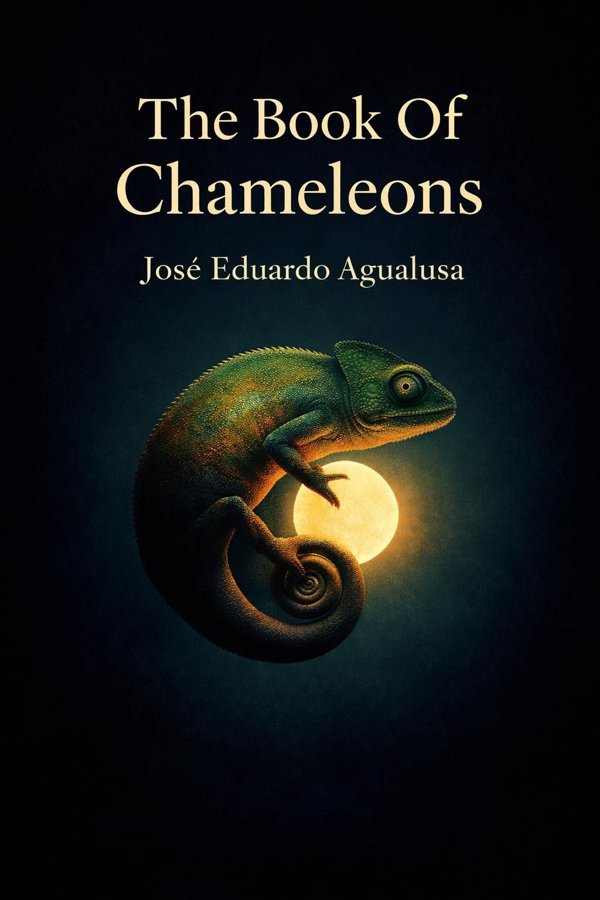
The Book Of Chameleons: Summary & Key Insights
 10 min8 chaptersAudio available
Key Takeaways from The Book Of Chameleons
Identity often depends less on truth than on storytelling.
A made-up identity becomes dangerous when it starts acting like a real one.
Sometimes the clearest observer is the one no one notices.
Love does not erase the past, but it can expose what the past has done to us.
When a country survives war, the struggle over memory does not end; it changes form.
What Is The Book Of Chameleons About?
The Book Of Chameleons by José Eduardo Agualusa is a bestsellers book spanning 4 pages. What if your past could be rewritten as easily as a passport application? In The Book Of Chameleons, José Eduardo Agualusa builds an unforgettable premise around that unsettling possibility. The novel centers on Félix Ventura, an albino Angolan who makes a living inventing aristocratic lineages, family histories, and convincing personal archives for clients eager to escape who they once were. What begins as a clever literary conceit opens into something deeper: a meditation on memory, truth, desire, and the fragile stories nations tell after violence. Set in postwar Angola, the book blends satire, mystery, and magical realism with remarkable elegance. Agualusa uses Félix’s business of fabricated identities to ask large philosophical questions: Are we the people we remember being, or the people others believe us to be? Can a society rebuild itself without confronting its buried past? The novel’s dreamlike narration, including the memorable perspective of a gecko who observes human lives from the margins, gives these questions both intimacy and strangeness. Agualusa, one of Angola’s most acclaimed contemporary writers, brings lyrical prose and historical insight to a story that feels playful on the surface yet haunting underneath.
This FizzRead summary covers all 8 key chapters of The Book Of Chameleons in approximately 10 minutes, distilling the most important ideas, arguments, and takeaways from José Eduardo Agualusa's work. Also available as an audio summary and Key Quotes Podcast.
The Book Of Chameleons
What if your past could be rewritten as easily as a passport application? In The Book Of Chameleons, José Eduardo Agualusa builds an unforgettable premise around that unsettling possibility. The novel centers on Félix Ventura, an albino Angolan who makes a living inventing aristocratic lineages, family histories, and convincing personal archives for clients eager to escape who they once were. What begins as a clever literary conceit opens into something deeper: a meditation on memory, truth, desire, and the fragile stories nations tell after violence.
Set in postwar Angola, the book blends satire, mystery, and magical realism with remarkable elegance. Agualusa uses Félix’s business of fabricated identities to ask large philosophical questions: Are we the people we remember being, or the people others believe us to be? Can a society rebuild itself without confronting its buried past? The novel’s dreamlike narration, including the memorable perspective of a gecko who observes human lives from the margins, gives these questions both intimacy and strangeness. Agualusa, one of Angola’s most acclaimed contemporary writers, brings lyrical prose and historical insight to a story that feels playful on the surface yet haunting underneath.
Who Should Read The Book Of Chameleons?
This book is perfect for anyone interested in bestsellers and looking to gain actionable insights in a short read. Whether you're a student, professional, or lifelong learner, the key ideas from The Book Of Chameleons by José Eduardo Agualusa will help you think differently.
- ✓Readers who enjoy bestsellers and want practical takeaways
- ✓Professionals looking to apply new ideas to their work and life
- ✓Anyone who wants the core insights of The Book Of Chameleons in just 10 minutes
Want the full summary?
Get instant access to this book summary and 100K+ more with Fizz Moment.
Get Free SummaryAvailable on App Store • Free to download
Key Chapters
Identity often depends less on truth than on storytelling. That unsettling idea sits at the center of Félix Ventura’s profession. Living in Luanda, surrounded by fabricated photographs, forged documents, and imaginary family trees, Félix sells new biographies to those who want to step out of unwanted histories and into cleaner, nobler ones. His clients do not simply want lies; they want coherent, elegant narratives that make their lives feel meaningful.
Agualusa uses Félix’s craft to expose how personal identity is built. Most people do not consciously hire someone to rewrite their past, but they do edit themselves constantly. They highlight certain memories, suppress others, and present different versions of themselves depending on the audience. A job interview, a wedding toast, and a political campaign all rely on selective storytelling. Félix merely turns this everyday human habit into a profession.
The novel also shows how class, power, and aspiration shape the stories people want. Clients do not usually ask for ordinary backgrounds; they want distinguished ancestors, tragic nobility, or patriotic sacrifice. Reinvention becomes a way to purchase legitimacy. In a society emerging from conflict, this becomes even more significant. If institutions are unstable, narrative itself becomes a kind of currency.
In practical terms, the book invites readers to notice where they are curating identity in their own lives. Think about social media profiles, professional bios, family myths, or the way people describe their hometowns and childhoods. None of these are neutral records. They are chosen versions of the self.
Actionable takeaway: Examine one story you tell repeatedly about yourself and ask whether it reveals truth, hides pain, or simply offers the version of you that feels easiest to live with.
A made-up identity becomes dangerous when it starts acting like a real one. The arrival of José Buchmann, a foreigner who asks Félix to construct a new past for him, shifts the novel from clever satire into psychological and moral suspense. Buchmann is not merely a customer seeking a cosmetic adjustment. He carries a murky presence, as if he is fleeing something larger than embarrassment or social ambition. Once Félix provides him with a fabricated lineage, the invented story does not stay on paper. It begins to ripple outward, altering relationships and exposing hidden histories.
This is one of Agualusa’s most powerful insights: fiction can become fact when people invest belief in it. A name on a document, a family portrait, a plausible anecdote, a repeated claim: these can create a social reality stronger than evidence. Buchmann’s case shows how identities are not private fantasies; they enter the world and affect others. A lie can open doors, protect guilt, erase accountability, or trigger desire.
The novel suggests parallels with politics and public life. Nations often rehabilitate troubling figures by rewriting official memory. Companies rebrand after scandals. Individuals reinvent themselves after failure. Sometimes transformation is necessary and humane. But the book asks what happens when reinvention bypasses responsibility.
For readers, Buchmann’s storyline offers a useful way to think about credibility. In daily life, we are constantly asked to accept narratives with incomplete proof: résumés, online personas, institutional histories, even family legends. The question is not only whether a story is persuasive, but what interests it serves.
Actionable takeaway: When you encounter a compelling narrative about a person or institution, ask not just “Is this believable?” but “Who benefits if I believe it?”
Sometimes the clearest observer is the one no one notices. One of the novel’s most original features is its gecko narrator, a creature perched at the edge of human life, watching, remembering, and reflecting. Far from being a decorative magical-realist flourish, the gecko provides the book’s philosophical spine. Its perspective is detached enough to notice human absurdity yet intimate enough to feel the emotional currents beneath speech.
Through the gecko, Agualusa explores memory as something fluid, unstable, and strangely alive. The gecko reflects on dreams, reincarnation, and the slippery overlap between observation and imagination. Human beings in the novel cling to records and testimonies as though they guarantee truth, yet the gecko’s presence reminds us that all witnessing is partial. Even the most attentive observer sees from somewhere.
This matters beyond literature. In ordinary life, people often assume that memory functions like an archive. But psychology tells us memory is reconstructive, not reproductive. We remember by rebuilding, and each rebuilding can subtly change the original event. The gecko embodies that insight in poetic form. It does not simply report reality; it meditates on how reality becomes narrative.
Readers can apply this idea when dealing with conflict or nostalgia. Family arguments often endure because everyone is defending a memory that feels complete from the inside. Communities do the same with political events. The gecko’s perspective encourages humility: what we saw may be real, but it is never the whole of reality.
Actionable takeaway: In your next disagreement over “what really happened,” pause before defending your memory as final truth and invite the possibility that every witness, including you, is only seeing one angle.
Love does not erase the past, but it can expose what the past has done to us. As the novel unfolds, relationships begin to bind Félix, Buchmann, and other central figures in ways that make reinvention emotionally costly. What first seems like an intellectual game about false biographies becomes a deeply human story about longing, guilt, tenderness, and the hope of renewal.
Agualusa refuses a simple opposition between deception and authenticity. People in the novel deceive because they fear rejection, shame, punishment, or emptiness. Yet they also desire intimacy, and intimacy requires being known. This creates one of the book’s central tensions: can anyone be loved while hiding behind an invented self? The answer is complex. Sometimes affection begins under false premises, but genuine feeling still emerges. That does not make the lie harmless; it makes the emotional stakes higher.
The theme of redemption is equally nuanced. Characters are not redeemed by receiving better stories about themselves. They are redeemed, if at all, when they move toward recognition, accountability, and vulnerability. In that sense, the novel suggests that the opposite of falsehood is not blunt confession but relational courage.
In practical life, many people perform edited versions of themselves in dating, friendship, or work. They conceal family history, failures, insecurities, or previous mistakes. Some level of self-protection is normal. But lasting trust depends on the gradual willingness to let the hidden parts surface.
Actionable takeaway: Identify one relationship in which you are relying too heavily on performance, and consider one honest disclosure that could replace image-management with real connection.
When a country survives war, the struggle over memory does not end; it changes form. The Book Of Chameleons is deeply rooted in postwar Angola, and the novel’s obsession with fabricated identities mirrors a broader national question: how does a society rebuild itself when history is fractured, painful, and politically contested? Félix’s private trade in invented lineages becomes a metaphor for collective reconstruction.
Agualusa shows that nations, like individuals, create usable versions of the past. Official heroes are elevated. Compromised alliances are softened. Violence is selectively remembered. Silence often settles where truth should be. In this context, the forging of personal histories is not a bizarre exception but an extension of social reality. If the public record itself is unstable, then authenticity becomes difficult to define.
This theme gives the novel its political depth. It is not only about individual self-fashioning but about the ethics of remembrance in a country marked by colonialism, civil war, and uneven peace. Agualusa does not lecture; instead, he dramatizes how historical confusion shapes desire. People want clean origins because real history is messy. They want honored ancestors because recent memory is compromised.
Modern readers can connect this to any society debating monuments, school curricula, archival truth, or collective guilt. Communities everywhere struggle to decide which stories become official and which are buried. The novel encourages critical attention to what gets preserved, who gets erased, and why.
Actionable takeaway: Reflect on one historical narrative you inherited from school, family, or media, and seek out a perspective that complicates it rather than confirms it.
We like to imagine memory as a locked box, but Agualusa treats it more like a living workshop. Throughout the novel, recollection is shown not as passive retrieval but as active construction. Characters remember selectively, embellish unconsciously, and sometimes replace unbearable truths with more livable versions. This does not make memory useless; it makes it creative, adaptive, and morally unstable.
That insight helps explain why Félix’s profession feels plausible instead of purely absurd. He externalizes a process many people already perform internally. After a painful event, someone may retell the story until they become the hero instead of the victim, the victim instead of the aggressor, or the survivor instead of the witness. Over time, repetition hardens the revised version into felt truth.
Agualusa is especially interested in the emotional function of this process. Memory is not merely about accuracy; it helps people endure. To remember everything clearly might be impossible. To distort everything completely is dangerous. Human life unfolds in the tension between preservation and reinvention.
In practical terms, this has clear applications. Personal journaling, therapy, family storytelling, and even organizational debriefs all shape memory. The stories people choose to repeat become the architecture of identity. This means revision can be healing, but only if it does not sever contact with reality.
Readers can use the novel as a reminder to review the narratives through which they organize their lives. Which memories are overpolished? Which are frozen in grievance? Which have never been examined?
Actionable takeaway: Write down one defining memory from your life, then rewrite it from two other perspectives to discover how much of your identity depends on interpretation.
Paper can feel more authoritative than memory, even when paper is lying. One of the sharpest ironies in the novel is that Félix’s inventions gain power through material evidence: photographs, certificates, letters, genealogies, and carefully arranged traces of a life that never existed. Agualusa uses these forged archives to show how institutions often confuse documentation with truth.
This is a profound modern concern. Bureaucracies, courts, border systems, and employers routinely privilege what can be documented over what can be experienced. Yet documents are made by people, and people are capable of manipulation, omission, and bias. Félix succeeds because he understands that legitimacy often depends less on reality than on persuasive records.
The novel therefore encourages skepticism without collapsing into cynicism. Not every archive is false, but every archive is curated. Something is always included, something excluded, and something framed. Even family albums tell partial truths. They preserve birthdays and weddings while leaving out estrangement, debt, addiction, or fear. Official records can do the same on a national scale.
For today’s reader, this theme feels especially relevant in the digital age. Profiles, databases, recommendation systems, and algorithmic reputations now function as living archives. People are scored, categorized, and judged by records that may be incomplete or wrong. The question Agualusa raises is simple but urgent: who has the power to certify reality?
Actionable takeaway: The next time a document, profile, or official record seems definitive, ask what it cannot show, who assembled it, and what human complexity has been reduced to a file.
If identity is flexible, freedom expands, but so does responsibility. One reason The Book Of Chameleons lingers in the mind is that it refuses a fixed definition of selfhood. Characters are not presented as stable essences waiting to be uncovered. They are mutable beings shaped by memory, desire, fear, social recognition, and invention. The title itself suggests adaptation, camouflage, and survival.
Yet Agualusa does not celebrate fluidity uncritically. To change is human; to evade consequence through change is another matter. The novel asks where transformation ends and moral escape begins. Can someone become new without acknowledging the old self? Can a society heal by changing its story before reckoning with its wounds? These questions give the book ethical force.
This idea has broad practical relevance. Contemporary culture often prizes reinvention: career pivots, personal brands, glow-ups, fresh starts, curated identities. Reinvention can be liberating, especially for people burdened by prejudice or trauma. But the novel suggests that not all reinventions are equal. Some are acts of growth. Others are acts of concealment.
The challenge, then, is to hold two truths together: people are not trapped by their past, and the past still matters. Mature identity is neither rigid continuity nor total self-invention. It is the difficult art of change with memory intact.
Actionable takeaway: When imagining your next personal reinvention, define not only what you want to become, but also what truths from your past you must carry forward honestly rather than erase.
All Chapters in The Book Of Chameleons
About the Author
José Eduardo Agualusa is an Angolan writer and journalist born in Huambo in 1960. He is widely regarded as one of the leading contemporary voices in African literature, known for prose that blends history, imagination, and philosophical reflection. His work often examines themes such as identity, memory, colonial legacy, civil conflict, and the stories individuals and nations tell about themselves. Agualusa’s fiction moves fluidly between realism and the fantastic, giving his novels a distinctive lyrical and dreamlike quality. He has written novels, short stories, and essays, and his books have been translated into numerous languages and recognized internationally. In The Book Of Chameleons, he brings together many of his signature concerns, using a striking premise to explore reinvention, truth, and postwar Angola.
Get This Summary in Your Preferred Format
Read or listen to the The Book Of Chameleons summary by José Eduardo Agualusa anytime, anywhere. FizzRead offers multiple formats so you can learn on your terms — all free.
Available formats: App · Audio · PDF · EPUB — All included free with FizzRead
Download The Book Of Chameleons PDF and EPUB Summary
Key Quotes from The Book Of Chameleons
“Identity often depends less on truth than on storytelling.”
“A made-up identity becomes dangerous when it starts acting like a real one.”
“Sometimes the clearest observer is the one no one notices.”
“Love does not erase the past, but it can expose what the past has done to us.”
“When a country survives war, the struggle over memory does not end; it changes form.”
Frequently Asked Questions about The Book Of Chameleons
The Book Of Chameleons by José Eduardo Agualusa is a bestsellers book that explores key ideas across 8 chapters. What if your past could be rewritten as easily as a passport application? In The Book Of Chameleons, José Eduardo Agualusa builds an unforgettable premise around that unsettling possibility. The novel centers on Félix Ventura, an albino Angolan who makes a living inventing aristocratic lineages, family histories, and convincing personal archives for clients eager to escape who they once were. What begins as a clever literary conceit opens into something deeper: a meditation on memory, truth, desire, and the fragile stories nations tell after violence. Set in postwar Angola, the book blends satire, mystery, and magical realism with remarkable elegance. Agualusa uses Félix’s business of fabricated identities to ask large philosophical questions: Are we the people we remember being, or the people others believe us to be? Can a society rebuild itself without confronting its buried past? The novel’s dreamlike narration, including the memorable perspective of a gecko who observes human lives from the margins, gives these questions both intimacy and strangeness. Agualusa, one of Angola’s most acclaimed contemporary writers, brings lyrical prose and historical insight to a story that feels playful on the surface yet haunting underneath.
More by José Eduardo Agualusa
You Might Also Like

The Godfather
Mario Puzo
10 min
The Handmaid's Tale
Margaret Atwood
10 min
The Hunger Games
Suzanne Collins
10 min
The Nightingale
Kristin Hannah
10 min
The Seven Husbands of Evelyn Hugo
Taylor Jenkins Reid
10 min
Backwater Justice
Fern Michaels
10 minBrowse by Category
Ready to read The Book Of Chameleons?
Get the full summary and 100K+ more books with Fizz Moment.