
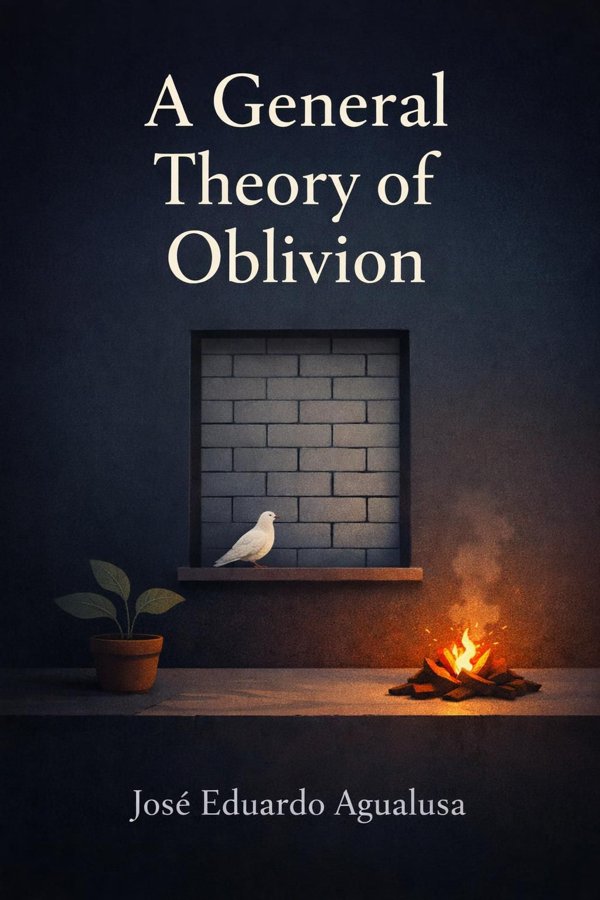
A General Theory of Oblivion: Summary & Key Insights
 10 min9 chaptersAudio available
Key Takeaways from A General Theory of Oblivion
Sometimes the walls we build for safety become the architecture of our inner lives.
No one lives outside history, even when they try to hide from it.
Sometimes renewal does not come through grand revelation, but through an unexpected human presence.
The truth of a nation is rarely told in a straight line.
What we remember can keep us alive, but it can also keep us trapped.
What Is A General Theory of Oblivion About?
A General Theory of Oblivion by José Eduardo Agualusa is a bestsellers book spanning 3 pages. A General Theory of Oblivion is a haunting, inventive novel about fear, history, and the strange ways human beings endure. At its center is Ludovica, or Ludo, a Portuguese woman living in Luanda, Angola, who walls herself inside her apartment as the country moves toward independence in 1975. What begins as an act of panic becomes a decades-long experiment in survival. From behind bricks and silence, Ludo witnesses a nation’s violent transformation without ever fully stepping into it. José Eduardo Agualusa turns this extraordinary premise into something larger than a survival story. He builds a mosaic of lives that intersect across war, displacement, love, crime, and memory, showing how private lives are shaped by public upheaval. The novel matters because it captures history not as a distant sequence of events, but as something intimate, fragmented, and deeply human. Agualusa writes with lyrical precision and moral curiosity, drawing on Angola’s colonial and post-independence realities with both tenderness and irony. The result is a novel that feels at once political and deeply personal: a meditation on what we lose when we hide from the world, and what survives when the world refuses to let us disappear.
This FizzRead summary covers all 9 key chapters of A General Theory of Oblivion in approximately 10 minutes, distilling the most important ideas, arguments, and takeaways from José Eduardo Agualusa's work. Also available as an audio summary and Key Quotes Podcast.
A General Theory of Oblivion
A General Theory of Oblivion is a haunting, inventive novel about fear, history, and the strange ways human beings endure. At its center is Ludovica, or Ludo, a Portuguese woman living in Luanda, Angola, who walls herself inside her apartment as the country moves toward independence in 1975. What begins as an act of panic becomes a decades-long experiment in survival. From behind bricks and silence, Ludo witnesses a nation’s violent transformation without ever fully stepping into it.
José Eduardo Agualusa turns this extraordinary premise into something larger than a survival story. He builds a mosaic of lives that intersect across war, displacement, love, crime, and memory, showing how private lives are shaped by public upheaval. The novel matters because it captures history not as a distant sequence of events, but as something intimate, fragmented, and deeply human. Agualusa writes with lyrical precision and moral curiosity, drawing on Angola’s colonial and post-independence realities with both tenderness and irony. The result is a novel that feels at once political and deeply personal: a meditation on what we lose when we hide from the world, and what survives when the world refuses to let us disappear.
Who Should Read A General Theory of Oblivion?
This book is perfect for anyone interested in bestsellers and looking to gain actionable insights in a short read. Whether you're a student, professional, or lifelong learner, the key ideas from A General Theory of Oblivion by José Eduardo Agualusa will help you think differently.
- ✓Readers who enjoy bestsellers and want practical takeaways
- ✓Professionals looking to apply new ideas to their work and life
- ✓Anyone who wants the core insights of A General Theory of Oblivion in just 10 minutes
Want the full summary?
Get instant access to this book summary and 100K+ more with Fizz Moment.
Get Free SummaryAvailable on App Store • Free to download
Key Chapters
Sometimes the walls we build for safety become the architecture of our inner lives. Ludo’s story begins with a dramatic physical act: on the eve of Angola’s independence, terrified by violence and uncertainty, she seals herself inside her Luanda apartment. Yet Agualusa makes clear that this retreat does not start with politics alone. Ludo is already estranged from the world around her. She is a Portuguese outsider in Angola, emotionally withdrawn, socially uneasy, and burdened by long-standing fear. The political rupture outside merely gives form to an isolation that already exists within.
Her sealed apartment becomes both prison and refuge. In cutting herself off from the city, Ludo also cuts herself off from ordinary time, conversation, and social identity. She survives by rationing food, growing what she can, burning books and furniture when necessary, and writing fragments of thought on her walls. Silence, in her case, is not emptiness. It becomes a medium through which memory, guilt, imagination, and observation sharpen. Detached from the noise of public life, she turns inward and begins recording existence in compressed, poetic form.
Agualusa uses this enclosure to explore a universal human pattern: fear often presents itself as prudence. We tell ourselves we are protecting peace, avoiding risk, staying sensible. But over time, avoidance can become a worldview. Ludo’s apartment is an exaggerated version of what many people do psychologically—retreat from change, distrust uncertainty, and reduce life to what can be controlled.
In practical terms, the novel invites readers to examine their own habits of withdrawal. Emotional bricking-up may look like refusing difficult conversations, avoiding unfamiliar communities, or living inside inherited assumptions. Ludo’s isolation is extreme, but its roots are ordinary.
Actionable takeaway: Notice one area where fear has disguised itself as safety in your life, and take one small step toward reentering connection rather than deepening retreat.
No one lives outside history, even when they try to hide from it. One of the novel’s greatest strengths is the way it refuses to let Ludo’s isolation become the whole story. As the years pass, Agualusa widens the lens. Through a series of vivid, interconnected episodes, he introduces soldiers, neighbors, thieves, officials, street children, survivors, opportunists, and dreamers. Angola’s history does not arrive as a lecture or timeline. It unfolds through rumor, interruption, coincidence, and consequence.
This structure matters. Rather than presenting war and political upheaval as abstract forces, Agualusa shows how they infiltrate everyday life. Outside Ludo’s sealed apartment, Luanda changes hands, ideologies harden, scarcity grows, violence erupts, fortunes rise and collapse. People adapt in morally ambiguous ways. Some betray to survive. Others reinvent themselves. Some cling to ideals. Others discover that chaos rewards cunning more than principle. The city becomes a living archive of historical pressure.
By moving between Ludo’s hidden existence and the lives of others, the novel creates a layered understanding of national transformation. The world beyond the walls is messy, contradictory, and alive. It contains brutality, yes, but also tenderness, absurdity, resilience, and humor. Agualusa suggests that history is not simply made by leaders or armies. It is made in apartments, markets, prison cells, back alleys, and accidental encounters.
For readers, this offers a powerful application beyond the novel. Large events—political transitions, economic crises, migrations, conflicts—are often easier to understand through individual stories than through headlines alone. To grasp a society, you must pay attention to its fragments.
Actionable takeaway: The next time a major public event feels distant or abstract, seek out one or two human stories behind it; understanding begins when statistics become lives.
Sometimes renewal does not come through grand revelation, but through an unexpected human presence. Late in the novel, Ludo’s long enclosure begins to shift because of Sabalu, a young boy whose arrival breaks the sealed logic of her solitary existence. Until this point, her survival has depended on radical self-containment. She has endured by minimizing need, reducing contact, and turning life into repetition. Sabalu changes that not by argument, but by relationship.
His presence brings movement, curiosity, noise, and practical connection to the outside world. More importantly, he returns Ludo to responsibility. Isolation had allowed her to exist almost as a ghost, accountable to no one but hunger and memory. With Sabalu, she must once again care, respond, explain, and trust. This is the beginning of awakening. Human attachment reintroduces time, purpose, and moral orientation. The world is no longer merely something feared beyond the wall; it becomes something one can reenter through another person.
Agualusa handles this transformation with restraint. Ludo is not magically healed, and the novel does not pretend that contact erases trauma. Instead, it shows that recovery often begins with partial openings. One relationship can restore proportion to a life narrowed by fear. Sabalu symbolizes more than hope. He represents the future—untidy, vulnerable, improvisational, and impossible to control. Through him, the novel suggests that life persists not because suffering vanishes, but because connection reanimates what fear had frozen.
This idea applies broadly. People often emerge from grief, shame, or withdrawal not through private insight alone, but through encounters that gently demand participation. A child, a friend, a neighbor, a student, even a pet can create the conditions for reentry into life.
Actionable takeaway: If you feel emotionally enclosed, do not wait for perfect readiness; allow one trustworthy relationship or small act of care to become your first doorway back into the world.
The truth of a nation is rarely told in a straight line. A General Theory of Oblivion is structured like a mosaic, assembling Angola’s turbulent decades through fragments rather than a single continuous narrative. Agualusa moves between characters, timelines, and tones, creating a book that feels less like a conventional historical novel and more like a chorus of remembered lives. This fragmentation is not stylistic decoration. It expresses the reality of societies shaped by rupture.
War, revolution, migration, and ideological struggle do not produce neat narratives. They scatter families, alter identities, erase records, and force people to rebuild meaning from incomplete pieces. The novel’s form reflects this condition. A rumor here, a diary fragment there, a chance meeting, a missing person, a changed name, a recovered memory—these become the building blocks of historical understanding. Readers must assemble the whole from parts, just as survivors do.
This fragmented method also challenges the assumption that official history is the most trustworthy version of events. In Agualusa’s world, political narratives are unstable, often self-serving, and sometimes absurd. What endures are glimpses of lived experience: who was hungry, who disappeared, who profited, who loved, who waited, who reinvented themselves. History becomes intimate and contested rather than authoritative and finished.
In daily life, this insight has practical value. We often oversimplify our own pasts, our families, or even our workplaces by relying on dominant stories. But real understanding usually requires listening to multiple perspectives, especially the partial and uncomfortable ones. Complexity is not confusion; it is often honesty.
Actionable takeaway: When trying to understand a difficult past—personal or collective—gather several perspectives before settling on one explanation, because truth often emerges through fragments, not slogans.
What we remember can keep us alive, but it can also keep us trapped. For Ludo, memory is one of the few resources that remains available inside her sealed apartment. Deprived of social life and ordinary movement, she turns increasingly to recollection, imagination, and reflection. Her writing on the walls becomes an effort to preserve experience, impose order, and resist disappearance. In that sense, memory is shelter. It gives shape to time and affirms that a self still exists.
Yet Agualusa never romanticizes remembrance. Memory also burdens Ludo. It ties her to fear, old wounds, inherited prejudice, and unresolved guilt. Because she lives in near-total solitude, memory cannot be corrected or softened by conversation. It loops. It hardens. The mind, left alone too long, can turn recollection into enclosure. Ludo records life partly to keep oblivion away, but she is also haunted by what cannot be forgotten. The title itself points to this tension: oblivion is both threat and temptation. To forget may mean erasure, but it may also mean relief.
The novel suggests that memory is ethically complicated. Societies emerging from violence face the same dilemma as individuals: How much should be preserved? What must be acknowledged? What is the cost of silence, and what is the cost of endless reliving? Agualusa avoids simple answers. Instead, he shows remembrance as a necessary but unstable act.
This resonates beyond literature. People often preserve journals, photographs, messages, and stories to maintain continuity with who they have been. But healthy memory is not mere accumulation. It requires interpretation, context, and sometimes sharing. Otherwise, private archives become private prisons.
Actionable takeaway: Revisit one memory that still shapes you and ask whether you are using it to understand your life or merely to repeat it; if needed, give it new meaning by writing or speaking it aloud.
In times of upheaval, survival rarely looks noble from the outside. One of Agualusa’s most humane insights is that people under pressure improvise, compromise, steal, barter, disguise, and adapt in ways that resist easy moral judgment. Ludo survives by using whatever remains around her. Others in the novel navigate war and scarcity through smuggling, opportunism, political allegiance, reinvention, or calculated silence. The book does not celebrate corruption, but it does insist on reality: when institutions collapse, ordinary ethics become strained.
This is especially visible in the city beyond Ludo’s walls. Characters move through dangerous systems where certainty is impossible and power shifts constantly. Some choices are admirable, some ugly, and many are both at once. Agualusa is interested in how people endure without pretending that endurance is always clean. He asks readers to consider the difference between moral purity and moral seriousness. Purity stands apart and judges. Seriousness enters the confusion of lived conditions.
Ludo herself is part of this pattern. Her methods of staying alive are inventive and often unsettling. She burns possessions, hunts from her apartment, cultivates resources where none should exist, and recalibrates what is necessary. Survival becomes practical intelligence: observe conditions, discard illusion, use what is available.
Readers can apply this insight without facing war. During personal crises—job loss, illness, grief, divorce, migration—rigid ideals can make adaptation harder. Survival may require temporary measures, altered plans, and unglamorous discipline. The question is not whether life remains elegant, but whether it continues.
Actionable takeaway: When circumstances change dramatically, stop measuring yourself against ideal conditions and ask a more useful question: what practical, imperfect adjustment would help me endure and move forward right now?
Political upheaval does not only redraw borders; it rearranges who people believe themselves to be. Throughout A General Theory of Oblivion, identities shift under pressure. Colonial categories erode, allegiances become dangerous, and names, occupations, and loyalties acquire new meanings. Some characters reinvent themselves to survive. Others discover that identities they thought stable were always contingent. The result is a novel deeply interested in the fluid relationship between selfhood and circumstance.
Ludo embodies this instability in a paradoxical way. By sealing herself away, she tries to preserve a fixed identity untouched by Angola’s transformation. But isolation does not freeze the self. Over decades, she changes anyway—through deprivation, writing, aging, and the slow erosion of certainty. Meanwhile, the people outside her apartment are constantly being recast by history. A wealthy person becomes vulnerable. A minor figure gains influence. A believer becomes a cynic. A criminal becomes a caretaker. A child becomes a bridge between worlds.
Agualusa’s broader point is that identity is never only private. It is social, historical, and often imposed. Colonialism, revolution, war, and class all shape the stories people can tell about themselves. Yet the novel also leaves room for agency. People are not mere products of history; they improvise within it, sometimes with surprising creativity.
This has contemporary relevance. In periods of social change, people often feel disoriented because roles that once felt clear begin to blur. Rather than seeing this only as loss, the novel encourages readers to recognize that identity can be revised without being annihilated.
Actionable takeaway: When life circumstances alter your role or status, resist the urge to cling only to an outdated self-image; instead, ask which parts of your identity are essential and which can evolve to meet the moment.
When the world becomes incomprehensible, language can be a form of shelter. Ludo writes on the walls of her apartment to mark time, preserve thought, and assert her existence against oblivion. These inscriptions are not merely records. They are acts of self-construction. In the absence of conversation and public recognition, writing allows her to remain present to herself. It says: I was here, I felt this, I saw that, I endured.
Agualusa uses these wall writings to show how art and language operate under extreme conditions. Writing does not eliminate hunger, loneliness, or danger. It does something subtler and no less vital: it organizes experience. It transforms panic into observation, repetition into rhythm, and silence into witness. Even fragmented lines can create coherence. In a life reduced to essentials, words become one of the few tools capable of resisting annihilation.
This extends beyond Ludo. The novel itself is an argument for storytelling as historical preservation. Official archives may fail, governments may lie, and memory may falter, but stories carry emotional truth across time. Literature can hold what public narratives omit. That is one reason the book remains so powerful: it refuses to separate aesthetics from survival.
In practical terms, readers do not need to be novelists to use this insight. Journaling during difficult periods, writing letters never sent, composing short reflections, or even keeping voice notes can help convert overwhelming experience into something graspable. Expression creates distance, and distance can create agency.
Actionable takeaway: Start a simple practice of recording one honest paragraph a day during stressful periods; naming your experience is often the first step toward understanding and surviving it.
Hope in this novel is never sentimental; it arrives in damaged, unlikely forms. Agualusa does not offer redemption through ideology, certainty, or historical progress. Instead, hope emerges through encounters—often accidental ones—between people whose lives should never have intersected. These bonds cut across class, race, age, politics, and circumstance, revealing that human connection can outlast the systems that divide people.
Ludo’s eventual reconnection to the world is the clearest example, but the entire novel is built from such crossings. Characters find one another through coincidence, need, affection, trade, rescue, or sheer chance. These meetings do not erase violence or repair history in a grand sense. What they do is smaller and more believable: they interrupt isolation. They create brief zones of trust, obligation, humor, and recognition inside unstable conditions.
This is why the book feels humane rather than despairing. Even in a society fractured by colonial legacy and civil war, people continue to form attachments. They help, deceive, love, exploit, forgive, and remember one another. Agualusa suggests that while history can deform lives, it does not fully extinguish the impulse toward relation. That impulse is fragile, but it is real.
Applied to ordinary life, this idea is both modest and powerful. People often wait for large solutions before allowing themselves hope: the perfect plan, the final answer, the total repair. But many lives change through smaller turning points—a conversation, a neighbor’s kindness, a teacher’s encouragement, an unexpected friendship.
Actionable takeaway: If life feels historically or personally overwhelming, look for one concrete bond you can strengthen today; durable hope often begins not in certainty about the future, but in contact with another person in the present.
All Chapters in A General Theory of Oblivion
About the Author
José Eduardo Agualusa is an Angolan novelist, journalist, and essayist born in Huambo in 1960. One of the most celebrated contemporary writers in Portuguese, he is known for blending history, fiction, and lyrical imagination in works that examine Angola’s colonial past, post-independence struggles, and the fluid nature of identity in the Lusophone world. His writing often moves between realism and fable, combining political awareness with wit, tenderness, and formal inventiveness. Agualusa has published numerous acclaimed books, including The Book of Chameleons, Creole, and A General Theory of Oblivion, many of which have been translated internationally. Through his fiction, he has become an essential literary voice on memory, displacement, and the human stories that official histories often overlook.
Get This Summary in Your Preferred Format
Read or listen to the A General Theory of Oblivion summary by José Eduardo Agualusa anytime, anywhere. FizzRead offers multiple formats so you can learn on your terms — all free.
Available formats: App · Audio · PDF · EPUB — All included free with FizzRead
Download A General Theory of Oblivion PDF and EPUB Summary
Key Quotes from A General Theory of Oblivion
“Sometimes the walls we build for safety become the architecture of our inner lives.”
“No one lives outside history, even when they try to hide from it.”
“Sometimes renewal does not come through grand revelation, but through an unexpected human presence.”
“The truth of a nation is rarely told in a straight line.”
“What we remember can keep us alive, but it can also keep us trapped.”
Frequently Asked Questions about A General Theory of Oblivion
A General Theory of Oblivion by José Eduardo Agualusa is a bestsellers book that explores key ideas across 9 chapters. A General Theory of Oblivion is a haunting, inventive novel about fear, history, and the strange ways human beings endure. At its center is Ludovica, or Ludo, a Portuguese woman living in Luanda, Angola, who walls herself inside her apartment as the country moves toward independence in 1975. What begins as an act of panic becomes a decades-long experiment in survival. From behind bricks and silence, Ludo witnesses a nation’s violent transformation without ever fully stepping into it. José Eduardo Agualusa turns this extraordinary premise into something larger than a survival story. He builds a mosaic of lives that intersect across war, displacement, love, crime, and memory, showing how private lives are shaped by public upheaval. The novel matters because it captures history not as a distant sequence of events, but as something intimate, fragmented, and deeply human. Agualusa writes with lyrical precision and moral curiosity, drawing on Angola’s colonial and post-independence realities with both tenderness and irony. The result is a novel that feels at once political and deeply personal: a meditation on what we lose when we hide from the world, and what survives when the world refuses to let us disappear.
More by José Eduardo Agualusa
You Might Also Like

The Godfather
Mario Puzo
10 min
The Handmaid's Tale
Margaret Atwood
10 min
The Hunger Games
Suzanne Collins
10 min
The Nightingale
Kristin Hannah
10 min
The Seven Husbands of Evelyn Hugo
Taylor Jenkins Reid
10 min
Backwater Justice
Fern Michaels
10 minBrowse by Category
Ready to read A General Theory of Oblivion?
Get the full summary and 100K+ more books with Fizz Moment.