
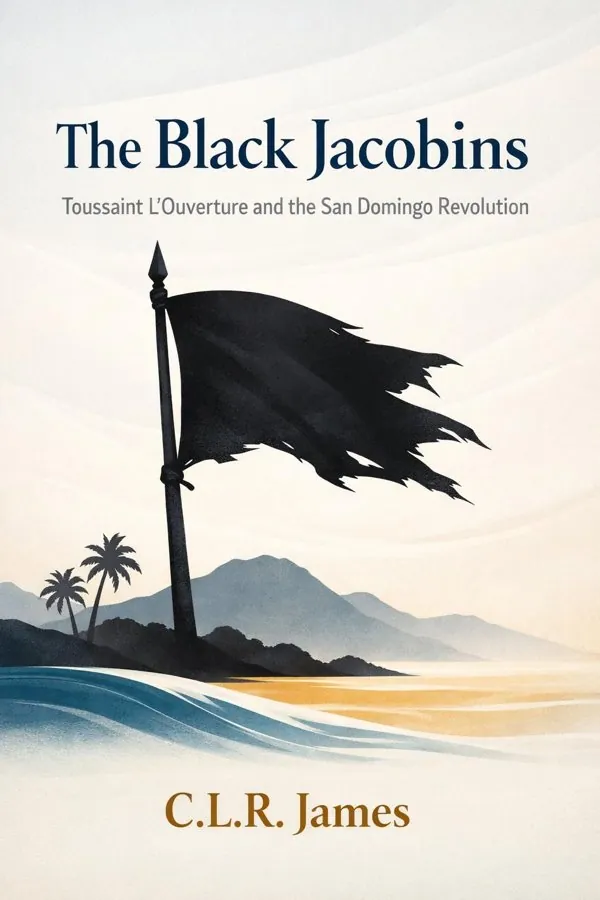
The Black Jacobins: Toussaint L'Ouverture and the San Domingo Revolution: Summary & Key Insights
by C.L.R. James
 10 min9 chaptersAudio available
What Is The Black Jacobins: Toussaint L'Ouverture and the San Domingo Revolution About?
The Black Jacobins: Toussaint L'Ouverture and the San Domingo Revolution by C.L.R. James is a world_history book spanning 9 pages. A seminal historical study of the Haitian Revolution (1791–1803), detailing how enslaved Africans in Saint-Domingue rose against French colonial rule to establish the first Black republic. C.L.R. James combines rigorous historical analysis with political insight, portraying Toussaint L'Ouverture as a revolutionary leader whose struggle mirrored the ideals of the French Revolution while exposing its contradictions.
This FizzRead summary covers all 9 key chapters of The Black Jacobins: Toussaint L'Ouverture and the San Domingo Revolution in approximately 10 minutes, distilling the most important ideas, arguments, and takeaways from C.L.R. James's work. Also available as an audio summary and Key Quotes Podcast.
The Black Jacobins: Toussaint L'Ouverture and the San Domingo Revolution
A seminal historical study of the Haitian Revolution (1791–1803), detailing how enslaved Africans in Saint-Domingue rose against French colonial rule to establish the first Black republic. C.L.R. James combines rigorous historical analysis with political insight, portraying Toussaint L'Ouverture as a revolutionary leader whose struggle mirrored the ideals of the French Revolution while exposing its contradictions.
Who Should Read The Black Jacobins: Toussaint L'Ouverture and the San Domingo Revolution?
This book is perfect for anyone interested in world_history and looking to gain actionable insights in a short read. Whether you're a student, professional, or lifelong learner, the key ideas from The Black Jacobins: Toussaint L'Ouverture and the San Domingo Revolution by C.L.R. James will help you think differently.
- ✓Readers who enjoy world_history and want practical takeaways
- ✓Professionals looking to apply new ideas to their work and life
- ✓Anyone who wants the core insights of The Black Jacobins: Toussaint L'Ouverture and the San Domingo Revolution in just 10 minutes
Want the full summary?
Get instant access to this book summary and 100K+ more with Fizz Moment.
Get Free SummaryAvailable on App Store • Free to download
Key Chapters
To understand the magnitude of the Haitian Revolution, one must first grasp the monstrosity and paradox of the colony itself. Saint-Domingue was at once the richest and most violent colony in the world. Its society was constructed upon a hierarchy as rigid as it was explosive. At the top sat the grand blancs—the powerful white planters who owned vast estates and thousands of enslaved Africans. Beneath them were petits blancs—artisans, overseers, clerks—who cherished their whiteness as a shield against poverty and resentment. Below these stood the free people of color, a population often educated and wealthy, yet barred from equality by race. At the base lay the masses of enslaved Africans—three-quarters of a million souls who bore the weight of this monstrous edifice.
In this world, liberal ideas and commercial greed coexisted in grotesque intimacy. European merchants spoke of freedom while trafficking in flesh. The planters measured humanity by profit margins. The whip was the instrument of production, and the drumbeat of African culture was the heartbeat of resistance. This contradiction—the coexistence of Enlightenment ideals and the reality of bondage—is what doomed Saint-Domingue from within. Every lash bred revolt; every sermon on liberty echoed back in the creole night with a terrible insistence: if liberty is universal, why are we slaves?
I devoted careful attention to showing how the colony’s wealth concealed its fragility. The whites were divided among themselves—metropolitan against colonial, planter against trader, rich against poor. The free people of color demanded recognition of their property and education, while the enslaved nurtured the memory of freedom carried from Africa. Beneath the veneer of stability, each faction sharpened its grievances. The colony was a powder keg awaiting a spark.
The French Revolution, beginning in 1789, proclaimed ideals that reverberated far beyond Europe. Liberty, equality, fraternity—these were not abstract words to the enslaved of Saint-Domingue. They were a promise, a summons. The Declaration of the Rights of Man and Citizen, read in Parisian salons, reached the ears of men and women who had never seen France but who could still recognize hypocrisy when they heard it.
The planters in the colony tried to seize upon the Revolution’s chaos to demand greater autonomy from the metropolis. The free people of color invoked the same revolutionary principles to claim legal equality with whites. But at the bottom of the ladder, in the slave quarters, the message took on a more radical meaning. Freedom, they decided, would not be granted; it must be seized.
I described in the book how revolutionary clubs emerged throughout the colony, echoing the Jacobin clubs of France but split by race and interest. The National Assembly wavered, its decrees alternating between timid reform and reactionary retreat. Meanwhile, the enslaved population listened, waited, and prepared. The colonists who had flirted with revolution found themselves staring into its eyes and recoiling in fear. The ideas they had unleashed would no longer serve them alone—they would be claimed by the dispossessed.
+ 7 more chapters — available in the FizzRead app
All Chapters in The Black Jacobins: Toussaint L'Ouverture and the San Domingo Revolution
About the Author
Cyril Lionel Robert James (1901–1989) was a Trinidadian historian, journalist, and socialist theorist. He was a leading figure in Pan-Africanism and Marxist thought, known for his works on politics, literature, and colonialism, including 'Beyond a Boundary' and 'The Black Jacobins'.
Get This Summary in Your Preferred Format
Read or listen to the The Black Jacobins: Toussaint L'Ouverture and the San Domingo Revolution summary by C.L.R. James anytime, anywhere. FizzRead offers multiple formats so you can learn on your terms — all free.
Available formats: App · Audio · PDF · EPUB — All included free with FizzRead
Download The Black Jacobins: Toussaint L'Ouverture and the San Domingo Revolution PDF and EPUB Summary
Key Quotes from The Black Jacobins: Toussaint L'Ouverture and the San Domingo Revolution
“To understand the magnitude of the Haitian Revolution, one must first grasp the monstrosity and paradox of the colony itself.”
“The French Revolution, beginning in 1789, proclaimed ideals that reverberated far beyond Europe.”
Frequently Asked Questions about The Black Jacobins: Toussaint L'Ouverture and the San Domingo Revolution
The Black Jacobins: Toussaint L'Ouverture and the San Domingo Revolution by C.L.R. James is a world_history book that explores key ideas across 9 chapters. A seminal historical study of the Haitian Revolution (1791–1803), detailing how enslaved Africans in Saint-Domingue rose against French colonial rule to establish the first Black republic. C.L.R. James combines rigorous historical analysis with political insight, portraying Toussaint L'Ouverture as a revolutionary leader whose struggle mirrored the ideals of the French Revolution while exposing its contradictions.
You Might Also Like
The Age of Capital
Eric Hobsbawm
10 min
The Gulag Archipelago
Aleksandr Solzhenitsyn
10 min
Jerusalem: The Biography
Simon Sebag Montefiore
10 min
The Anglo-Saxons
James Campbell
10 min
The Boer War
Thomas Pakenham
10 min
The Industrial Revolutionaries: The Making of the Modern World 1776–1914
Gavin Weightman
10 minBrowse by Category
Ready to read The Black Jacobins: Toussaint L'Ouverture and the San Domingo Revolution?
Get the full summary and 100K+ more books with Fizz Moment.