
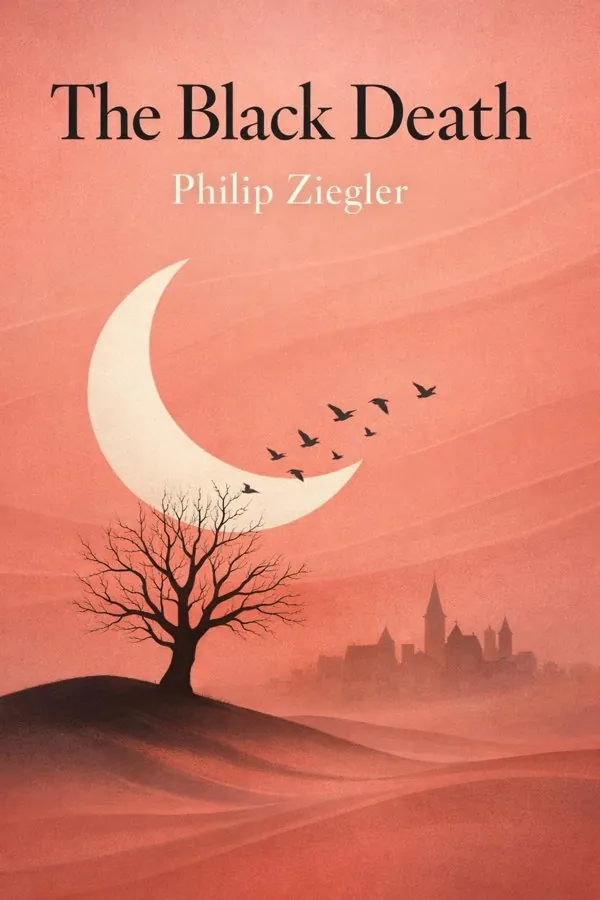
The Black Death: Summary & Key Insights
 10 min9 chaptersAudio available
Key Takeaways from The Black Death
Great disasters rarely begin where history remembers them.
Civilizations are often entered not by armies but by ships.
A crisis becomes more frightening when expertise cannot stop it.
Numbers can become abstract unless we remember that each percentage represents shattered households.
Disaster tests character, but it also tests structure.
What Is The Black Death About?
The Black Death by Philip Ziegler is a world_history book spanning 11 pages. Philip Ziegler’s The Black Death is a gripping history of the most devastating pandemic in medieval Europe: the plague that erupted in the fourteenth century and killed millions within a few catastrophic years. More than a chronicle of disease, the book reconstructs an entire civilization under extreme pressure. Ziegler traces the plague’s likely origins in Asia, follows its movement along trade routes into Europe, and examines how towns, villages, rulers, clergy, physicians, and ordinary families responded when familiar structures of meaning began to collapse. His account stands out because it combines disciplined historical research with a vivid narrative sense; statistics and archival evidence are never separated from the human fear, confusion, grief, and adaptation behind them. The book matters because the Black Death did not simply interrupt medieval life: it altered labor systems, weakened assumptions about authority, changed religious feeling, and reshaped Europe’s social and economic development. Ziegler writes with clarity, restraint, and empathy, making a distant catastrophe feel immediate while helping modern readers understand how epidemics expose the strengths and fractures of any society.
This FizzRead summary covers all 9 key chapters of The Black Death in approximately 10 minutes, distilling the most important ideas, arguments, and takeaways from Philip Ziegler's work. Also available as an audio summary and Key Quotes Podcast.
The Black Death
Philip Ziegler’s The Black Death is a gripping history of the most devastating pandemic in medieval Europe: the plague that erupted in the fourteenth century and killed millions within a few catastrophic years. More than a chronicle of disease, the book reconstructs an entire civilization under extreme pressure. Ziegler traces the plague’s likely origins in Asia, follows its movement along trade routes into Europe, and examines how towns, villages, rulers, clergy, physicians, and ordinary families responded when familiar structures of meaning began to collapse. His account stands out because it combines disciplined historical research with a vivid narrative sense; statistics and archival evidence are never separated from the human fear, confusion, grief, and adaptation behind them. The book matters because the Black Death did not simply interrupt medieval life: it altered labor systems, weakened assumptions about authority, changed religious feeling, and reshaped Europe’s social and economic development. Ziegler writes with clarity, restraint, and empathy, making a distant catastrophe feel immediate while helping modern readers understand how epidemics expose the strengths and fractures of any society.
Who Should Read The Black Death?
This book is perfect for anyone interested in world_history and looking to gain actionable insights in a short read. Whether you're a student, professional, or lifelong learner, the key ideas from The Black Death by Philip Ziegler will help you think differently.
- ✓Readers who enjoy world_history and want practical takeaways
- ✓Professionals looking to apply new ideas to their work and life
- ✓Anyone who wants the core insights of The Black Death in just 10 minutes
Want the full summary?
Get instant access to this book summary and 100K+ more with Fizz Moment.
Get Free SummaryAvailable on App Store • Free to download
Key Chapters
Great disasters rarely begin where history remembers them. One of Ziegler’s first important points is that the Black Death was not originally a European event at all. Its deeper roots likely lay in Central Asia, where the bacterium later identified as Yersinia pestis circulated among rodent populations. From there, long-distance commerce helped turn a local ecological problem into a continental catastrophe. Trade routes that moved silk, spices, grain, and luxury goods also moved fleas, rats, and infected humans. In other words, the same networks that enriched medieval societies also made them vulnerable.
Ziegler uses this origin story to show that plague was not random in the mystical sense many contemporaries imagined. It followed patterns of contact, movement, and exchange. Merchant caravans and shipping routes linked distant regions tightly enough that disease could outrun understanding. This offers a powerful lesson in historical systems thinking: prosperity and exposure often travel together.
A practical way to apply this insight today is to think about how interconnected systems behave. Modern supply chains, air travel, and digital communication create extraordinary opportunities, but they also amplify shocks. A virus, financial panic, or misinformation campaign can spread quickly for exactly the same reason innovation spreads quickly: connectivity.
Ziegler’s treatment of the plague’s origins reminds readers to look upstream. When a crisis arrives dramatically in one place, its causes may lie far away in geography, trade, ecology, or policy. Actionable takeaway: whenever evaluating a major social crisis, trace the networks that carried it rather than focusing only on the moment it became visible.
Civilizations are often entered not by armies but by ships. Ziegler vividly describes the arrival of plague in Europe in 1347, especially through Mediterranean ports such as Messina. The disease did not march in a straight line; it radiated through the arteries of commerce. Port cities, market towns, pilgrimage routes, and inland trading centers became stepping stones in a deadly chain reaction. What made the plague so terrifying was not merely its lethality but its speed. Places that felt secure one month could be overwhelmed the next.
Ziegler shows that mobility shaped mortality. Busy urban centers, with crowded housing and active exchange, were especially vulnerable. Yet remoteness offered no guaranteed safety, because local trade, refugees, and routine travel eventually carried infection onward. The medieval world, though slower than ours, was deeply connected in practice.
This idea has modern relevance. We often imagine risk as local, but many dangers are networked. A disruption in one node can rapidly affect others. Public health, logistics, emergency planning, and even corporate resilience depend on understanding pathways, chokepoints, and timing. The Black Death teaches that where people and goods move freely, information and safeguards must move even faster.
Ziegler’s narrative also undercuts the myth that medieval people were isolated and static. Their world was dynamic enough to sustain international contagion. Actionable takeaway: when assessing vulnerability in any organization or community, map the routes of movement—people, goods, and information—because crises usually spread along existing lines of connection.
A crisis becomes more frightening when expertise cannot stop it. One of the most revealing sections of Ziegler’s book concerns medieval medicine. Physicians did not lack intelligence or seriousness; they lacked the scientific framework necessary to understand what plague was. Their explanations drew on humoral theory, astrology, bad air, divine punishment, and inherited authorities. Treatments included bloodletting, purging, aromatic substances, isolation, prayers, and dietary regulation. Some advice was accidentally useful, much of it ineffective, and none offered a true cure.
Ziegler treats this subject with nuance rather than mockery. Medieval doctors worked within the best conceptual tools available to them. The real tragedy was that a society facing an unprecedented biological event had no reliable mechanism for identifying causes or testing interventions. This widened the gap between status and usefulness: learned men could still command respect even when they could not deliver results.
The broader lesson is timeless. Expertise matters, but expertise must be adaptive, evidence-based, and open to revision. Institutions can become trapped inside respectable but inadequate models. That applies not only to medicine but also to economics, education, management, and politics. People under pressure often cling harder to familiar theories, even when reality is disproving them.
A practical application is to ask, in any field: what assumptions are we treating as settled that may fail under extreme conditions? Ziegler’s account encourages intellectual humility. Actionable takeaway: respect expertise, but always examine whether current explanations are producing real results, especially when conditions change rapidly.
Numbers can become abstract unless we remember that each percentage represents shattered households. Ziegler emphasizes that the Black Death’s demographic impact was almost beyond medieval comprehension. In many regions, a third or more of the population may have died, and in some localities the losses were even worse. Villages thinned, monasteries emptied, family lines ended, and labor suddenly became scarce. The plague was not a single dramatic scene but a rolling series of absences: abandoned fields, untended children, unburied bodies, silent workshops, and communities with no memory of normal continuity.
This demographic collapse mattered because population is the hidden infrastructure beneath every society. It sustains food production, tax revenue, religious life, military organization, caregiving, and inherited knowledge. When death strikes at scale, every institution weakens simultaneously. Ziegler shows that the plague’s death toll was not just a humanitarian calamity; it transformed the basic arithmetic of power and survival.
Modern readers can apply this insight by taking demographic resilience seriously. Whether the issue is migration, aging, disease, or labor shortages, population shifts can alter economies and politics for generations. We often react to visible events while ignoring the quieter structural consequences that unfold afterward.
Ziegler also reminds us that statistics should never erase emotional truth. Large-scale mortality changes how people think about family, duty, inheritance, and the future itself. Actionable takeaway: when evaluating a historical or modern crisis, ask not only how many died, but how those losses changed institutions, relationships, and long-term capacity.
When explanation fails, people look for meaning. Ziegler gives careful attention to the religious responses provoked by the Black Death. For many medieval Europeans, plague was interpreted through a spiritual framework: divine punishment, a test of faith, or a sign of cosmic disorder. Churches remained central places of comfort, confession, ritual, and hope. At the same time, the inability of many clergy to explain or halt the catastrophe weakened confidence in established religious authority.
Some responses were deeply sincere and compassionate. Priests ministered to the dying; communities prayed, processed, and gave alms. But fear also generated excess and distortion. Movements such as the flagellants dramatized public repentance, while minorities, especially Jewish communities, were scapegoated and violently persecuted. Ziegler shows how easily suffering can be redirected into moral accusation when a society craves certainty.
The enduring insight here is that belief systems do more than answer abstract questions; they shape behavior under pressure. In modern crises, people still search for frameworks that explain why events are happening and what they demand ethically. Those frameworks can inspire service and sacrifice, or they can fuel blame, conspiracy, and exclusion.
A practical application is to pay close attention to narratives during times of collective fear. People rarely endure chaos with facts alone; they need meaning. But meaning must be paired with responsibility and restraint. Actionable takeaway: in moments of uncertainty, choose narratives that increase compassion and accountability rather than those that target vulnerable groups.
Sometimes catastrophe destroys lives while unexpectedly redistributing leverage. One of Ziegler’s most important arguments is that the Black Death transformed Europe economically by making labor scarce. With so many workers dead, survivors found themselves in a stronger bargaining position. Wages rose in some areas, employers struggled to retain labor, and traditional feudal relationships came under pressure. Landlords who had once relied on abundant peasant labor faced a new and uncomfortable reality: workers were now valuable in a different way.
Ziegler does not portray this as a simple upward march toward freedom. Governments and elites often tried to freeze wages, control mobility, and preserve old hierarchies through legislation and coercion. Yet the demographic shock made it difficult to restore the previous order fully. The plague thus became a force that accelerated long-term social and economic change.
This is one of the book’s most useful contributions for modern readers. It demonstrates that labor markets are not merely shaped by policy or ideology; they are also shaped by demographic realities and bargaining conditions. When the supply of workers changes dramatically, institutions must adapt, whether they want to or not.
You can apply this idea by looking at labor, compensation, and productivity with historical perspective. Shortages alter negotiation power, business models, and social expectations. They also reveal which systems depended too heavily on expendable human effort. Actionable takeaway: whenever labor conditions shift, look beyond wages alone and ask how power, mobility, and institutional assumptions are being redefined.
Authority is most revealing when it confronts what it cannot command. Ziegler examines how rulers and civic authorities responded to the Black Death with a mixture of improvisation, denial, regulation, and practical administration. Officials attempted quarantines, travel restrictions, burial rules, sanitation measures, and labor controls. Some responses were sensible and forward-looking; others were reactive and unevenly enforced. What stands out is that governments were learning in real time while facing a crisis they barely understood.
The plague highlighted a permanent tension in public policy: leaders are expected to act decisively even when knowledge is incomplete. Delay can be deadly, but overconfidence can also do harm. Ziegler shows that medieval authorities were not simply passive or irrational; many tried earnestly to preserve order, maintain supplies, and reduce panic. Still, their capacities were limited by weak communication systems, local autonomy, and uncertain medical theory.
The modern relevance is obvious. Effective crisis management requires legitimacy, clarity, and flexibility. People need to believe that rules serve a real purpose and are applied fairly. Public measures become less effective when they are inconsistent, poorly explained, or transparently self-serving.
Ziegler’s account also suggests that policy has symbolic as well as practical value. In emergencies, visible organization can stabilize public confidence even before perfect solutions exist. Actionable takeaway: judge crisis leadership by three standards—speed, transparency, and adaptability—because authority without trust and learning rarely performs well under pressure.
The end of mortality is not the end of consequence. Ziegler closes the story by showing that the Black Death’s legacy far exceeded the years of its first eruption. Even after the worst wave passed, Europe did not simply return to its old self. The plague altered patterns of settlement, inheritance, labor, devotion, and imagination. It entered art, literature, religious consciousness, and collective memory as a symbol of fragility, judgment, and sudden reversal. Societies rebuilt, but they rebuilt on different assumptions.
Ziegler is especially strong on the idea that historical trauma lingers in culture. People who survive catastrophe often carry changed expectations about authority, death, risk, and fortune. Some institutions harden; others loosen. Some habits become more practical, others more fatalistic. The Black Death was therefore not only an event to be counted but an experience that changed what people believed was possible.
This matters today because societies often underestimate the afterlife of crisis. We focus on infection curves, military campaigns, recessions, or disaster costs, but less on memory, behavior, and institutional adaptation. Yet those may be the most enduring effects of all.
A practical application is to ask after any major disruption: what assumptions have quietly changed? How do people now think differently about work, family, security, faith, or governance? Ziegler’s answer is that recovery is never pure restoration. Actionable takeaway: after a crisis, look not only for what has resumed, but for what has been permanently reimagined.
All Chapters in The Black Death
About the Author
Philip Ziegler (1929–2019) was a British historian, biographer, and author admired for his ability to make serious history accessible to a wide audience. He was educated at Eton and New College, Oxford, and began his professional life in the British Foreign Service before turning to writing full time. Over the course of his career, he produced acclaimed biographies of public figures such as Lord Mountbatten and Edward VIII, along with works of narrative history. Ziegler’s writing is marked by clarity, balance, careful research, and a humane interest in the people behind historical events. In The Black Death, he brings those qualities together to illuminate one of Europe’s greatest catastrophes with both scholarly discipline and compelling storytelling.
Get This Summary in Your Preferred Format
Read or listen to the The Black Death summary by Philip Ziegler anytime, anywhere. FizzRead offers multiple formats so you can learn on your terms — all free.
Available formats: App · Audio · PDF · EPUB — All included free with FizzRead
Download The Black Death PDF and EPUB Summary
Key Quotes from The Black Death
“Great disasters rarely begin where history remembers them.”
“Civilizations are often entered not by armies but by ships.”
“A crisis becomes more frightening when expertise cannot stop it.”
“Numbers can become abstract unless we remember that each percentage represents shattered households.”
“Disaster tests character, but it also tests structure.”
Frequently Asked Questions about The Black Death
The Black Death by Philip Ziegler is a world_history book that explores key ideas across 9 chapters. Philip Ziegler’s The Black Death is a gripping history of the most devastating pandemic in medieval Europe: the plague that erupted in the fourteenth century and killed millions within a few catastrophic years. More than a chronicle of disease, the book reconstructs an entire civilization under extreme pressure. Ziegler traces the plague’s likely origins in Asia, follows its movement along trade routes into Europe, and examines how towns, villages, rulers, clergy, physicians, and ordinary families responded when familiar structures of meaning began to collapse. His account stands out because it combines disciplined historical research with a vivid narrative sense; statistics and archival evidence are never separated from the human fear, confusion, grief, and adaptation behind them. The book matters because the Black Death did not simply interrupt medieval life: it altered labor systems, weakened assumptions about authority, changed religious feeling, and reshaped Europe’s social and economic development. Ziegler writes with clarity, restraint, and empathy, making a distant catastrophe feel immediate while helping modern readers understand how epidemics expose the strengths and fractures of any society.
You Might Also Like
The Age of Capital
Eric Hobsbawm
10 min
The Gulag Archipelago
Aleksandr Solzhenitsyn
10 min
Jerusalem: The Biography
Simon Sebag Montefiore
10 min
The Anglo-Saxons
James Campbell
10 min
The Boer War
Thomas Pakenham
10 min
The Industrial Revolutionaries: The Making of the Modern World 1776–1914
Gavin Weightman
10 minBrowse by Category
Ready to read The Black Death?
Get the full summary and 100K+ more books with Fizz Moment.