
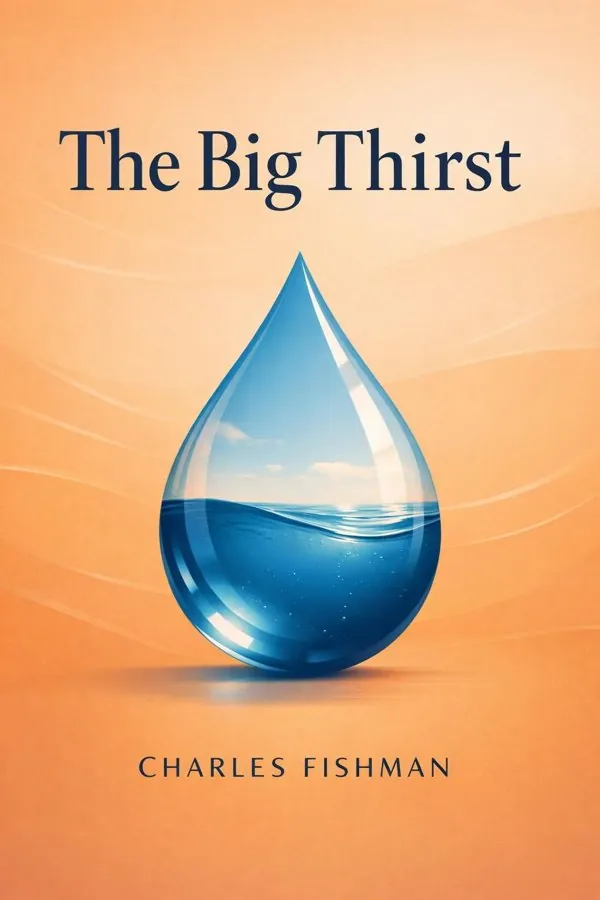
The Big Thirst: The Secret Life and Turbulent Future of Water: Summary & Key Insights
 10 min9 chaptersAudio available
What Is The Big Thirst: The Secret Life and Turbulent Future of Water About?
The Big Thirst: The Secret Life and Turbulent Future of Water by Charles Fishman is a environment book spanning 9 pages. The Big Thirst explores the complex relationship between humans and water, revealing how we take this essential resource for granted and how our future depends on rethinking its use. Charles Fishman investigates the global water crisis, the economics of water, and innovative solutions emerging around the world to ensure sustainable water management.
This FizzRead summary covers all 9 key chapters of The Big Thirst: The Secret Life and Turbulent Future of Water in approximately 10 minutes, distilling the most important ideas, arguments, and takeaways from Charles Fishman's work. Also available as an audio summary and Key Quotes Podcast.
The Big Thirst: The Secret Life and Turbulent Future of Water
The Big Thirst explores the complex relationship between humans and water, revealing how we take this essential resource for granted and how our future depends on rethinking its use. Charles Fishman investigates the global water crisis, the economics of water, and innovative solutions emerging around the world to ensure sustainable water management.
Who Should Read The Big Thirst: The Secret Life and Turbulent Future of Water?
This book is perfect for anyone interested in environment and looking to gain actionable insights in a short read. Whether you're a student, professional, or lifelong learner, the key ideas from The Big Thirst: The Secret Life and Turbulent Future of Water by Charles Fishman will help you think differently.
- ✓Readers who enjoy environment and want practical takeaways
- ✓Professionals looking to apply new ideas to their work and life
- ✓Anyone who wants the core insights of The Big Thirst: The Secret Life and Turbulent Future of Water in just 10 minutes
Want the full summary?
Get instant access to this book summary and 100K+ more with Fizz Moment.
Get Free SummaryAvailable on App Store • Free to download
Key Chapters
For most of the modern era, we’ve lived in what I call the Age of Abundance. Turn the tap, and water flows. Flush the toilet, and everything disappears. It’s the infrastructure of invisibility—so reliable that we’ve stopped thinking about it. But now, around the world, that illusion is cracking. Cities like Atlanta, Barcelona, and Sydney have all faced moments when the taps nearly ran dry. These crises are not anomalies—they are harbingers.
In this section, I explore how the abundance of water shaped our expectations. Postwar industrial and suburban expansion in the United States, for instance, was built on a network of dams and aqueducts that made deserts bloom and suburban lawns sparkle. Yet as populations grow and climate patterns shift, those same systems are reaching their limits. The story of the recent droughts in California offers a striking example: decades of irrigation and political favoritism created an agricultural miracle that became ecologically fragile.
But rather than despair, I ask readers to reconsider what abundance really means. True abundance is not about endless supply—it’s about intelligent use, resilience, and recycling. The end of abundance marks a new stage in our maturity as a civilization. It’s the point at which we learn to treat water not as a given but as a partner. Just as energy conservation reshaped our relationship with electricity and fossil fuels, water scarcity can lead us to innovations that make our communities stronger and more connected to the planet beneath our feet.
+ 7 more chapters — available in the FizzRead app
All Chapters in The Big Thirst: The Secret Life and Turbulent Future of Water
About the Author
Charles Fishman is an American journalist and author known for his investigative works on business, technology, and social issues. He has written for Fast Company and other major publications, focusing on how people and organizations adapt to change and innovation.
Get This Summary in Your Preferred Format
Read or listen to the The Big Thirst: The Secret Life and Turbulent Future of Water summary by Charles Fishman anytime, anywhere. FizzRead offers multiple formats so you can learn on your terms — all free.
Available formats: App · Audio · PDF · EPUB — All included free with FizzRead
Download The Big Thirst: The Secret Life and Turbulent Future of Water PDF and EPUB Summary
Key Quotes from The Big Thirst: The Secret Life and Turbulent Future of Water
“For most of the modern era, we’ve lived in what I call the Age of Abundance.”
“The greatest marvel of modern life may be that we can move trillions of gallons of water every day without seeing it.”
Frequently Asked Questions about The Big Thirst: The Secret Life and Turbulent Future of Water
The Big Thirst: The Secret Life and Turbulent Future of Water by Charles Fishman is a environment book that explores key ideas across 9 chapters. The Big Thirst explores the complex relationship between humans and water, revealing how we take this essential resource for granted and how our future depends on rethinking its use. Charles Fishman investigates the global water crisis, the economics of water, and innovative solutions emerging around the world to ensure sustainable water management.
You Might Also Like
A Life on Our Planet: My Witness Statement and a Vision for the Future
David Attenborough
10 min
A Sky Full Of Birds
Matt Merritt
10 min
Carbon Zero: Imagining Cities That Can Save the Planet
Alex Steffen
10 min
Eaarth: Making a Life on a Tough New Planet
Bill McKibben
10 min
The Social Contract and Environmental Governance
Various Editors
10 min
The Wild Places
Robert Macfarlane
10 minBrowse by Category
Ready to read The Big Thirst: The Secret Life and Turbulent Future of Water?
Get the full summary and 100K+ more books with Fizz Moment.