
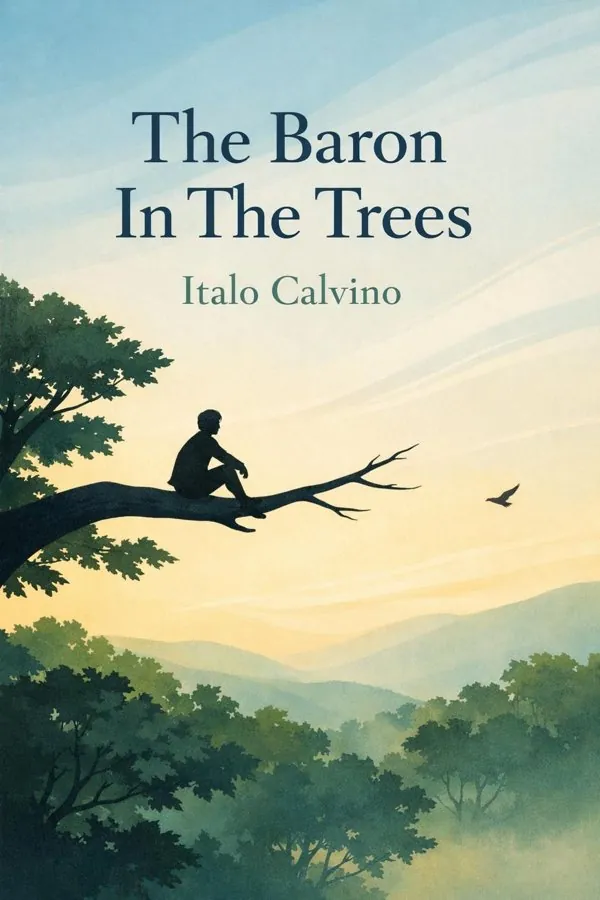
The Baron In The Trees: Summary & Key Insights
 10 min9 chaptersAudio available
Key Takeaways from The Baron In The Trees
A life can change not through grand strategy, but through one uncompromising no.
Freedom means little if it cannot sustain daily life.
Stepping apart from society does not necessarily mean turning away from people.
It is easy to defend independence in the abstract; love is what exposes its limits.
Thought becomes richer when it is lived, tested, and revised.
What Is The Baron In The Trees About?
The Baron In The Trees by Italo Calvino is a classics book spanning 5 pages. What if the most serious act of philosophy began with a child refusing dinner? In The Baron In The Trees, Italo Calvino turns a boy’s rebellion into one of modern literature’s most memorable thought experiments. Set in eighteenth-century Liguria, the novel follows Cosimo Piovasco di Rondò, a young aristocrat who climbs into the trees after quarreling with his family and vows never to touch the ground again. What sounds whimsical soon becomes profound. From the branches, Cosimo builds an entire life: he learns, loves, argues, helps others, and watches history unfold while remaining suspended between society and solitude. Calvino uses this strange premise to explore freedom, dignity, love, reason, and the price of living by one’s principles. The novel matters because it asks a timeless question: how can a person remain fully engaged with the world without surrendering independence? Calvino, one of the twentieth century’s most inventive writers, answers with wit, elegance, and philosophical depth. The result is both a fable and a serious meditation on what it means to live authentically.
This FizzRead summary covers all 9 key chapters of The Baron In The Trees in approximately 10 minutes, distilling the most important ideas, arguments, and takeaways from Italo Calvino's work. Also available as an audio summary and Key Quotes Podcast.
The Baron In The Trees
What if the most serious act of philosophy began with a child refusing dinner? In The Baron In The Trees, Italo Calvino turns a boy’s rebellion into one of modern literature’s most memorable thought experiments. Set in eighteenth-century Liguria, the novel follows Cosimo Piovasco di Rondò, a young aristocrat who climbs into the trees after quarreling with his family and vows never to touch the ground again. What sounds whimsical soon becomes profound. From the branches, Cosimo builds an entire life: he learns, loves, argues, helps others, and watches history unfold while remaining suspended between society and solitude. Calvino uses this strange premise to explore freedom, dignity, love, reason, and the price of living by one’s principles. The novel matters because it asks a timeless question: how can a person remain fully engaged with the world without surrendering independence? Calvino, one of the twentieth century’s most inventive writers, answers with wit, elegance, and philosophical depth. The result is both a fable and a serious meditation on what it means to live authentically.
Who Should Read The Baron In The Trees?
This book is perfect for anyone interested in classics and looking to gain actionable insights in a short read. Whether you're a student, professional, or lifelong learner, the key ideas from The Baron In The Trees by Italo Calvino will help you think differently.
- ✓Readers who enjoy classics and want practical takeaways
- ✓Professionals looking to apply new ideas to their work and life
- ✓Anyone who wants the core insights of The Baron In The Trees in just 10 minutes
Want the full summary?
Get instant access to this book summary and 100K+ more with Fizz Moment.
Get Free SummaryAvailable on App Store • Free to download
Key Chapters
A life can change not through grand strategy, but through one uncompromising no. Cosimo’s journey begins at the family table, when the twelve-year-old baron’s son refuses to eat a dish he despises and then resists his father’s demand for obedience. He climbs into the trees and, in a moment that seems impulsive and childish, decides never to come down again. Calvino makes this act feel both absurd and deeply serious. Cosimo is not merely rejecting a meal or a parental order; he is rejecting a rigid social script built on rank, habit, and submission.
What gives this rebellion lasting meaning is that Cosimo accepts the consequences. He does not descend after an hour or a day, once tempers cool. He transforms refusal into commitment. That decision becomes the foundation of his identity. Calvino suggests that individuality is not defined by having unusual opinions, but by organizing one’s life around convictions and enduring the inconvenience they create.
In practical terms, Cosimo’s rebellion reflects a challenge many people face: when should you conform, and when should you stand apart? In work, family, or culture, there are moments when small acts of resistance reveal larger truths about who you are. The lesson is not to be stubborn for its own sake. Rather, it is to distinguish between rebellion that is merely reactive and rebellion that expresses a genuine moral or personal vision.
Actionable takeaway: Identify one area of your life where you comply from habit rather than conviction, and ask what a principled, thoughtful refusal would look like.
Freedom means little if it cannot sustain daily life. After Cosimo climbs into the trees, Calvino does not treat his new existence as a magical escape from reality. Instead, he shows the practical difficulties: finding food, moving safely, enduring storms, and dealing with loneliness. Cosimo must learn the physical logic of the canopy, understand how different trees connect, and adapt his habits to a world that is beautiful but demanding. This is where his rebellion becomes credible. He is not living in fantasy; he is building competence.
Over time, the trees become not a hiding place but a social and intellectual territory. Cosimo observes villages, estates, travelers, and workers from above. He creates pathways through branches and develops a form of life with its own routines, disciplines, and advantages. The novel shows that independence is not isolation from structure; it is the ability to create a structure of your own. To live differently, you must become resourceful.
This idea applies far beyond fiction. Anyone who chooses a nontraditional path—freelancing instead of taking a stable job, moving to a new place, changing careers, or setting firmer boundaries—soon discovers that freedom requires systems. You need practical habits to support your ideals. Calvino reminds us that autonomy is maintained not by emotion alone, but by patience, improvisation, and skill.
Actionable takeaway: If you want more independence, strengthen one practical habit that supports it, such as budgeting, scheduling, or learning a core skill that reduces your dependence on others.
Stepping apart from society does not necessarily mean turning away from people. One of Calvino’s most subtle achievements is showing that Cosimo, despite never returning to the ground, becomes intensely involved in human life. From the branches he speaks with villagers, assists neighbors, observes injustices, and forms friendships across class lines. He becomes a figure who is both near and far: detached enough to see clearly, engaged enough to matter.
This paradox lies at the heart of the novel. Cosimo’s distance gives him perspective. Because he is not fully absorbed into the routines of ordinary social life, he can examine them with unusual sharpness. Yet he does not become cold or indifferent. He remains curious, compassionate, and active. Calvino suggests that some forms of distance are necessary for wisdom. When we are too embedded in expectations, we may lose the ability to judge them.
Modern readers can recognize this in everyday life. Sometimes stepping back from a workplace conflict, a family pattern, or constant social media exposure allows you to relate more intelligently, not less. Boundaries can improve connection by reducing emotional noise and making intention clearer. Cosimo’s life teaches that participation does not require total conformity; one can belong critically.
The novel also pushes against the false choice between solitude and community. Cosimo creates a third option: a life of selective involvement. He does not withdraw from humanity; he redefines the terms of contact.
Actionable takeaway: Create one healthy boundary this week that gives you more perspective without cutting you off from people who matter.
It is easy to defend independence in the abstract; love is what exposes its limits. Cosimo’s relationship with Viola is one of the novel’s most vibrant and destabilizing elements. Their connection is passionate, playful, difficult, and often painful. Viola is not a sentimental reward for Cosimo’s uniqueness. She is a force who challenges him, excites him, and reveals the emotional cost of living by strict principles. Through her, Calvino shows that even a carefully chosen life cannot protect a person from longing, jealousy, volatility, and disappointment.
The relationship matters because it prevents the novel from becoming a simple celebration of detachment. Cosimo can live above society, but he cannot rise above human need. Love makes demands that logic cannot fully organize. It introduces unpredictability into a life built on discipline. In this sense, Viola becomes the test of whether Cosimo’s freedom is expansive or defensive. Is he free enough to love deeply, or so committed to self-definition that intimacy becomes impossible?
This is a familiar modern tension. People often value autonomy, but relationships require compromise, emotional flexibility, and vulnerability. The challenge is not choosing between selfhood and love, but learning how to keep both alive. Calvino does not offer a neat solution. Instead, he portrays love as a realm where ideals become complicated and where people discover the edges of their own identities.
Actionable takeaway: In an important relationship, ask yourself whether a principle you defend is truly essential or whether it mainly protects you from vulnerability.
Thought becomes richer when it is lived, tested, and revised. As Cosimo matures, his life in the trees becomes a platform for philosophical reflection. He reads widely, engages with the currents of Enlightenment thought, and considers reason, justice, and the organization of society. Yet Calvino never presents him as a detached intellectual floating above the world. Cosimo’s ideas are grounded in action. He forms judgments while dealing with actual people, customs, inequalities, and institutions.
This is one of the novel’s deepest strengths. The trees symbolize not escape from reality, but an alternative vantage point from which to evaluate it. Cosimo can see both the beauty and absurdity of social arrangements. He is close enough to be implicated, distant enough to remain critical. Calvino suggests that intellectual independence requires some remove from dominant assumptions. At the same time, ideas lose value if they never encounter lived complexity.
For readers today, this raises an important challenge. It is easy to adopt opinions from a group, a platform, or a trend without examining how they function in real life. Cosimo models a more demanding approach: observe carefully, think independently, and stay engaged with consequences. Philosophy is not only what you claim to believe; it is the way your daily choices embody those beliefs.
Actionable takeaway: Take one belief you hold strongly about society, work, or relationships, and test it against your actual behavior. Ask whether your life supports your stated values.
No one stands outside history, not even someone living in the trees. Although Cosimo chooses an eccentric and highly personal path, he remains part of a changing eighteenth-century world marked by political upheaval, intellectual ferment, and shifting social structures. Calvino uses this contrast to show that private independence does not exempt a person from public reality. The world moves, ideas spread, empires rise and weaken, and even the most solitary life is touched by collective events.
This matters because it prevents the novel from becoming purely inward. Cosimo is not only crafting a self; he is also witnessing an era. His strange position gives him a unique relationship to history. He observes it from the margins, which helps him recognize both the promise and the contradictions of progress. Calvino seems interested in how large historical forces interact with personal ideals. Can a person remain morally independent in times of change? Can private integrity influence public life?
The question remains urgent. Many people today feel tempted to disengage from politics, institutions, or civic responsibilities in order to protect their peace. Yet history does not pause because individuals opt out. The challenge is to participate without being absorbed, to remain ethically awake without becoming helplessly reactive. Cosimo offers an image of engaged distance: he is not conventional, but neither is he indifferent.
Actionable takeaway: Choose one public issue you care about and take a concrete, modest step—read deeply, discuss thoughtfully, donate, volunteer, or vote with greater intention.
Character is not declared once; it is proven repeatedly. The enduring power of Cosimo’s life comes from his consistency. What begins as youthful defiance becomes, over years and decades, a coherent way of being. He does not return to the ground when novelty fades, when romance disappoints him, or when aging makes his choice more difficult. This constancy gives his life meaning. Calvino shows that identity emerges through repetition—through what a person continues to choose when circumstances change.
At the same time, consistency is not the same as rigidity. Cosimo evolves intellectually and emotionally. He learns, suffers, adapts, and expands his understanding of the world. The outward form of his commitment remains unchanged, but his inner life grows more complex. This balance is crucial. A meaningful principle should organize life without freezing it. The strongest identities combine fidelity with development.
In practical terms, many people confuse self-knowledge with self-description. They say they value creativity, discipline, honesty, or courage, but those values become real only when translated into recurring behavior. Cosimo’s life makes an uncomfortable point: we are shaped less by our aspirations than by the patterns we maintain over time. If you want to become a certain kind of person, you must create habits that carry that identity through ordinary days.
Actionable takeaway: Pick one value you want your life to reflect, then define a weekly action that expresses it consistently enough to become part of your character.
Every ideal becomes more serious when time tests it. As Cosimo grows older, his life in the trees acquires a different emotional tone. The excitement of youthful rebellion gives way to endurance, memory, and the awareness of mortality. Calvino does not romanticize this stage. The very choice that once seemed liberating also becomes burdensome. Bodies age, relationships fade, and even the most meaningful commitments can leave a person exposed to loneliness and loss.
This late dimension of the novel gives it unusual depth. Cosimo is not a symbol frozen in heroic defiance; he is a human being who must inhabit his decision across a lifetime. Calvino invites readers to ask not only whether a principle is admirable, but whether it can be lived humanely over the long term. A dramatic stand may win respect, yet every stand creates exclusions. To choose one path is to surrender another.
This insight applies to careers, marriages, artistic vocations, moral commitments, and forms of independence. Choices gain dignity from sacrifice, but sacrifice should still be examined honestly. Mature freedom includes an awareness of trade-offs. Rather than undermining Cosimo, this realism makes him more compelling. His life matters not because it is easy or flawless, but because he remains faithful while facing its costs.
Actionable takeaway: Reflect on one major commitment in your life and write down both what it gives you and what it asks you to give up. Clarity strengthens wiser devotion.
Sometimes a fantastic story reveals reality more clearly than literal realism. The central premise of The Baron In The Trees is impossible in ordinary terms, yet it illuminates ordinary life with remarkable precision. By placing Cosimo in the canopy, Calvino creates a fable-like distance that helps readers see familiar issues—family pressure, class expectations, intellectual independence, romantic difficulty, political change—in a newly vivid way. The novel’s strangeness is not decorative; it is a method of thinking.
Calvino belongs to a tradition of writers who use imaginative forms to reach psychological and philosophical truths. The trees become a visual and moral metaphor: elevated but connected, free yet constrained, apart yet involved. Because the image is so memorable, the novel’s ideas linger. We understand Cosimo’s inner stance not through abstract lectures but through a life physically arranged around his convictions.
For modern readers, this is a reminder that stories can be tools for reflection, not just entertainment. A metaphor, a fable, or a speculative premise can make hidden assumptions visible. Instead of asking whether such a story is realistic, we can ask what aspect of reality it clarifies. Calvino’s answer is that imagination can sharpen moral perception.
Actionable takeaway: When reading fiction, pause after a striking symbol or premise and ask what real-life conflict it helps you see more clearly in your own world.
All Chapters in The Baron In The Trees
About the Author
Italo Calvino (1923–1985) was one of the most influential Italian writers of the twentieth century. Born in Santiago de Las Vegas, Cuba, and raised in Sanremo, Italy, he developed a literary career marked by extraordinary range. His early work emerged from postwar realism, but he became best known for blending fantasy, philosophy, folktale, and formal experimentation. His major books include The Cloven Viscount, The Baron In The Trees, Invisible Cities, Cosmicomics, and If on a winter’s night a traveler. Calvino’s writing is admired for its precision, wit, lightness, and intellectual depth. Again and again, he used imaginative premises to explore serious questions about identity, society, memory, and human possibility. Today he remains a central figure in world literature and a favorite among readers who value both elegance and originality.
Get This Summary in Your Preferred Format
Read or listen to the The Baron In The Trees summary by Italo Calvino anytime, anywhere. FizzRead offers multiple formats so you can learn on your terms — all free.
Available formats: App · Audio · PDF · EPUB — All included free with FizzRead
Download The Baron In The Trees PDF and EPUB Summary
Key Quotes from The Baron In The Trees
“A life can change not through grand strategy, but through one uncompromising no.”
“Freedom means little if it cannot sustain daily life.”
“Stepping apart from society does not necessarily mean turning away from people.”
“It is easy to defend independence in the abstract; love is what exposes its limits.”
“Thought becomes richer when it is lived, tested, and revised.”
Frequently Asked Questions about The Baron In The Trees
The Baron In The Trees by Italo Calvino is a classics book that explores key ideas across 9 chapters. What if the most serious act of philosophy began with a child refusing dinner? In The Baron In The Trees, Italo Calvino turns a boy’s rebellion into one of modern literature’s most memorable thought experiments. Set in eighteenth-century Liguria, the novel follows Cosimo Piovasco di Rondò, a young aristocrat who climbs into the trees after quarreling with his family and vows never to touch the ground again. What sounds whimsical soon becomes profound. From the branches, Cosimo builds an entire life: he learns, loves, argues, helps others, and watches history unfold while remaining suspended between society and solitude. Calvino uses this strange premise to explore freedom, dignity, love, reason, and the price of living by one’s principles. The novel matters because it asks a timeless question: how can a person remain fully engaged with the world without surrendering independence? Calvino, one of the twentieth century’s most inventive writers, answers with wit, elegance, and philosophical depth. The result is both a fable and a serious meditation on what it means to live authentically.
More by Italo Calvino

You Might Also Like


Browse by Category
Ready to read The Baron In The Trees?
Get the full summary and 100K+ more books with Fizz Moment.