
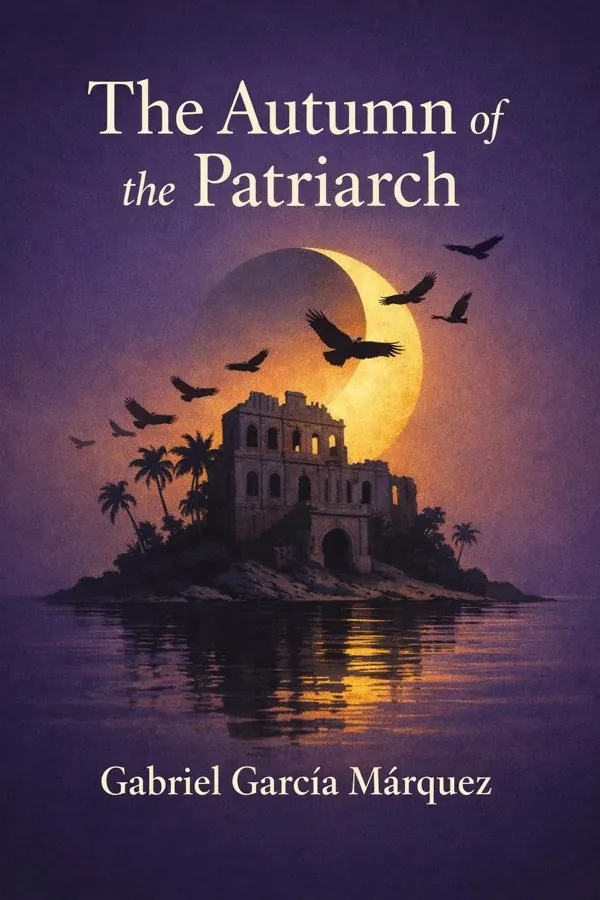
The Autumn of the Patriarch: Summary & Key Insights
 10 min9 chaptersAudio available
Key Takeaways from The Autumn of the Patriarch
Power often appears strongest just before it is revealed to be empty.
Dictators are not born as legends; they are made through opportunity, fear, and the failures of institutions.
When no one can challenge a ruler, truth becomes whatever he can impose.
Private attachment can become political theater when a ruler needs legitimacy.
A corrupt regime eventually begins to rot in visible, physical ways.
What Is The Autumn of the Patriarch About?
The Autumn of the Patriarch by Gabriel García Márquez is a classics book spanning 11 pages. First published in 1975, The Autumn of the Patriarch is Gabriel García Márquez’s haunting meditation on dictatorship, memory, and the slow corruption of a nation under absolute rule. Set in an unnamed Caribbean country, the novel follows an aging tyrant whose seemingly endless reign has turned both the presidential palace and the nation into landscapes of decay, illusion, and fear. Rather than telling a straightforward political story, García Márquez builds a feverish, circular narrative in which time folds in on itself, rumor becomes truth, and the dictator appears both monstrous and pitiful. The result is a portrait not only of one ruler, but of power itself—how it seduces, isolates, distorts reality, and survives through myth long after its legitimacy has vanished. The book matters because it transforms the history of Latin American strongmen into something universal: a study of loneliness at the center of authority. García Márquez, one of the greatest novelists of the twentieth century and a Nobel Prize winner, brings unmatched poetic force to this subject, blending political insight with magical realism to create one of literature’s most challenging and unforgettable examinations of tyranny.
This FizzRead summary covers all 9 key chapters of The Autumn of the Patriarch in approximately 10 minutes, distilling the most important ideas, arguments, and takeaways from Gabriel García Márquez's work. Also available as an audio summary and Key Quotes Podcast.
The Autumn of the Patriarch
First published in 1975, The Autumn of the Patriarch is Gabriel García Márquez’s haunting meditation on dictatorship, memory, and the slow corruption of a nation under absolute rule. Set in an unnamed Caribbean country, the novel follows an aging tyrant whose seemingly endless reign has turned both the presidential palace and the nation into landscapes of decay, illusion, and fear. Rather than telling a straightforward political story, García Márquez builds a feverish, circular narrative in which time folds in on itself, rumor becomes truth, and the dictator appears both monstrous and pitiful. The result is a portrait not only of one ruler, but of power itself—how it seduces, isolates, distorts reality, and survives through myth long after its legitimacy has vanished. The book matters because it transforms the history of Latin American strongmen into something universal: a study of loneliness at the center of authority. García Márquez, one of the greatest novelists of the twentieth century and a Nobel Prize winner, brings unmatched poetic force to this subject, blending political insight with magical realism to create one of literature’s most challenging and unforgettable examinations of tyranny.
Who Should Read The Autumn of the Patriarch?
This book is perfect for anyone interested in classics and looking to gain actionable insights in a short read. Whether you're a student, professional, or lifelong learner, the key ideas from The Autumn of the Patriarch by Gabriel García Márquez will help you think differently.
- ✓Readers who enjoy classics and want practical takeaways
- ✓Professionals looking to apply new ideas to their work and life
- ✓Anyone who wants the core insights of The Autumn of the Patriarch in just 10 minutes
Want the full summary?
Get instant access to this book summary and 100K+ more with Fizz Moment.
Get Free SummaryAvailable on App Store • Free to download
Key Chapters
Power often appears strongest just before it is revealed to be empty. The Autumn of the Patriarch opens with the discovery of a decaying body in the presidential palace, a scene that immediately unsettles the reader because the corpse is both recognizable and uncertain. Is it really the dictator, or merely another false ending in a regime built on deception? García Márquez uses this confusion to announce one of the novel’s central ideas: under tyranny, even the simplest facts become unstable. Death, identity, and history are all filtered through rumor, fear, and propaganda.
This beginning matters because it shows that despotism does not only control armies and institutions; it also controls perception. Citizens learn to doubt what they see. Official narratives replace reality. Even after the ruler’s apparent death, his presence continues to dominate the imagination, as though the nation has lost the ability to distinguish between a man and the myth built around him.
In practical terms, this idea applies far beyond dictatorships. Any organization dominated by secrecy, personality cults, or misinformation can produce the same paralysis. In workplaces, politics, or communities, people become hesitant to trust evidence when power constantly rewrites events. Confusion becomes a tool of control.
García Márquez reminds us that the first step in confronting abusive power is recovering shared reality. We must ask simple, difficult questions: What actually happened? Who benefits from uncertainty? Which voices are missing from the story? Actionable takeaway: when authority thrives on confusion, insist on verifiable facts and collective memory before accepting any official version of the truth.
Dictators are not born as legends; they are made through opportunity, fear, and the failures of institutions. From the ruins of the patriarch’s death, the novel circles back to his obscure beginnings as a poor boy from the Caribbean margins. García Márquez refuses to give him a heroic origin. There is no noble destiny, only chance, opportunism, and a social order weak enough to let a ruthless man become indispensable.
This matters because the novel dismantles the comforting idea that tyrants emerge from some exceptional, almost supernatural force. Instead, they grow in systems where inequality is normalized, institutions are brittle, and people become willing to trade freedom for promises of order. The patriarch’s ascent is tied to a culture that gradually confuses dominance with leadership.
The character’s humble origins also add complexity. He is not portrayed only as a symbol of evil, but as someone shaped by deprivation, insecurity, and ambition. That does not excuse his cruelty, but it helps explain why he clings so fiercely to power. To him, authority is not merely privilege; it is protection against returning to insignificance.
In everyday life, this insight encourages skepticism toward leaders who present themselves as saviors rising from hardship. Personal struggle may build resilience, but it does not guarantee moral vision. Organizations and nations should judge leaders by accountability, not by dramatic biographies.
García Márquez shows that when societies romanticize raw survival instincts, they risk elevating domination over wisdom. Actionable takeaway: examine the conditions that allow destructive leaders to rise, and strengthen fair institutions before charisma and insecurity harden into unchecked power.
When no one can challenge a ruler, truth becomes whatever he can impose. As the patriarch consolidates absolute authority, the novel shows power moving beyond politics into the fabric of reality itself. Laws, calendars, military decisions, and public memory bend around his desires. He does not simply govern the nation; he occupies it so completely that personal whim begins to function like destiny.
García Márquez captures how absolute power destroys the ordinary boundaries that keep societies sane. In a healthy system, institutions limit leaders, advisers can speak honestly, and the public can contest decisions. In the patriarch’s world, those limits dissolve. Ministers flatter, generals obey, and citizens adapt themselves to absurdity because resistance seems futile. Over time, the irrational becomes normal.
This concept is remarkably practical. In companies, governments, and even families, concentrated power can produce smaller versions of the same dynamic. If one person cannot be questioned, others stop offering honest feedback. Errors multiply because no corrective mechanism remains. People learn to survive by reading moods rather than principles.
The novel is especially sharp in showing how this kind of authority harms the ruler too. The patriarch becomes trapped inside his own supremacy, unable to know who loves him, who fears him, and what is real. Control isolates him from the world he commands.
The lesson is not merely political; it is structural. No individual, however gifted, should hold unchecked power for too long. Actionable takeaway: wherever you live or work, support systems that distribute authority, protect dissent, and make truth independent of any single person’s ego.
Private attachment can become political theater when a ruler needs legitimacy. One of the novel’s most striking elements is the figure of Bendición Alvarado, the patriarch’s mother, whose presence grows into a mythic force. She is transformed from a personal memory into a symbolic source of purity, tenderness, and almost sacred authority. Through her, García Márquez shows how dictators often use family, especially motherhood, to humanize their brutality and wrap power in sentiment.
The patriarch’s devotion to his mother is genuine in its own distorted way, but it is also politically useful. By elevating her, he seeks moral innocence by association. If the nation can imagine him as a son, perhaps it will hesitate to see him as a tyrant. The maternal image softens the violence of the regime without changing its nature.
This mechanism still operates in modern public life. Leaders cultivate images of devotion, simplicity, or family values to shield themselves from scrutiny. A carefully managed personal narrative can distract from unethical conduct. Institutions then begin rewarding image over accountability.
García Márquez is not mocking maternal love itself. He is showing how emotional symbols can be weaponized when citizens are desperate for stories that make authority feel familiar or sacred. Once sentiment replaces judgment, power gains a moral costume.
Readers can apply this insight whenever they encounter leaders who lean heavily on personal mythology. Ask whether intimate details are being used to avoid harder questions about justice, competence, or harm. Actionable takeaway: admire humanity in public figures if you wish, but never let emotional symbolism substitute for evidence about how they use power.
A corrupt regime eventually begins to rot in visible, physical ways. Throughout The Autumn of the Patriarch, García Márquez fills the palace and the nation with images of excess and decay: animals wandering through official spaces, luxurious rooms collapsing into filth, grandeur turning grotesque. These surreal details are not decorative flourishes. They are the material expression of political and moral decomposition.
The palace, in particular, becomes a perfect symbol of dictatorship. It was built to project permanence and authority, yet it slowly resembles a ruin inhabited by ghosts, leftovers, and delusions. This is how García Márquez dramatizes a profound truth: systems built on domination cannot sustain genuine order. They may produce spectacle, but underneath the ceremony lies neglect.
The novel’s magical realism sharpens this point. The exaggeration makes visible what ordinary language might miss—that corruption is not abstract. It enters architecture, habits, bodies, and public life. A state can continue functioning outwardly while internally becoming hollow.
This idea has practical relevance in contemporary settings. Signs of institutional decay often appear before formal collapse: ritualized meetings with no substance, expensive branding that hides dysfunction, symbolic displays of prestige masking ethical failure. Whether in politics or business, appearances can conceal rot for only so long.
García Márquez teaches us to read environments as moral texts. What is being maintained, and what is being ignored? What does the condition of the shared space reveal about the values of those in charge? Actionable takeaway: pay attention to the physical and cultural signs of neglect around power, because decay often tells the truth long before leaders do.
The person who commands everyone may be the one least able to connect with anyone. Beneath the patriarch’s cruelty and extravagance lies overwhelming loneliness. He can possess bodies, issue commands, and surround himself with servants, but he cannot create trust, intimacy, or love. García Márquez presents solitude not as an accidental side effect of dictatorship, but as its deepest condition.
This loneliness is intensified by the patriarch’s encounters with desire. He longs for affection and recognition, yet his power poisons every relationship. No one can approach him freely because he controls too much. What looks like romance is contaminated by fear, dependency, and performance. Even tenderness becomes another domain of domination.
The novel’s insight is psychologically powerful. Authority can produce a false sense of abundance while stripping life of reciprocity. If everyone depends on you or fears you, it becomes impossible to know whether you are genuinely seen. The patriarch’s emotional life becomes a prison built from his own supremacy.
This applies on smaller scales too. Managers, public figures, and family heads can become isolated when they confuse control with respect. The more they demand obedience, the less honest affection they receive. Relationships need vulnerability, not just influence.
García Márquez suggests that loneliness is not cured by possession. It is cured by limits, mutuality, and the willingness to be ordinary. For the patriarch, that becomes nearly impossible because he has spent a lifetime treating others as extensions of his will.
Actionable takeaway: if you hold authority of any kind, create spaces where others can disagree safely and relate to you as a human being rather than as a role, because without reciprocity power will harden into solitude.
Some regimes become so entrenched that they seem immortal, even when their rulers are visibly dying. One of the novel’s most brilliant patterns is its repeated blending of death and resurrection. The patriarch appears to die, return, vanish, and reemerge through rumor, memory, and official manipulation. García Márquez uses this cyclical structure to show that dictatorship survives not only through force, but through repetition, myth, and collective habituation.
The effect is disorienting by design. Readers experience what citizens experience: the inability to feel certain that an era has truly ended. In authoritarian systems, succession is unclear, history is rewritten, and the symbols of power persist after the body weakens. The dictator becomes less an individual than a condition of national life.
This insight matters because it highlights how hard it is to dismantle entrenched domination. Removing a leader does not automatically remove the culture of obedience, fear, and dependence built around him. Institutions, language, and habits may continue reproducing the same patterns under new names.
We can see parallels in organizations where a founder or executive leaves, yet the dysfunctional culture remains untouched. The face changes, but the assumptions endure: no criticism, no transparency, no distributed authority. Real change requires more than transition; it requires structural renewal.
García Márquez warns against celebrating endings too quickly. A political death may be theatrical, partial, or strategically staged. What matters is whether the system that made the ruler possible has been transformed.
Actionable takeaway: when a dominant leader falls, look beyond the spectacle and ask which routines, myths, and institutions still carry that leader’s power into the future.
A dictator who claims to embody the nation often ends up selling it piece by piece. In The Autumn of the Patriarch, foreign exploitation is not a side issue but a central dimension of political decay. The regime invites external powers, investors, and opportunists to profit from the country’s weakness, turning sovereignty into a commodity. García Márquez connects domestic tyranny with international dependency, showing that authoritarian rule often thrives through outside complicity.
This is one of the novel’s most incisive political arguments. The patriarch presents himself as the father of the nation, yet he presides over its humiliation. Resources are extracted, dignity is bartered away, and the country becomes vulnerable to manipulation because one man’s survival matters more than collective freedom. Nationalist rhetoric masks practical surrender.
The novel’s famous surreal exaggerations sharpen a real historical pattern in Latin America and beyond: corrupt elites frequently align with foreign interests when it helps them preserve power. Citizens are then asked to confuse patriotic speeches with actual independence.
The lesson extends to the present. A government, institution, or company can loudly defend its identity while quietly making decisions that undermine long-term autonomy. Outsourcing judgment to powerful outsiders may deliver short-term gains but deepen structural weakness.
García Márquez urges readers to judge sovereignty not by symbols, but by material realities. Who controls resources? Who profits from decisions? Who bears the cost? A nation cannot be said to rule itself if its future is traded for the ruler’s convenience.
Actionable takeaway: whenever leaders speak in the name of patriotism, examine whether their policies genuinely protect shared interests or merely exchange public wealth for private security.
In a system built on fear, loyalty becomes temporary and betrayal becomes ordinary. As the patriarch ages, isolation deepens around him. The circle of power grows more fragile, alliances become more cynical, and those nearest to him calculate survival rather than devotion. García Márquez shows that authoritarian rule cannot produce stable loyalty because it destroys the very trust that loyalty requires.
At first glance, fear appears useful. It compels obedience and silences opposition. But over time it corrodes the bonds that hold any regime together. Advisers conceal information, subordinates perform allegiance while waiting for advantage, and even intimate relationships are shaped by caution. The dictator, who has spent his life fearing betrayal, creates the exact conditions that make betrayal inevitable.
This pattern is recognizable in many human systems. Leaders who punish honesty may enjoy short-term compliance, but they also train others to lie, flatter, and defect strategically. Teams become political rather than collaborative. People protect themselves first and the mission second.
The novel also emphasizes the ruler’s own complicity in his abandonment. The patriarch cannot distinguish friend from opportunist because he has made sincerity too dangerous. By eliminating trust, he has eliminated the possibility of genuine solidarity.
This is a sobering lesson for anyone in authority. Control does not create commitment. Surveillance does not create respect. A frightened environment may look orderly while quietly becoming unstable.
Actionable takeaway: if you want durable loyalty in any group, reward truth-telling, share power, and make disagreement survivable; otherwise, apparent obedience will eventually turn into concealment, betrayal, or collapse.
All Chapters in The Autumn of the Patriarch
About the Author
Gabriel García Márquez (1927–2014) was a Colombian novelist, short story writer, journalist, and one of the defining literary voices of the modern era. Born in Aracataca, Colombia, he drew deeply from the politics, folklore, and oral storytelling traditions of Latin America. He became internationally renowned for his masterful use of magical realism, blending the everyday with the extraordinary in works of immense emotional and historical depth. His landmark novel One Hundred Years of Solitude established him as a major world author, and he later wrote celebrated books including Love in the Time of Cholera, Chronicle of a Death Foretold, and The Autumn of the Patriarch. In 1982, he received the Nobel Prize in Literature. García Márquez remains widely admired for his lyrical prose, political intelligence, and profound explorations of memory, power, love, and solitude.
Get This Summary in Your Preferred Format
Read or listen to the The Autumn of the Patriarch summary by Gabriel García Márquez anytime, anywhere. FizzRead offers multiple formats so you can learn on your terms — all free.
Available formats: App · Audio · PDF · EPUB — All included free with FizzRead
Download The Autumn of the Patriarch PDF and EPUB Summary
Key Quotes from The Autumn of the Patriarch
“Power often appears strongest just before it is revealed to be empty.”
“Dictators are not born as legends; they are made through opportunity, fear, and the failures of institutions.”
“When no one can challenge a ruler, truth becomes whatever he can impose.”
“Private attachment can become political theater when a ruler needs legitimacy.”
“A corrupt regime eventually begins to rot in visible, physical ways.”
Frequently Asked Questions about The Autumn of the Patriarch
The Autumn of the Patriarch by Gabriel García Márquez is a classics book that explores key ideas across 9 chapters. First published in 1975, The Autumn of the Patriarch is Gabriel García Márquez’s haunting meditation on dictatorship, memory, and the slow corruption of a nation under absolute rule. Set in an unnamed Caribbean country, the novel follows an aging tyrant whose seemingly endless reign has turned both the presidential palace and the nation into landscapes of decay, illusion, and fear. Rather than telling a straightforward political story, García Márquez builds a feverish, circular narrative in which time folds in on itself, rumor becomes truth, and the dictator appears both monstrous and pitiful. The result is a portrait not only of one ruler, but of power itself—how it seduces, isolates, distorts reality, and survives through myth long after its legitimacy has vanished. The book matters because it transforms the history of Latin American strongmen into something universal: a study of loneliness at the center of authority. García Márquez, one of the greatest novelists of the twentieth century and a Nobel Prize winner, brings unmatched poetic force to this subject, blending political insight with magical realism to create one of literature’s most challenging and unforgettable examinations of tyranny.
More by Gabriel García Márquez


You Might Also Like






Browse by Category
Ready to read The Autumn of the Patriarch?
Get the full summary and 100K+ more books with Fizz Moment.